

Protect family health: water analysis for private wells
TL;DR:
- Most Swedish private wells have at least one water quality issue despite appearing clean.
- Comprehensive testing covering microbiological, chemical, physical, and radiological parameters is essential for safety.
- Routine and event-triggered tests help detect hidden hazards, especially in seasonal and higher-risk wells.
Most Swedish well owners assume their water is clean. The land looks pristine, the water runs clear, and it tastes fine. But 82% of Swedish private wells show at least one water quality issue, according to national well water data. That number is especially sobering for families using wells at summer cottages, campsites, or seasonal homes. There is no special “campsite water analysis” category, but the same rigorous testing that protects year-round households applies directly here. This article walks you through why testing matters, what it covers, how it works, and what to do when results reveal a problem.
Table of Contents
- Why water analysis matters for campsites and summer homes
- What does a comprehensive water analysis include?
- How does water analysis work? Step-by-step for Swedish campsites and homes
- When (and how often) to test your well: timing, triggers, and risks
- What to do if your water analysis shows a problem
- The hidden truth: most Swedish well water isn’t as safe as you think
- Get reliable water analysis for your campsite or private well
- Frequently asked questions
Key Takeaways
| Point | Details |
|---|---|
| Most wells have issues | Over 80 percent of Swedish private wells show some level of water quality problem. |
| Comprehensive testing is vital | Basic tests often miss dangerous contaminants, so full-panel analysis is best for family safety. |
| Test regularly and upon key changes | Annual testing is advised for families, with extra checks after floods, repairs, or off tastes. |
| Take fast action on bad results | If your water is unsafe, use alternatives immediately and follow up with treatment and re-testing. |
| Documentation protects everyone | Keep records of all analyses for health, compliance, and proof in property sales. |
Why water analysis matters for campsites and summer homes
With contamination surprisingly common, it is crucial to understand why water testing cannot be ignored. A well that served your family last summer without incident may look and smell identical this year while carrying a dangerous bacterial load. Water quality shifts silently, and you cannot detect most hazards by taste, color, or odor.
“We have helped thousands of well owners across Sweden realize that clear water is not always clean water. The gap between appearance and reality is where health risks hide.”
Children under five and elderly family members face the greatest danger. Nitrates, for example, are colorless and odorless but can cause a condition called methemoglobinemia (“blue baby syndrome”) in infants, where the blood’s ability to carry oxygen drops sharply. Bacteria such as E. coli and coliform organisms cause gastrointestinal illness that ranges from uncomfortable to life-threatening depending on the person’s health status.
Common waterborne health hazards at Swedish campsites and summer homes include:
- Coliform bacteria and E. coli from surface water infiltration or animal waste
- Nitrates from agricultural runoff, especially in southern Sweden
- Arsenic, naturally occurring in certain Swedish bedrock
- PFAS (per- and polyfluoroalkyl substances) from nearby industrial or military sites
- Radon, particularly in granite-heavy regions like Dalarna and Värmland
- Iron and manganese causing taste, staining, and potential long-term health effects
Livsmedelsverket recommends testing every three years for most households and annually if there are young children in the home. For seasonal wells that sit unused through winter, annual testing before the camping season is the safer default.
Dug wells, which are common at older summer properties, show significantly higher bacteria rates than drilled wells because they draw from shallower groundwater layers that are more exposed to surface contamination. If your cottage or campsite uses a dug well, treat that as a higher-risk situation from the start.
Pro Tip: If you open a summer cottage after a long winter closure and the water smells musty or looks slightly discolored, do not assume it will clear up. That is a signal to test before anyone drinks it.
Review essential water analysis facts if you are unsure where to start, and check the water guidelines for private wells for an overview of what Swedish standards actually require.
What does a comprehensive water analysis include?
Knowing why testing is critical prompts a closer look at what a good analysis actually measures. Many people assume a basic bacteria test is enough. It is not. A basic panel might confirm your water is free of E. coli, but it tells you nothing about arsenic levels, PFAS contamination, or radon, all of which are health hazards that require separate measurements.
A comprehensive Swedish analysis covers microbiological, chemical, physical, and radiological parameters. Swedish 2026 standards have tightened limits for both arsenic and PFAS, meaning wells that passed older tests may no longer meet current requirements.
Key parameters in a full-panel analysis:
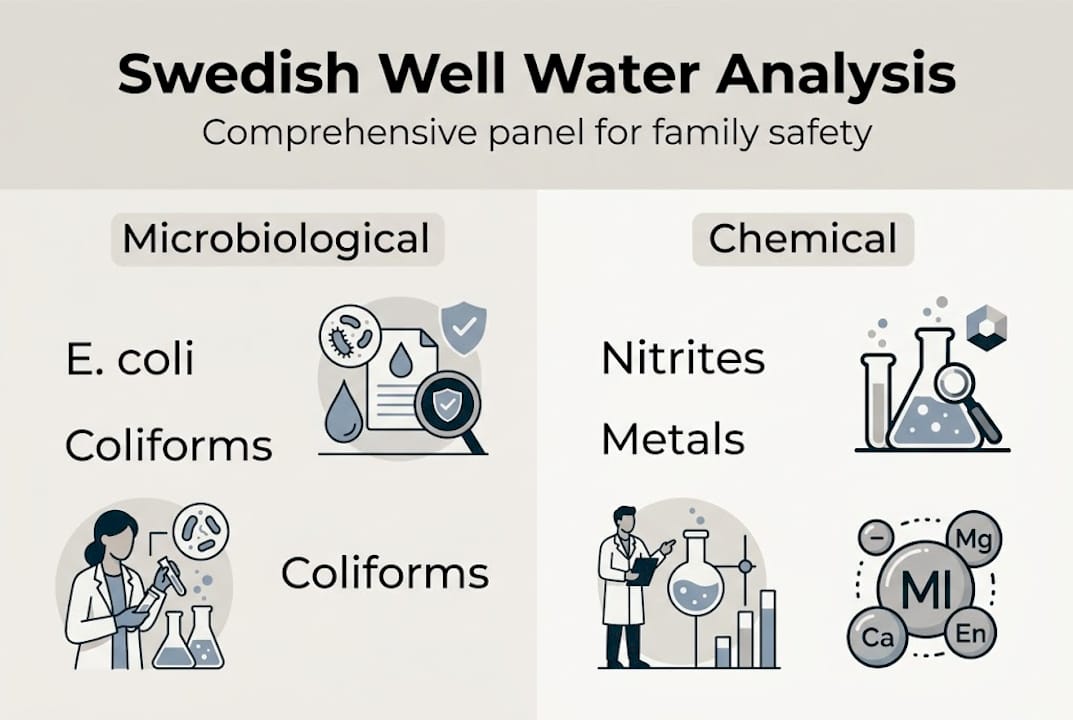
- Microbiological: E. coli, total coliform bacteria, Enterococcus
- Chemical: Nitrate, nitrite, arsenic, lead, manganese, iron, fluoride, PFAS (30 substances)
- Physical: pH, turbidity (cloudiness), color, conductivity
- Radiological: Radon, uranium
| Parameter | Health risk | Who is most at risk |
|---|---|---|
| E. coli / coliforms | Gastrointestinal illness | Everyone, especially children |
| Nitrate | Blue baby syndrome, fatigue | Infants, pregnant women |
| Arsenic | Cancer risk (long-term exposure) | All ages |
| PFAS | Immune, hormonal, liver effects | Children, pregnant women |
| Radon | Lung cancer risk from inhalation | All ages |
| Lead | Neurological damage | Children, fetuses |
| pH / turbidity | Corrosion, pipe damage | Infrastructure and health |
Families should choose a full-panel package rather than a basic test. The cost difference is modest, but the information difference is enormous. Knowing your arsenic level is within the new 2026 limit, or confirming PFAS is below the detection threshold, is genuinely reassuring in a way that a bacteria-only test cannot provide.
Pro Tip: Before ordering your analysis, review the 2026 Swedish water quality parameters so you understand which limits have changed. Also bookmark water hygiene for well owners for guidance on keeping your well in good condition between tests.
How does water analysis work? Step-by-step for Swedish campsites and homes
Once you know what to test for, here is exactly how the analysis process works, from order to results. You do not need any specialist knowledge to collect a valid sample. The entire process is designed for regular homeowners.
Step-by-step guide:
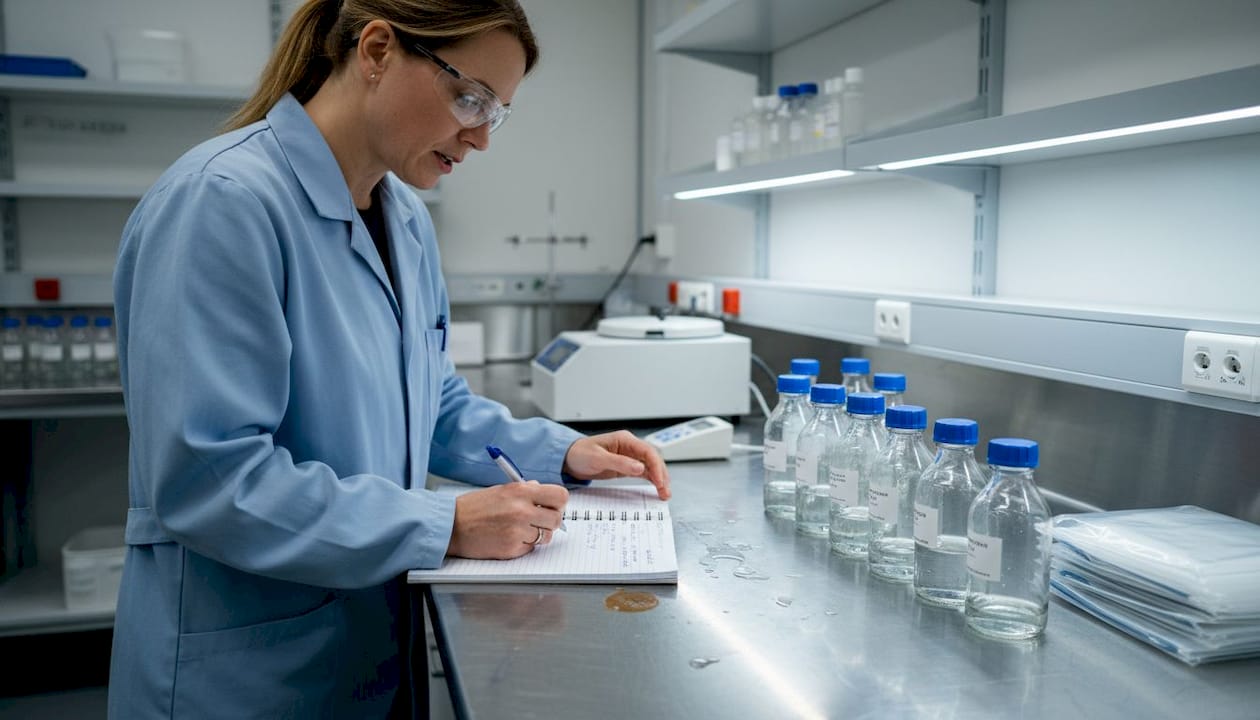
- Order a test kit from an accredited provider. Your kit arrives with sterile sample bottles, detailed instructions, and a prepaid return label.
- Flush the tap by running cold water for two to three minutes before sampling. Do not sample from a filtered tap.
- Fill the bottles carefully without touching the inside of the cap or bottle neck. Use a cold-water tap that is directly connected to the well.
- Label and seal the samples according to the instructions. Note the time and date of collection.
- Ship the samples within 24 hours of collection, keeping them cool during transport.
- Receive results from the accredited lab, typically within 5 to 10 business days.
Accredited labs operating under Swedac/ISO 17025 certification deliver results classified into three categories:
| Result category | Swedish term | What it means |
|---|---|---|
| Fit for drinking | Tjänligt | All parameters within safe limits |
| Fit with remark | Tjänligt med anmärkning | Minor deviation, monitor closely |
| Unfit for drinking | Otjänligt | Exceeds safety limits, action needed |
The accreditation matters because it guarantees the methodology is standardized. Results from a Swedac/ISO 17025 lab are legally valid, meaning you can use them for property sales, grant applications, or communication with your local municipality. Learn more about how Swedish water is assessed and review the water analysis guidelines for Swedish wells for additional context.
When (and how often) to test your well: timing, triggers, and risks
So when exactly should you test? Both routine checks and specific events matter. Routine testing keeps you informed about gradual changes. Event-triggered testing catches sudden contamination before it causes harm.
Test immediately if any of the following apply:
- Your well is at a seasonal campsite or summer cottage that has been closed for winter
- You notice changes in taste, odor, or color
- Flooding or heavy rainfall has affected the property
- Construction, digging, or drilling has occurred nearby
- You are selling or buying a property with a private well
- New agricultural activity or industry has started in the surrounding area
- A pipe repair or pump replacement has recently been done
Seasonal wells present a specific risk that year-round wells do not. When a well sits unused for months, stagnant water and bacteria can build up in the pipes, pressure tank, and the well itself. Simply running the tap for a few minutes does not eliminate that risk. Annual testing before each camping season is the responsible standard here.
Comprehensive testing is particularly important if you have children under five, if someone in the household is immunocompromised, or if a woman in the household is pregnant. For these groups, the annual schedule is not optional.
Documentation is often overlooked but genuinely important. Keeping a record of your analysis results over the years helps you spot trends, satisfy legal requirements when selling a property, and demonstrate diligence if a contamination dispute arises. Use the water quality checklist to organize your records systematically.
Pro Tip: Schedule your annual campsite test for April, before your first visit of the season. That gives you time to act on results before your family arrives.
What to do if your water analysis shows a problem
If testing reveals a problem, do not panic. A clear result, even a problematic one, is far better than unknowing exposure. Here is what to do next.
Immediate steps when water is classified as “otjänligt” (unfit):
- Stop drinking the water. Use bottled water or boil tap water for at least one minute for all consumption.
- Identify the contaminant type. Bacteria problems require disinfection; chemical or radiological issues require different solutions.
- Contact a water treatment specialist if the problem involves elevated arsenic, PFAS, radon, or heavy metals.
- Treat the source. Options include shock chlorination for bacterial contamination, activated carbon or reverse osmosis filters for PFAS, and aeration systems for radon.
- Retest after treatment. Do not resume normal use until a follow-up analysis confirms the water is now within safe limits.
- Document everything. Keep copies of both the problematic result and the clearance result for your property records.
An important statistic: Families who act on unfit results and complete follow-up testing regularly achieve clean water within one to three treatment cycles.
Proper remediation steps depend entirely on the specific contaminant. A UV filter addresses bacteria but does nothing for PFAS. Aeration reduces radon but does not impact nitrate levels. That is why identifying the exact problem before investing in treatment equipment saves both money and time.
For a straightforward overview of your options after a problematic result, see reliable well testing explained.
Pro Tip: If your result shows “tjänligt med anmärkning” (fit with remark), do not dismiss it. A borderline result is a warning to test again within six months and investigate the cause.
The hidden truth: most Swedish well water isn’t as safe as you think
Seeing what to do when issues arise deserves a straight-talking perspective on the stakes. We have analyzed water from thousands of wells across Sweden, and the most consistent pattern we see is not contamination itself. It is misplaced confidence.
Families skip tests because their water has always tasted fine. Others run a quick bacteria check and call it good, unaware that PFAS or arsenic would not show up on that panel at all. The uncomfortable truth is that a basic test gives you a fraction of the information you actually need, especially post-2026 when Swedish limits on PFAS and arsenic have tightened considerably.
Comprehensive testing is not about being anxious about your water. It is about making a genuinely informed decision rather than an assumed one. The cost of a full-panel analysis is modest compared to the cost of treating a waterborne illness, replacing corroded pipes, or managing long-term exposure to PFAS.
We also see owners of summer properties apply even less scrutiny than year-round residents, which is the opposite of what the risk profile justifies. A seasonal well deserves more attention, not less. Check the Swedish well quality standards and make an informed choice this season.
Get reliable water analysis for your campsite or private well
Ready to secure safe water for your loved ones? Here is your next step.
Before your next camping season opens, order a complete water analysis and know exactly what you are working with. At Svenskt Vattenprov, we make this straightforward. Your kit arrives with everything you need, and every sample is analyzed by SGS Analytics and Eurofins, a Swedac-accredited lab that meets the same standards as Sweden’s public water utilities.
Start with our accredited private well analysis for a full-panel result that covers microbiological, chemical, and radiological parameters. If you want targeted screening, our bacteria water analysis kit is a fast and reliable entry point. For properties near industrial zones or airports, our PFAS water test screens for 30 PFAS substances using 2026 Swedish limits. Do not leave your family’s health to chance this season.
Frequently asked questions
What are the main risks of not testing well water at Swedish campsites?
Untested well water may contain bacteria, metals, and PFAS alongside nitrates and radon, all of which pose serious health risks, particularly for children and the elderly.
How often should I analyze water in a campsite or summer cottage?
Test at least every three years, and annually for families with children under five, or after floods, repairs, or any noticeable change in taste or odor.
What does ‘accredited’ water analysis mean in Sweden?
It means the test is conducted by a Swedac/ISO 17025 certified laboratory, guaranteeing accuracy, reproducibility, and full regulatory compliance.
How soon will I get results after sending in my water sample?
Most accredited labs return water analysis results within 5 to 10 business days after receiving your sample.
What should I do if my well water is classified as ‘unfit’?
Stop drinking the water immediately and use bottled alternatives, then follow immediate actions for unfit water including disinfection, treatment, and reconfirmation testing before resuming normal use.
Recommended
- Instructions for water sampling – How to take the sample correctly – Svenskt Vattenprov
- What is water analysis: a guide for Swedish well owners – Svenskt Vattenprov
- Important Water Parameters for Private Wells 2026 – Svenskt Vattenprov
- Ensuring clean drinking water: a guide for well owners 2026 – Svenskt Vattenprov