

Comprehensive water analysis for Swedish private wells 2026
TL;DR:
- Private wells in Sweden often contain harmful contaminants invisible to taste or sight.
- Comprehensive water testing covers microbiological, chemical, physical, and radiological parameters.
- Regular, accredited analysis ensures safe water, property protection, and compliance with strict standards.
Most private well owners in Sweden assume their water is safe because it looks and tastes fine. That assumption can be dangerously wrong. Many Swedish private wells do not meet recommended safety levels for key contaminants, and the risks are often invisible. Bacteria, radon, arsenic, PFAS, and nitrates leave no obvious trace in your glass. This guide walks you through what comprehensive water analysis actually covers, how the process works, when to test, and what to do when results come back. Understanding your water is not complicated once you know what to look for.
Table of Contents
- What does a comprehensive water analysis cover?
- Key parameters and Swedish guideline limits
- How is a comprehensive water analysis conducted?
- How often and when should you test your well?
- What to do with your test results
- A smarter approach: How real analysis shields well owners from costly surprises
- Get accredited, comprehensive water analysis for your well
- Frequently asked questions
Key Takeaways
| Point | Details |
|---|---|
| Covers all vital risks | Comprehensive analysis tests your well for bacteria, chemicals, and other threats to health. |
| Swedish limits matter | Results must meet Livsmedelsverket’s strict guidelines for safe drinking water. |
| Use accredited labs only | Only Swedac-accredited analysis is valid for real estate and reliable health decisions. |
| Test regularly, test right | Stable wells: test every three years; high-risk or changes: test sooner to prevent problems. |
| Actionable results | Your report guides specific treatments so you can fix issues and protect your family. |
What does a comprehensive water analysis cover?
With the risks in context, let’s clarify exactly what a thorough water analysis includes and how it protects you.
A full water analysis scope goes far beyond checking whether water looks clear. It means systematic testing across four categories: microbiological, chemical, physical, and radiological parameters, each tied directly to health and regulatory compliance.
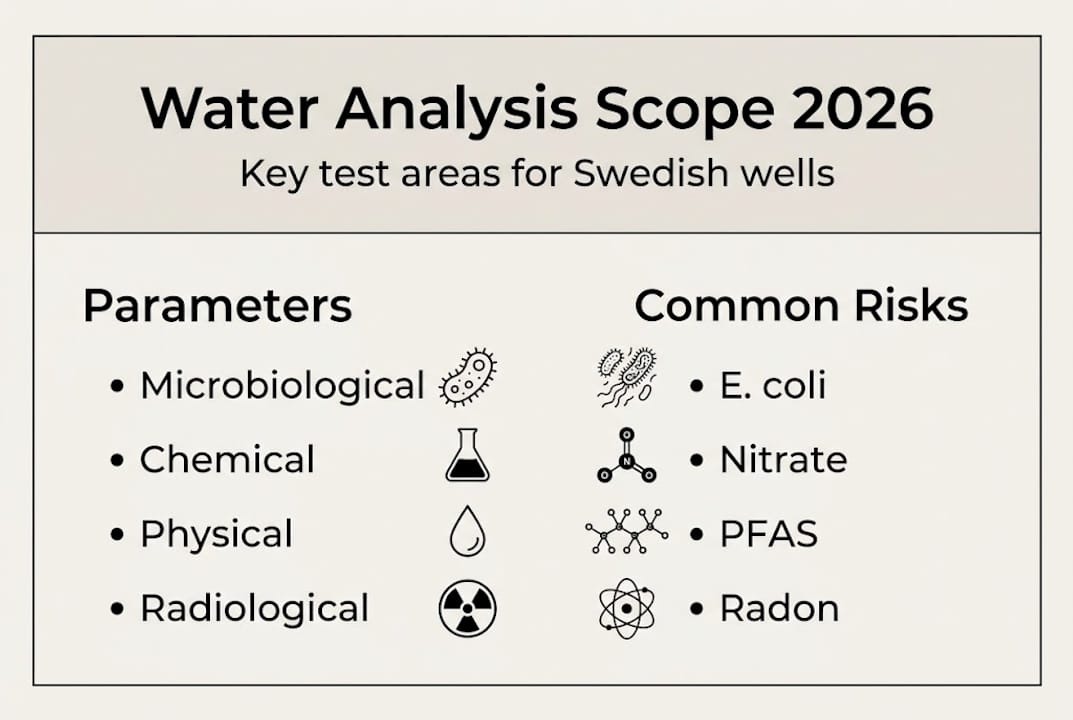
Microbiological parameters include E. coli and total coliforms. These bacteria signal fecal contamination and are the most urgent health threat in private wells. Even a single confirmed E. coli detection means your water is classified as otjänligt (unsafe) and you should stop drinking it immediately.
Chemical parameters cover nitrate, lead, arsenic, PFAS compounds, and iron, among others. Nitrate is especially dangerous for infants. Lead affects neurological development in children. PFAS are persistent synthetic chemicals linked to immune and hormonal disruption. Arsenic is a known carcinogen. None of these have any taste or smell at harmful levels.
Physical parameters include pH, turbidity (cloudiness), conductivity, and color. Low pH makes water corrosive, which causes it to leach lead and copper from pipes. High turbidity can shield bacteria from disinfection treatments.
Radiological parameters focus on radon, a naturally occurring radioactive gas common in granite-rich areas of Sweden like Värmland, Dalarna, and parts of Norrland. Long-term exposure through drinking water increases cancer risk.
Swedish results are classified into three categories based on Livsmedelsverket regulations:
| Classification | Meaning | Action required |
|---|---|---|
| Tjänligt | Safe to drink | No action needed |
| Tjänligt med anmärkning | Needs attention | Monitor or treat |
| Otjänligt | Unsafe | Stop use, treat immediately |
A basic test might check only bacteria and nitrate. A comprehensive analysis, on the other hand, checks 30 to 70 parameters depending on the package. The difference matters enormously. You can have perfectly safe bacteria levels and still have arsenic or PFAS well above safe limits. The essential facts for well owners make clear that partial testing gives you partial safety, not full protection.
“A water analysis that only checks bacteria is like a medical checkup that only measures your height. It tells you something, but nowhere near enough.”
Key parameters and Swedish guideline limits
Now that you know which parameters matter, let’s see the recommended Swedish limits and why they’re so important.
Sweden follows some of the strictest drinking water standards in Europe. In 2026, Livsmedelsverket tightened limits for arsenic and PFAS compounds, bringing them in line with updated EU directives. If you tested your well even three years ago, those results may no longer reflect current safety thresholds.
Here is a summary of the key parameters and their current recommended limits for private wells:
| Parameter | Recommended limit | Primary health risk |
|---|---|---|
| E. coli | 0 per 100 ml | Gastrointestinal illness |
| Nitrate | 50 mg/l | Infant oxygen deprivation |
| Arsenic | 5 µg/l (tightened 2026) | Cancer, organ damage |
| Lead | 5 µg/l | Neurological damage |
| PFAS (sum) | 0.10 µg/l (tightened 2026) | Immune and hormonal disruption |
| Radon | 1000 Bq/l | Increased cancer risk |
| pH | 6.5 to 9.0 | Pipe corrosion, taste |
The arsenic and PFAS limit reductions deserve special attention. PFAS contamination is particularly common near airports, military training areas, and industrial zones. If your property is within 10 to 20 kilometers of any of these, testing for PFAS is not optional. It’s urgent.
For families with young children or pregnant women, the stakes are higher across nearly every parameter. Nitrate above 25 mg/l is considered a risk for infants under six months, well below the general 50 mg/l limit. Lead at any detectable level is a concern for children under five.
A useful guideline overview shows that the official Swedish guidelines are designed for average adults. Vulnerable groups need an extra margin of safety, which is exactly why a comprehensive analysis matters more than a basic one.
Key health risk alerts:
- Infants: nitrate, lead, bacteria
- Pregnant women: lead, arsenic, PFAS
- Elderly: bacteria, radon, arsenic
- Everyone: PFAS, radon in granite areas
How is a comprehensive water analysis conducted?
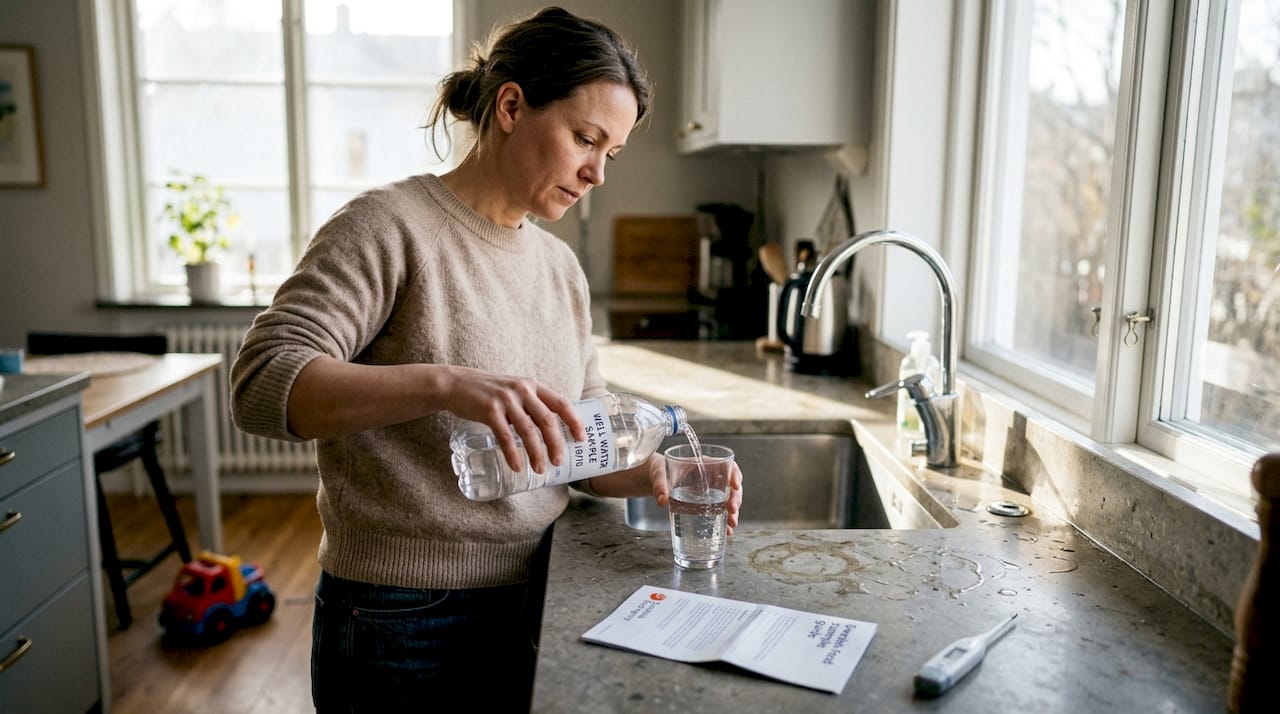
Understanding what’s tested is just the start. Here’s how a professional analysis actually works, from kitchen tap to lab report.
The process is more straightforward than most people expect. Here’s how it works step by step:
- Order your test kit. Choose a package suited to your well type (dug or drilled) and receive sterile sampling bottles with clear instructions.
- Prepare your tap. Remove any aerator or filter from the faucet. Run cold water for two to three minutes to flush standing water from pipes.
- Collect the sample. Fill the sterile bottles carefully without touching the inside of the bottle or cap. Avoid contaminating the sample with soap, skin contact, or air exposure.
- Seal and label. Close bottles immediately, label them correctly, and store them cool (below 8°C) until shipping.
- Send to the lab. Ship the sample the same day or the next morning. Samples are collected in sterile bottles using ISO standards and analyzed in Swedac-accredited labs, which is the only way to get legally valid, actionable results.
- Receive your report. Results typically arrive within five to ten business days. The report classifies each parameter and flags any values outside guideline limits.
Pro Tip: Always collect your sample early in the week. Samples sent on Thursday or Friday risk sitting over the weekend, which can affect microbiological accuracy even in cold storage.
Using a Swedac-accredited lab is non-negotiable if you want results you can act on. Non-accredited labs may offer cheaper prices, but their results carry no legal weight for property sales, municipal inquiries, or grant applications. The key sampling facts confirm that accreditation is what separates a reliable result from a guess.
The ISO sampling standard governs exactly how samples must be handled to preserve integrity. Following the instructions precisely is what makes your result trustworthy.
How often and when should you test your well?
Knowing how a test works brings up the next question: how often should you test, and what triggers more frequent checks?
Livsmedelsverket recommends testing your private well every three years as a baseline. For households with infants, elderly residents, or immunocompromised individuals, annual testing is the safer choice.
Beyond the regular schedule, certain events should trigger immediate testing regardless of when you last tested:
- Flooding or heavy rainfall near or over your well, which can introduce surface bacteria and contaminants
- Changes in water appearance, taste, or smell, including cloudiness, a sulfur odor, or a metallic taste
- New construction or agricultural activity nearby, which may affect groundwater quality
- A new well that has never been tested before
- After any repair or maintenance work on the well or pipe system
- Before selling or buying a property with a private well
Dug wells and drilled wells face different risks. Dug wells are shallower and more vulnerable to surface water intrusion, especially after heavy rain. They should be tested more frequently, ideally every one to two years. Drilled wells reach deeper groundwater and are generally more protected, but they are more susceptible to geological contaminants like radon and arsenic.
Pro Tip: If you notice your water has a new smell after a storm, don’t wait. Test immediately. Bacterial contamination after flooding can make water unsafe within hours, and the health consequences are not worth the delay.
Understanding the specific well water issues tied to your well type helps you set the right testing schedule and avoid being caught off guard by a problem that was building for months.
What to do with your test results
Once you receive your analysis, clear action is key. Here’s how to use your results for safe water.
Your report will classify each parameter as safe, needs attention, or unsafe. Don’t be overwhelmed by the numbers. Focus first on any parameter flagged as otjänligt or tjänligt med anmärkning.
If bacteria are detected: Shock chlorinate the well immediately and retest after two weeks. If bacteria persist, investigate the well casing for cracks or surface water entry points. UV disinfection systems are highly effective for ongoing bacterial control.
If pH is too low (acidic water): Acidic water corrodes pipes and leaches lead and copper. A limestone filter or calcite neutralizer raises pH and protects your plumbing.
If PFAS levels are elevated: Activated carbon filters or reverse osmosis systems are the most effective treatment options currently available. Note that standard pitcher filters do not remove PFAS.
If radon is high: Aeration systems that expose water to air can reduce radon levels significantly. This is a well-established treatment for radon in drinking water.
If arsenic is detected: Reverse osmosis or specialized adsorption filters are effective. This is not a problem you can treat with standard household filters.
Analysis guides targeted remedies, from UV for bacteria to filters for acidity or PFAS. The key is matching the right treatment to the specific problem your analysis identifies, rather than guessing or using a generic solution.
Pro Tip: Always retest after installing any treatment system. A filter that isn’t working correctly gives you false confidence. Retesting confirms the treatment is actually doing its job.
For persistent or complex issues, contact your municipality’s environmental and health protection board (miljö- och hälsoskyddsnämnd). They can provide guidance and may offer support for remediation costs. The using analysis results page covers additional next steps for common problem scenarios.
A smarter approach: How real analysis shields well owners from costly surprises
Here’s an uncomfortable truth we’ve observed after years of helping Swedish well owners: the people who cut corners on testing are almost always the ones who end up with the most expensive problems.
A well owner in a granite area skips the radon test because “it’s probably fine.” Years later, a property sale falls through because the buyer’s inspector orders a full analysis and finds radon at three times the guideline limit. Now the seller faces remediation costs and a delayed sale. That’s a real scenario, and it happens regularly.
Non-accredited analysis lacks legal or resale validity, often leading to overlooked costly issues in property transactions or health. A cheap test from a non-accredited provider gives you numbers without legal standing. You cannot use those results with your municipality, in a property transaction, or when applying for improvement grants.
The full value of accredited analysis goes well beyond peace of mind. It’s documentation. It’s protection. And when something is wrong, it’s the difference between catching a problem early and discovering it when it’s already caused harm. Comprehensive, accredited testing is not a luxury for cautious homeowners. It’s the baseline standard every well owner deserves.
Get accredited, comprehensive water analysis for your well
You’ve learned what comprehensive analysis covers, why the parameters matter, and how to act on your results. The next step is straightforward.
At Svenskt Vattenprov, we offer Swedac-accredited water testing packages designed specifically for Swedish private well owners. Whether you have a dug well, a drilled well, or need specialized PFAS or radon testing, we have a package that fits your situation. Every kit includes sterile sampling bottles, step-by-step instructions, and a clear, actionable report. Order accredited water analysis online today, or explore our comprehensive testing package to find the right fit for your well and your family.
Frequently asked questions
Who needs comprehensive water analysis in Sweden?
Any private well owner concerned about health, property value, or compliance with Livsmedelsverket monitoring guidelines should get a full analysis at least every three years, and more often for high-risk households.
How do I collect a water sample for analysis?
You’ll receive sterile bottles and step-by-step instructions with your test kit. Follow the hygiene guidelines carefully, as samples must be collected in sterile conditions to ensure accurate, valid results.
What happens if my well water fails a test?
If any parameter exceeds guideline limits, you match the right treatment to the problem, such as UV for bacteria or reverse osmosis for PFAS, and targeted remedies guided by analysis ensure you address the actual issue rather than guessing.
Are private well owners legally required to test in Sweden?
Most private wells are exempt from legal mandates, but Livsmedelsverket strongly recommends following guideline limits for safety, and accredited results are required for property sales and grant applications.
How long does water analysis take?
From the day you send your sample, results typically arrive within five to ten business days from a Swedac-accredited lab, following the standard accredited lab procedure.