

Water quality explained: reliable well testing for Swedish homes
TL;DR:
- Up to 20% of Swedish private wells may produce unsafe drinking water without visible signs.
- Well owners are responsible for regular testing and maintaining water safety due to lack of oversight.
- Proper testing, monitoring, and awareness of local risks are essential for safe private well use.
Your well water looks perfectly clear. It has no smell, no odd taste, and you have been drinking it for years without any obvious problems. So it must be safe, right? Not necessarily. Up to 20% of Swedish private wells contain water that fails to meet safe drinking water standards, and most of those homeowners have no idea. This guide walks you through what water quality actually means, which standards apply to your well, how to test correctly, and what risks are specific to your situation in Sweden.
Table of Contents
- What is water quality? Key terms and standards explained
- Why private well water is different: Your responsibilities and risks
- How to test your well: Methods, frequency, and Swedish best practices
- Common risks and nuances for Swedish wells: Understanding your vulnerabilities
- Why standard testing intervals may not be enough for Swedish well owners
- Get reliable water testing for your Swedish well
- Frequently asked questions
Key Takeaways
| Point | Details |
|---|---|
| Water quality basics | Good water quality means meeting chemical, biological, and physical criteria for safe drinking. |
| Private well responsibility | As a private well owner in Sweden, you are solely responsible for monitoring and maintaining water safety. |
| Regular testing is essential | Test your well water frequently using accredited labs to ensure your family’s health and meet guidance. |
| Risks vary by well type | Dug and drilled wells have different typical risks and may require customized analysis plans. |
| Act on unsafe results | If water tests show problems, take immediate action and consult experts to resolve issues quickly. |
What is water quality? Key terms and standards explained
Water quality is not just about whether your water looks clean. By definition, water quality refers to the chemical, physical, biological, and radiological characteristics of water measured against established standards for its intended use. For drinking water, that means every glass you pour needs to meet specific thresholds for dozens of different parameters.
For Swedish private well owners, the most relevant framework is LIVSFS 2022:12, the guidance issued by Livsmedelsverket (the Swedish Food Agency). It is worth noting that these standards are strongly recommended for private wells but are not legally mandated the same way they are for public water systems. That distinction matters, because it puts the responsibility squarely on you.
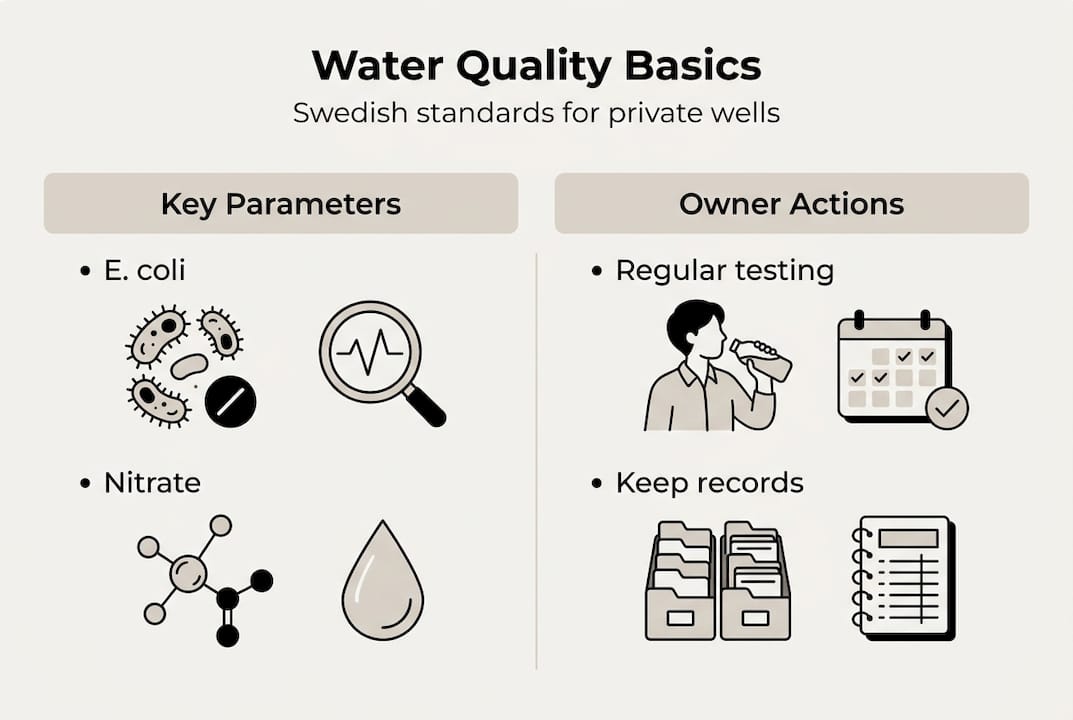
Here are the key parameters you need to know, along with their current Swedish and EU thresholds:
| Parameter | Type | Limit (Sweden/EU) | Why it matters |
|---|---|---|---|
| E. coli | Microbiological | 0 per 100 ml | Indicates fecal contamination |
| Nitrate | Chemical | 50 mg/l | Risk for infants (blue baby syndrome) |
| Arsenic | Chemical | 10 µg/l (5 µg/l from 2026) | Carcinogenic at elevated levels |
| Lead | Chemical | 10 µg/l | Neurotoxic, especially for children |
| pH | Physical | 6.5 to 9.5 | Affects corrosion and taste |
| Radon | Radiological | 1000 Bq/l (recommended) | Linked to lung cancer risk |
One important update: the arsenic limit tightens from 10 µg/l to 5 µg/l in 2026. If your last test showed arsenic levels between 5 and 10 µg/l, your water now falls outside the recommended limit. That is a significant change that many well owners are not yet aware of.
Results from Swedish water quality testing are typically classified into three categories: tjänligt (safe to drink), tjänligt med anmärkning (acceptable but requires investigation), and otjänligt (unsafe, do not drink). Understanding which category your water falls into is the starting point for any action.
Stat to know: Between 15 and 20% of tested private wells in Sweden produce water that does not meet recommended safety standards, often without any visible warning signs.
For a deeper look at how private well water standards are structured in Sweden, including the full list of regulated parameters, it helps to understand both the national guidance and the EU Drinking Water Directive that underpins it.
Why private well water is different: Your responsibilities and risks
If you are connected to a municipal water supply, a team of professionals tests your water regularly, treats it continuously, and is legally required to notify you if anything goes wrong. When you own a private well, none of that exists. You are on your own.
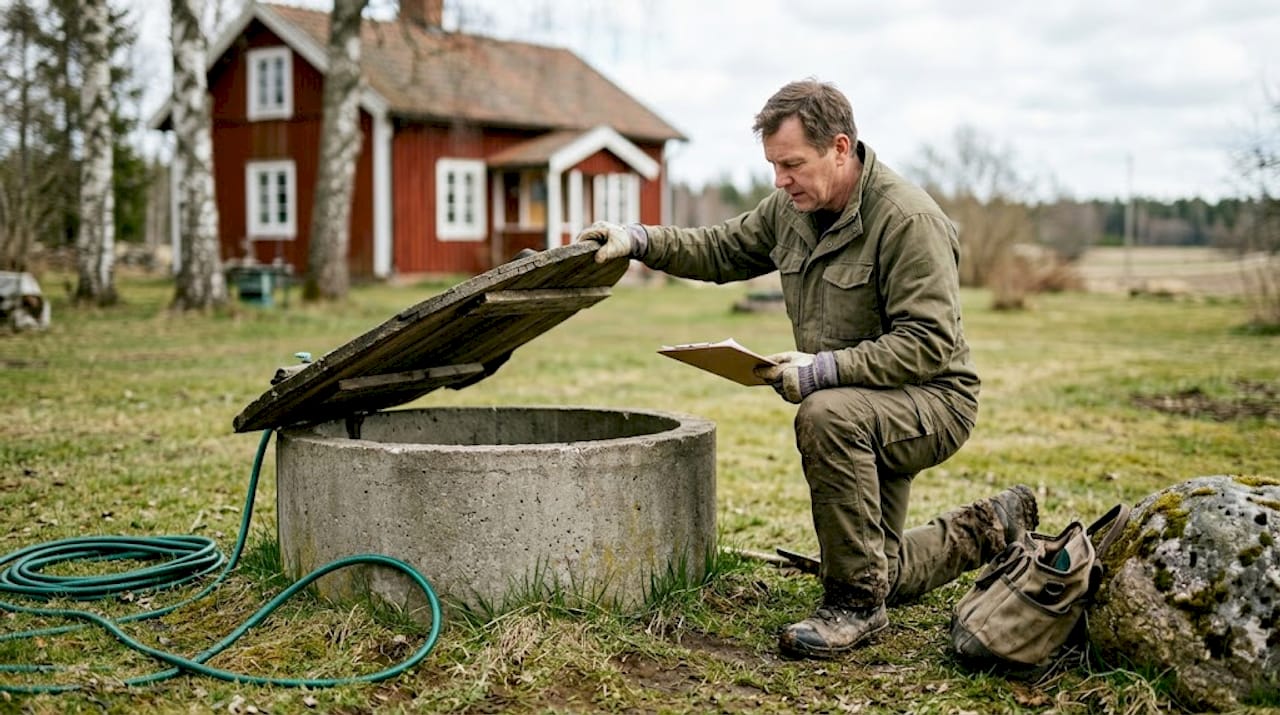
Over 1.2 million people in Sweden rely on private wells for their drinking water, and every single one of those households is fully responsible for the safety of their own supply. There is no government guarantee, no automatic monitoring, and no alert system if contamination develops.
Here is how the two systems compare:
| Factor | Public water supply | Private well |
|---|---|---|
| Who is responsible | Municipality | You, the homeowner |
| Testing frequency | Continuous and regulated | Your choice |
| Legal standards | Legally binding | Recommended only |
| Support if problems arise | Utility company | You find your own solution |
| Cost of testing | Included in fees | Paid by you |
The legal nuance is important. Private wells are recommended to meet the same standards as public systems under LIVSFS 2022:12, but you decide how often to test and whether to act on results. That freedom comes with real risk.
“Homeowners are fully responsible for their private well water. There is no government guarantee or automatic oversight for private wells in Sweden.”
Practically speaking, this means a few things:
- Keep records. Every test result should be saved. You will need them if you ever sell your property, file a complaint with the local health authority, or apply for subsidies for water improvement measures.
- Do not wait for symptoms. Many contaminants, including arsenic, nitrate, and radon, have no taste or smell. Illness can develop slowly over years.
- Know your private well statistics for your region. Contamination risks vary significantly across Sweden.
Pro Tip: Always keep a physical or digital folder with your well test history. It protects you legally and helps identify trends over time. For more on what every well owner should know, see these essential water quality facts.
How to test your well: Methods, frequency, and Swedish best practices
Knowing you need to test is one thing. Doing it correctly is another. A poorly collected sample can produce misleading results, which is almost worse than no test at all.
Here is a step-by-step approach to testing your well water safely:
- Order a kit from a Swedac-accredited lab. All reputable labs in Sweden must hold Swedac accreditation under ISO 17025. This ensures results are legally defensible and meet national standards. You can find complete guidance for Swedish well owners on what to look for when choosing a lab.
- Use only the sterile bottles provided. Do not rinse them or substitute other containers. Contamination of the sample bottle will ruin the test.
- Run the tap for 2 to 3 minutes before collecting. This clears stagnant water from the pipes and gives you a representative sample from the well itself.
- Keep the sample cold and reach the lab within 24 hours. Bacteria multiply at room temperature. Delays compromise microbiological results.
- Label your sample clearly with the date, time, and collection point.
For testing frequency, follow these guidelines:
- Bacteria: Test annually, or more often if you have vulnerable users (infants, elderly, immunocompromised individuals) or if the well is in a high-risk location.
- Chemical and metal parameters: Test every three years under normal conditions.
- After any event: Test immediately after flooding, well repairs, nearby construction, or any change in taste, smell, or color.
For step-by-step instructions on how to take a water sample, including visual guides, it is worth reviewing the process before your first collection. You can also use a well water checklist to make sure nothing is missed.
Pro Tip: Test your well immediately after any repairs or flooding, even if your last test was recent. A single event can dramatically change your water quality overnight.
Common risks and nuances for Swedish wells: Understanding your vulnerabilities
Not all wells carry the same risks. Where your well is located, how it was built, and what surrounds it all shape what you need to watch for.
Dug wells (grävda brunnar) are shallow, typically less than 10 meters deep. Because they sit close to the surface, they are highly vulnerable to:
- Bacterial contamination from surface runoff, especially after heavy rain
- Nitrate from nearby agricultural land or septic systems
- Seasonal fluctuations in quality as groundwater levels change
Drilled wells (borrade brunnar) go deep into bedrock and are generally better protected from surface contamination. But they carry their own risks:
- Arsenic leaching from certain rock formations, particularly in parts of central and western Sweden
- Radon from granite bedrock, which is widespread across large parts of the country
- Manganese and iron at elevated levels, which can stain fixtures and affect taste
Geography matters too. A well near farmland faces higher nitrate risk. A well near an old industrial site or airport may need PFAS testing. Coastal wells can be affected by saltwater intrusion. Wells in granite-heavy regions like Värmland or Dalarna carry a higher radon risk.
Up to 20% of private wells in Sweden produce water that does not meet safety recommendations, and many of those problems go undetected for years simply because the water looks and tastes normal.
For a full breakdown of what to test based on your well type and location, the guidelines for well testing offer region-specific guidance.
Pro Tip: If your area has experienced significant flooding or a nearby construction project has altered the landscape, test your well promptly, even outside your regular schedule. Environmental changes can shift groundwater flow in ways that introduce new contaminants quickly.
Why standard testing intervals may not be enough for Swedish well owners
Testing every three years is the baseline recommendation, and following it is far better than doing nothing. But in our experience, it can create a false sense of security that leaves real gaps in your protection.
Water quality is not static. It responds to what happens above ground: a neighbor’s excavation, a new drainage ditch, a wetter-than-usual spring, or a change in nearby land use. Any of these can shift your groundwater within weeks, not years. We have seen families catch a serious lead spike only because they chose to test annually rather than waiting for the three-year mark. The spike traced back to a neighbor’s excavation that had altered the local groundwater flow. Had they waited, they would have been drinking that water for another two years.
Climate change is adding another layer of unpredictability. More intense rainfall events increase surface runoff into shallow wells. Longer dry periods concentrate certain minerals and contaminants. The standard testing calendar was designed for stable conditions that are becoming less reliable.
Our recommendation: treat the three-year interval as a minimum, not a target. Test after any environmental event. Keep a written log of all changes near your property, every test result, and any repairs to your well. When you review that log over time, patterns emerge that a single test result can never reveal. Proactive well owners who use water analysis facts to stay informed consistently avoid the expensive and stressful surprises that reactive testing misses.
Get reliable water testing for your Swedish well
You now have a clear picture of what water quality means, what your responsibilities are, and what risks your well may face. The next step is acting on that knowledge.
Svenskt Vattenprov offers Swedac-accredited water tests designed specifically for Swedish well owners. Whether you need a focused bacteria analysis for wells, a full-spectrum comprehensive well analysis covering up to 71 parameters, or a package built for tests for dug wells, we have the right option for your situation. Order your kit, collect your sample following our simple instructions, send it to the lab, and receive clear, easy-to-read results with plain-language recommendations. No guesswork, no jargon. Just the answers you need to keep your family safe and stay aligned with the 2026 guidelines.
Frequently asked questions
How often should I test my private well water in Sweden?
Test bacteria annually and chemical parameters at least every three years, or more frequently if your well is near agriculture, industry, or serves vulnerable users like infants or the elderly.
What should I do if my test shows ‘otjänligt’ (unsafe) water?
Stop drinking or cooking with the water immediately and contact an accredited lab or your local environmental health authority for guidance on treatment options and next steps.
Is there a legal requirement for private well testing in Sweden?
There is no legal mandate for private well owners to test their water, but Livsmedelsverket’s recommendations under LIVSFS 2022:12 are strong guidance that all well owners should follow.
What’s the difference between dug and drilled wells regarding risks?
Dug wells face higher bacteria and nitrate risks due to their shallow depth and exposure to surface runoff, while drilled wells carry greater risk of arsenic, radon, and heavy metals from bedrock.
What is the new arsenic standard for Swedish well water in 2026?
The arsenic limit drops from 10 µg/l to 5 µg/l for private wells as of 2026, meaning some wells that previously passed may now fall outside the recommended limit.