

Ensuring clean drinking water: a guide for well owners 2026
Having your own well means freedom but also responsibility for water quality. Many well owners feel unsure about how to ensure their drinking water is safe, especially as low groundwater levels increase the risk of bacterial contamination. Climate change and varying groundwater conditions in Sweden make regular monitoring more important than ever. This guide provides you with concrete steps to test, interpret, and ensure your water quality.
Table of Contents
- Key Insights
- Challenges in Ensuring Clean Drinking Water from Private Wells
- Preparation: Responsibility and Common Checks for Well Owners
- Implementation: Step-by-Step for Water Sampling and Analysis
- Interpreting Analysis Results and Ensuring Ongoing Water Quality
- Discover Our Water Analyses for Safe Drinking Water Quality
- Frequently Asked Questions about Well Water and Water Quality
Key Insights
| Point | Details |
|---|---|
| Regular testing is crucial | Check well water at least every three years, more often for households with small children or shared water sources. |
| Responsibility rests with the well owner | You are solely responsible for inspecting, maintaining, and ensuring the water quality in your well. |
| Interpreting results prevents risks | Understanding analysis data helps you detect contamination early and act before health risks arise. |
| Climate affects water quality | Dry periods and extreme weather increase the risk of bacteria and chemical changes in groundwater. |
Challenges in Ensuring Clean Drinking Water from Private Wells
Private well owners face several risks that can affect drinking water quality. Bacterial contamination, especially E. coli, poses the most common health risk for well water in Sweden. Bacteria can come from surface water, faulty sewage systems, or animal waste that seeps into the groundwater.
Climate change exacerbates the situation. Studies show that low groundwater levels increase the risk of E. coli in private wells. Dry periods concentrate pollutants and make the water more vulnerable to contamination. When groundwater levels drop, chemical parameters can also change, affecting both taste and safety.
Shared water use further complicates responsibility issues. If several properties share the same water source, all parties must cooperate on sampling and maintenance. Lack of communication between neighbors can lead to problems being discovered too late.
Common risk factors for well water:
- Surface water intrusion during heavy rainfall or flooding
- Nearby manure handling or agricultural activities
- Old well constructions with faulty covers or leaky pipes
- Placement in low-lying areas where polluted water collects
- Saltwater intrusion in coastal areas
"Well owners must be proactive with their monitoring. Water quality can deteriorate rapidly without visible signs, especially as the climate changes."
Regional variation also plays a role. A drilled well in granite areas can have completely different challenges than a dug well in agricultural areas. Granite bedrock often entails radon risks, while intensive agricultural regions have a higher risk of nitrate contamination. Understanding your well's specific conditions is the first step towards safe drinking water. More about regional differences can be found in well water statistics.
Preparation: Responsibility and Common Checks for Well Owners
As a well owner, you bear full responsibility for water quality. Property owners are responsible for maintaining private wells and ensuring the water is safe to drink. This responsibility includes both regular inspection and prompt action when problems are discovered.
Testing frequency depends on several factors. Households with infants, pregnant women, or immunocompromised individuals should test more often than every three years. Shared water sources require annual sampling to ensure all users have safe water. In case of visible changes in water odor, taste, or color, you should test immediately.
Preparatory measures before sampling:
- Clean the well structure externally and check that covers and seals are intact
- Avoid using chemicals or cleaning products near the well 48 hours before sampling
- Document any changes in water quality or the well's surroundings
- Identify the correct sampling point, preferably before any water treatment
- Prepare clean sampling equipment according to the laboratory's instructions
Well-planned maintenance prevents both contamination and costly repairs. Check well covers and valves at least twice a year. Ensure that the ground around the well slopes away from the opening so that surface water does not flow in. Maintain a minimum safety distance of 30 meters between the well and sewage systems or manure handling.
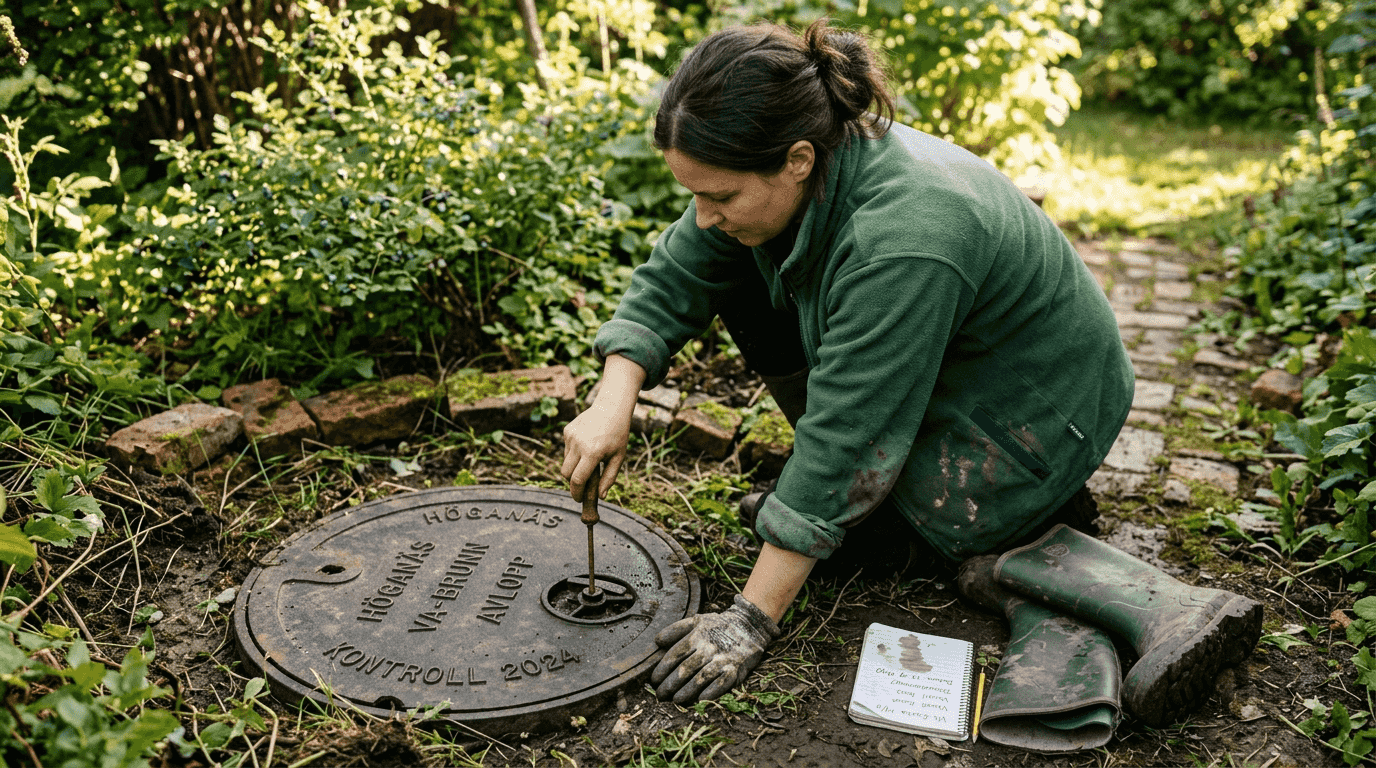
Pro tip: Register your well with the municipality if you haven't already. A correct well water registration facilitates communication with authorities and may be necessary for sale or grant applications.
Conduct sampling before dry periods or after heavy rainfall to capture the water in normal conditions. Extreme weather conditions can yield misleading results that do not represent typical water quality. Plan your tests strategically to get an accurate picture of your well water's status throughout the year.
Implementation: Step-by-Step for Water Sampling and Analysis
Correct sampling is crucial for reliable results. Incorrect handling can introduce bacteria or contaminants not present in the well, leading to unnecessary actions and costs.
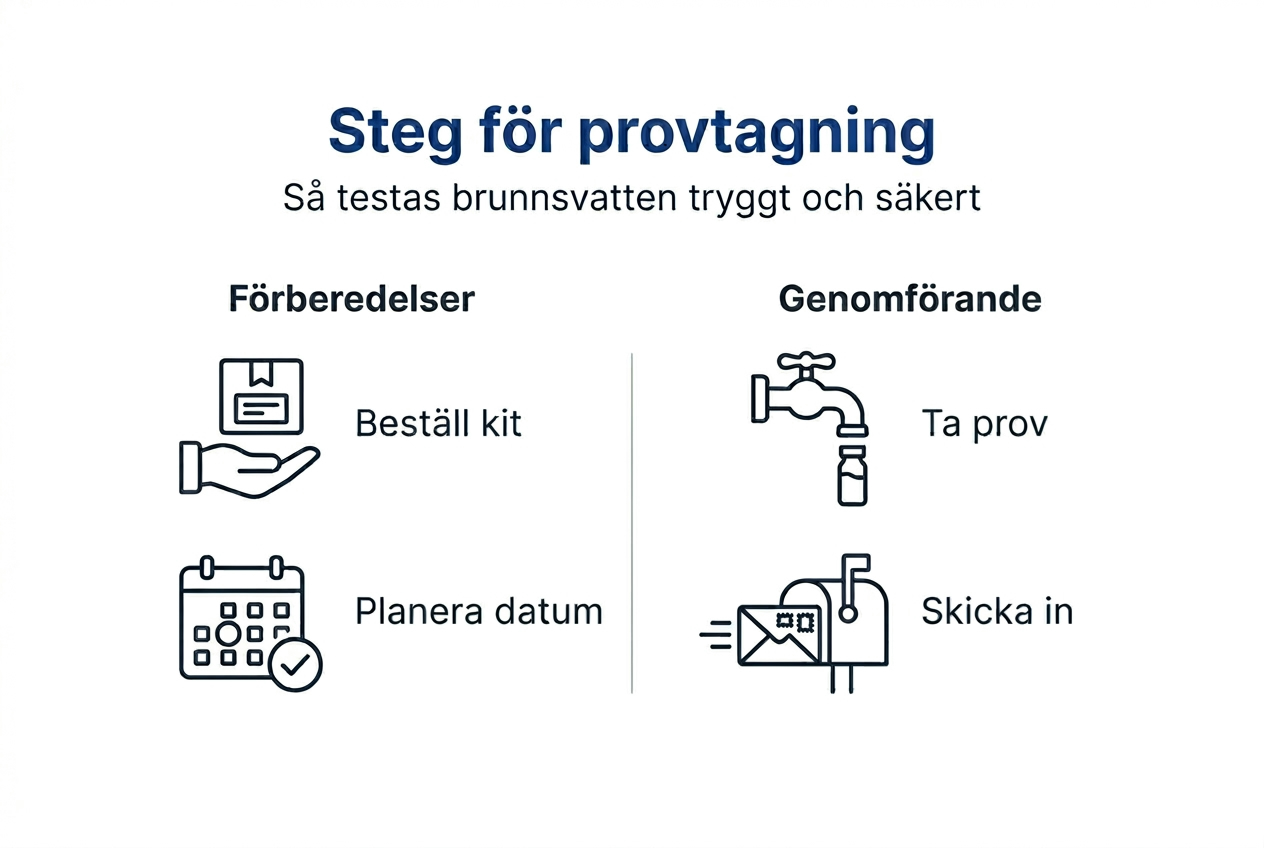
The sampling process in practical steps:
- Flush the tap for at least 5 minutes to get representative well water, not stagnant water from the pipes
- Disinfect the tap outlet by wiping with ethanol or flame sterilizing with a lighter (for metal taps)
- Open the sample bottle only when you are ready to fill it, avoid touching the inside of the cap or bottle
- Fill the bottle according to instructions, often to a marked level that leaves a little air space
- Close tightly and label the bottle with date, time, and sampling location
- Store the sample cool (4-8°C) and send to the laboratory within 24 hours for bacterial analysis
Test at least every three years, annually for sensitive households or shared sources. Certain situations require immediate testing: after well work, flooding, changed water quality, or installation of a new treatment system.
| Parameter | What it measures | Limit value | Common source |
|---|---|---|---|
| E. coli | Fecal contamination | 0 per 100 ml | Sewage, animal waste |
| Coliform bacteria | General bacterial contamination | 0 per 100 ml | Surface water, faulty well construction |
| Nitrate | Fertilizers, sewage | 50 mg/l | Agriculture, leaking sewage |
| Iron | Natural mineral | 0.2 mg/l (recommendation) | Bedrock, corrosion |
| Radon | Radioactive gas | 100 Bq/l (action limit) | Granite bedrock |
Results typically arrive within 7-10 business days. A Swedac-accredited laboratory analyzes the samples against Swedish drinking water requirements and EU directives. You receive a report showing measured values and comparing them with applicable limit values.
Pro tip: Always take a duplicate sample during the first sampling if possible. If one sample shows deviation, you can compare it with the other before drawing conclusions. This saves time and avoids unnecessary actions based on single inaccuracies.
For a deeper understanding of sampling routines and frequently asked questions, visit water test FAQs. Regional water quality affects which parameters are most important to test, which you can read more about in Swedish water quality.
Interpreting Analysis Results and Ensuring Ongoing Water Quality
When the analysis report arrives, it's important to understand what the numbers mean in practice. A good understanding of analysis results is key to detecting contamination early and acting before health risks arise.
Bacterial indicators are most acute. The presence of E. coli means fecal contamination and immediate action is required. The water must be boiled or not used for drinking until the problem is resolved and a new test shows a clean result. Coliform bacteria indicate general bacterial activity, which can be an early warning sign.
Chemical parameters require more nuanced interpretation. Exceeding iron or manganese affects taste and color but rarely poses an immediate health risk. High nitrate levels, however, can be dangerous, especially for infants. Radon in well water requires long-term action as exposure increases the risk of lung cancer.
Signs requiring immediate action:
- Detected E. coli or enterococci in the water sample
- Sudden change in water odor, taste, or color
- Nitrate levels above 50 mg/l, especially in households with infants
- Radon levels above 1000 Bq/l
- Turbid water after heavy rainfall or snowmelt
Ongoing maintenance ensures water quality between samplings. Inspect the well area after severe weather. Check that surface water does not enter through cracks or leaky covers. Avoid storing chemicals, fuel, or fertilizer near the well.
| Analysis type | Parameters | Best for | Cost level |
|---|---|---|---|
| Basic analysis | Bacteria, pH, color, odor | Quick check after problems | Low |
| Standard analysis | 20-30 parameters incl. metals | Regular triennial check | Medium |
| Complete analysis | 40-70 parameters | First check, sale, suspected contamination | High |
| Special analysis | PFAS, pesticides, radon | Specific suspicions or risk areas | Varying |
In case of abnormal results, contact the municipal environmental office for advice. They can help you assess the severity and recommend actions. Some problems require professional well renovation, while others can be solved with simpler purification methods.
Repeated testing after measures confirms that the problem is resolved. Wait at least two weeks after disinfection or repair before taking a new sample. This allows the system to stabilize. Continue regular testing at the recommended frequency even when results are good. More information on interpreting analysis results can be found in water analysis knowledge center.
Discover Our Water Analyses for Safe Drinking Water Quality
Once you understand the importance of regular water testing, the next step is to choose the right analysis package. Svenskt Vattenprov offers specialized solutions for Swedish well owners. Our analysis packages are compiled by experts and analyzed by SGS Analytics, a Swedac-accredited laboratory that complies with Swedish and European drinking water requirements.
Start with water analysis for bacteria for a quick check of microbial safety. For comprehensive control, we recommend complete water analysis with over 40 parameters, giving you a full overview of water quality. Dug wells have specific needs covered by dug well water analysis, adapted for surface water intrusion and sediment-related problems.
Each analysis package includes clear instructions, sampling equipment, and an easy-to-understand report with concrete recommendations. You don't just get numbers, but also explanations of what the results mean and what actions may be needed. We support your responsibility as a well owner with professional tools and expert knowledge of Swedish water conditions.
Frequently Asked Questions about Well Water and Water Quality
How often should I test my well water?
Test at least every three years as a standard routine. Households with infants, pregnant women, or the elderly should test annually. In case of visible changes in water or after extreme weather, test immediately regardless of the last sampling.
What do I do if the test shows E. coli?
Stop drinking the water immediately and boil all water for at least one minute before use. Contact the environmental office for advice and find the source of the fault, usually a leaky well cover or nearby contamination. Disinfect the well and take a new sample to confirm the problem is resolved.
Can I test the water myself at home?
Quick tests for some parameters are available but do not offer the same reliability as laboratory analysis. For legally valid results accepted by authorities and for property sales, analysis from a Swedac-accredited laboratory is required. Home tests can be used for quick indications between regular samplings.
How do I maintain my well to prevent problems?
Inspect well covers and construction twice a year. Keep the area around the well clean and ensure the ground slopes away from the opening. Avoid chemicals and fertilizers within 30 meters. Flush the well regularly and consider professional inspection every ten years to assess the condition of the structure.
What does a water analysis cost?
The price varies depending on the number of parameters. Basic analyses for bacteria cost a few hundred Swedish kronor, while complete analyses with 40-70 parameters range from 2000-4000 Swedish kronor. Invest in a comprehensive analysis for the first sampling or when selling, then you can use more targeted analyses for ongoing control. Read more in water test FAQs.