

Swedish water guidelines for private wells: protect your family
Around 1 in 5 private wells in Sweden has water that is unfit for drinking, and 15% show bacterial contamination. That number surprises most well owners, who assume their water is naturally clean. The reality is that contamination is often invisible, odorless, and tasteless, which makes it far more dangerous. Unlike households connected to a municipal supply, you carry full responsibility for the safety of your well water. This guide walks you through what Swedish water guidelines actually say, what you need to test for, and how to protect your family with confidence.
Table of Contents
- The Swedish water guidelines: Who sets the rules and why they matter
- What Swedish water guidelines recommend for private wells
- Standards and parameters: What should you test for?
- How testing works: Process, labs, and documentation
- When water quality issues arise: Solutions and ongoing protection
- Professional water testing: Protect your home with accredited analysis
- Frequently asked questions
Key Takeaways
| Point | Details |
|---|---|
| Homeowner responsibility | You are solely responsible for your private well’s water safety and quality. |
| Regular testing recommended | Test your well water every three years, or more often in high-risk cases or for households with young children. |
| Follow national guidelines | Use Swedish guidelines for private well water as a safety benchmark, even though they’re not legally binding. |
| Accredited lab analysis | Always use Swedac-accredited labs and proper sampling procedures for reliable water analysis. |
| Proactive problem solving | Treat issues promptly, maintain your well, and document water quality—especially when planning to sell your property. |
The Swedish water guidelines: Who sets the rules and why they matter
Swedish water safety is primarily guided by Livsmedelsverket, the Swedish Food Agency, which issues national standards and recommendations for drinking water quality. These standards are well-established and science-based. But here is the part that catches many homeowners off guard.
Swedish guidelines for private wells (enskilda brunnar) are not legally binding. They fall below the threshold defined in LIVSFS 2022:12, which applies to larger or commercial water supplies serving more than 50 persons or producing over 10 cubic meters per day. Your private well sits outside that legal framework entirely.
That does not mean you are free to ignore the guidelines. In fact, homeowners with private wells are fully responsible for the quality and safety of their water. No government agency will monitor your well or alert you to a problem. The burden is entirely yours.
Here is what that responsibility looks like in practice:
- Monitor your water regularly, even when it looks and tastes fine
- Understand your local risk factors, such as nearby agriculture, granite bedrock, or coastal proximity
- Keep records of all tests and any changes to your well or surroundings
- Act on results, not assumptions
“Most water quality problems are invisible. You cannot see arsenic, smell nitrates, or taste coliform bacteria. Regular testing is the only reliable way to know what is in your water.”
Pro Tip: Check the guidelines for well water published by Livsmedelsverket and use them as your personal benchmark, even though they are not legally required.
What Swedish water guidelines recommend for private wells
With the background set, let’s look at what the guidelines actually recommend for checking your well water. The core message from Livsmedelsverket is clear: test regularly, and test more often when risk factors are present.
Livsmedelsverket strongly recommends testing private well water at least every three years for stable wells. For households with children aged five or younger, new wells, recent changes in water quality, or risk factors like flooding, annual testing is advised.
Here is a practical framework for deciding how often to test:
- Every three years for a stable, established well with no known risk factors and no changes in taste, color, or odor
- Every year if you have young children, elderly residents, or anyone with a compromised immune system in your household
- Immediately after a flood, heavy rainfall event, or any nearby construction or agricultural activity
- After any change in water appearance, smell, or taste, no matter how subtle
- Before selling your property, since buyers and lenders increasingly expect a current water analysis
Your first test should always be a full-spectrum analysis. This gives you a baseline across all major parameters. From there, you can tailor future well water testing recommendations to the specific risks your well faces.
Pro Tip: If your well is located near farmland, test for nitrates every year regardless of how stable your results have been. Fertilizer use and seasonal runoff can shift nitrate levels quickly and without warning.
Standards and parameters: What should you test for?
Once you know how often to test, the next question is what to test for and what standards to apply. Swedish guidelines draw from both national standards and EU limits, giving you a clear set of benchmarks to measure against.
Testing should cover three main categories: microbiological, chemical, and physical parameters. Each category reveals a different dimension of your water’s safety.
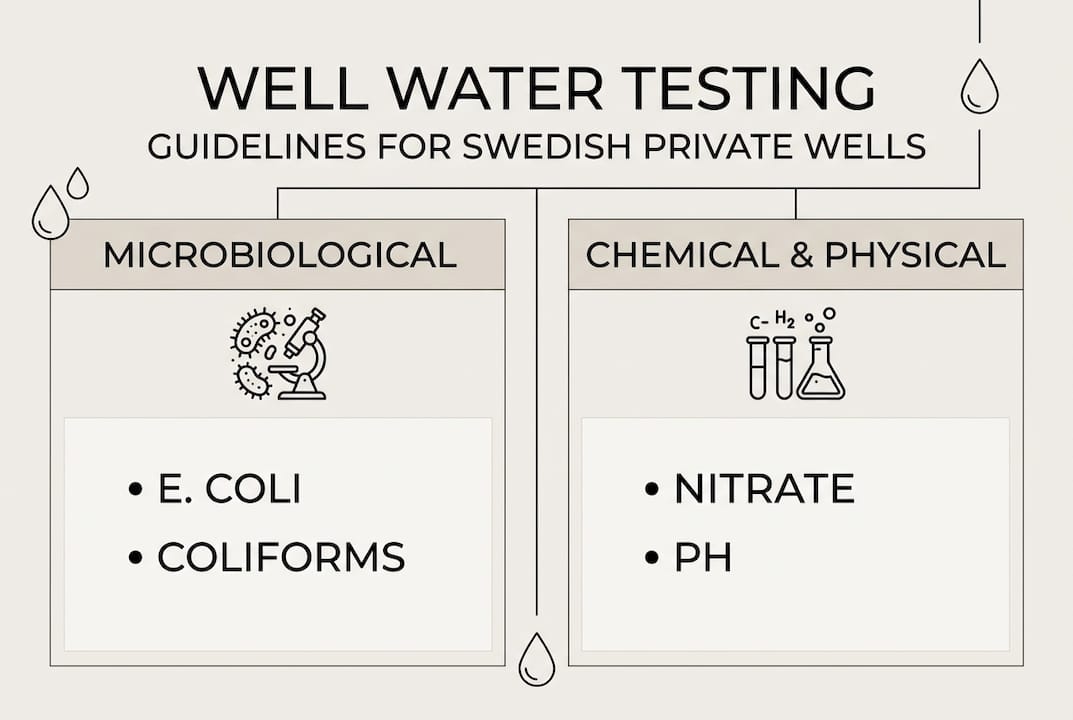
| Parameter type | Key substances | Guideline limit (LIVSFS 2022:12) |
|---|---|---|
| Microbiological | E. coli, coliforms | 0 per 100 ml |
| Chemical | Nitrate | 50 mg/l |
| Chemical | Lead | 5 µg/l |
| Chemical | PFAS (sum) | 0.1 µg/l |
| Radioactive | Radon | 1000 Bq/l (action level) |
| Physical | pH | 6.5 to 9.5 |
These water quality standards are defined in Bilaga 1 to LIVSFS 2022:12. For regulated public supplies, exceeding these limits triggers mandatory investigation. For private wells, they serve as your recommended benchmark.
Contaminant relevance varies significantly by region and well type. Consider these key risk factors:
- Radon is a priority concern for drilled bedrock wells in granite-rich areas like Värmland, Dalarna, and parts of Norrland
- Nitrates are most relevant near agricultural land, especially in southern Sweden
- PFAS contamination is elevated near airports, military training areas, and industrial sites
- Iron and manganese are common in forested areas and can affect taste and staining even at non-toxic levels
- Saltwater intrusion is a risk for coastal wells, particularly in low-lying areas
“Meeting these benchmarks is not just about compliance. It is about protecting the people who drink your water every single day.”
For a deeper look at Swedish water quality benchmarks and how they apply to your specific well type, regional context matters enormously. A well in Skåne faces very different challenges than one in Dalarna. You can also learn more about microbiological contaminants in wells and why bacteria are often the most urgent concern. For additional context on preparedness for private wells, external resources can also help you plan ahead.
How testing works: Process, labs, and documentation
With clarity on what needs testing, it’s time to cover the practical how-to of getting your water analyzed and what to do with the results. The process is straightforward when you follow the right steps.
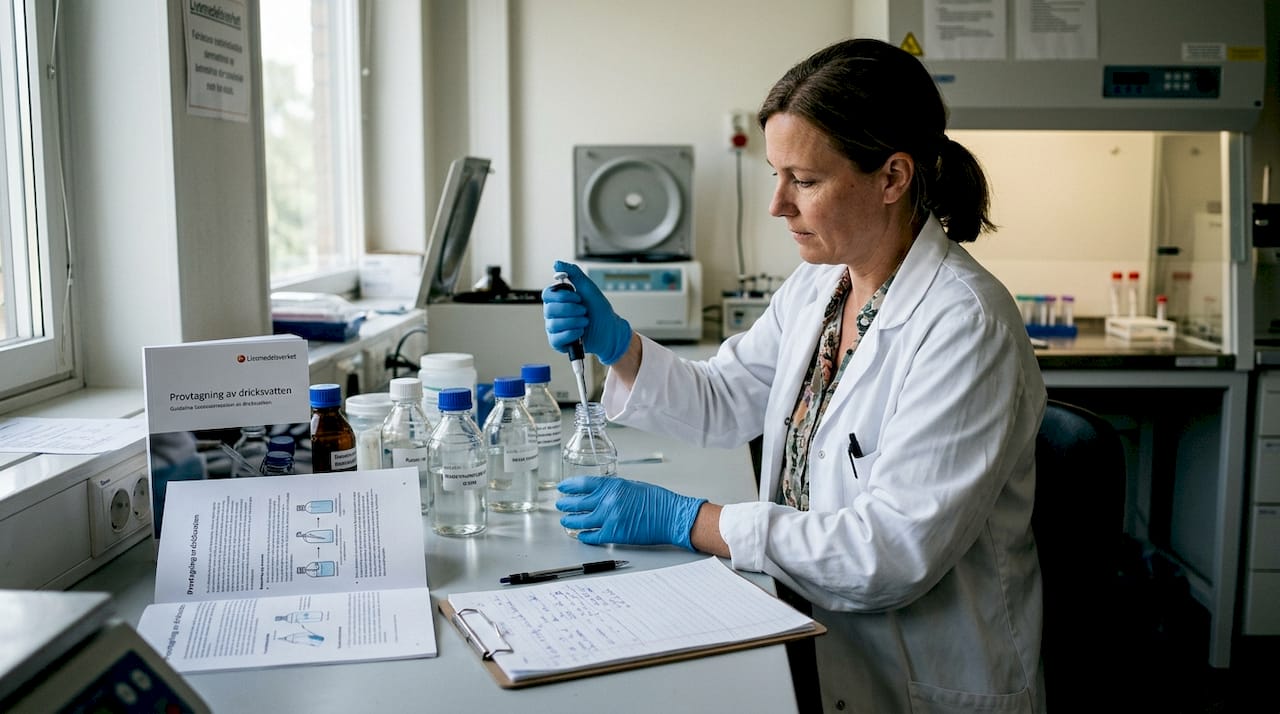
- Order your analysis kit from a provider that works with a Swedac-accredited laboratory
- Follow the sterile sampling protocol exactly, including flushing the tap, using the provided sterile bottles, and avoiding contamination during collection
- Send the sample promptly, ideally within 24 hours of collection, to preserve accuracy
- Receive your report and review each parameter against the guideline benchmarks
- Act on the results, whether that means retesting, treating, or simply filing the report for your records
Use accredited Swedac labs following Livsmedelsverket guidelines for sampling and analysis. Sterile bottles are required. This is not a detail to skip. Results from non-accredited labs may not be accepted by municipal authorities or during property transactions.
| Factor | Accredited lab | Non-accredited lab |
|---|---|---|
| Legal validity | Yes | No |
| Accepted for property sales | Yes | Often not |
| Follows LIVSFS 2022:12 | Yes | Not guaranteed |
| Usable for grant applications | Yes | No |
Documentation matters more than most homeowners realize. A well-maintained record of your water analysis process and results protects you legally and financially, especially when selling your property. Buyers increasingly request recent test results, and some lenders require them.
Pro Tip: Store three to five liters of clean water per person per day as a backup while waiting for results or during any emergency that affects your well. It is a simple precaution that costs almost nothing.
For a full overview of standards for private well testing, including which parameters matter most for your well type, it helps to review the guidelines before ordering your kit.
When water quality issues arise: Solutions and ongoing protection
Finally, let’s turn to what to do if you find a problem in your water, or if risky events or edge cases affect your well. Finding a contaminant above the guideline limit is alarming, but it is also actionable.
Here is how to respond based on the type of issue:
- Bacterial contamination: Shock-chlorinate the well, then retest. For ongoing protection, install a UV disinfection system. Boiling water is a short-term fix, not a long-term solution.
- High iron or manganese: Install a dedicated filter system. These metals are rarely a direct health threat at typical levels, but they damage appliances and affect water quality noticeably.
- Elevated radon: Aeration systems are the most effective treatment for radon in water. Ventilation in the home also helps reduce airborne radon released during showering.
- PFAS or arsenic: Reverse osmosis filtration is the most reliable option. These contaminants require specific filter types, so get professional advice before purchasing.
If issues are found, treat the problem, maintain your well to protect it from surface water intrusion, keep the required distance from septic systems, and document everything for future property sales.
Some situations demand immediate retesting, even if your last results were clean. More frequent testing is advised after floods, nearby construction or agricultural activity, or any change in taste or odor. Drilled bedrock wells are generally less prone to bacterial contamination than dug wells, but they carry a higher radon risk in granite areas.
Pro Tip: After any flood or heavy rainfall event, treat your well water as potentially contaminated until you have a clean test result in hand. Do not wait for visible signs of a problem.
For guidance on troubleshooting well water issues or understanding PFAS well water risks specific to your region, additional resources can help you make informed decisions about treatment options.
One important statistic to keep in mind: approximately 20% of Swedish private wells contain water that does not meet drinking water standards. That means if you have never tested your well, the odds are not in your favor.
Professional water testing: Protect your home with accredited analysis
Understanding the guidelines is the first step. Acting on them is what actually protects your family. At Svenskt Vattenprov, we have helped thousands of well owners across Sweden get clear, reliable answers about their water since 2018.
All our analyses are performed by SGS Analytics and Eurofins, a Swedac-accredited laboratory that follows Livsmedelsverket and Naturvårdsverket standards. Your results are legally valid and can be used for property sales, grant applications, and contact with municipal authorities. Whether you need a targeted bacteria water analysis, a complete well water testing package covering 71 parameters, or want to browse our full range of comprehensive water analysis packages, we make the process simple from start to finish. You get a clear report, plain-language explanations, and concrete recommendations, not just a page of numbers.
Frequently asked questions
Are Swedish water guidelines for private wells legally binding?
No. Swedish guidelines for private wells are strong recommendations, not legal requirements, but homeowners carry full responsibility for ensuring their water is safe.
How often should I test my private well in Sweden?
Test at least every three years for stable wells, or annually if you have young children, a new well, or any change in water quality.
What should Swedish well owners test their water for?
Test for bacteria, nitrates, metals, PFAS, and radon in risk areas, plus physical parameters like pH and turbidity to get a complete picture.
What do I do if my well water fails Swedish guideline benchmarks?
Investigate the source, apply the right treatment such as UV for bacteria or filters for metals, maintain your well’s physical integrity, and retest after any flood or significant change.
Why is private well water testing my responsibility, not the government’s?
Private wells are unregulated unlike public supplies, which means the full burden of monitoring and ensuring safe water falls on the individual owner.
Recommended
- Drinking water quality standards for Swedish private wells – Svenskt Vattenprov
- How guidelines shape water analysis for Swedish well owners – Svenskt Vattenprov
- 10 essential water analysis facts for Swedish well owners – Svenskt Vattenprov
- Complete guide for Swedish well owners: water testing 2026 – Svenskt Vattenprov