

Water risk assessment for private wells in Sweden 2026
TL;DR:
- About 20% of Swedish private wells contain unsafe water, with contamination risks increasing due to climate change.
- Proper sampling techniques and accredited labs are essential for accurate water testing and safe well management.
- Regular testing and prompt action upon detecting issues ensure the safety of private well water in Sweden.
Around 1 in 5 Swedish private wells contain water that fails to meet safe drinking standards, yet no government authority will knock on your door to warn you. As a private well owner, the full legal and health responsibility rests with you. That means if something goes wrong, the consequences land squarely on your family. This guide walks you through exactly how to assess your well’s water risk, what to prepare before you start, how to interpret your lab results, and what corrective steps to take when problems appear.
Table of Contents
- Understanding the risks of private well water
- What you need before starting: Tools and preparation
- Step-by-step: How to conduct your water risk assessment
- Interpreting your results and next action steps
- A Swedish well owner’s overlooked advantage (and blind spot)
- Make water safety routine with accredited Swedish testing
- Frequently asked questions
Key Takeaways
| Point | Details |
|---|---|
| Owner responsibility | As a Swedish private well owner, you are solely responsible for monitoring and ensuring safe water quality. |
| Use accredited labs | Always test your well with Swedac-accredited (ISO 17025) laboratories for valid results. |
| Follow a proven process | Carefully prepare, sample, and submit water using best practices to avoid errors and get actionable results. |
| Act on results | Interpret lab results, address risks, and document all steps to maintain ongoing safety and compliance. |
| Retest after events | Floods, droughts, or repairs require immediate retesting to ensure continued water safety. |
Understanding the risks of private well water
Now that you know what’s at stake, let’s get clear on the risks you need to assess.
Private well owners in Sweden carry complete legal responsibility for the quality of their drinking water. There is no municipal safety net. If your water is contaminated, you are the one who must detect it, report it, and fix it.
The most common hazards found in Swedish private wells include:
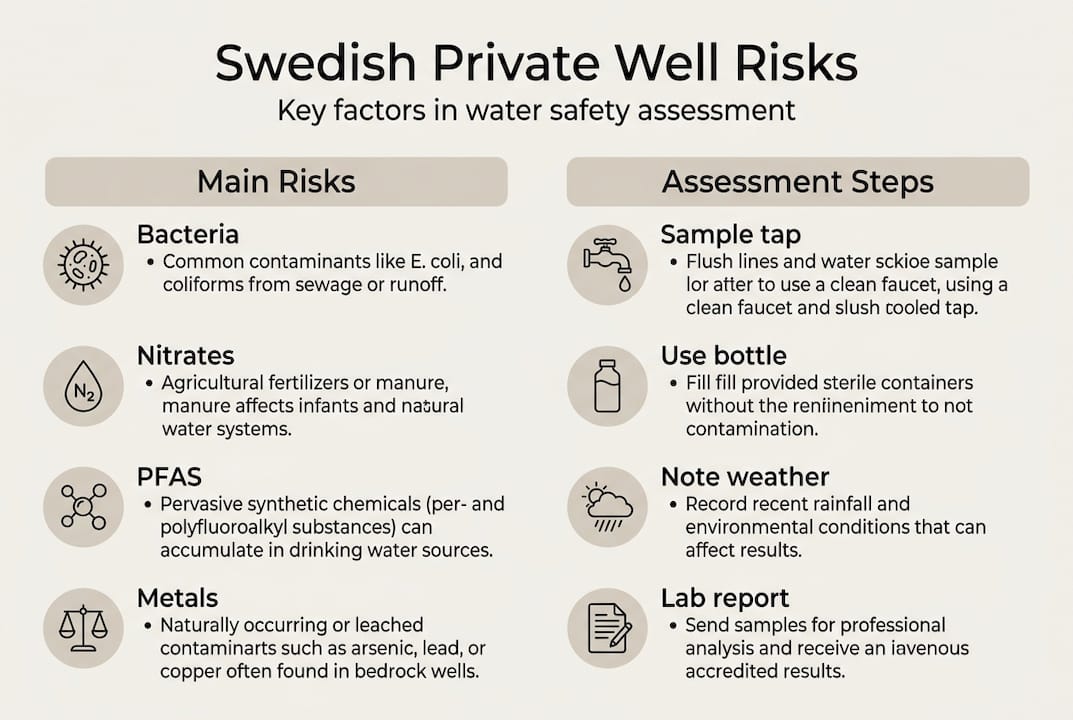
- Bacteria (E. coli and coliform bacteria): Often the result of surface water intrusion, cracked well casings, or nearby septic systems. These are the most frequently detected threats.
- Nitrates: Common near agricultural land, especially in southern Sweden. High nitrate levels are particularly dangerous for infants.
- PFAS (per- and polyfluoroalkyl substances): Persistent chemicals linked to health risks, often found near airports, military bases, or industrial sites. They do not break down naturally.
- Iron and manganese: Naturally occurring minerals that affect taste, color, and plumbing, and can signal deeper chemical imbalances.
- Radon: A radioactive gas that dissolves into groundwater, especially in granite-rich regions like Värmland and Dalarna.
Climate events make this worse. Heavy flooding can push surface bacteria and agricultural runoff directly into shallow wells. Prolonged drought concentrates minerals and contaminants as water levels drop. According to Folkhälsomyndigheten, about 1 in 5 Swedish wells are unsafe, and climate-related events are increasing that risk year by year.
“Clean-looking water is not safe water. Bacteria, nitrates, and PFAS are completely invisible to the naked eye, and none of them change the taste or smell of your water in early stages.”
This is exactly why regular assessment matters even when your water appears perfectly fine. You can review current Swedish drinking water standards and the Livsmedelsverket guidelines to understand what limits apply to your well.
What you need before starting: Tools and preparation
Understanding the risks means you need to be prepared before you even open a test kit.
A successful water risk assessment starts well before you collect the first sample. Using the wrong container, sampling at the wrong time, or sending your sample to an uncertified lab can invalidate your entire effort. Here is what you need:
| Item | Why it matters |
|---|---|
| Sterile sampling bottles | Prevents contamination before analysis |
| Lab request form | Required for the lab to process your sample |
| Swedac-accredited lab kit | Ensures legally valid, reliable results |
| Gloves | Avoids skin bacteria contaminating the sample |
| Cooler bag with ice packs | Keeps sample stable during transport |
| Pen and labels | Documents time, date, and tap location |
The most important item on that list is the accredited lab kit. Swedac-accredited labs (ISO 17025) follow standardized testing protocols that are recognized by Swedish authorities. Results from non-accredited labs cannot be used for property sales, municipal reporting, or subsidy applications.
Timing your sampling also matters more than most owners realize:
- After flooding or heavy rain: Wait at least 48 hours, then test immediately.
- After repairs or disinfection: Wait two weeks before sampling.
- Seasonal variation: Late spring and early autumn often show elevated bacterial counts.
- Routine testing: Aim for the same time of year each cycle to track trends accurately.
Pro Tip: Before collecting your sample, remove any aerator or filter attachment from the tap. These harbor bacteria and will give you a false reading. Follow the complete instructions for taking water samples and review why the importance of accredited water analysis cannot be overstated for reliable outcomes.
Step-by-step: How to conduct your water risk assessment
Once prepared, here’s exactly how to execute the water risk assessment from start to finish.
- Remove the aerator and any filters from the tap you plan to sample from. These components trap bacteria and will skew results.
- Flush the tap for 2 to 5 minutes with cold water before collecting anything. This clears stagnant water from the pipes.
- Put on clean gloves and open the sterile bottle only at the moment of collection. Do not touch the inside of the cap or bottle.
- Fill the bottle to the marked line without letting it overflow. Overfilling dilutes any added preservative in microbiological bottles.
- Seal and label immediately with the date, time, tap location, and your name.
- Place in a cooler bag and ship or deliver to the lab the same day. Samples older than 24 hours are typically rejected.
According to sampling procedure guidelines, flushing the tap 2 to 5 minutes, removing aerators, using a sterile bottle, and shipping the same day are all non-negotiable steps for valid results.
| Scenario | Best sampling timing | Reason |
|---|---|---|
| Routine annual check | Late spring or early autumn | Captures seasonal bacterial peaks |
| After flooding | 48 hours post-event | Allows initial turbidity to clear |
| After well repairs | 2 weeks post-repair | Disinfection chemicals must dissipate |
| Suspected contamination | Immediately | Delays can reduce detectable levels |
Pro Tip: If you have a multi-tap system or suspect one area of your home is more affected, collect samples from both the kitchen tap and an outdoor tap. Comparing the two helps you pinpoint whether contamination is in the well itself or in your internal plumbing.
Always document every step. Note the weather conditions, any recent work done near the well, and the exact time of collection. This record becomes your compliance log and is invaluable if you ever need to discuss results with authorities. Review key water quality parameters to understand what your lab will be measuring.
Interpreting your results and next action steps
Your lab results arrive. Here’s what they mean and exactly what to do next.
Swedish lab results for private well water are classified into three categories:
- Tjänligt (fit for use): All tested parameters fall within acceptable limits. Your water is safe under current conditions. Continue routine testing.
- Tjänligt med anmärkning (fit with remarks): One or more parameters are elevated but not at immediately dangerous levels. Action is recommended but not always urgent.
- Otjänligt (unfit for use): One or more parameters exceed safe limits. Stop drinking the water until the problem is resolved.
If your result is med anmärkning or otjänligt, the next steps matter enormously. Investigate, treat, retest, and document every action you take.
Here is what different findings typically require:
- Bacterial contamination: Shock chlorinate the well, identify the entry point (cracked casing, poor seal), and retest after two weeks.
- High nitrates: Check for nearby fertilizer use or septic leakage. Install a reverse osmosis filter and retest. Avoid giving unfiltered water to infants.
- PFAS detected: Contact your municipality. PFAS cannot be removed by standard filters. Activated carbon or reverse osmosis systems are options, but source investigation is essential.
- Elevated radon: Aeration systems can reduce radon in water effectively. Retest after installation.
Important: Always retest after any treatment. A single clean result after treatment is not enough. Two consecutive clean results over separate sampling periods give you real confidence.
Climate events deserve special mention. After flooding, even wells that previously tested clean can show bacterial spikes. Understanding environmental water risks helps you recognize when an unscheduled test is the right call, not an overreaction.
A Swedish well owner’s overlooked advantage (and blind spot)
Beyond the practical steps, it’s worth considering what makes Swedish well ownership unique.
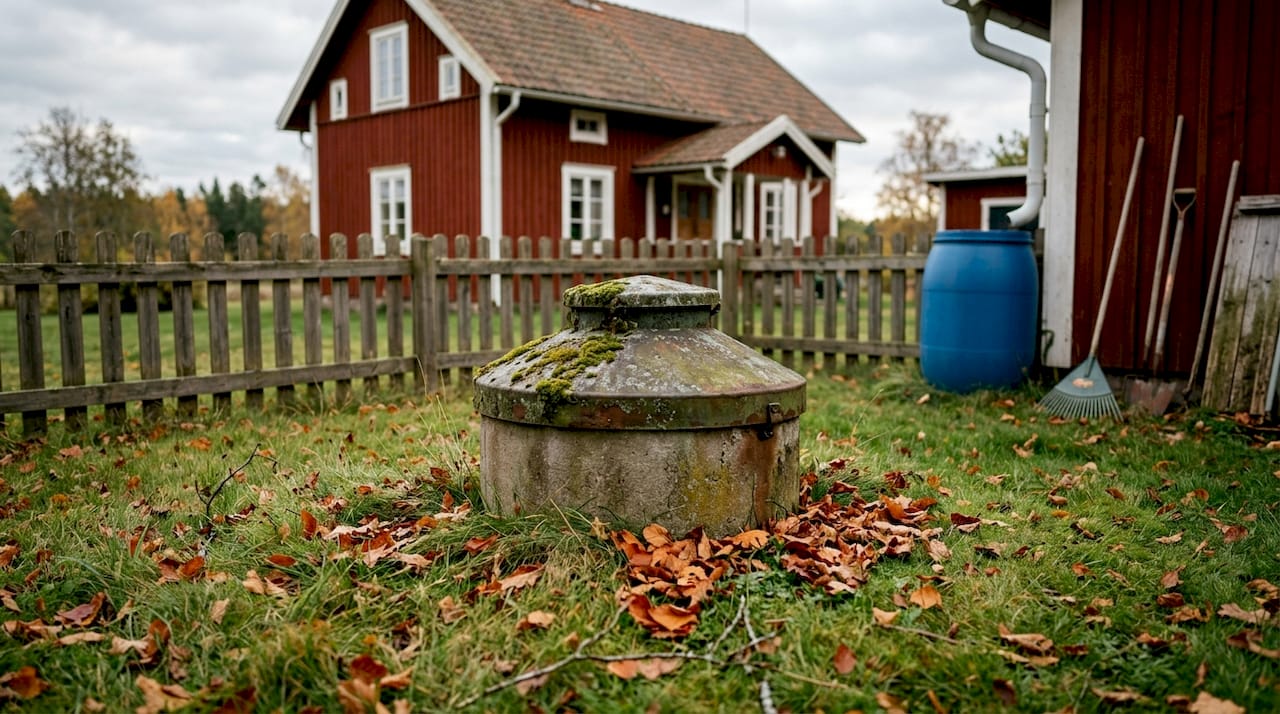
Unlike households connected to a municipal supply, you have something rare: direct control over your own water source. You can test when you want, act immediately on results, and track changes over time without waiting for a utility company to respond. That is a genuine advantage.
But it comes with a blind spot that catches many owners off guard. Because no mandatory government testing exists for private wells, the only safety check in place is the one you choose to do. Many owners go years without testing, assuming that water that looks clear and tastes normal must be fine.
It is not a reasonable assumption. Bacteria, PFAS, and nitrates are tasteless and odorless at dangerous concentrations. The water that looks perfectly clean in your glass could be carrying contaminants that accumulate in the body over months or years.
The owners who benefit most from well ownership are those who treat regular testing as a routine, not a reaction. Your well’s safety comes down to what you actually test, not what you assume. Start building that habit now, and review water safety guidance for private wells to understand what a proactive approach looks like in practice.
Make water safety routine with accredited Swedish testing
Ready to take the guesswork out of water safety? Here’s how to act.
At Svenskt Vattenprov, we make it straightforward to get started. Every kit we send includes sterile sampling bottles, a prepaid return label, and clear step-by-step instructions. All samples are analyzed by SGS Analytics and Eurofins, a Swedac-accredited laboratory, so your results are legally valid and directly comparable to public water supply standards.
You can order a comprehensive water analysis that covers up to 71 parameters, or start with a focused bacteria testing kit if bacterial contamination is your primary concern. For ongoing peace of mind, you can also register your well to track results over time and stay ahead of any emerging issues.
Frequently asked questions
How often should I test my private well in Sweden?
Test your well at least once a year and always after flooding, repairs, or unexplained changes in taste or color. Routine testing frequency should follow public supply standards as a minimum benchmark.
Which lab should I use for well water analysis?
Always use a Swedac-accredited (ISO 17025) laboratory. Only accredited labs produce results that are legally recognized for property sales, municipal reporting, and subsidy applications.
What does ‘Tjänligt’, ‘med anmärkning’, or ‘otjänligt’ mean in my results?
Lab results are classified as Tjänligt (fit), med anmärkning (fit with remarks), or otjänligt (unfit). Act based on the specific recommendations tied to your result category.
What should I do if my well water is unsafe or has remarks?
Investigate possible pollution sources, apply the correct treatment method, and always retest after treatment to confirm the problem is resolved before resuming normal use.