

Why accredited water analysis matters for Swedish well owners
TL;DR:
- Accreditation ensures legal validity and reliability of water test results for health and property matters.
- Regular testing every three years or after high-risk events detects hazardous, invisible water contaminants.
- Use Swedac-accredited labs with proper sampling procedures to accurately assess private well water safety.
If your well water looks clear and tastes fine, it’s easy to assume everything is safe. But 15–20% of private wells in Sweden contain health-hazardous substances that you simply cannot detect by sight, smell, or taste. Unlike municipal water systems, private wells receive no automatic government oversight. You are solely responsible for your family’s water safety. That responsibility starts with one critical decision: choosing an accredited water analysis. This article explains what accreditation actually means, which contaminants your test must cover, how the sampling process works, and when you need to test.
Table of Contents
- Why accreditation matters: Beyond basic water tests
- What gets tested: The parameters your well analysis must cover
- How accredited analysis is performed: The process from sampling to result
- When and how often should you test? Special cases and real-world scenarios
- Our perspective: The real mistake most Swedish well owners make
- Ready to safeguard your well? Choose accredited testing tailored for Sweden
- Frequently asked questions
Key Takeaways
| Point | Details |
|---|---|
| Accreditation ensures trust | Only Swedac-accredited labs provide results that are legally valid and reliable in Sweden. |
| Comprehensive testing is vital | Effective well water analysis covers bacteria, chemicals, and physical properties in line with health guidelines. |
| Regular checks protect families | Testing every 3 years—or more often for at-risk wells—can prevent health issues and financial loss. |
| Follow correct sampling process | Sterile sampling is essential to prevent invalid results and ensure accurate risk assessment. |
Why accreditation matters: Beyond basic water tests
The word “accreditation” gets used loosely, but it has a precise legal meaning in Sweden. A laboratory accredited by Swedac has been independently verified to meet the international standard ISO/IEC 17025. This standard covers everything from how instruments are calibrated to how results are reported and how measurement uncertainty is calculated. It is not a self-declared quality badge. It is a formal certification that requires regular audits.
Why does this matter for you as a well owner? Because the results from an accredited lab are legally recognized. They can be used in contact with your municipality’s environmental health office, as documentation when applying for grants for water improvement measures, and as required evidence when selling a property with a private well. Accreditation by Swedac guarantees compliance with EU and Swedish standards, providing legal validity essential for health decisions and property transactions.
Non-accredited tests, by contrast, can look convincing on paper. They may arrive in a neat report with numbers and color-coded results. But they carry no legal weight, and their methods are not independently verified. If you rely on a non-accredited test and later discover a contamination problem, you have no reliable baseline to reference. If you try to sell your home, the buyer’s bank or the municipality may reject the results entirely.
Here is a direct comparison of what separates the two:
| Feature | Accredited lab | Non-accredited lab |
|---|---|---|
| ISO/IEC 17025 certified | Yes | No |
| Legally valid results | Yes | No |
| Accepted for property sales | Yes | No |
| Uncertainty reporting | Required | Optional |
| Regular external audits | Yes | No |
| Accepted by municipalities | Yes | Rarely |
The key risks of using a non-accredited test include:
- Results rejected during a property sale, potentially blocking the transaction
- No legal recourse if contamination is missed
- Methods not validated against Swedish or EU drinking water standards
- Inability to use results as official documentation for grants or health decisions
“The only way to know your well water is truly safe is to test it with a method that can be trusted, verified, and legally defended. Anything less is guesswork.”
For a deeper look at water analysis essentials, understanding what you are actually ordering makes a real difference. Reputable accredited laboratory services follow the same rigorous standards that public water utilities use, which is exactly the level of reliability your family deserves.
What gets tested: The parameters your well analysis must cover
Understanding the value of accreditation leads us directly to another question: What exactly does a proper, accredited test encompass? The answer depends on your well type and location, but there are core categories that every serious analysis must address.
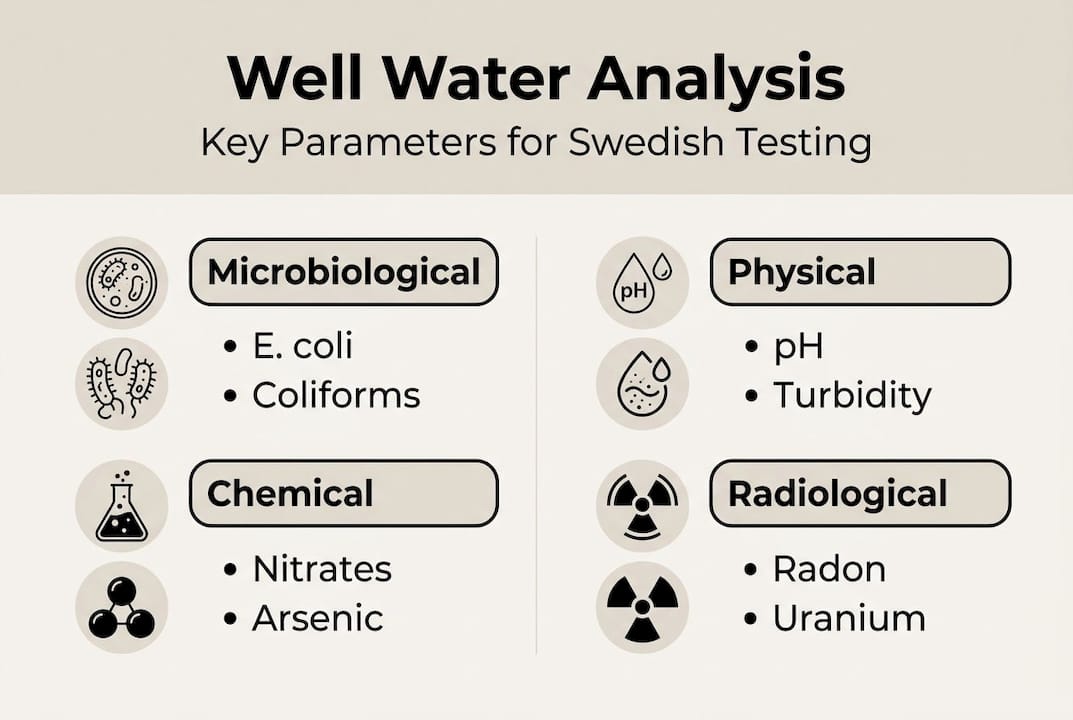
Microbiological parameters are the most urgent. E. coli and coliform bacteria indicate fecal contamination. Their presence in your drinking water is a direct health threat, causing gastrointestinal illness, and in vulnerable individuals, serious complications. These bacteria are invisible and odorless.
Chemical parameters include nitrates, arsenic, manganese, iron, and lead. Nitrates are particularly dangerous for infants under six months, potentially causing a condition that restricts oxygen in the blood. Arsenic occurs naturally in Swedish bedrock and has been linked to long-term cancer risk. Iron and manganese affect taste, stain laundry, and can indicate deeper quality issues.
Physical parameters like pH and turbidity (cloudiness) tell you about the overall character of your water. Low pH means acidic water that can corrode pipes and leach metals. High turbidity can signal surface water intrusion, which often carries bacteria.
Radiological parameters, especially radon, are critical in granite-heavy regions of Sweden such as Värmland, Dalarna, and parts of Stockholm county. Radon dissolves into groundwater and is released when you run a tap or shower, creating an inhalation risk indoors.
The well water parameters that your analysis covers should reflect these categories. According to official testing recommendations, Livsmedelsverket recommends testing private wells at least every 3 years, more often for risk groups, and notes that 15–20% of wells contain hazardous substances.
Key contaminant categories and their health risks:
- Bacteria (E. coli, coliforms): Gastrointestinal illness, risk of serious infection in children and elderly
- Nitrates: Dangerous for infants, associated with methemoglobinemia
- Arsenic: Long-term exposure linked to cancer and cardiovascular disease
- Radon: Inhalation risk when dissolved radon is released indoors from tap water
- Iron and manganese: Taste, staining, and potential neurological effects at high levels
- PFAS compounds: Persistent chemicals linked to immune and hormonal disruption
Statistic: Roughly 1 in 5 Swedish private wells tested are found to contain substances at levels that pose a health risk. Most owners had no idea before testing.
A comprehensive accredited analysis covers all these categories and benchmarks each result against Swedish drinking water standards and EU limit values.
How accredited analysis is performed: The process from sampling to result
Knowing what should be tested sets the stage for understanding how the process actually works. It is simpler than most people expect, but there are specific steps where errors can invalidate your sample.
The end-to-end process looks like this:
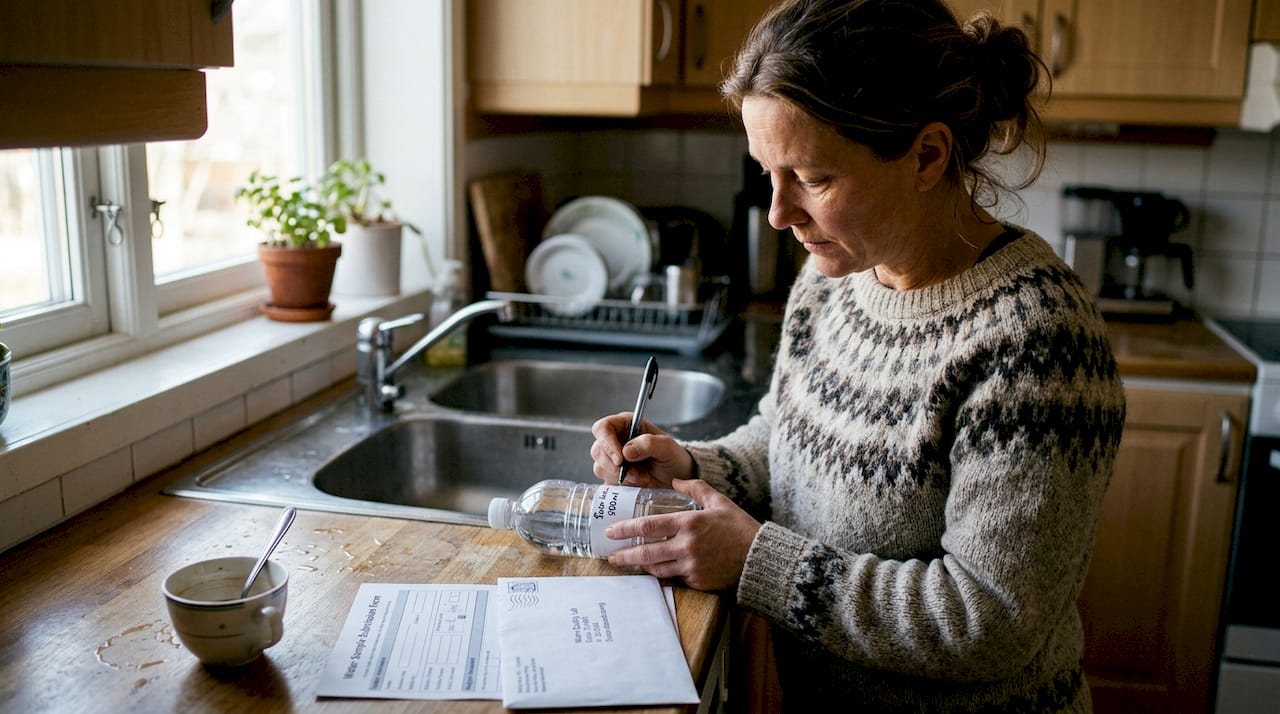
- Order your kit. You select the analysis package that fits your well type and receive a sampling kit with sterile bottles, instructions, and a prepaid return label.
- Take your sample correctly. You flush the tap for 2 to 3 minutes before collecting water for chemical analysis. For microbiological samples, you follow strict sterile procedure: do not touch the inside of the bottle or cap, and collect directly from a clean tap without an aerator.
- Ship the sample promptly. Microbiological samples must reach the lab within 24 hours of collection. Temperature matters. Ship on a weekday to avoid samples sitting over a weekend.
- Lab analysis begins. The accredited laboratory processes your sample using standardized methods under ISO/IEC 17025. Every measurement includes documented uncertainty values, and any deviation from standard conditions is noted in the report.
- You receive your results. A clear report arrives, with each parameter compared to Swedish and EU limit values. Abnormal results are flagged with recommended actions.
Your role in step two is more important than most people realize. Methodologies involve sterile sampling from accredited labs using standardized methods, and labs must report uncertainties and deviations clearly. But if your sample is contaminated during collection, even the best lab cannot produce a valid result.
Pro Tip: Avoid sampling during or immediately after heavy rain. Rainfall can temporarily push surface contaminants into your well, giving you a result that does not reflect normal conditions. Wait at least 48 hours after significant precipitation.
Common mistakes that lead to invalid or misleading samples include:
- Touching the inside of the sample bottle or cap
- Sampling from a tap with an aerator (which harbors bacteria)
- Failing to flush the tap before collecting chemical samples
- Delays in shipping the microbiological sample
- Sampling during a weather event
For more on why consistency matters, see the importance of regular testing and how Swedish water labs maintain the chain of custody that makes results defensible.
When and how often should you test? Special cases and real-world scenarios
After understanding the testing process, it is crucial to know when and how often you should actually test your well water. The standard recommendation is every three years. But that baseline does not cover every situation.
Several circumstances call for immediate testing, regardless of when you last tested:
- New or recently repaired well: Construction disturbs soil and can introduce contaminants. Always test before regular use.
- After flooding: Floodwater carries bacteria, nitrates, and chemical runoff directly into shallow wells. Test more often after flooding or well construction, especially for high-risk groups.
- Infants in the household: Babies under six months are especially vulnerable to nitrates. Annual testing is advisable.
- Elderly or immunocompromised residents: Their tolerance for bacterial or chemical exposure is lower. More frequent testing reduces risk.
- Property purchase or sale: A current accredited analysis is required. Non-accredited tests are invalid for property sales or authorities.
- Changes in taste, odor, or color: These are warning signs. Do not wait for your scheduled test.
- New agricultural or industrial activity nearby: Fertilizers, pesticides, and industrial runoff can reach your groundwater faster than you expect.
Statistic: Approximately 20% of Swedish private wells that have been tested are found to be unfit for drinking. Many of those owners had been using the water for years without knowing.
Pro Tip: Put your next well test in your calendar right now. Set a recurring reminder every three years, and add a note to check for any of the trigger events listed above. Treating it like a routine maintenance task, the same way you service your heating system, removes the guesswork.
For a broader view of regional water quality patterns across Sweden, the Swedish water quality overview helps you understand what risks are most relevant to your specific location.
Our perspective: The real mistake most Swedish well owners make
After working with thousands of well owners across Sweden since 2018, we have noticed a pattern that no standard guide talks about openly. The most common mistake is not neglecting to test. It is price shopping for the cheapest available option and ending up with a non-accredited test that looks credible but carries no legal or scientific weight.
When you search for water analysis services, you will find offers at very different price points. Some of the cheaper options come from providers who are not Swedac-accredited. Their reports may look professional. The numbers may even seem reasonable. But if a problem is missed, you have no recourse. If you try to sell your property, the results will be rejected. And if a health issue arises, you cannot point to a legally valid baseline.
As Livsmedelsverket notes, private wells lack the regulation that protects public water supplies, making accredited analysis the only reliable way to detect invisible threats. The cost difference between an accredited and a non-accredited test is often small. The difference in protection is enormous.
Our advice: Before ordering any water analysis, check that the provider explicitly mentions Swedac accreditation and ISO/IEC 17025. If those terms are not clearly stated, ask. If the provider cannot confirm them, look elsewhere. Your family’s health and your property’s value are not worth the savings.
Ready to safeguard your well? Choose accredited testing tailored for Sweden
You now know what separates a reliable water analysis from one that could leave you exposed. Taking action is straightforward.
At Svenskt Vattenprov, every analysis is performed by SGS Analytics and Eurofins, a Swedac-accredited laboratory whose results are legally recognized across Sweden. Whether you have a dug well or a drilled well, we have a kit designed specifically for your water source. Sampling equipment ships directly to you with clear instructions, and your results come with plain-language explanations and concrete recommendations. Browse our full range of accredited tests and order the package that fits your situation. Protecting your family’s water starts with one simple step.
Frequently asked questions
What is Swedac accreditation and why is it important?
Swedac accreditation certifies that a laboratory meets strict international standards under ISO/IEC 17025, making its water analysis legally valid and reliable for health decisions and property transactions in Sweden.
Which well water contaminants are most common in Sweden?
Bacteria, nitrates, metals like arsenic and iron, and radon are the most frequent issues. 20% of tested wells are found unfit due to these contaminants, many of which are undetectable without laboratory analysis.
How often should I test my private well water?
You should test at least every 3 years, and more frequently if you have a new well, experience flooding, or have infants or elderly residents using the water.
Can I use non-accredited water tests for property sales in Sweden?
No. Non-accredited tests are invalid for property sales or official authority use. Only results from Swedac-accredited laboratories are accepted for legal transactions.
How can I ensure my water sample won’t be rejected?
Follow your lab’s sterile sampling instructions carefully, avoid touching the inside of the bottle, and ship the sample promptly. Improper technique is the most common reason a microbiological sample is invalidated.