

How to check environmental water quality: Swedish wells
Your well water looks clear, tastes fine, and has never made anyone sick. That sense of security is exactly what makes private well contamination so dangerous. Up to 20% of private wells in Sweden contain unsafe water, with E. coli found in 11% of tested wells and coliform bacteria in a staggering 50%. Most well owners have no idea. This guide walks you through every phase of an environmental water check, from understanding what you’re up against, to collecting samples correctly, to acting on your results with confidence.
Table of Contents
- Understanding the risks of private well water
- Preparation: What you need before testing
- Step-by-step guide: How to perform an environmental water check
- Interpreting results and next steps
- Why Swedish water safety demands vigilance: Lessons from real cases
- Get support for your next water analysis
- Frequently asked questions
Key Takeaways
| Point | Details |
|---|---|
| Routine checks matter | Regular water analysis prevents dangerous contamination from going unnoticed. |
| Follow legal guidelines | Only Swedac-accredited labs and the right testing intervals ensure reliable, recognized results. |
| Act on poor results promptly | Immediate action protects your family if contaminants are detected—don’t delay. |
| Proper sampling is crucial | How you collect, store, and deliver samples directly impacts the accuracy of water quality tests. |
Understanding the risks of private well water
Private well water in Sweden is not regulated the same way as municipal water. You are responsible for its safety. That means no automatic testing, no oversight body checking your tap, and no alerts if something changes underground. The risk is real, and it’s more common than most people expect.
Bacterial contamination is the most immediate threat. E. coli and coliform bacteria are found in a large share of Swedish private wells, and their presence signals fecal contamination, which can cause serious gastrointestinal illness. What makes this particularly alarming is that contaminated water often looks and smells completely normal.
Beyond bacteria, Swedish well owners face a range of chemical and physical threats:
- Nitrates: Common near agricultural land, high nitrate levels are especially dangerous for infants and can cause a condition called methemoglobinemia, which reduces the blood’s ability to carry oxygen.
- Heavy metals: Arsenic, lead, and manganese can leach naturally from bedrock or enter through old pipes. Long-term exposure is linked to serious health effects including neurological damage.
- Radon: Wells drilled into granite bedrock, common in areas like Värmland and Dalarna, often carry elevated radon levels. Radon in drinking water contributes to overall radiation exposure in the home.
- PFAS: These are per- and polyfluoroalkyl substances, sometimes called “forever chemicals” because they don’t break down in the environment. Wells near airports, military sites, or industrial areas face higher PFAS risk.
| Contaminant | Common source | Health risk |
|---|---|---|
| E. coli | Fecal contamination, surface water intrusion | Gastrointestinal illness |
| Nitrates | Agricultural runoff, septic systems | Infant illness, long-term effects |
| Arsenic | Natural bedrock leaching | Cancer risk with long-term exposure |
| Radon | Granite bedrock | Radiation exposure |
| PFAS | Industrial sites, airports | Hormonal disruption, cancer risk |
The hard truth is that regular water testing is the only reliable way to know what’s actually in your water. Visual inspection tells you almost nothing. A well that has been safe for years can change after a wet season, nearby construction, or a shift in the local groundwater table.
Key statistic: Research shows that 15 to 20% of Swedish private wells contain unsafe water. That’s roughly one in five homes with a private well.
Preparation: What you need before testing
Knowing the risks is step one. Preparing correctly for your water test is what makes the difference between a result you can trust and one that’s compromised before the sample even reaches the lab.
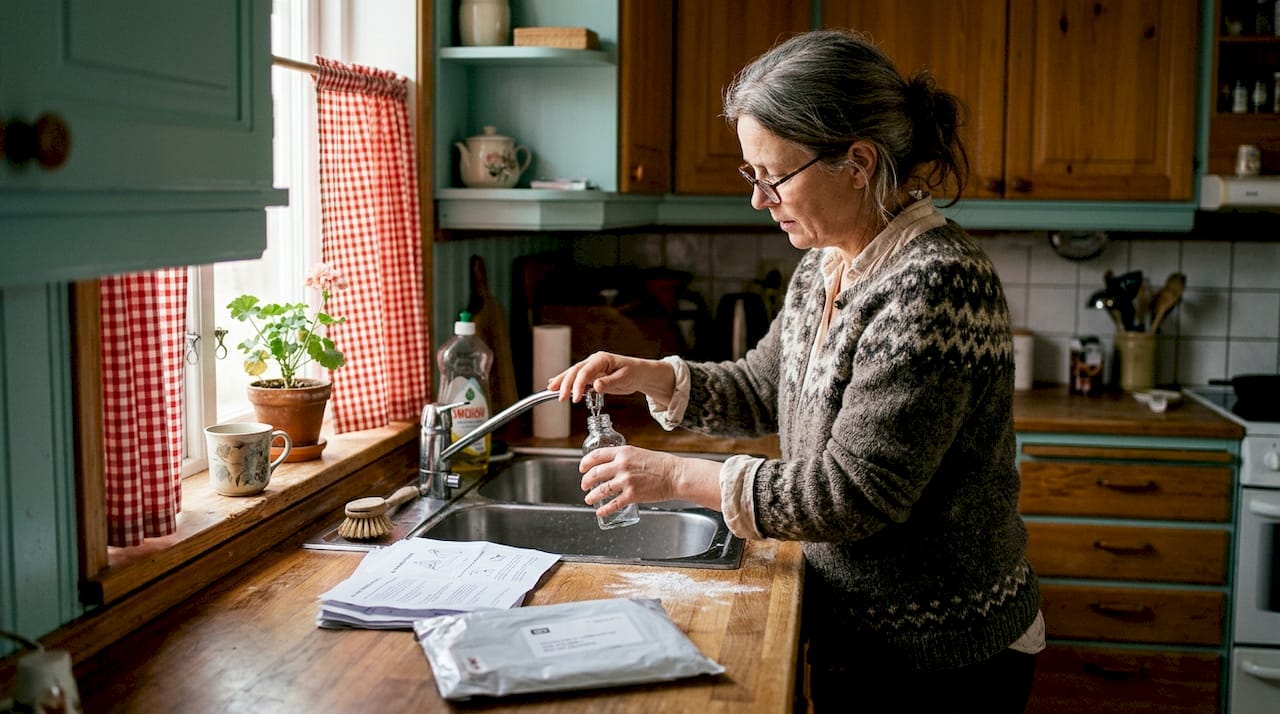
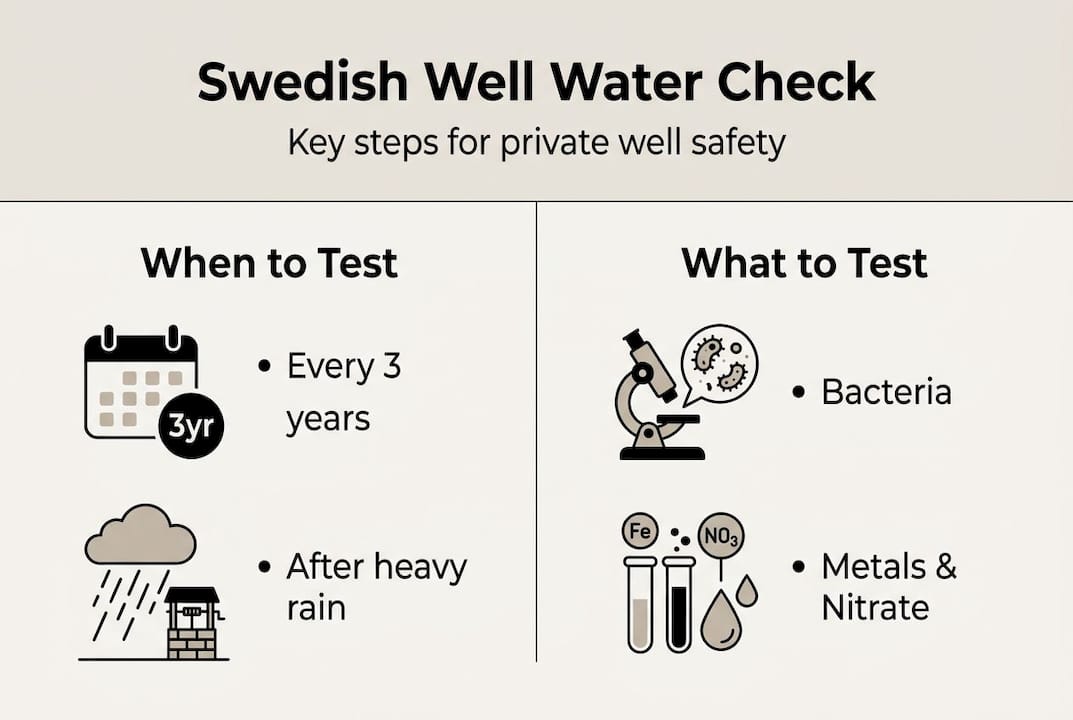
First, you need to understand when to test. Livsmedelsverket recommends testing your well water at least every three years for stable households, and annually if you have infants under five, or if there have been recent changes like flooding, nearby construction, or noticeable shifts in water taste, smell, or color.
| Household situation | Recommended testing frequency |
|---|---|
| Standard household, stable well | Every 3 years |
| Infants under 5 in the home | Annually |
| Recent flooding or heavy rain | Immediately after event |
| Nearby construction or new agriculture | Immediately, then monitor |
| Change in water taste, odor, or color | Immediately |
Here’s what to gather and confirm before you collect your sample:
- Order approved sampling bottles from a Swedac-accredited laboratory. These bottles are sterile and specifically prepared for microbiological and chemical analysis. Do not use household containers.
- Identify the analysis types you need. At minimum, a standard check covers microbiological parameters (bacteria), chemical parameters (nitrates, heavy metals), and physical parameters (pH, conductivity). If you live in a granite area, add radiological testing for radon.
- Check your water quality standards to understand what limits apply to your well and what you’re testing against.
- Document recent observations. Write down any changes in water appearance, smell, or taste over the past weeks or months. This information helps the lab and any specialist you consult later.
- Confirm lab turnaround time. Microbiological samples must reach the lab within 24 hours of collection, so plan your sampling day around the lab’s drop-off or courier schedule.
Pro Tip: Schedule your sample collection for early in the week, on a Monday or Tuesday morning. This ensures your sample arrives at the lab before the weekend, avoiding delays that could compromise microbiological results.
Step-by-step guide: How to perform an environmental water check
With your materials ready and your schedule set, here is exactly how to collect a water sample that will give you reliable, legally valid results.
- Wash your hands thoroughly with soap and water before handling any sampling equipment. Contamination from your hands can invalidate microbiological results.
- Remove any filters, aerators, or attachments from the tap you’re sampling. These can harbor bacteria that don’t reflect actual well water quality.
- Run the tap for two to three minutes at full flow before collecting the sample. This flushes out stagnant water sitting in the pipes and gives you a true reading of what’s coming from the well.
- Fill the microbiological bottle first, without letting the bottle touch the tap. Fill it to the marked line, not to the brim, as the lab needs air space for analysis. Seal it immediately.
- Fill chemical and physical parameter bottles according to the instructions provided with your kit. Some parameters require specific bottle types or preservatives already included in the kit.
- Label all bottles clearly with your name, address, date, time of collection, and the tap location. Incomplete labeling can delay or invalidate your results.
- Complete all required submission forms that came with your sampling kit. These forms link your sample to your account and specify which parameters to analyze.
- Store samples in a cool environment, ideally between 2 and 8 degrees Celsius, and transport them to the lab or courier point as quickly as possible.
“Testing must follow Swedac-accredited methods per LIVSFS 2022:12, covering microbiological, chemical, physical, and radiological parameters.”
For a detailed walkthrough of the full process, the water testing step-by-step guide covers additional scenarios including dug wells and surface water sources. If you want to understand exactly what each measurement means before your results arrive, reviewing key water quality parameters in advance helps you read your report with confidence.
Pro Tip: Keep a copy of every lab report you’ve ever received for your well. If you sell your property, buyers and their agents will ask for this documentation, and it protects you legally.
Interpreting results and next steps
Your results arrive, and suddenly you’re looking at a table full of numbers, abbreviations, and reference values. Here’s how to make sense of it.
Most lab reports compare your measured values against Swedish drinking water standards and EU limits. Each parameter will be marked as either within acceptable range or exceeding it. Focus first on the parameters that require urgent action.
| Parameter | Urgent action needed | Monitor only |
|---|---|---|
| E. coli detected | Yes, stop drinking immediately | No |
| Total coliforms elevated | Yes, boil water or use alternatives | No |
| Nitrates above 50 mg/L | Yes, especially with infants | No |
| Arsenic above 10 µg/L | Yes, seek specialist advice | No |
| pH between 6.5 and 9.0 | No | Yes, if near limits |
| Radon above 1000 Bq/L | Yes, aeration or filtration needed | No |
If your results show bacterial contamination, act the same day:
- Stop using the water for drinking or cooking without boiling it first.
- Boil water for at least one minute before use as a short-term measure.
- Consider a certified water filter rated for microbiological removal if boiling is not practical long-term.
- Contact a well specialist to inspect for surface water intrusion, cracks in the well casing, or nearby contamination sources.
For chemical issues like elevated arsenic or PFAS, boiling does not help. In fact, boiling concentrates some chemicals. You need either a certified reverse osmosis filter or an alternative water source while the problem is investigated.
Long-term, any well that fails safety thresholds should be retested after remediation to confirm the fix worked. Reviewing Swedish water guidelines helps you understand exactly which thresholds apply and what actions are legally supported.
Why Swedish water safety demands vigilance: Lessons from real cases
Here’s something we’ve observed after years of working with well owners across Sweden: the families who run into the most serious problems are rarely careless. They’re simply trusting. They tested once, got a clean result, and assumed it would stay that way.
Water doesn’t work like that. A single heavy rainfall event can push surface bacteria into a dug well. A neighbor’s new septic system can shift the local groundwater chemistry within months. A change in taste that seems minor, maybe a slight metallic edge or a faint earthy smell, can be an early warning of something that will get worse.
About 20% of private wells in Sweden are unsafe at any given time. Most of those problems are preventable. The families who stay safe are the ones who treat water analysis as routine home maintenance, the same way they service their heating system or check their roof after a storm.
Reviewing essential water analysis facts regularly keeps you informed about what to watch for between tests. Small, consistent habits protect your family far more reliably than a single thorough check every decade.
Get support for your next water analysis
Ready to take the next step for your family’s health? Getting a reliable, accredited water analysis doesn’t need to be complicated or stressful.
At Svenskt Vattenprov, we handle the entire process for you, from sending out sterile sampling kits to delivering clear, actionable results analyzed by SGS Analytics and Eurofins, a Swedac-accredited laboratory. Whether you need a focused bacteria testing package for a quick check or a thorough complete testing package covering 71 parameters, we have the right option for your situation. Browse our full range of analysis bundles and find the package that fits your well type and household needs. Your water deserves more than guesswork.
Frequently asked questions
How often should I check my private well water in Sweden?
Livsmedelsverket recommends testing at least every three years for stable wells, and annually if you have young children, or after flooding, nearby construction, or any change in water quality.
What parameters are tested in a Swedish environmental water check?
Samples analyzed under LIVSFS 2022:12 standards cover bacteria (E. coli, coliforms), nitrates, heavy metals like arsenic and lead, pH, conductivity, and radon in risk areas, all using Swedac-accredited laboratories.
What should I do if my well water fails the test?
Stop drinking untreated water immediately, switch to boiled or bottled water, and identify the contamination source. Retesting after remediation confirms whether the fix was successful before you return to normal use.
Recommended
- 10 essential water analysis facts for Swedish well owners – Svenskt Vattenprov
- Drinking water quality standards for Swedish private wells – Svenskt Vattenprov
- Why regular water testing is vital for private wells 2026 – Svenskt Vattenprov
- Microbiological water analysis for Swedish wells: 20% at risk – Svenskt Vattenprov