

Ensure safe well water: Swedish drinking water standards 2026
TL;DR:
- Sweden’s 2026 private well guidelines now set tighter limits for arsenic PFAS lead and microbial bacteria.
- Regular testing, especially for arsenic, nitrate, lead, E.coli, and PFAS, is essential for safety.
- Immediate actions include boiling, bottled water, and installing treatment like UV or reverse osmosis.
Sweden updated its private well guidelines on February 4, 2026, and many homeowners are still unsure what that means for their family’s safety. The Swedish Food Agency’s riktvärden (guideline values) now reflect tighter limits for several substances, driven partly by new EU directives. If you own a private well, this is the guidance your water is measured against. Getting up to speed on the changes is not just about paperwork. It is about knowing that every glass of water your family drinks is genuinely safe.
Table of Contents
- Overview of Swedish drinking water standards for private wells in 2026
- Key parameters: What to test for under the 2026 standards
- How to check and interpret your well’s results
- Actions to take if your water fails 2026 standards
- A practical perspective: What most well owners miss about drinking water compliance
- Worried about your well water? Get help from the experts
- Frequently asked questions
Key Takeaways
| Point | Details |
|---|---|
| Tighter 2026 standards | Sweden’s 2026 standards set stricter limits for arsenic, PFAS, and other health risks in private well water. |
| Regular well testing | Test your private well at least annually using accredited labs to ensure ongoing safety. |
| Immediate action for issues | If results show problems, use short-term controls and invest in long-term fixes, then always retest. |
| Non-binding but crucial | Private well guidelines aren’t legally required but are key for protecting your family’s health. |
Overview of Swedish drinking water standards for private wells in 2026
Private wells in Sweden are not regulated the same way as public water supplies. Instead, they are governed by non-binding riktvärden, and results fall into three clear categories you will see on any lab report:
- Tjänligt (fit for use): Your water meets all guideline values.
- Tjänligt med anmärkning (fit with remark): One or more values are elevated, and further action is advised, but water is not immediately dangerous.
- Otjänligt (unfit for use): A value exceeds safe limits, and you should not drink the water without treatment.
Understanding this distinction matters. A “remark” result does not mean you need to panic, but it does mean something needs attention. An “unfit” result requires immediate action.
The legal framework is worth clarifying. LIVSFS 2022:12 sets binding gränsvärden (limit values) for public water supplies, and these are formally recommended as reference points for private wells too. The 2026 update tightened guidelines for arsenic, PFAS (per- and polyfluoroalkyl substances, a group of synthetic chemicals), and lead, bringing them in line with updated EU drinking water directives.
“Private well owners are not legally obligated to follow these values, but they represent the clearest scientific consensus on what is safe to drink over a lifetime.”
For more background on drinking water quality standards in Sweden, including how private and public rules differ, that context helps you understand where your responsibilities begin. You can also review Swedish groundwater statistics to get a sense of how common quality issues are across the country. The data may surprise you.
Key parameters: What to test for under the 2026 standards
With the overall framework understood, it is vital to know exactly which substances and organisms require regular monitoring. The 2026 guidelines cover both chemical and microbial (relating to bacteria and microorganisms) parameters.
Top chemical parameters to watch:
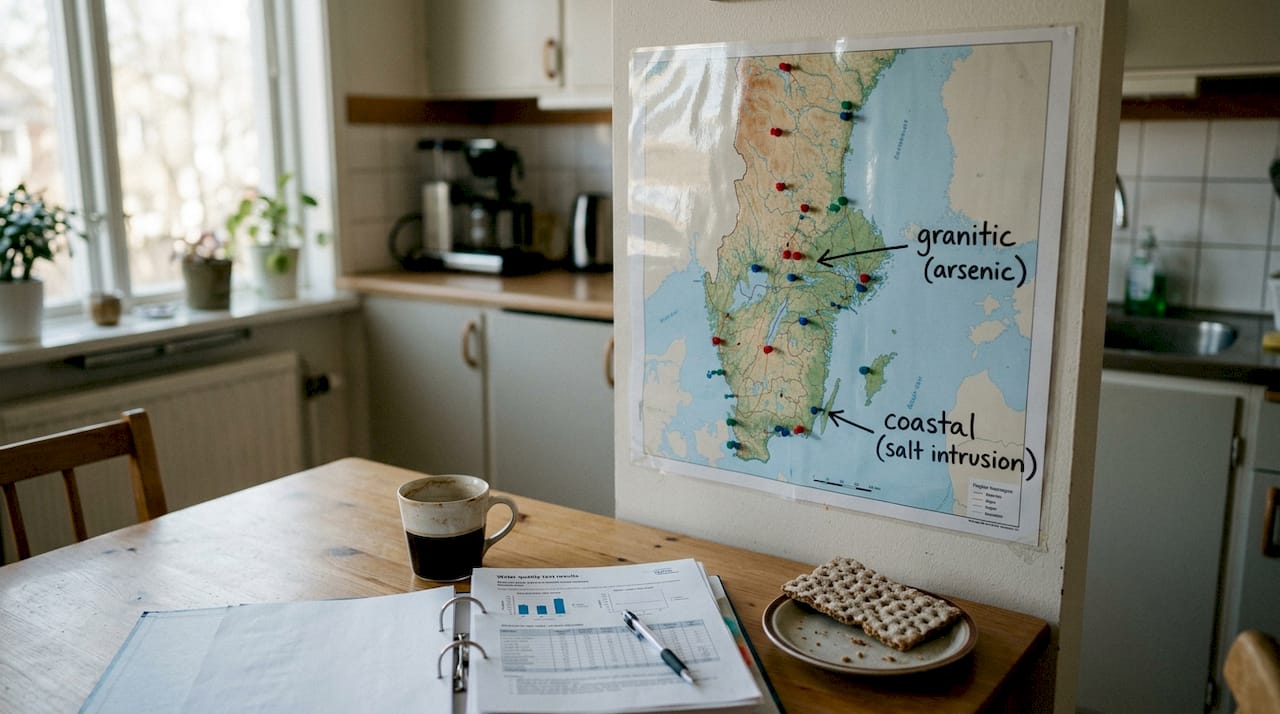
- Arsenic: Naturally occurring in many Swedish granite bedrock areas. The arsenic limit tightened to 5 µg/l in 2026, down from the previous 10 µg/l.
- Nitrate: Limit stays at 50 mg/l, but agricultural areas carry elevated risk.
- Lead: Tightened in 2026, with particular concern for older plumbing systems.
- PFAS: PFAS regulated at 4 ng/l (sum of four key compounds) under the 2026 update. Wells near airports, industrial sites, or fire training areas carry higher risk.
- Uranium: Relevant for granite bedrock wells, especially in parts of Dalarna and Värmland.
Microbial parameters:
- E.coli: Zero tolerance, meaning E.coli must read 0 CFU/100ml. Any detection makes water immediately unfit.
- Coliform bacteria: A broader group that signals fecal or surface water contamination.
| Parameter | 2026 guideline value | Primary risk area |
|---|---|---|
| Arsenic | 5 µg/l | Granitic bedrock regions |
| Nitrate | 50 mg/l | Agricultural land |
| PFAS (sum 4) | 4 ng/l | Near airports, industrial sites |
| E.coli | 0 CFU/100ml | All wells |
| Lead | 5 µg/l | Older pipes and fittings |
Regional risk patterns matter here. Granitic areas are arsenic-prone, while coastal wells face salt intrusion. National data also shows that 15% of untreated private wells carry bacterial contamination, a figure that underlines why annual microbial testing is especially important for households with children or elderly family members.
For a detailed look at PFAS in well water and what the new arsenic and PFAS limits mean practically, those resources break down the science in plain language.
How to check and interpret your well’s results
Once you know what to test for, the next step is actually conducting the tests and understanding what your lab report means. Here is a clear sequence to follow:
- Assess your risk factors. Consider your well type (drilled or dug), location, nearby land use, and the age of the well. Risk-based testing methodology is the recommended starting point before you even collect a sample.
- Collect your sample correctly. Use the sampling kit provided by your lab. Contaminated collection technique is one of the most common reasons for false positives in microbial testing.
- Choose a Swedac-accredited laboratory. Only accredited labs produce results that are legally valid for property sales, grant applications, or official inspections.
- Send and wait. Most labs return results within a few business days.
- Read your report carefully. Results will indicate whether each parameter is tjänligt, tjänligt med anmärkning, or otjänligt.
“A result showing tjänligt med anmärkning does not mean your water is dangerous today. It means a specific value needs watching, and in some cases, treatment or retesting within a defined period.”
Pro Tip: Always keep printed or digital copies of your water test results. You will need them if you sell your property, apply for water improvement grants, or are asked to document compliance by your local municipality.
If you use your well for food production or a commercial operation, different rules apply entirely. Those wells fall under full regulatory control and require mandatory monitoring. For more on how guidelines shape water analysis decisions, and to review the official requirements for well water in 2026, those resources cover the legal side in detail.
Actions to take if your water fails 2026 standards
If test results show your water is not up to standard, here is what you can do to immediately protect your health and restore quality.
Short-term steps (start immediately):
- Boil water for at least one minute before drinking or cooking if bacteria are detected.
- Switch to bottled water for drinking, brushing teeth, and cooking until the issue is resolved.
- Alert everyone in the household, especially children, elderly family members, and anyone with a weakened immune system.
Long-term treatment options:
- UV disinfection: Highly effective against bacteria and viruses. A strong choice for microbial problems. Low running costs once installed.
- Mechanical and activated carbon filters: Remove sediment, some metals, and organic compounds. Often used as a first stage in multi-step systems.
- Reverse osmosis (RO): The most effective option for removing heavy metals, nitrate, and PFAS. Works by pushing water through a semi-permeable membrane.
- Shock chlorination: A one-time treatment used to disinfect a well after contamination. UV, filters, and shock chlorination are the primary remedies recommended after a failed test.
| Treatment method | Best for | Approximate cost (SEK) | Removes PFAS/metals? |
|---|---|---|---|
| UV disinfection | Bacteria, viruses | 3,000 to 8,000 | No |
| Activated carbon filter | Organic compounds, odor | 2,000 to 6,000 | Partial |
| Reverse osmosis | Metals, PFAS, nitrate | 5,000 to 15,000 | Yes |
| Shock chlorination | Post-contamination bacteria | 500 to 2,000 | No |
Note that no legal mandates force private well owners to install treatment systems. But the health consequences of doing nothing are real and often invisible for years.
Pro Tip: Always retest your water 4 to 6 weeks after any treatment installation. This confirms the system is working as expected and gives you documented proof of improvement.
For more guidance on understanding well water issues and matching treatment options to your specific situation, that resource walks through the most common scenarios in detail.
A practical perspective: What most well owners miss about drinking water compliance
Most homeowners only think about testing when something looks or smells wrong. That instinct is understandable, but it is exactly backward when it comes to the most serious risks in well water.
Arsenic, PFAS, and uranium have no color, no odor, and no taste. You will not notice them. They accumulate over years, not days. The 2026 standards specifically tightened limits on these long-term toxins because the science on chronic low-dose exposure has gotten much clearer, and it is not reassuring.
The families who genuinely protect their health test annually, not just when selling a home. They understand that 15% of untreated private wells carry bacterial contamination even when the water looks perfectly clear. They recognize that their specific geology, whether that is granite in Värmland, limestone in Gotland, or coastal soil in Blekinge, shapes their personal risk profile in ways that generic advice cannot address.
Climate change adds another layer. Heavier rainfall events increase surface water intrusion into shallow wells. Droughts concentrate minerals in bedrock wells. The risk landscape is shifting, and static testing habits cannot keep up with it.
Reviewing the latest updated water quality standards annually and matching your testing schedule to your actual local conditions is a smarter approach than waiting for problems to appear.
Worried about your well water? Get help from the experts
Knowing the 2026 standards is the first step. Acting on them is what actually keeps your family safe. At Svenskt Vattenprov, we have helped thousands of well owners across Sweden understand their water quality with clarity and confidence.
Our accredited water analysis packages are analyzed by SGS Analytics and Eurofins, a Swedac-accredited laboratory, so every result is legally valid and built on the same standards as public water treatment plants. Whether you need a targeted bacterial water analysis or a broader screen, you can browse our full range of well water analysis packages to find the right fit for your situation. Every report includes plain-language explanations and concrete next steps. No guesswork.
Frequently asked questions
Are Swedish private well owners legally required to follow the 2026 drinking water standards?
No, the 2026 guidelines are not legally binding for private well owners, but the health risks of ignoring them are serious and well-documented.
What substances are most important to test for according to the 2026 standards?
Prioritize arsenic, nitrate, lead, E.coli, and PFAS. The arsenic limit is now 5 µg/l and PFAS is set at 4 ng/l, with granitic regions especially arsenic-prone.
What do I do if my well water fails the 2026 standards?
Start with boiling and bottled water immediately, then install appropriate treatment such as UV, activated carbon filters, or reverse osmosis. Always retest after any intervention to confirm effectiveness.
How often should I test my private well water under the new guidelines?
Test at least once a year, and consider twice-yearly if bacterial contamination risk is elevated or if children, elderly people, or anyone with a compromised immune system regularly drinks the water.