

Vattenkvalitetsparametrar för svenska privata brunnar 2026
Nearly 15 to 20% of Swedish private wells have water that fails at least one recommended safety value. That number is striking, especially when you consider that private well owners carry full responsibility for their own water quality. No municipality checks your well. No authority sends you a warning. If something is wrong, you are the one who needs to catch it. This article breaks down what water quality parameters actually are, which ones matter most for your family’s health, and what you should do if your results come back with values above Swedish recommendations.
Table of Contents
- What are water quality parameters?
- Types of water quality parameters: Health-critical vs. aesthetic
- Key health-related parameters and their limits in Sweden
- Why regular water testing is essential
- How to test your well water: Process and credible labs
- What to do if results exceed recommended values
- Get peace of mind with accredited water analysis
- Frequently asked questions
Key Takeaways
| Point | Details |
|---|---|
| Owner responsibility | You are responsible for your well’s water quality and your family’s safety. |
| Health parameter limits | Follow Livsmedelsverket’s guidelines for key contaminants like bacteria, nitrate, arsenic, lead, and radon. |
| Testing frequency | Test every three years or more often in high-risk situations for peace of mind and safety. |
| Immediate action | Act quickly if tests reveal bacteria or harmful chemicals to prevent health risks. |
| Accredited labs | Use only SWEDAC-accredited labs for reliable results and recognized analysis. |
What are water quality parameters?
A water quality parameter is simply a measurable characteristic of your water. Think of it as a checklist of substances and properties that tell you whether your water is safe to drink, cook with, and bathe in. Parameters cover microbiological, chemical, physical, and radiological substances, ranging from bacteria and nitrate to iron, pH, and radon.
For private wells in Sweden, the key reference document is SLVFS 2022:12. It is important to understand that SLVFS 2022:12 sets guideline values, not legally binding requirements for private well owners. Public waterworks must comply by law. You, as a private owner, are not legally obligated to meet these values. But that does not make them optional in any practical sense.
“The responsibility for private well water quality rests entirely with the property owner. Livsmedelsverket’s guidelines exist to protect your health, not to create paperwork.”
Understanding what water analysis means is the first step toward taking that responsibility seriously. And knowing which parameters to look for, and what the numbers mean, is what separates a useful test result from a confusing page of figures. You can also review Livsmedelsverket’s recommended values to see exactly where the thresholds sit.
Key categories of parameters include:
- Microbiological: Bacteria like E. coli, coliform bacteria, and enterococci
- Chemical: Nitrate, arsenic, lead, PFAS, pesticides, and pH
- Physical: Color, turbidity, odor, and taste
- Radiological: Radon and uranium
Types of water quality parameters: Health-critical vs. aesthetic
Not all parameters carry the same weight. Some directly threaten your health. Others affect how your water looks, smells, or tastes without posing an immediate danger. Knowing the difference helps you prioritize.
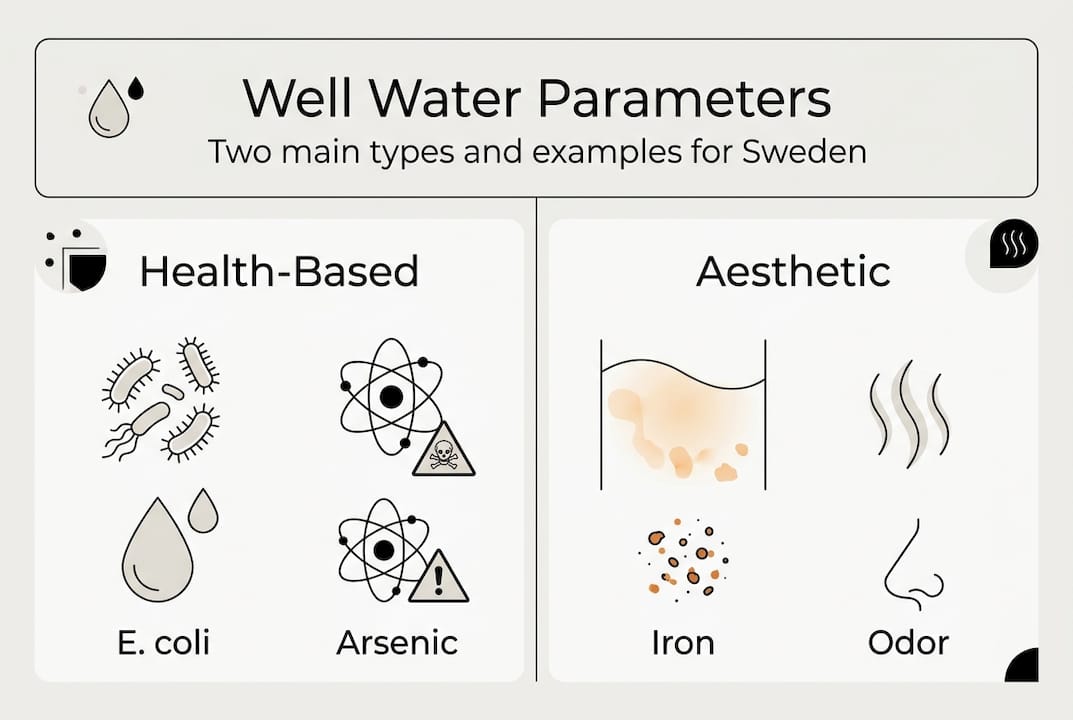
Parameters divide into health-based and aesthetic categories, and both matter for well owners. Here is a clear comparison:
| Parameter | Category | Why it matters |
|---|---|---|
| E. coli | Health-based | Indicates fecal contamination; causes serious illness |
| Nitrate | Health-based | Dangerous for infants under 6 months |
| Arsenic | Health-based | Carcinogenic with long-term exposure |
| Lead | Health-based | Neurotoxic, especially harmful to children |
| Radon | Health-based | Increases lung cancer risk |
| Iron | Aesthetic | Stains laundry and fixtures; affects taste |
| Manganese | Aesthetic | Discolors water; can affect taste and odor |
| Color | Aesthetic | May indicate organic matter or corrosion |
| Turbidity | Aesthetic | Cloudiness that can signal contamination |
Here is the part many well owners miss: exceeding an aesthetic guideline is not just a nuisance. Sudden changes in color, taste, or odor can signal a deeper problem. A well that starts producing rusty water may have a corroding casing. Cloudy water after heavy rain can mean surface water is entering your well. These are warning signs worth investigating, not ignoring.
Pro Tip: If your water suddenly smells different or looks off, do not wait for your next scheduled test. Order a targeted analysis right away. You can find essential water analysis facts to help you decide which parameters to prioritize.
Key health-related parameters and their limits in Sweden
With this context, let’s examine the actual numbers that matter for your well’s health safety.
| Parameter | Swedish recommended limit | Health risk if exceeded |
|---|---|---|
| E. coli | 0 CFU/100 ml | Gastrointestinal illness, serious infection |
| Coliform bacteria | 0 CFU/100 ml | Indicator of fecal or environmental contamination |
| Enterococci | 0 CFU/100 ml | Fecal contamination marker |
| Nitrate | 50 mg/l | Methemoglobinemia in infants |
| Arsenic | 5 to 10 μg/l (lowered from 2026) | Long-term cancer risk |
| Lead | 5 μg/l | Neurological damage, especially in children |
| Radon | 100 Bq/l | Elevated lung cancer risk |
The limit values for these parameters are set based on long-term health research. Arsenic limits are actually being tightened starting in 2026, which means wells that previously passed may now need attention.
Microbiological risk parameters like E. coli, coliform bacteria, and enterococci have a recommended value of zero. There is no safe level. Even a single detection means you should stop drinking the water immediately and investigate the source.
Nearly one in five Swedish private wells fails at least one recommended value. That is not a rare edge case. It is a real and common risk that affects families across the country, from coastal properties to forest cabins.
Pro Tip: If you have infants at home, nitrate deserves special attention. Levels above 50 mg/l can cause a dangerous condition called methemoglobinemia, which reduces the blood’s ability to carry oxygen. Review Swedish water standards to understand how these limits are applied in practice.
Why regular water testing is essential
Your well water can change without any visible warning. A dry summer, a nearby construction project, or a cracked well casing can all alter what comes out of your tap. That is why routine testing is not optional if you care about your family’s health.
Here is what drives contamination risk in Swedish wells:
- Geological factors: Radon is naturally elevated in granite-rich regions like Värmland and Dalarna. Arsenic occurs naturally in certain groundwaters across Sweden. Acid sulfate soils in coastal areas can release metals into groundwater.
- Climate change: Heavier rainfall events increase the risk of surface water entering wells, bringing bacteria and organic matter with it.
- Land use changes: New agricultural activity, construction, or nearby fuel storage can introduce nitrate, pesticides, or hydrocarbons into your groundwater.
- Well age and condition: Older wells with deteriorating casings are more vulnerable to contamination from above.
Livsmedelsverket recommends testing private wells every 3 years at minimum, and more frequently if you have infants, notice changes in water quality, or experience environmental changes nearby.
Being proactive is also a financial decision. Catching a contamination problem early is far less costly than dealing with a health crisis or a failed property sale. Learn more about the importance of regular testing and use our well water testing guide to plan your schedule.
How to test your well water: Process and credible labs
Knowing regular testing is crucial, here’s exactly how to go about it safely and reliably.
- Order a test kit from an accredited provider. The kit includes sterile sampling bottles and clear instructions.
- Collect your sample following the instructions precisely. Flush the tap for two minutes first. Use only the sterile bottles provided.
- Send the sample to the lab within the required timeframe, typically the same day or next morning.
- Receive your results with a clear explanation of each parameter and what the values mean for your specific situation.
Accredited labs use sterile bottles and analyze per SLVFS 2022:12, covering 30 to 70 parameters depending on the package. Swedac accreditation is the quality standard you should look for. It means the lab operates under the same requirements as those serving public waterworks.
Pro Tip: Never collect a water sample in a rinsed-out juice bottle or any container from home. Contamination from the container itself can produce false positives or mask real problems. Always use the sterile bottles supplied by your accredited lab.
Packages typically cover:
- Microbiological parameters (bacteria, coliform, enterococci)
- Chemical parameters (nitrate, arsenic, lead, pH, hardness, PFAS)
- Physical parameters (color, turbidity, odor)
- Radiological parameters (radon, uranium)
Review the guidelines for water analysis to understand what each package level includes and which one fits your well type.
What to do if results exceed recommended values
Even with careful monitoring, problems can arise. Here’s how to respond quickly and confidently if your results aren’t ideal.
Your response depends on which parameter is elevated:
- Bacteria (E. coli, coliform, enterococci): Stop drinking the water immediately. Do not boil as a long-term solution. Investigate the contamination source and treat with UV disinfection or chlorination.
- Nitrate above 50 mg/l: Stop using the water for infant formula or drinking. Reverse osmosis (RO) filtration is the most effective treatment.
- Arsenic or lead: Switch to bottled water for drinking and cooking. RO filtration removes both effectively. Consult a water treatment specialist.
- Radon above 100 Bq/l: Aeration systems are the standard treatment. This is especially relevant for drilled wells in granite regions.
- Iron or manganese: These are aesthetic issues but can be treated with oxidation filters or aeration.
Pro Tip: After any treatment installation, always retest your water. A filter or UV system that is installed incorrectly or maintained poorly may not perform as expected. Retesting confirms the problem is actually resolved.
For guidance on specific issues, our problem-solving resource for well water walks through the most common scenarios Swedish well owners face. You can also contact your local municipality’s environmental health office (miljö- och hälsoskyddsnämnd) for advice and potential grant support for remediation.
Get peace of mind with accredited water analysis
You now understand what water quality parameters are, which ones carry real health risks, and what to do when something is off. The next step is straightforward: get your well tested by a lab you can trust.
At Svenskt Vattenprov, we handle the entire process for you. From sterile sampling bottles to a clear, plain-language report from SGS Analytics, a Swedac-accredited laboratory, every step is designed to give you reliable answers without confusion. Our complete water analysis package covers up to 71 parameters, while our bacteria analysis is ideal if microbiological safety is your immediate concern. Whether you are testing for the first time or following up after a previous result, accredited testing for private wells is the most responsible step you can take for your family’s health.
Frequently asked questions
Are water quality parameters legally binding for private wells in Sweden?
No. SLVFS 2022:12 is not legally binding for private well owners, but Livsmedelsverket strongly recommends following the guideline values to protect your health.
How often should private well owners test their water?
Test every three years at minimum, or annually if you have infants at home, notice changes in water quality, or experience environmental changes near your property.
What should I do if my well water contains bacteria?
Stop drinking the water immediately and act on bacteria results without delay. UV disinfection or chlorination are the recommended treatment options, followed by a retest to confirm the problem is resolved.
Which Swedish regions are at higher risk for radon or arsenic?
Radon is common in granite-rich regions like Värmland and Dalarna, while arsenic occurs naturally in certain groundwaters across Sweden, particularly in areas with specific bedrock geology.
Why do parameters for taste, color, or odor matter if they’re not dangerous?
Exceedances of aesthetic parameters often signal underlying issues worth investigating, such as surface water intrusion, corrosion, or organic matter entering your well.
Recommended
- 10 essential water analysis facts for Swedish well owners – Svenskt Vattenprov
- Drinking water quality standards for Swedish private wells – Svenskt Vattenprov
- How guidelines shape water analysis for Swedish well owners – Svenskt Vattenprov
- Why regular water testing is vital for private wells 2026 – Svenskt Vattenprov