

How to monitor water quality in your own well, step by step
Approximately 2.5 million Swedes get their water from private wells, and an estimated 20 percent of these wells have water that does not meet drinking water standards. This is a high figure. And the worrying thing is that most people don't know it, because contaminated well water rarely looks, smells, or tastes bad at an early stage. Bacteria, radon, iron, and PFAS can be present in the water without you noticing anything, right up until health problems arise. The good news is that the right follow-up routine makes control simple, preventive, and secure. This article shows you exactly how to do it, step by step.
Table of Contents
- Why you need regular water quality monitoring
- What you need to monitor water quality
- Step-by-step: water quality monitoring workflow
- Common problems and edge cases – how to solve them
- How to interpret results and take the next step
- Easier water analysis and advice for private well owners
- Frequently asked questions about water quality monitoring
Key Insights
| Point | Details |
|---|---|
| Regular checks | Testing well water at least every three years reduces health risks and increases safety. |
| Correct workflow | A step-by-step process and the right tools simplify and ensure quality monitoring. |
| Customized action | Interpreting the results correctly allows for quick implementation of appropriate measures or seeking help. |
| Edge cases require vigilance | Drought, flooding, and strange odors require immediate additional follow-up. |
Why you need regular water quality monitoring
As a well owner, you are not legally required to regularly check your water. However, you are responsible for it. Well owners are solely responsible for their water quality without a statutory inspection obligation, but with strong recommendations from authorities. This means that if something goes wrong, you are the one who suffers, both health-wise and financially.
Regular sampling is the only way to actually know what you are drinking. Water quality can change rapidly, for example after heavy rain, a dry summer, or if a neighbor starts digging nearby. The Swedish Food Agency's guidelines are clear: well water should be checked regularly to protect health.
There are situations where sampling is extra important:
- Infants or pregnant women in the household
- Unusual taste, smell, or color of the water
- Heavy rain or flooding near the well
- Excavation work or new construction in the area
- Long time since the last analysis
Remember: Contaminated water doesn't necessarily look or taste different. Bacteria and chemicals are invisible. Regular analysis is your only security.
To understand what applies to your specific well and area, you can read more about Swedish water quality and the drinking water requirements for well owners.
What you need to monitor water quality
Before you start sampling, you need to have the right conditions in place. This is not about advanced equipment, but it requires some preparation.
You will need:
- Sampling bottle from an accredited laboratory (often included in analysis kits)
- Access to an accredited laboratory, as sampling must be carried out by a Swedac-accredited lab for the results to be reliable and legally sound
- Logbook or digital tool to document results over time
- Well information, such as well type, depth, and last service history
| Material or tool | Function |
|---|---|
| Sampling bottle | Collects water sample hygienically |
| Accredited laboratory | Analyzes and validates results |
| Logbook or app | Documents history and trends |
| Well log | Collects technical info about the well |
| Inspection checklist | Ensures no step is missed |
To simplify the entire process, you can follow the sampling instructions we have developed, and register your well via well water registration for a better overview.
If you want to continuously monitor the well level, there are also solutions for digital level monitoring that can supplement your follow-up.
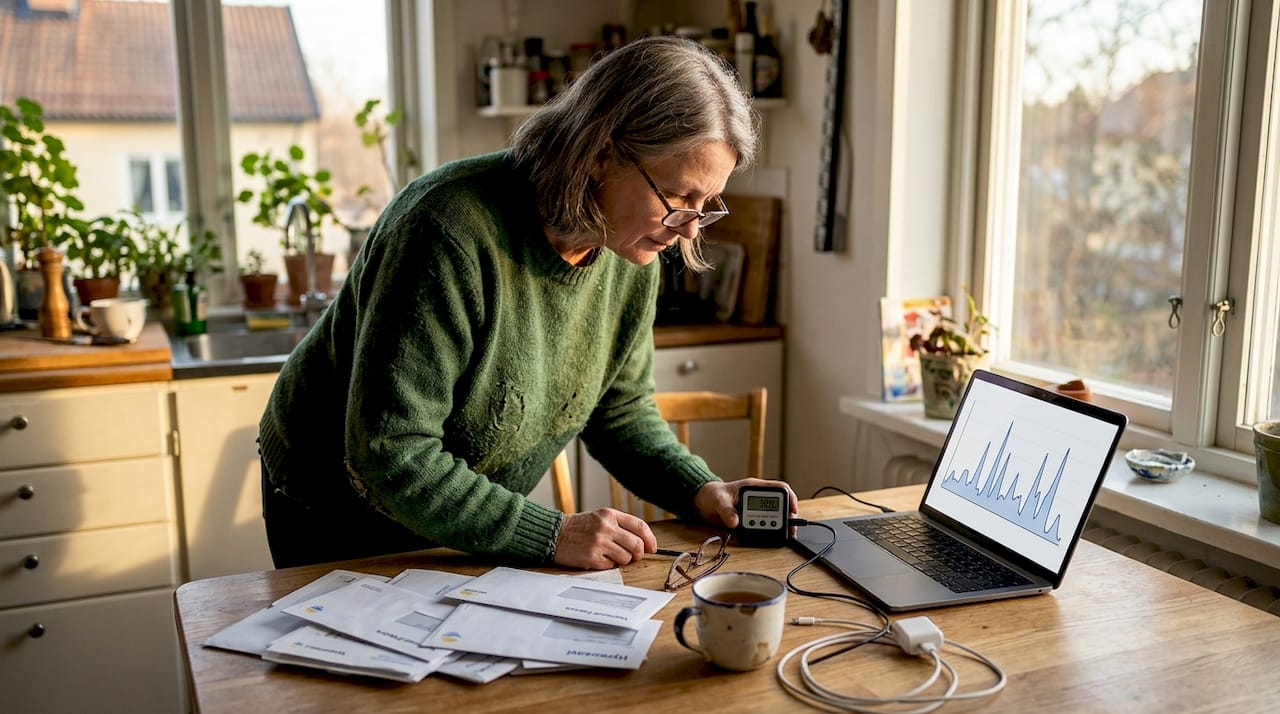
Pro Tip: Always save your analysis results digitally, preferably in a cloud service. This way, you have the history available if you need to show it during a property transaction or contact with the municipality.
Step-by-step: water quality monitoring workflow
Once the preparations are complete, it's time to carry out the follow-up. Here's the process in the correct order:
- Visually inspect the well. Check the lid, seals, and surrounding ground. Are there cracks, damage, or signs of surface water intrusion?
- Check the water from the tap. Note any unusual color, odor, or taste before sampling.
- Take the water sample. Follow the laboratory's instructions carefully. Flush the tap for at least two minutes before filling the bottle.
- Send the sample to the laboratory. Keep track of response times and store the sample in a cool place during transport.
- Interpret the results. Compare each parameter against the drinking water limit values and note any deviations.
- Take action if necessary. Filtration, UV disinfection, or contact with the municipality depending on the problem.
- Document in your logbook. Date, results, and any actions taken. Repeat the process according to the recommended frequency.
The recommended sampling frequency is at least every three years, but families with children and wells with known risk factors should analyze more often, preferably every year. You can see how your well compares to others in the country via well water statistics.
| Step | Key Moment | Frequency |
|---|---|---|
| Visual inspection | Lid, seals, surroundings | Annually |
| Sampling | Accredited lab, correct technique | Every 3 years, more often if at risk |
| Results analysis | Compare against limit values | With each sample |
| Action | Filtration, UV, repair | Upon deviation |
| Documentation | Logbook with date and results | Ongoing |
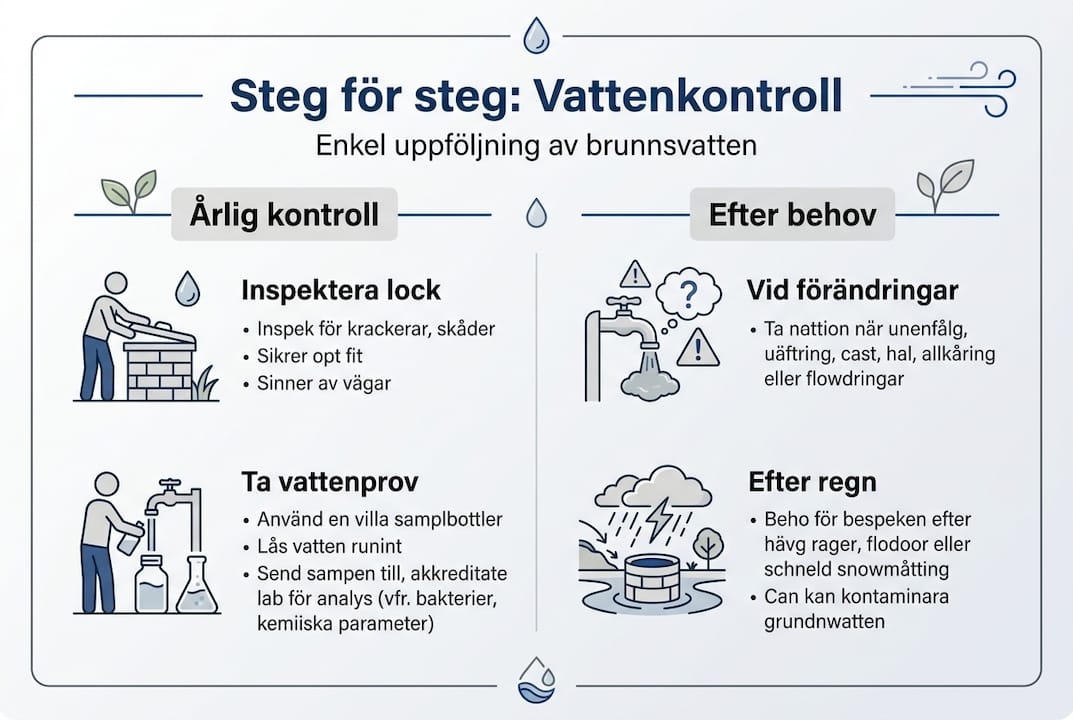
Pro Tip: If it has rained heavily or if the water suddenly smells or tastes different, take an extra sample immediately. Don't wait until the next planned analysis.
Common problems and edge cases – how to solve them
Most well owners encounter similar problems. Recognizing them early makes a big difference.
Approximately 20 percent of Swedish wells have unusable water, and the most common causes are bacteria, iron, manganese, and radon. Here are the problems you should pay extra attention to:
- Bacteria (coliform bacteria, E. coli): Most common in dug wells and after rain. Requires immediate action, often UV disinfection or chlorination.
- Iron and manganese: Causes discolored water and rust stains. Treated with an iron filter.
- Radon: Invisible and odorless gas dissolved in groundwater, most common in granite areas. Requires specific radon analysis and possible aeration.
- PFAS: Persistent substances that can be present near airports and industrial areas. Requires activated carbon filter.
- Nitrate: Common in agricultural areas. Dangerous for infants. Treated with reverse osmosis.
Edge cases that require extra attention:
- Drought: Lower groundwater levels concentrate pollutants. Take a sample after a dry period.
- Flooding: Surface water can penetrate the well and bring bacteria. Take a sample immediately afterward.
- Excavation work nearby: Can disturb groundwater flow and introduce pollutants.
Important: In case of suspected acute contamination, stop using the water for drinking and cooking immediately. Contact the municipal environmental office and take a sample right away.
For more information on water quality risks and how to prepare for extreme weather, also see the emergency guide for well owners.
How to interpret results and take the next step
Once you have received your analysis results, it's time to understand what the numbers actually mean. It's simpler than it seems.
- Review each parameter. The report lists values for microbiological, chemical, and physical parameters. Compare against the Swedish Food Agency's guidelines to see what is approved.
- Identify deviations. Values exceeding the limit values are often clearly marked. Note which parameters deviate and by how much.
- Assess the severity. Bacteria require immediate action. A high iron value is a problem but rarely urgent. Radon and PFAS require planned measures.
- Choose the right action. Filtration, UV disinfection, aeration, or contact with the municipality depending on what the analysis shows. Read more about the Swedish Food Agency's limit values to understand which levels require action.
- Document and plan the next analysis. Enter the date, results, and actions in your logbook. Set a reminder for the next sampling.
If you are unsure what the results mean or which measures are appropriate for your situation, contact the laboratory or the municipal environmental office. You can also find guidance via drinking water information for private individuals. Asking for help is not a sign of weakness; it's a sign that you take your responsibility seriously.
Easier water analysis and advice for private well owners
You now have a clear understanding of how to monitor your water quality, from preparation to interpretation and action. The next step is to actually carry out the analysis, and this is where we can help you.
At Svenskt Vattenprov, we offer analysis packages that cover all needs, whether you have a dug or drilled well. Our Complete+ Water Analysis covers 71 parameters and gives you maximum security. If you have a dug well, the Dug Well Water Analysis is more suitable, focusing on the risks most common for that type of well. All analyses are carried out by SGS Analytics, a Swedac-accredited laboratory, and you receive clear explanations for each result. Curious to see how your well compares to others in Sweden? Check out our Well Water Statistics for a regional overview.
Frequently asked questions about water quality monitoring
How often should I analyze my well water?
At least every three years is recommended for most well owners, but families with children and wells with known risk factors should analyze annually.
Which parameters should I always test for?
You should always test for microbiological and chemical parameters such as bacteria, nitrate, iron, manganese, and radon, as these are the most common problems in Swedish wells.
What do I do if the analysis shows unusable water?
Contact the laboratory or the municipal environmental office for advice, and rectify deviations with an appropriate method such as filtration, UV disinfection, or chlorination depending on the problem.
What about extreme weather or changed water?
Take an extra sample immediately if the water changes color, smell, or taste, or if there has been a flood or drought near the well.
How do I register my well?
You can register your well in SGU's Well Archive and use the well water registration service at Svenskt Vattenprov for better documentation and history.