

What is water hardness? Ensure the quality of your well
Imagine two neighbors with wells on the same street. Both drink the same type of groundwater. But one replaces their water heater every five years, struggles with lime stains inside the dishwasher, and needs twice as much detergent. The other has no such problems at all. The difference isn't about luck. It's about water hardness, a property that is invisible but affects everything from your pipes to your health. This article will show you what hardness actually is, how to measure it in your own well, and what you can do if the values are too high or too low.
Table of Contents
- What is water hardness?
- Different levels of water hardness: classification and Swedish examples
- How to measure water hardness in your own well?
- Consequences of hard and soft water for your household
- How do you manage excessively high or low hardness in your well?
- Analyze and secure your water quality easily
- Frequently asked questions about water hardness
Key Insights
| Point | Details |
|---|---|
| Hardness depends on minerals | Water hardness is determined by the amount of calcium and magnesium ions in the water. |
| Regional differences important | Water is softest in northern Sweden and hardest around calcareous areas – check your local value. |
| Test water regularly | Testing at least every three years ensures that the water maintains good technical and health quality. |
| Measures available if needed | If you have excessively hard water, filters or ion exchange systems can be used to adjust the hardness. |
| Hardness affects both health and household | Balance is best – a little hardness is beneficial, but too much can create problems with pipes and appliances. |
What is water hardness?
Water hardness is a measure of the concentration of calcium and magnesium ions in the water, measured in German degrees of hardness (°dH). The more such ions, the harder the water. It is simply a measure of how much of these minerals have dissolved as the groundwater has passed through bedrock and soil.
Calcium and magnesium are natural substances. They are found in the soil and enter the groundwater on its way down to your well. This is why hardness varies so widely depending on where in Sweden you live and what type of bedrock is beneath your property.
In practice, you notice hardness in several ways:
- White lime powder around faucets and on tiles
- Foam that doesn't form properly when you soap your hands
- Gray or stiff laundry despite normal detergent amounts
- Deposits inside the kettle and dishwasher
You can read more about how Sweden's water quality varies regionally and what it means for you as a well owner.
Different levels of water hardness: classification and Swedish examples
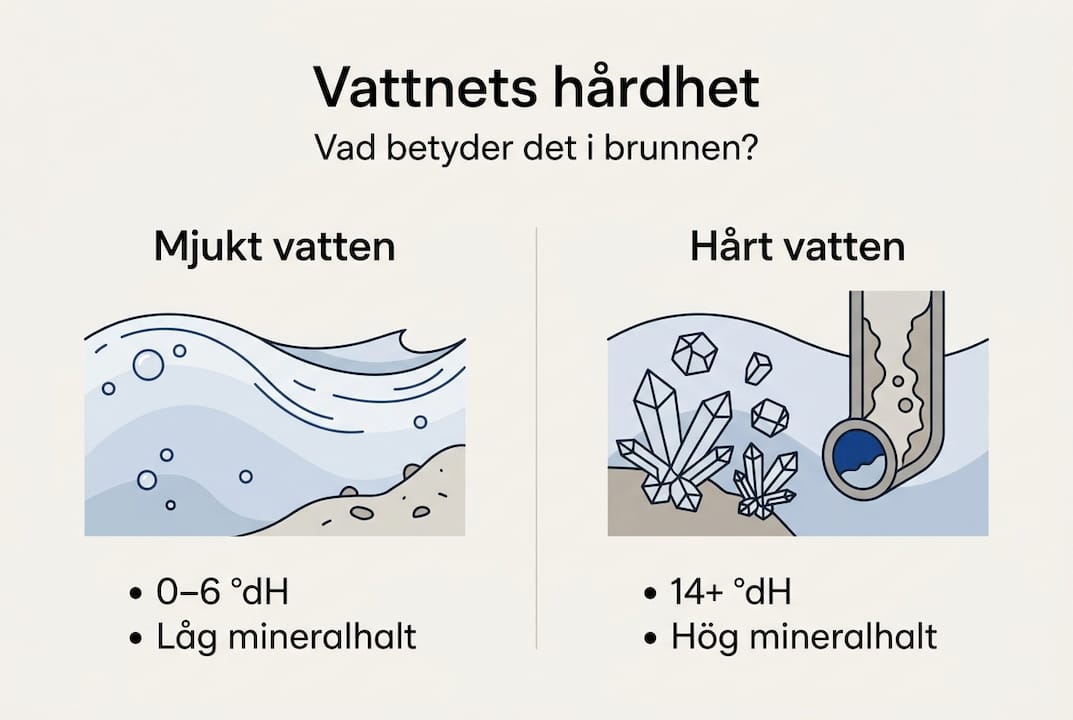
After the definition, it becomes easier to talk about levels and which ones are typical for your area. According to Swedish standards, hardness is divided into four classes:
| Hardness Class | Value (°dH) | Description |
|---|---|---|
| Soft | 0–6 | Low mineral content, common in northern Sweden |
| Medium hard | 7–13 | Balanced, most common in central Sweden |
| Hard | 14–20 | Noticeable lime problems, common in Skåne |
| Very hard | >20 | Significant deposits, requires action |
The official classification shows that 0–6 °dH is considered soft, 7–13 °dH as medium hard, 14–20 °dH as hard, and above 20 °dH as very hard.
In Sweden, groundwater is generally soft, but in calcareous areas such as Skåne, Öland, Gotland, and parts of Västergötland, hardness is significantly higher due to calcareous bedrock. Drilled wells also tend to yield harder water than dug wells, as the water passes through deeper layers of mineral-rich rock.
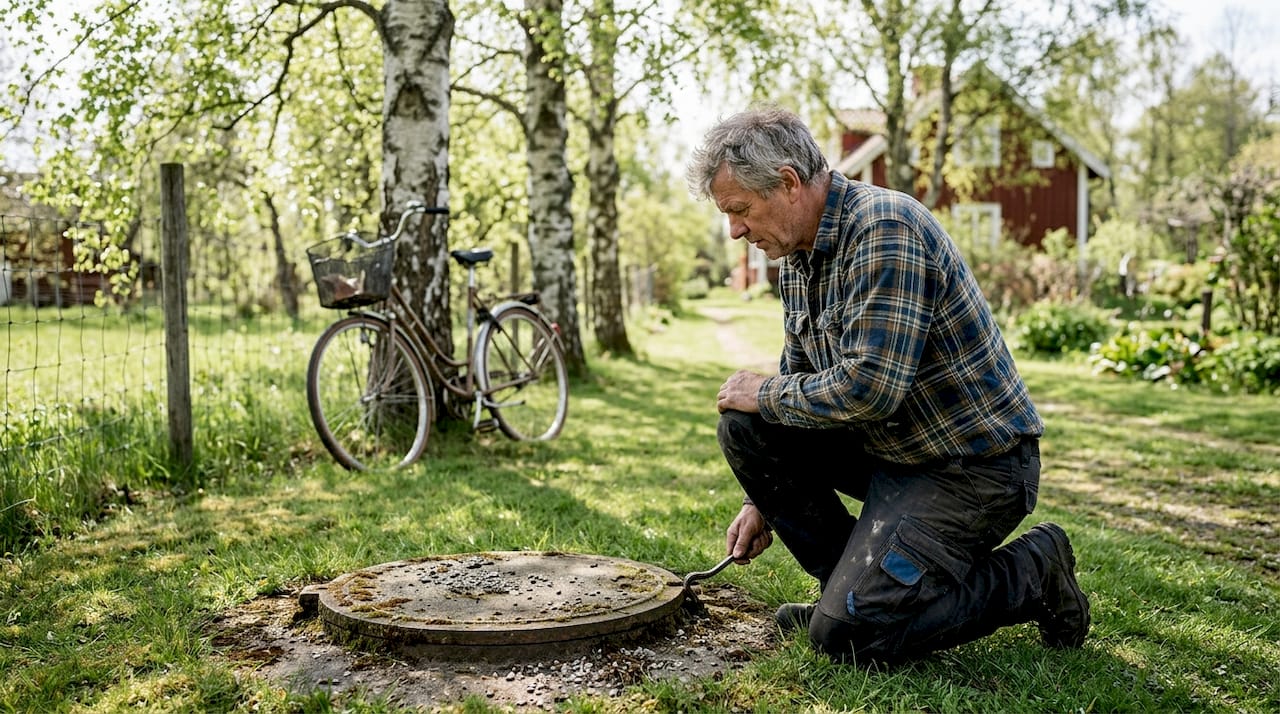
This is important to understand: your neighbor with a dug well might have soft water, while you with a drilled well on the same property might have hard water. It's about depth and geology, not the condition of the wells.
If you want to see how wells in your area typically perform, you can access well water statistics and delve deeper into our knowledge center.
How to measure water hardness in your own well?
Once you know the common hardness level in your area, the next step is to find out what your own water is actually like. There are several ways to do this.
The most common measurement methods are complexometric titration in a laboratory, test strips for home use, and digital meters. Laboratory analysis provides the most reliable results and is always included in a professional water analysis.
Here's how to proceed step by step:
- Start with a quick test. Test strips from pharmacies or hardware stores provide a rough estimate within minutes. They are not exact but can give an initial indication.
- Send a water sample to a laboratory. This provides exact values and also covers other parameters such as bacteria, metals, and pH. Follow the instructions for water sampling carefully to ensure a representative sample.
- Interpret the results against Swedish limit values. The Swedish Food Agency's analysis guide helps you understand what the numbers mean.
- Repeat regularly. Water composition changes over time.
According to the Swedish Food Agency, you should analyze well water at least every three years. Hard water protects against corrosion in pipes but causes deposits that can damage appliances in the long run.
Pro tip: Always take the sample in the morning before you've used the water, and let the tap run for 2-3 minutes first. This gives a more representative sample from the well rather than from the pipes inside the house. You can also register your well to keep track of its history.
Consequences of hard and soft water for your household
Once you've tested and analyzed your water's hardness, it's time to understand what it means for your daily life. The effects are more numerous than most people think.
The Swedish Food Agency classifies water with hardness above 15 °dH as fit for use with an annotation. It is not harmful to health but causes scale deposits in pipes and appliances, and you need more soap and detergent.
Hard water affects the household in several concrete ways:
- Machines and appliances wear out faster. Limescale accumulates on heating elements in dishwashers and water heaters, increasing energy consumption and shortening lifespan.
- Pipes and faucets develop deposits that can eventually reduce flow and cause leaks.
- Laundry requires more detergent and can become grey and stiff if the water is very hard.
- Skin and hair can feel dry after showering in hard water.
But there's also a positive side. Calcium and magnesium in drinking water contribute to your daily intake of these minerals and can reduce the risk of cardiovascular disease. Soft water lacks this protective effect and can also increase corrosion in pipes, meaning that metals like lead and copper can leach into the water.
So, it's not about hard water always being bad or soft water always being good. It's about knowing your values and acting accordingly. Read more about the connection between water quality and health and about water hygiene and well water for a broader perspective.
How do you manage excessively high or low hardness in your well?
If you know you have a problem or a risk, the next step is to figure out what you can or should do about it. There are several proven methods.
| Method | Suitable when | Cost (approx.) | Note |
|---|---|---|---|
| Ion exchange filter | Hardness >15 °dH | 5,000–20,000 SEK | Increases sodium content |
| Mechanical filter | Particles and sediment | 1,000–5,000 SEK | Does not affect hardness |
| Mixing water sources | Access to softer source | Low | Requires analysis of both |
| No action | Hardness 7–14 °dH | 0 SEK | Often good enough |
The most common solution for excessively hard water is an ion exchange softener, which exchanges calcium and magnesium for sodium. The WHO considers this not to pose a health risk, but you should be aware that the sodium content in the water increases. This can be relevant if you need to limit your sodium intake for medical reasons.
For drilled wells in calcareous areas with hardness above 20 °dH, we always recommend testing the water chemically and microbiologically before choosing a course of action. Hardness is rarely the only problem in such wells.
Pro tip: If you install an ion exchange filter, make sure it is regularly maintained with salt and that you check the sodium content in the water afterwards. Don't forget to follow the Swedish Food Agency's guidelines for drinking water.
If, on the other hand, the hardness is low, below 6 °dH, it may be worth checking if the water is corrosive. Soft water with low pH attacks pipes and can release metals. Read more about improvement measures for well water and about the water cycle to understand why the composition varies.
Analyze and secure your water quality easily
Now that you understand what water hardness is and what it can cause, it's time to take the next step. A professional water analysis will give you exact answers, not just about hardness but about overall water quality.
At Svenskt Vattenprov, you receive a complete analysis package delivered to your home. You take the sample yourself according to simple instructions, send it to our Swedac-accredited laboratory SGS Analytics, and receive a clear result with concrete recommendations. No guessing, no unclear figures. Our water analysis for drilled wells covers 41 parameters including hardness, and our complete water analysis provides even broader security with 71 parameters. You can also register your well and water quality to monitor developments over time.
Frequently asked questions about water hardness
What does it mean if the water is too hard?
Hard water, above 15 °dH according to the Swedish Food Agency, is classified as suitable with a remark. It is not harmful to health but causes limescale deposits in machines and pipes and requires more soap and detergent.
How often should I test the hardness of my well water?
The Swedish Food Agency recommends testing at least every three years. If you notice changes in taste, smell, or increased lime deposits, you should test earlier.
Is it possible to soften hard water at home?
Yes, with an ion exchange filter, you can effectively reduce water hardness at home. Keep in mind that the sodium content increases and that the filter requires regular maintenance.
Is hard water dangerous for health?
No. Neither the WHO nor the Swedish Food Agency considers hard water to be harmful to health. Calcium and magnesium in the water can, on the contrary, contribute positively to your mineral intake.