

Water quality checklist for Swedish well owners: safe water
TL;DR:
- Swedish private well owners are fully responsible for their water safety without mandatory government testing.
- Regular testing, visual inspections, and proper sampling are key to maintaining water quality.
- Comprehensive water analysis packages help identify contaminants like bacteria, nitrates, radon, and metals.
Unlike households connected to a municipal water supply, private well owners in Sweden carry full responsibility for the safety of their own drinking water. There is no government agency testing your tap, no automatic alerts when something goes wrong. According to Livsmedelsverket, private well owners are fully responsible for their water quality, with no mandatory government testing required. That means the safety of the water your family drinks, cooks with, and bathes in depends entirely on the steps you take. This guide gives you a clear, practical checklist to assess your well water quality, understand what to test for, and make informed decisions about the right analysis for your situation.
Table of Contents
- Understanding Swedish well water regulations and guidelines
- Step-by-step water quality checklist for Swedish private wells
- Key parameters to test and why they matter
- Comparing water analysis packages: Which is right for your well?
- Why regular checklists beat annual panic: An expert perspective
- Take action: Get accurate water analysis for your well
- Frequently asked questions
Key Takeaways
| Point | Details |
|---|---|
| Owner responsibility | Private well owners in Sweden must independently assure their water is safe to drink. |
| Checklist essentials | A structured checklist makes water testing simple, consistent, and reliable. |
| Critical parameters | Testing for bacteria, pH, metals, and nitrates is vital for safety and compliance. |
| Choose the right package | Select an analysis package that fits your well’s risks and your family’s needs. |
| Proactive testing wins | Routine, planned water checks prevent costly and dangerous emergencies. |
Understanding Swedish well water regulations and guidelines
Many well owners assume there must be strict rules governing their water quality. The reality is more nuanced, and understanding it is the first step toward taking real control.
Swedish drinking water legislation, specifically LIVSFS 2022:12, applies primarily to larger water suppliers. Private wells serving fewer than 50 people fall outside the scope of mandatory testing requirements. This means no authority will knock on your door and demand a sample. No fine will arrive if you skip testing for five years.
But here is the critical point: Livsmedelsverket (the Swedish Food Agency) provides strong recommendations but no enforceable requirements for private wells under 50 users. These recommendations exist because the risks are real, even when the rules are not binding.
“The absence of a legal requirement does not mean the absence of risk. Contaminated well water can cause serious illness without any visible warning signs.”
Here is what every private well owner in Sweden should know:
- No mandatory testing applies to wells serving fewer than 50 people under current Swedish law
- Livsmedelsverket recommends testing at least every three years under normal conditions
- More frequent testing is advised after flooding, nearby construction, or any change in water appearance or taste
- Results can be used legally when selling a property, applying for grants, or engaging with your local environmental authority (miljö- och hälsoskyddsnämnd)
- You are liable if contaminated water from your well causes harm, even without a legal testing mandate
- EU drinking water standards serve as the benchmark for assessing your results, even for private wells
For a broader understanding of what Swedish regulations mean in practice, the water analysis facts resource is a solid starting point. If you want a thorough overview of the full testing landscape, the complete water testing guide covers everything from sampling to interpreting results.
The bottom line: Swedish law gives you freedom, but that freedom comes with responsibility. Treat Livsmedelsverket’s recommendations as the minimum standard, not the ceiling.
Step-by-step water quality checklist for Swedish private wells
Understanding the rules is just the start. Here is a practical checklist to keep your well water safe all year, structured so you can work through it systematically.
-
Inspect your well visually. Check the well casing, cover, and surrounding area for cracks, gaps, or signs of surface water intrusion. Look for rust, algae, or debris. A damaged casing is one of the most common entry points for bacteria and contaminants.
-
Check for changes in water appearance, taste, or odor. Cloudiness, a metallic taste, a sulfur smell, or unusual color are all warning signs. Do not wait for your scheduled test if you notice any of these. Act immediately.
-
Review your maintenance history. When was the well last serviced? When was the pump last replaced? Older infrastructure increases contamination risk. Keep a written log of all maintenance work and previous test results.
-
Schedule your water test. Regular testing is essential even when not legally required. Aim for at least once a year. If your well is older, near agricultural land, or in a granite area with radon risk, test more frequently.
-
Collect your sample correctly. Follow the instructions provided with your sampling kit precisely. Contamination during collection is a common source of false results. Use only the supplied containers and follow the timing guidelines.
-
Send your sample to an accredited laboratory. Only accredited labs can provide legally usable results. Results from non-accredited sources may not be accepted by authorities or during property transactions.
-
Record and store your results. Keep a file with all test reports, dates, and any follow-up actions taken. This record is valuable when selling your property and helps you track trends over time.
-
Act on the results. If a parameter exceeds recommended limits, consult your provider for guidance on treatment options. Do not ignore elevated values and hope they resolve on their own.
For detailed guidance on what constitutes safe levels for each parameter, the well water standards page provides clear reference points. And if you are wondering how often to test based on your specific situation, regular water testing breaks it down by well type and risk factor.
Pro Tip: Set a recurring calendar reminder every 12 months labeled “Well water test due.” Pair it with a spring inspection of your well casing. Consistent timing makes it a habit, not a chore.
Key parameters to test and why they matter
With your checklist in hand, it is crucial to know exactly what to test for and why each factor matters for your family’s health.
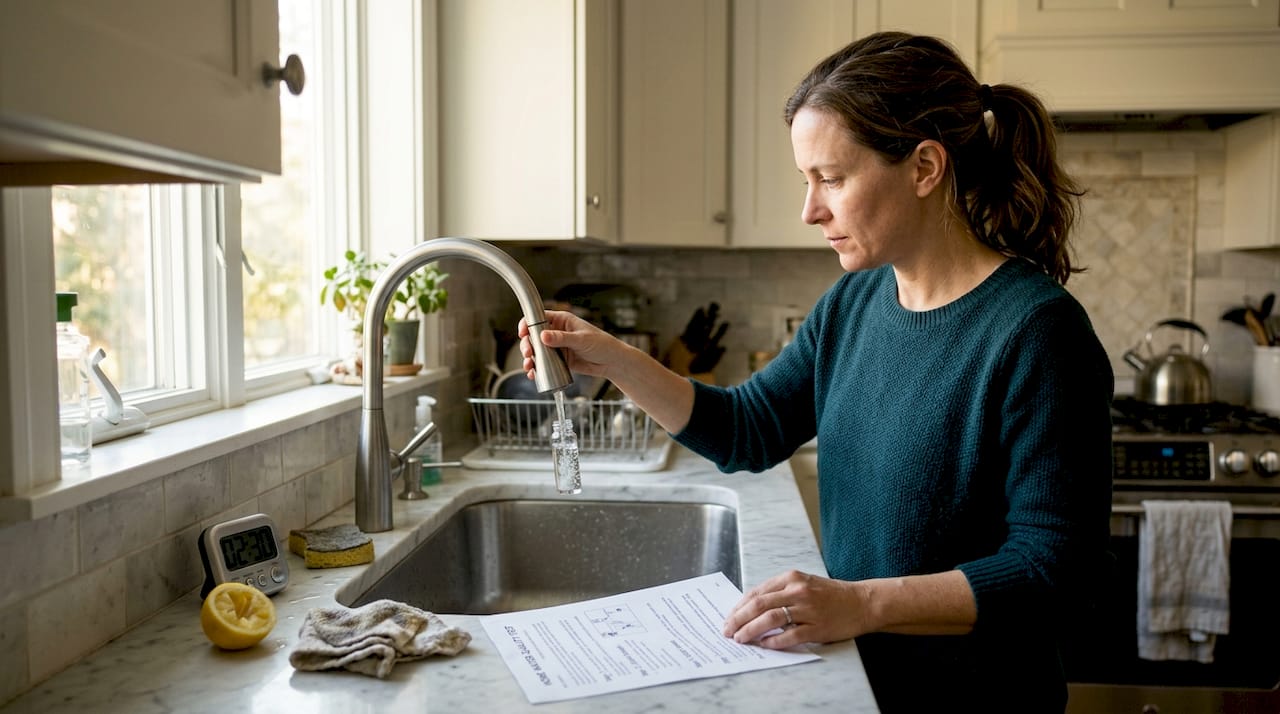
Bacterial and chemical contaminants can impact health and water suitability in ways that are often invisible to the naked eye. Here are the most important parameters to include in any well water analysis:
| Parameter | Why it matters | Risk if elevated |
|---|---|---|
| Coliform bacteria | Indicates fecal contamination | Gastroenteritis, serious illness |
| E. coli | Direct marker of sewage contamination | Severe gastrointestinal disease |
| pH | Affects taste and pipe corrosion | Pipe damage, metal leaching |
| Iron | Common in Swedish wells, stains fixtures | Taste issues, pipe blockages |
| Hardness (calcium/magnesium) | Affects appliances and skin | Scale buildup, dry skin |
| Nitrate | Linked to agricultural runoff | Dangerous for infants |
| Manganese | Naturally occurring in groundwater | Neurological effects at high levels |
| Radon | Found in granite bedrock areas | Increased cancer risk |
| Arsenic | Occurs naturally in some Swedish geology | Long-term organ damage |
| PFAS | Industrial and firefighting chemicals | Immune and hormonal disruption |
Several of these parameters deserve special attention. Radon is a concern specifically in granite-rich areas like Värmland, Dalarna, and parts of Norrland. You cannot taste, smell, or see it. The only way to know your exposure level is to test. Similarly, PFAS (per- and polyfluoroalkyl substances) are persistent chemicals that accumulate in the body over time, and wells near airports or industrial sites carry higher risk.
For a deeper look at how bacteria enter well water and what the microbiological risks mean for your family, that resource covers the science in plain language. You can also explore groundwater statistics to understand how common various contaminants are across Swedish well types.
Knowing which parameters are most relevant to your region and well type helps you choose the right analysis package, which brings us to the next step.
Comparing water analysis packages: Which is right for your well?
Once you know what to test, the next challenge is choosing the right analysis package. Not every well needs the same level of scrutiny, and choosing wisely saves both money and worry.
Lab analysis ensures detection of hidden health hazards that visual inspection or basic home tests simply cannot catch. Here is how the main package types compare:
| Package type | Parameters covered | Best suited for |
|---|---|---|
| Basic bacterial analysis | 5 to 10 (bacteria, pH, nitrate) | New owners doing a quick first check |
| Standard drilled well (borrad brunn) | 41 parameters | Most bergborrade (bedrock) wells |
| Standard dug well (grävd brunn) | 31 parameters | Older, shallower dug wells |
| Complete analysis (Komplett+) | 71 parameters | Older wells, at-risk areas, property sales |
| PFAS specific | 30 PFAS substances | Wells near airports or industrial sites |
| Radon specific | Radon only | Granite bedrock areas |
| Farm/agricultural (Gård) | Extended panel | Livestock farms, horse properties |
A basic package is a reasonable starting point if your well is new, recently tested, and located in a low-risk area. But for older wells, wells near farmland, or properties changing hands, a more thorough package is worth every krona. The cost of treating a waterborne illness, or losing a property sale over an inadequate water report, far exceeds the price of a complete analysis.
For a closer look at what each test actually covers and what the analysis facts mean in real terms, that resource helps you compare with confidence.
Pro Tip: If your well is more than 20 years old, located near agricultural fields, or has never been tested for PFAS or radon, choose a complete or specialized package. The broader picture is always worth having.
Why regular checklists beat annual panic: An expert perspective
After years of helping well owners across Sweden understand their water, one pattern stands out clearly. The owners who encounter the fewest serious problems are not necessarily the ones with the best wells. They are the ones who check consistently.
There is a common scenario we see: a family ignores their well for several years, then scrambles to get a full analysis done the week before listing their property for sale. The results come back with elevated iron, borderline nitrate, and a bacterial flag. Suddenly they are negotiating price reductions and delaying the sale while arranging treatment.
Contrast that with the owner who follows a simple checklist every spring, catches a slow rise in manganese levels over two consecutive tests, and installs a filter before it becomes a health concern. Same well. Very different outcome.
The water testing guide reinforces this point with practical structure. A “little but often” approach to well monitoring does not require expertise. It requires consistency. Checklists make that consistency achievable for any homeowner, regardless of technical background.
Take action: Get accurate water analysis for your well
You now have the checklist, the parameter knowledge, and the package comparison to make a confident decision about your well water. The next step is putting it into practice.
At Svenskt Vattenprov, every analysis is processed by SGS Analytics and Eurofins, a Swedac-accredited laboratory that meets the same standards as public water utilities. Results are legally usable for property sales, grant applications, and authority contacts. Whether you need a focused bacterial analysis for a quick check, a complete water analysis for maximum peace of mind, or guidance on which package fits your situation, our accredited water analysis services are designed to make the process simple and the results clear. Order online and we will handle the rest.
Frequently asked questions
How often should I test my private well water in Sweden?
Test your well water at least once a year, and more frequently if you notice changes in taste, color, or odor. Private well owners are responsible for their own testing and monitoring, so consistent scheduling is essential.
What parameters are most important for private well water testing?
Focus on bacteria (including E. coli), pH, hardness, metals like iron and manganese, nitrate, radon, and visual clarity. Bacterial contamination is a significant risk for Swedish private wells and should always be included.
Is water testing required by law for Swedish private wells?
No mandatory testing applies to wells serving fewer than 50 people, but no enforceable requirements does not mean no responsibility. Owners are fully liable for their water safety.
Where can I get help interpreting my water test results?
Your testing provider should include clear explanations with every result. You can also refer to Livsmedelsverket’s national guidelines for water quality interpretation and recommended action levels.