

PFAS in well water: 2026 guide for Swedish well owners
Your well water looks perfectly clear. It has no smell, no strange taste, and no visible sign of anything wrong. Yet it may contain PFAS, man-made chemicals that have been building up in groundwater across Sweden for decades. These are not trace amounts you can ignore. They are persistent, they accumulate in your body, and they do not break down over time. This guide covers what PFAS are, where they come from, what Swedish regulations say, how to test your well, and what to do if your results come back elevated.
Table of Contents
- What are PFAS and why are they a concern?
- How does PFAS get into Swedish well water?
- Understanding Swedish PFAS regulations and limits
- Health risks of PFAS in drinking water
- How to test your Swedish well for PFAS
- Removing PFAS from your well water
- Reducing everyday PFAS exposure: Beyond water
- Get peace of mind with expert PFAS water analysis
- Frequently asked questions
Key Takeaways
| Point | Details |
|---|---|
| PFAS are persistent contaminants | PFAS remain in water and the environment for decades, making regular testing key for Swedish well owners. |
| New regulations guide safety | Sweden’s 2026 limits on PFAS in water help homeowners understand when action is needed. |
| Accredited testing and treatment | Use accredited laboratories for reliable PFAS analysis and choose certified filtration to effectively reduce exposure. |
| Health risks affect everyone | Long-term PFAS exposure, especially for children and pregnant women, carries significant health risks. |
| Prevention goes beyond water | Reducing PFAS risk includes being mindful of local food and staying informed about emerging hotspot advisories. |
What are PFAS and why are they a concern?
PFAS stands for per- and polyfluoroalkyl substances. That is a broad group of more than 10,000 synthetic chemicals, all sharing one defining trait: an extremely strong carbon-fluorine bond that almost nothing in nature can break. That is why they are called “forever chemicals.”
Used in industry since the 1940s, PFAS were valued precisely because they resist heat, water, and grease. You find them in:
- Non-stick cookware coatings
- Water-repellent clothing and outdoor gear
- Food packaging and microwave popcorn bags
- Firefighting foam (AFFF), used heavily at airports and military bases
- Industrial processes including metal plating and semiconductor manufacturing
The problem is that these same properties make PFAS nearly impossible to remove from the environment once they are there. They leach into soil, move through groundwater, and end up in private wells. For Swedish well owners, understanding PFAS in Swedish drinking water is no longer optional. It is a practical health concern.
How does PFAS get into Swedish well water?
PFAS does not appear in your well by accident. There are specific, traceable pathways that bring it from industrial or military sites into groundwater and eventually into your tap.
The most significant sources in Sweden include:
- Airports and military bases: Firefighting foam used in training exercises is the single biggest contamination source in Sweden.
- Landfills: Old waste sites leach PFAS into surrounding soil and groundwater.
- Industrial facilities: Metal plating, textile treatment, and paper manufacturing all historically used PFAS.
- Contaminated agricultural land: Sludge applied to farmland can carry PFAS into the soil.
Once PFAS enters the ground, it travels. Groundwater does not respect property lines. A contamination source 2 kilometers from your well can still affect your water, especially in areas with sandy or permeable soils.
Key fact: PFAS near airports, landfills, and fire training sites can migrate into private wells far from the original source.
Sweden has documented hotspots. Ronneby in Blekinge is the most well-known case, where residents living near a military airbase were found to have elevated PFAS blood levels significantly above the national average. That case changed how Sweden approaches PFAS monitoring.
| Contamination source | Risk level for nearby wells | Typical PFAS compounds |
|---|---|---|
| Military/civil airports | Very high | PFOS, PFHxS |
| Fire training areas | Very high | PFOS, PFOA |
| Landfills (pre-2000) | High | Mixed PFAS |
| Industrial sites | Medium to high | Varies by industry |
| Agricultural land (sludge) | Medium | Long-chain PFAS |
If you are unsure whether your well shows signs of contaminated well water, location relative to these sources is your first clue.
Understanding Swedish PFAS regulations and limits
Sweden updated its drinking water regulations in January 2026, aligning with the EU Drinking Water Directive. The new limits are stricter than before and apply formally to public water supplies. But they also serve as the practical benchmark for private well owners.
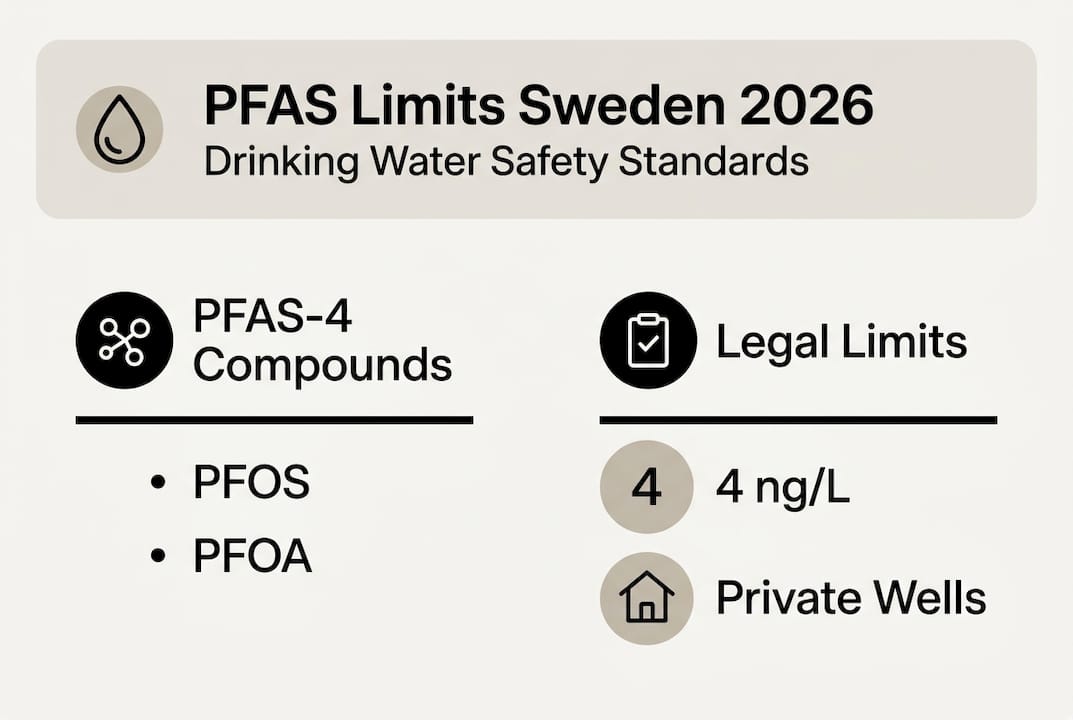
Here is what the 2026 Swedish PFAS limits look like:
| Parameter group | Substances included | Maximum limit (ng/L) |
|---|---|---|
| PFAS-4 | PFOS, PFOA, PFHxS, PFNA | 4 |
| PFAS-21 | 21 specific PFAS compounds | 100 |
4 ng/L. That is four nanograms per liter for the four most harmful PFAS compounds. To put that in perspective, one nanogram is one billionth of a gram. These are vanishingly small concentrations, which tells you how potent these chemicals are.
Private wells are not legally required to meet these limits, but any responsible approach to your family’s water safety uses them as the target. The water testing guidelines for 2026 explain how these standards apply in practice for private well owners. For a broader look at what your water should contain, the Swedish well water standards page is a useful reference.
Health risks of PFAS in drinking water
PFAS does not cause immediate symptoms. You will not feel sick the day after drinking contaminated water. The risk is cumulative. PFAS builds up in your blood, liver, and kidneys over years, and the health effects emerge slowly.
Swedish research confirms that PFAS exposure through contaminated water raises blood levels and creates measurable health risks, particularly for children. The groups most at risk include:
- Young children: Their developing immune and hormonal systems are more sensitive.
- Pregnant women: PFAS crosses the placenta and can affect fetal development.
- Breastfeeding mothers: PFAS transfers through breast milk.
- People with compromised immune systems: PFAS can reduce vaccine effectiveness.
The health effects linked to long-term PFAS exposure include increased risk of certain cancers (kidney and testicular cancer in particular), thyroid disruption, elevated cholesterol, and reduced immune response. Even low chronic exposure accumulates over time and increases these risks.

Pro Tip: If you have young children or are planning a pregnancy, prioritize PFAS testing now rather than waiting for a routine check. The essential water analysis facts for Swedish well owners explain exactly which parameters matter most for family health.
How to test your Swedish well for PFAS
Testing for PFAS is not the same as a standard water quality check. You need a lab that is specifically equipped and accredited for PFAS analysis. Here is how to approach it:
- Assess your location risk. Are you within 5 kilometers of an airport, former military base, landfill, or industrial site? If yes, PFAS testing is a priority.
- Choose an accredited lab. Private well users should test for PFAS-4 and PFAS-21 using a Swedac-accredited laboratory. This ensures results are legally valid and comparable to public water standards.
- Collect your sample correctly. Use the sampling kit provided by your lab. Contamination during collection can skew results. Follow the instructions exactly.
- Interpret results against 2026 limits. Compare your PFAS-4 total against the 4 ng/L threshold and your PFAS-21 total against 100 ng/L.
- Plan re-testing. If you are near a risk source, re-test every 1 to 2 years. Groundwater contamination can change as remediation efforts progress or as new contamination spreads.
A recent PFAS well investigation in Halmstad found that many private well owners in the area had no idea their water was affected until systematic testing was done. That is a pattern repeated across Sweden.
Pro Tip: If you are new to water testing, the guide to water analysis gives you a clear overview of the whole process before you order your first kit. When you are ready to test specifically for PFAS, the PFAS water analysis package screens for 30 PFAS compounds.
Removing PFAS from your well water
If your test results show elevated PFAS, you have real treatment options. Not all filters work, though. This is important: a standard pitcher filter or basic faucet attachment will not remove PFAS reliably.
| Treatment method | PFAS removal rate | Best for | Notes |
|---|---|---|---|
| Reverse osmosis (RO) | Over 90% | Point-of-use (kitchen tap) | Most effective; requires maintenance |
| Ion exchange (IX) | Very high | Whole-house or point-of-use | Works for both long- and short-chain PFAS |
| Granular activated carbon (GAC) | Moderate to high | Whole-house | Better for long-chain PFAS; less effective for short-chain |
| Standard pitcher filter | Low to none | Not recommended for PFAS | Does not meet PFAS removal standards |
Certified RO, ion exchange, and activated carbon systems are the recommended approaches. Basic household filters are not sufficient.
Key points to keep in mind:
- Certification matters. Look for NSF/ANSI 58 (for RO) or NSF/ANSI 62 (for activated carbon) certification on any unit you buy.
- Professional installation is worth it. Improper installation reduces effectiveness significantly.
- Regular filter replacement is non-negotiable. A saturated filter can actually release PFAS back into your water.
- Whole-house vs. point-of-use: For drinking and cooking, a point-of-use RO system under the kitchen sink is often the most practical and cost-effective solution.
Understanding how guidelines affect water analysis helps you make sense of your treatment options in the context of Swedish standards.
Reducing everyday PFAS exposure: Beyond water
Even with a certified filter installed, PFAS exposure can come from other sources. In areas with known contamination, local food can be a significant pathway.
Here is what you can do:
- Check local fish and egg advisories. Authorities recommend limiting local fish and eggs from lakes and farms in contaminated areas. Your kommun or miljöförvaltning publishes these advisories.
- Contact your local municipality. Many Swedish municipalities offer free or subsidized PFAS testing for private well owners in known risk zones. Ask directly.
- Use certified filters for all drinking and cooking water. Not just for drinking straight from the tap, but also for water used to boil vegetables, make coffee, and prepare baby food.
- Reduce PFAS from other household sources. Avoid non-stick cookware with damaged coatings, and check that food packaging is PFAS-free where possible.
- Stay updated on Swedish and EU bans. New PFAS are being restricted, but legacy contamination in soil and groundwater will persist for generations. Ongoing vigilance matters.
The importance of ongoing water testing cannot be overstated, especially as contamination maps in Sweden continue to be updated with new data.
Get peace of mind with expert PFAS water analysis
Knowing that PFAS is a real risk for Swedish private wells is one thing. Having a certified result in hand is another. That result is what lets you make informed decisions about treatment, and it is what you need if you ever contact your municipality, apply for remediation support, or sell your property.
At Svenskt Vattenprov, we offer accredited water testing through SGS Analytics, a Swedac-accredited laboratory that meets Livsmedelsverket’s standards. Our PFAS water analysis screens for 30 PFAS compounds and gives you results you can act on. If you want the broadest possible picture of your water quality alongside PFAS, our comprehensive well water analysis covers 71 parameters. Every report comes with clear explanations and concrete recommendations, not just a table of numbers.
Frequently asked questions
What are the signs that my well water may be contaminated with PFAS?
PFAS contamination is invisible, odorless, and tasteless. There are no sensory warning signs, which is exactly why lab testing is the only reliable detection method.
How often should I test my private well for PFAS in Sweden?
If you live near a risk source such as an airport or landfill, test every 1 to 2 years, or immediately if your local authorities issue an advisory.
Which filters are effective against PFAS in well water?
Certified reverse osmosis and ion exchange units are the most effective options. Basic pitcher filters are not sufficient for PFAS removal and should not be relied on.
Are children and pregnant women at higher risk from PFAS?
Yes. Vulnerable groups face higher risks from PFAS exposure, and Swedish studies confirm that children near contamination hotspots show measurably elevated blood levels.
Recommended
- How guidelines shape water analysis for Swedish well owners – Svenskt Vattenprov
- Drinking water quality standards for Swedish private wells – Svenskt Vattenprov
- 10 essential water analysis facts for Swedish well owners – Svenskt Vattenprov
- Vad är PFAS i dricksvatten – risker, källor och gränsvärden – Svenskt Vattenprov