

How to manage well water risks: A 2026 guide
If you own a private well in Sweden, the safety of your drinking water rests entirely on your shoulders. Private well owners are fully responsible for ensuring the safety and adequacy of their well water, with no government oversight or mandatory testing. That means no automatic alerts, no routine inspections, and no safety net if something goes wrong. The risks are real: microorganisms, nitrates, metals, and PFAS can all contaminate your water silently. This guide walks you through understanding those risks, preparing for testing, collecting samples correctly, and acting on your results.
Table of Contents
- Understanding well water risks
- Preparing for reliable water testing
- Step-by-step process for water testing
- Interpreting results and managing risks
- A fresh perspective: Why proactive management beats reactive fixes
- Get expert help: Reliable water analysis packages for your well
- Frequently asked questions
Key Takeaways
| Point | Details |
|---|---|
| Swedish well owners are fully responsible | In Sweden, you alone must test and manage your private well water for safety. |
| Annual testing is essential | Regular analysis helps you identify and address contamination risks before they affect your health. |
| Understand and mitigate risks | Learn to interpret laboratory results and take decisive action against microbial or chemical threats. |
| Choose reliable analysis providers | Opt for accredited labs and well-designed testing packages for trustworthy results. |
| Proactive management saves money | Regular testing and risk mitigation prevent costly emergencies and health hazards. |
Understanding well water risks
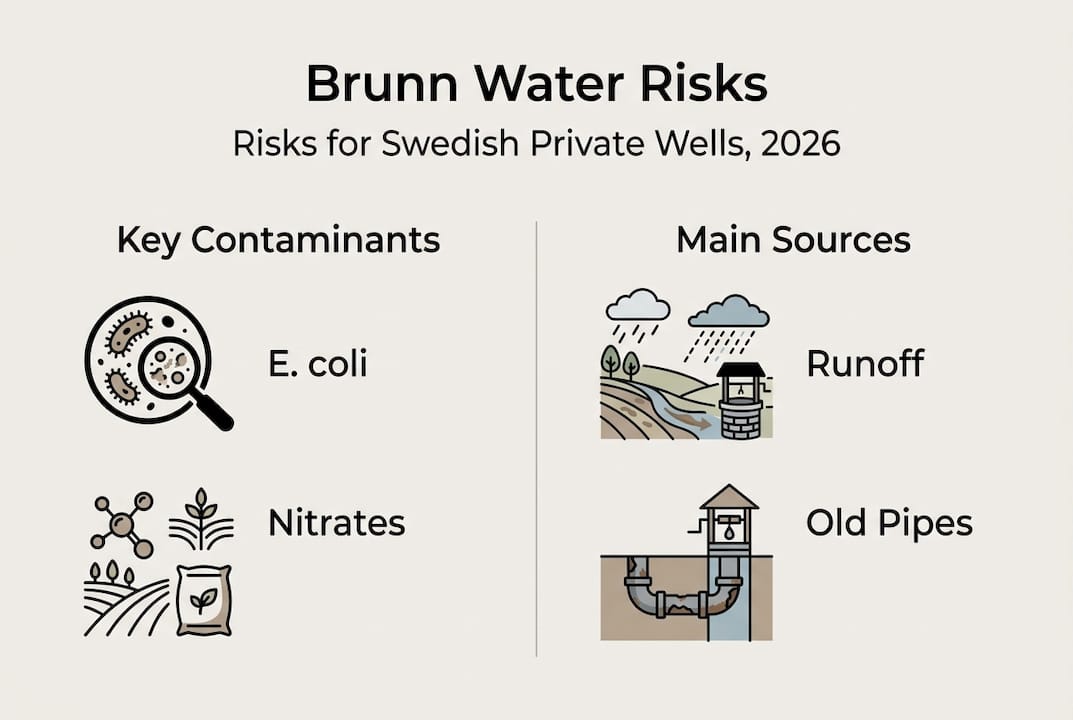
Sweden has roughly 1.2 million people relying on private wells, and the contamination rates are sobering. Around 40% of dug wells show excess microorganisms or nitrates at some point. That is not a rare edge case. It is a widespread reality that affects hundreds of thousands of households across the country.
The risks fall into two broad categories: biological and chemical.
Biological contaminants include:
- Coliform bacteria and E. coli, often from animal waste or surface water intrusion
- Viruses and parasites that can enter through cracks or poor well construction
- Enterococci, which signal fecal contamination
Chemical contaminants include:
- Nitrates from agricultural runoff, which are especially dangerous for infants
- Heavy metals such as arsenic, lead, and manganese from surrounding geology
- PFAS (per- and polyfluoroalkyl substances), persistent chemicals linked to health risks near airports, military sites, and industrial areas
- Radon, a naturally occurring radioactive gas common in granite-rich regions
Understanding which risks apply to your specific location matters. A well in Skåne faces different pressures than one in Dalarna. Coastal wells risk saltwater intrusion. Wells near farmland face nitrate loads. Reviewing water quality standards for Swedish private wells gives you a clear benchmark for what is acceptable and what is not.
| Contaminant | Primary source | Health impact |
|---|---|---|
| E. coli | Fecal matter, surface runoff | Gastrointestinal illness |
| Nitrates | Agricultural fertilizers | Infant methemoglobinemia |
| Arsenic | Natural geology | Long-term cancer risk |
| PFAS | Industrial/military sites | Hormonal and immune disruption |
| Radon | Granite bedrock | Lung cancer risk |
For a broader picture of what these findings mean in practice, the essential water analysis facts for Swedish well owners is a useful starting point. You can also review water guidelines for private wells to understand what Swedish authorities recommend.
Preparing for reliable water testing
Once you understand the risks, preparation is key to accurate analysis. Because well owners choose their own tests and interpret results without mandatory oversight, selecting the right analysis package upfront saves time, money, and uncertainty.
Before you collect a sample, gather the following:
- Sterile sample bottles (provided in most analysis kits)
- Clean gloves to avoid contaminating the sample
- A permanent marker to label bottles with date, time, and well location
- A cooler with ice packs for transport
- The prepaid return shipping label from your testing provider
Choosing the right test type depends on your well construction and local environment.
| Analysis type | Best for | Parameters covered |
|---|---|---|
| Borrad brunn (drilled) | Bedrock wells | 41 parameters including metals and bacteria |
| Grävd brunn (dug) | Shallow dug wells | 31 parameters with focus on surface contamination |
| Komplett+ | Maximum coverage | 71 parameters for full peace of mind |
| PFAS specific | Near airports or industry | 30 PFAS substances |
| Radon specific | Granite regions | Radon concentration |
When selecting a laboratory, look for Swedac accreditation. This confirms the lab operates under the same standards as public water utilities and that results are legally valid for property sales or municipal contact. Our complete water testing guide covers exactly how to evaluate providers and what to expect from the process.
Not sure what a water analysis actually measures? The water analysis guide for Swedish well owners breaks it down clearly.
Pro Tip: Always record the sample date, time, and exact well location on the bottle and in a personal log. If you test again in two years, this baseline data helps you spot trends and catch gradual deterioration before it becomes a health issue.
Step-by-step process for water testing
Once you have gathered your tools and chosen a testing provider, here is exactly how to conduct your water analysis.
- Let the tap run for 2 to 3 minutes before collecting a sample. This flushes stagnant water from the pipes and gives you a representative sample from the well itself.
- Rinse the sample bottle once with the water you are testing, then fill it to the marked line. Do not touch the inside of the bottle or cap.
- Label each bottle immediately with date, time, and sample point. If you are testing multiple taps, label them separately.
- Place bottles in the cooler with ice packs. Samples must stay below 8°C during transport to prevent bacterial growth that could skew results.
- Ship the same day if possible, or the next morning at the latest. Most providers include prepaid overnight shipping.
- Note any recent events on the submission form: flooding, nearby construction, changes in taste or smell, or recent pump work.
For dug wells, collect the sample from the tap closest to the well, not from a filtered outlet. For drilled wells, the same rule applies, but also note the well depth and casing material if known, as this affects how results are interpreted.
Never collect a sample immediately after heavy rainfall. Surface water infiltration during rain events temporarily spikes bacterial counts and can produce misleading results. Wait at least 48 hours after significant precipitation.
Because no government-mandated schedule exists for private well testing, you need to build your own routine. The importance of regular testing cannot be overstated, especially if your well is older or in an area with known agricultural or industrial activity. If you live near an airport or military base, a dedicated PFAS well water guide will help you understand what to look for.
Pro Tip: Avoid sampling after heavy rainfall or during spring snowmelt. These periods cause temporary spikes in contamination that may not reflect your well’s true baseline condition.
Interpreting results and managing risks
With your water analyzed, managing risks starts by understanding and acting on the results. Laboratory reports list each parameter alongside its measured value and the Swedish or EU threshold. Any value above the limit is flagged, usually in red or with a clear notation.

Any detected excess of microorganisms or nitrates signals immediate risk and requires action. Do not wait for a second opinion before stopping use of the water for drinking and cooking.
| Result | Threshold exceeded | Immediate action |
|---|---|---|
| E. coli detected | Any level | Stop drinking, boil or use bottled water |
| Nitrates above 50 mg/L | EU limit | Stop use, especially for infants |
| Arsenic above 10 µg/L | WHO/EU limit | Install certified filter, contact specialist |
| PFAS above 0.1 µg/L (sum) | EU limit | Stop drinking, contact municipality |
| Radon above 1000 Bq/L | Swedish action level | Aerate water before use, consult expert |
For microbial contamination, shock chlorination is often the first step. This involves adding a measured dose of chlorine to the well to kill bacteria, then flushing and retesting. It is a temporary fix, not a permanent solution. If bacteria return, the source of intrusion needs to be found and sealed.
For chemical contamination, the approach depends on the substance. Nitrates require a reverse osmosis filter or a new water source. Arsenic and heavy metals respond well to certified filtration systems. PFAS is harder to address and often requires professional guidance and possibly a connection to municipal water.
Reviewing well water issues in detail helps you match the right solution to the right problem. For a structured overview of what each parameter means, the water analysis guidelines and water quality parameters pages are practical references.
Pro Tip: Keep a written record of every test result, including the date, lab used, and any actions taken. Over time, this log reveals trends, such as rising iron levels or seasonal bacterial spikes, that a single test cannot show.
A fresh perspective: Why proactive management beats reactive fixes
Most well owners test their water only when something seems wrong: the water smells odd, looks cloudy, or someone in the household gets sick. This reactive approach is understandable, but it is also the most expensive and risky way to manage your well.
Here is the uncomfortable truth: many contaminants have no taste, no smell, and no visible sign. Arsenic, PFAS, and nitrates are all invisible. By the time you notice something is wrong, exposure may have been ongoing for months or years.
Proactive monitoring changes the equation entirely. Regular testing, ideally every one to three years, gives you a baseline. You know what your water looked like when it was good. If something shifts, you catch it early, when solutions are simpler and cheaper. A shock chlorination treatment costs far less than a full filtration system installed after years of bacterial contamination have damaged your pipes.
We have seen this pattern repeatedly since 2018: well owners who test regularly avoid emergencies. Those who wait often face compounding problems. The regular testing insights we have gathered confirm that proactive management is not just safer. It is smarter.
Get expert help: Reliable water analysis packages for your well
If you want expert support for reliable analysis and peace of mind, here is your next step.
At Svenskt Vattenprov, we have helped thousands of Swedish well owners get clear, actionable answers about their water since 2018. All analyses are performed by SGS Analytics, a Swedac-accredited laboratory, so your results meet the same standards as public water utilities. Whether you need the thorough Komplett water analysis covering 71 parameters, or a targeted Dug well analysis for your dug well, we have a package built for your situation. Visit our knowledge center to explore all options and get guidance on which test fits your needs. Your family’s water safety is too important to leave to chance.
Frequently asked questions
How often should I test my well water?
Test at least every one to three years, and always after flooding, nearby construction, or any change in taste, smell, or color. Because no mandatory testing schedule exists for private wells in Sweden, setting your own routine is essential.
What contaminants are most common in Swedish well water?
Microorganisms such as coliform bacteria, nitrates, and PFAS are the most frequent issues, particularly in dug wells. Over 40% of dug wells show excess microorganisms or nitrates at some point.
Can I fix contamination myself, or do I need professional help?
For coliform bacteria, shock chlorination can work as a first response, but persistent or chemical contamination such as arsenic or PFAS requires professional assessment and certified treatment systems.
Is there any government support for private well water safety in Sweden?
No. Swedish well owners are fully responsible for their own water safety and must arrange and fund all testing and remediation themselves.
What should I do if my test shows high nitrate levels?
Stop using the water for drinking and cooking immediately, especially if infants are in the household, and contact a water analysis professional to identify the source and select the right treatment.