

What does a water report show? How to interpret the results
Your water looks clear. It doesn't taste strange. Yet, it could contain bacteria, nitrates, or metals that you won't notice until your health is affected. Many invisible health risks can exist even though the water appears completely normal. That's precisely why a water report exists. It analyzes what you cannot see, smell, or taste. In this article, we will go through what the report actually contains, how to read the results, and what actions you should take depending on what the analysis shows.
Table of Contents
- What is a water report and why is it important?
- What parameters are analyzed in the water report?
- How to interpret results and guidelines in your report
- How and when should you take your next water sample?
- Our view: Common misconceptions and best ways forward
- Time for water analysis? Here’s how we can help you
- Frequently asked questions about water reports
Key Insights
| Point | Details |
|---|---|
| Water report reveals hidden risks | A water report discloses substances and bacteria you cannot see or taste. |
| Results determine action | The final assessment of 'fit for use' or 'unfit for use' helps you decide if the water is safe or requires action. |
| Regular sampling needed | Test your well water at least every three years to detect harmful changes in time. |
| Follow guidelines for safety | The Swedish Food Agency's guidelines are indicative for safe drinking water from private wells. |
What is a water report and why is it important?
A water report is a document from an accredited laboratory showing the results of your water sampling. It contains measured values for a number of parameters and compares them against the Swedish Food Agency's guidelines for drinking water. Simply put: the report tells you whether your water is safe to drink or not.
A water report shows microbiological, chemical, and physical parameters compared to the Swedish Food Agency's guidelines. This means you get answers to questions such as: Are there bacteria in the water? Is the iron content too high? Are nitrates present at levels dangerous for infants?
There are several reasons to understand the importance of water testing for your well. Water quality can change without warning. A dry summer, a leak from a nearby septic tank, or natural geological processes can quickly affect groundwater. You won't notice anything until you test.
Analysis is especially important in these situations:
- Children under one year old drink the water, as nitrates can be life-threatening for infants
- Several households share the same well
- The well is older or newly renovated
- There have been changes in the surroundings, such as new construction or agriculture
- You are buying or selling a property with a private well
“Always choose a Swedac-accredited laboratory for your water analysis. This ensures that the results meet legal and scientific standards and can be used as a basis for authorities or property transactions.”
You can read more about Swedish water quality requirements to understand the norms that apply to private wells in Sweden.
Pro tip: Always save your latest water report. If you need to contact the municipality's environmental and health protection committee or apply for a grant for water improvement, the report is your most important document.
What parameters are analyzed in the water report?
A water report doesn't just contain a single value. It measures a range of different substances and properties. The parameters are divided into three groups: microbiological, chemical, and physical.
Common parameters include E. coli, coliform bacteria, pH, nitrates, metals, radon, PFAS, and conductivity, among many others. Each parameter tells something specific about your water.
| Parameter Type | Example | Possible Source |
|---|---|---|
| Microbiological | E. coli, coliform bacteria | Sewage, animals, surface water |
| Chemical | Nitrate, arsenic, PFAS, iron | Agriculture, geology, industry |
| Physical | pH, conductivity, odor, color | Natural processes, corrosion |
Microbiological parameters concern bacteria and other microorganisms. E. coli is the most serious, as it directly indicates fecal contamination. Coliform bacteria are a broader measure and can signal surface water intrusion.
Chemical parameters are often the most difficult to detect on your own. Nitrates have no smell or taste but can cause oxygen deficiency in the blood of infants. Arsenic occurs naturally in the bedrock in some parts of Sweden. PFAS, known as "forever chemicals," do not break down in nature and can accumulate in the body over time.
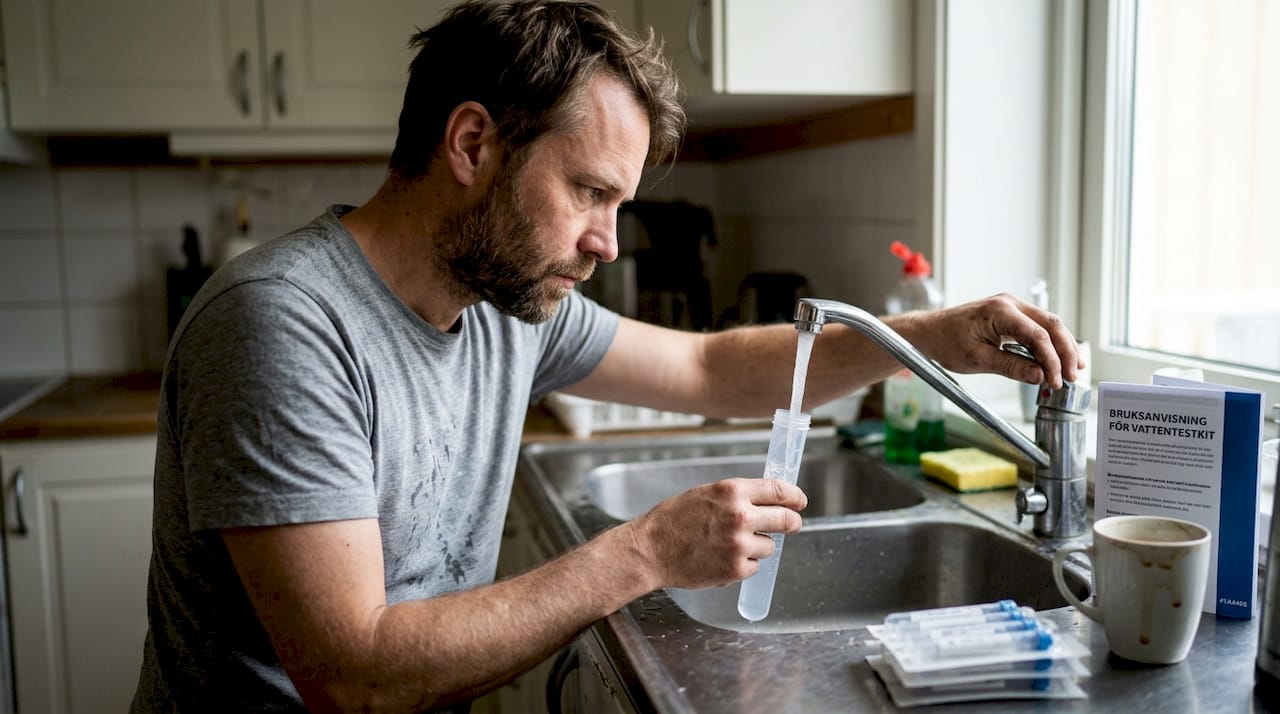
Physical parameters like pH and conductivity do not always directly affect health but can indicate corrosion in pipes or that the water is leaching metals.
There are important differences depending on the well type. You can read about important parameters in well water for a more detailed review.
- Drilled well: Higher risk of radon, arsenic, and high iron levels from the bedrock
- Dug well: Higher risk of bacteria and nitrates due to surface water intrusion
Pro tip: Choose an analysis package based on your well type. A dug well needs extra focus on microbiological parameters, while a drilled well in granite areas should include radon analysis. Read more about how you can ensure clean water for your specific situation. Do you want to see how common these problems actually are? Check out well water statistics for Sweden.
How to interpret results and guidelines in your report
When you open your water report, you'll be met with figures and values. It can feel overwhelming. But the system is actually quite simple once you understand its basic structure.
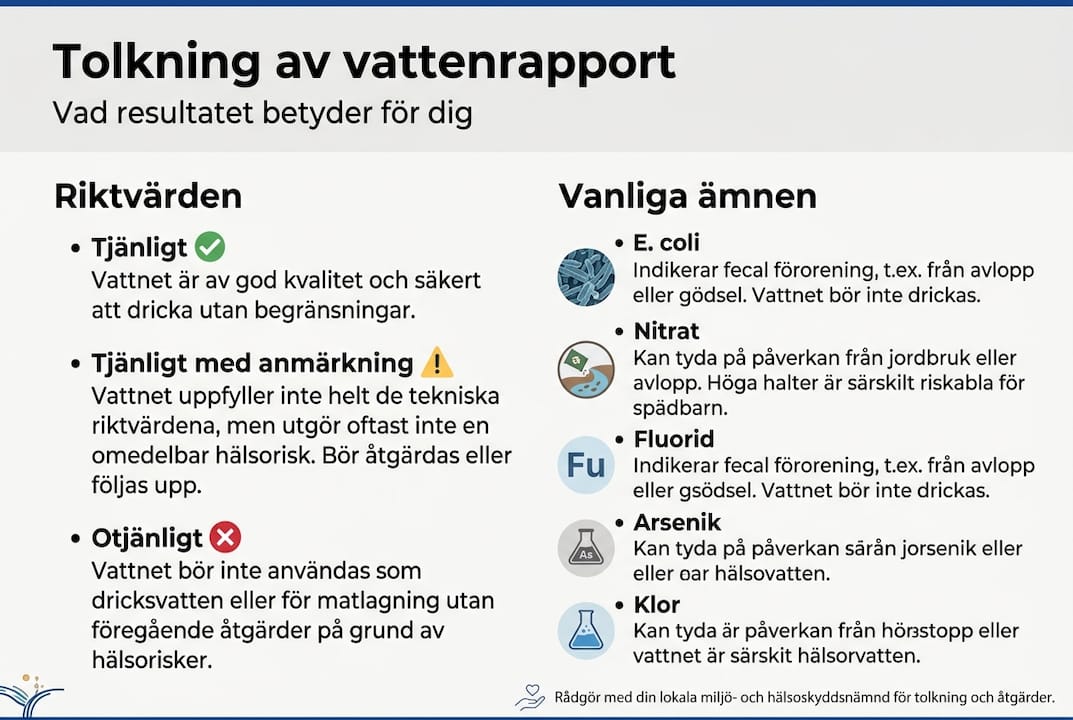
The report always concludes with an assessment in one of three categories. The assessment is either "fit for use," "fit for use with remarks," or "unfit for use," depending on which values deviate and how serious the deviation is.
| Assessment | Meaning | Action |
|---|---|---|
| Fit for use | No exceedances | Continue regular testing |
| Fit for use with remarks | Aesthetic or technical deviations | Investigate cause, consider action |
| Unfit for use | Health risk present | Do not drink water, act immediately |
The difference between health-related and aesthetic deviations is important to understand. A high iron content makes the water brown and taste metallic, but is rarely directly dangerous for healthy adults. It is classified as an aesthetic or technical remark. However, E. coli in the water is always a health risk and results in an "unfit for use" assessment.
What do you do for each assessment?
- Fit for use: Archive the report and schedule the next sampling according to the recommended interval.
- Fit for use with remarks: Contact a plumbing specialist or well expert to investigate the cause. Hold off on actions until you know what is causing the deviation.
- Unfit for use: Stop drinking the water immediately. Boil the water if bacteria are present. Contact the municipality's environmental office and hire a specialist.
“Guidelines for private wells are not legally binding in the same way as for municipal water. But they are set to protect your health, and ignoring them is an unnecessary risk.”
It's worth noting that 15 to 20 percent of private wells contain harmful substances. That's not a small proportion. Read more about drinking water limit values and how they affect your health and water quality.
How and when should you take your next water sample?
Taking one water sample is not enough. Water quality changes over time. What was safe three years ago might not be today.
The Swedish Food Agency recommends sampling at least every three years, but more often if children drink the water, in multi-household setups, or when changes occur in the surroundings.
Here's a plan for how you should think about sampling intervals:
- Standard household without risk factors: Every three years as a minimum.
- Households with children under one year or pregnant individuals: Annually, as nitrates are particularly dangerous.
- Well near agriculture, industry, or dense development: Every two years or more frequently.
- After well renovation or pipe installation: Immediately after the work is completed.
- If taste, smell, color, or turbidity changes: Test immediately, do not wait.
There are also situations where you should act without delay. If you notice the water starting to smell bad, if there's a sewage leak nearby, or if you've become ill without a known cause, it's time to test immediately.
Pro tip: Always schedule sampling in spring or autumn. Extreme temperatures, such as severe frost heave or drought, can temporarily affect water quality and lead to misleading results if you test immediately after an unusual period.
Hiring a Swedac-accredited laboratory is not optional if you want reliable results. Non-accredited tests can miss important parameters or provide incorrect values. Long-term health risks from neglected follow-up include chronic exposure to arsenic, nitrates, and PFAS, which can have serious consequences for kidneys, liver, and hormonal systems. Read more about why regular water sampling is one of the most important things you can do for your family's health.
Our view: Common misconceptions and best ways forward
The most common misconception we encounter is simple: "It tastes good, so it's safe." That's not true. Arsenic, PFAS, and nitrates are all tasteless. Bacteria can be present in water that looks and tastes perfect.
Another common pitfall is choosing the cheapest or fastest test. Simple tests often measure only a few parameters, giving you a false sense of security. You know one value is okay, but you know nothing about the thirty other substances that could actually be the problem.
We also see well owners who wait too long. They know they should test but postpone it year after year. During that time, levels of harmful substances can slowly increase without giving any visible signs. This is a risk that is completely unnecessary to take.
Our experience shows that a broad analysis package with in-depth parameter information is always better than a narrow one. You don't want to have to re-test because you chose a package that didn't cover the right substances. Do it properly from the start.
Time for water analysis? Here’s how we can help you
Now that you understand what a water report contains and how to interpret it, the next step is to actually take the sample. It's easier than you think.
We at Svenskt Vattenprov send sampling equipment directly to your home. You take the sample, send it to SGS Analytics, and receive a clear, easy-to-read result with concrete recommendations. If you have a drilled well, our drilled well analysis with 41 parameters is suitable. For dug wells, we recommend dug well analysis with extra focus on bacteria and surface water intrusion. If you want maximum security, choose Complete Water Analysis+ with a total of 71 parameters.
Frequently asked questions about water reports
What is the difference between "fit for use," "fit for use with remarks," and "unfit for use" water?
"Fit for use" means no exceedances; "fit for use with remarks" applies to aesthetic or technical flaws such as elevated iron content; while "unfit for use" means the water poses a health risk and should not be drunk.
How often should water samples be taken from a private well?
The Swedish Food Agency recommends at least every three years, but more often if children drink the water, for multiple households, or when water quality changes.
What does it mean if the water report shows traces of E. coli?
E. coli above zero means the water is classified as unfit for use and should not be drunk, as the bacteria indicate fecal contamination and pose a serious health risk.
What symptoms can contaminated well water cause?
Invisible health risks from bacteria, nitrates, and metals can cause stomach problems and nausea in the short term, as well as an increased risk of serious health problems with long-term exposure.