

Essential water testing tips for Swedish well owners
TL;DR:
- Homeowners are responsible for testing and ensuring their private well water safety.
- Regular, risk-based testing with accredited laboratories is essential to detect contaminants early.
- Following proper sampling procedures and choosing appropriate parameters ensures accurate water quality assessment.
If your home runs on a private well, the safety of every glass of water is entirely your responsibility. No government agency monitors your supply, and no automatic alerts warn you when something goes wrong. Livsmedelsverket’s guidelines under LIVSFS 2022:12 set the benchmark for what safe drinking water looks like, but following them is your call. What makes this especially urgent is that 1 in 5 private wells in Sweden contains contaminants at levels that exceed recommended limits. The tips below will help you test smarter, stay compliant, and protect your family.
Table of Contents
- 1. Know your well and its risks
- 2. Choose the right testing frequency
- 3. Select essential parameters for analysis
- 4. Follow proper sampling and lab procedures
- Our perspective: Avoid shortcuts, embrace evidence
- Reliable solutions for private well testing
- Frequently asked questions
Key Takeaways
| Point | Details |
|---|---|
| Assess your well’s risk | Where your well is located and what surrounds it will determine which contaminants you should test for. |
| Test regularly for safety | Annual or triannual testing keeps your water safe, especially for vulnerable groups and changing conditions. |
| Use accredited labs only | Valid results for compliance and property sales require Swedac-accredited lab analysis, not home kits. |
| Include new parameters in 2026 | Stricter standards for arsenic, PFAS, and radon mean your test needs to match the latest health guidelines. |
| Keep records and retest | Tracking results over time and retesting after treatment provides reliable protection for your household. |
1. Know your well and its risks
Understanding your well starts with looking beyond the water itself. The land around your property tells you a lot about what might be entering your groundwater. A thorough risk assessment is the foundation of any smart testing strategy, and it should happen before you order a single test kit.
Start by mapping everything within a 100-meter radius of your well. According to guidelines for water analysis, evaluating your well’s location relative to agriculture, industry, and septic systems is the first step in tailoring your tests to actual threats. This matters because different sources of contamination require different tests. A farm nearby raises the risk of nitrate and pesticide runoff. A septic tank too close to your well increases bacterial contamination risk. An old industrial site could mean heavy metals or solvents in the soil.
Here are the main risk factors to assess:
- Proximity to farmland or livestock areas: Nitrate, phosphate, and pesticide contamination are common near agricultural activity.
- Nearby septic systems or sewage infrastructure: These increase the risk of E. coli and coliform bacteria reaching your water.
- Industrial zones or former industrial land: Solvents, heavy metals, and PFAS (per- and polyfluoroalkyl substances, a group of persistent chemicals) are possible concerns.
- Coastal or low-lying areas: Saltwater intrusion can affect wells near the coast.
- Granite bedrock regions: Areas like Värmland and Dalarna carry elevated natural radon and arsenic levels.
- Flood history or recent heavy rainfall: Surface water can carry bacteria and sediment directly into shallow wells.
Your risk level also shapes how often you should test. A well in a low-risk rural setting with stable results over many years is very different from one sitting 80 meters from a cattle farm. Higher risk means more frequent testing and a broader range of parameters.
Pro Tip: Take photos of your well’s surroundings each year. If land use nearby changes, such as a new barn being built or a neighbor installing a septic system, you have a visual record that helps you decide when to retest sooner than planned.
Once you have a clear picture of your risk environment, you can move from guessing to knowing. That shift alone can prevent serious health issues for your household.
2. Choose the right testing frequency
Once risk factors are established, determine how often your well should be tested. The answer depends on your specific situation, not a one-size-fits-all schedule.
For most stable wells with no significant nearby risks and a clean testing history, testing every 3 years is the standard recommendation from Livsmedelsverket and Folkhälsomyndigheten. But several situations call for annual testing, sometimes even more frequently.
Key statistic: Approximately 20% of private wells in Sweden have water quality that does not meet recommended safety limits. That is roughly 1 in 5 households drinking water that may pose a health risk without knowing it.
Here is a clear breakdown of when to test and how often:
- Every 3 years: Stable wells with consistent clean results, no major nearby land use changes, and no vulnerable household members.
- Annually: Households with children under 5, pregnant women, elderly residents, or immunocompromised individuals.
- Annually: New wells during the first few years of use, when baseline data is still being established.
- Immediately after: Flooding, heavy storms, nearby construction, changes in water appearance, smell, or taste.
- After any treatment system is installed: Always retest to confirm the treatment is working as intended.
Refer to regular water testing guidance for more detail on scheduling based on household type and well history.
One thing many well owners overlook: a single clean test result does not mean your water will stay clean. Seasonal changes, heavy rainfall, and shifting land use can all alter water quality between tests. Building a consistent testing schedule is the only way to catch problems before they affect your health.
If you have never tested your well before, start now regardless of how long you have lived there. You may be surprised by what a first test reveals.
3. Select essential parameters for analysis
To ensure your testing covers potential threats, choose the right parameters for your situation. Not every test needs to screen for everything, but skipping key parameters based on your location is a risk you should not take.
Parameters fall into four main categories:
| Category | Key parameters | Typical limits (2026) |
|---|---|---|
| Microbiological | E. coli, total coliforms | 0 CFU/100ml |
| Chemical | Nitrate, arsenic, lead, PFAS | Nitrate ≤50 mg/l; arsenic reducing to 5 µg/l |
| Physical | pH, conductivity, turbidity, color | Varies by parameter |
| Radiological | Radon, uranium | Radon ≤100 Bq/l |
The Swedish water quality standards outline these benchmarks in detail, and 2026 brings notable changes. Arsenic limits are tightening from 10 µg/l down to 5 µg/l, and new PFAS thresholds now apply. These updates reflect growing evidence of health risks at lower concentrations, so older test results may no longer be valid against current standards.
Geography matters a great deal when selecting parameters:
- Granite bedrock areas (Värmland, Dalarna, parts of Norrland): Prioritize arsenic, radon, and uranium.
- Agricultural regions (Skåne, Halland, Östergötland): Add nitrate, phosphate, and pesticide screening.
- Near airports or industrial sites: PFAS testing is essential.
- Coastal wells: Check for elevated chloride and sodium from saltwater intrusion.
“The 2026 revision to arsenic limits reflects updated toxicological data. Wells that passed testing in 2023 may now fall outside acceptable limits without any change in the water itself.”
For EU Drinking Water Directive updates on product certifications affecting treatment equipment, check the latest guidance from RISE Research Institutes of Sweden. These changes affect not just what you test for, but which treatment products are approved for use.
If you are unsure which parameters apply to your well, a broad-spectrum analysis package removes the guesswork entirely.
4. Follow proper sampling and lab procedures
After identifying what to test, the next step is making sure your sample process and lab selection are accurate and compliant. A poorly collected sample can produce misleading results, even from the best laboratory.
Here is the correct sampling process:
- Use sterile bottles provided by your lab. Never substitute household containers. Contamination from the bottle itself will ruin the sample.
- Flush the cold tap for 3 to 5 minutes before collecting the sample. This clears stagnant water from pipes and gives you a true reading of the groundwater.
- Remove aerators and screens from the tap before sampling. These can harbor bacteria that skew microbiological results.
- Sample indoors, before any treatment system. You want to know what is in the source water, not what comes out after filtration.
- Send the sample to the lab within 24 hours. Microbiological activity continues after collection. Delays change the results.
Following SS-EN ISO 19458 sampling methodology is the standard for valid microbiological analysis. For chemical parameters, equivalent ISO and SS-EN standards apply.
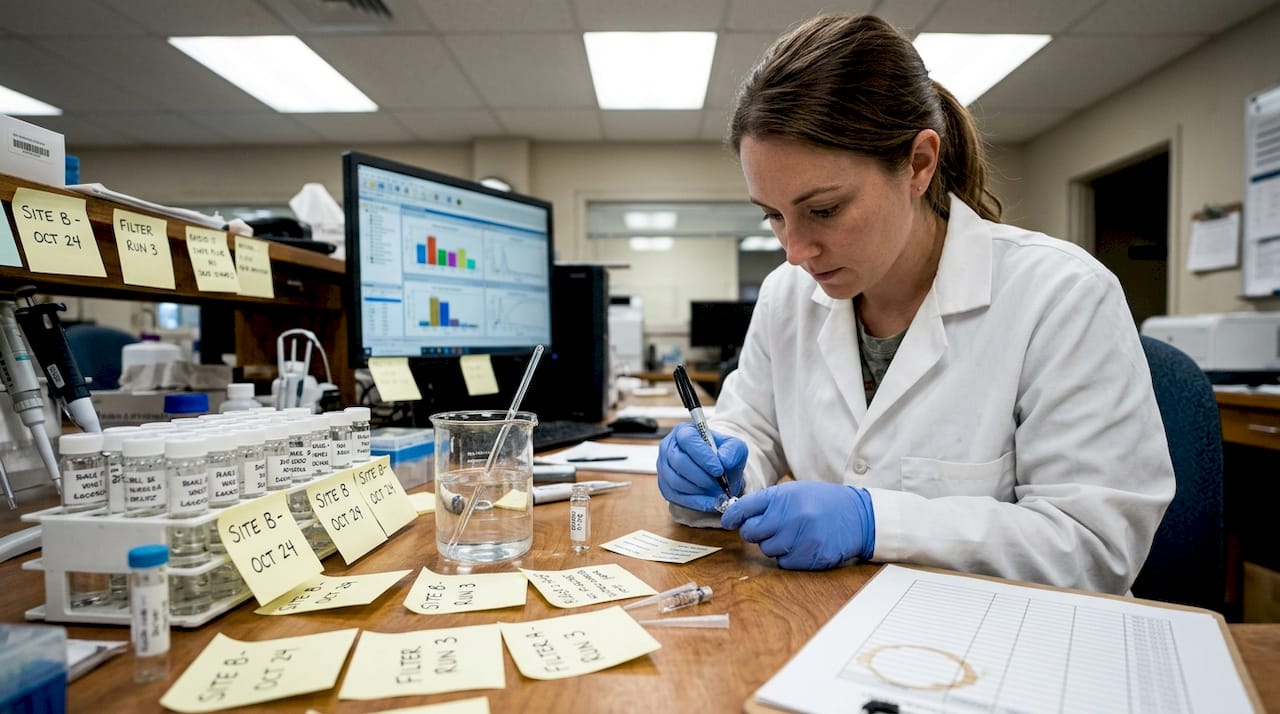
Lab accreditation is non-negotiable. Swedac-accredited labs produce results that are legally recognized by authorities, accepted in property sales, and usable when applying for grants or permits. Home test kits, while convenient, do not meet this standard. They can detect gross contamination but routinely miss low-level chemical threats, and their results carry no legal weight.
| Testing method | Accuracy | Legal validity | Cost |
|---|---|---|---|
| Accredited lab | High | Yes | Moderate |
| Home test kit | Low to moderate | No | Low |
Pro Tip: Keep a folder with every test result, the date collected, who collected it, and any changes made to your well or treatment system afterward. This record becomes invaluable if you ever sell the property or need to demonstrate compliance to authorities.
Always retest after installing or servicing a treatment system. Treatment equipment can fail, and the only way to confirm it is working is to check the official well water requirements and verify results with a new accredited lab sample.
Our perspective: Avoid shortcuts, embrace evidence
After years of working with well owners across Sweden, one pattern stands out clearly. Most problems are not discovered during a crisis. They show up in routine tests, often years before symptoms appear. That is exactly why single tests miss trends and why keeping historical records matters so much. A single clean result is reassuring. A decade of clean results with one outlier tells you something important is changing.
We see too many homeowners rely on home test kits because they seem faster and cheaper. The reality is that these kits are not designed to catch the contaminants that cause the most harm at low concentrations, such as arsenic, PFAS, or radon. They create a false sense of security.
Private wells are unregulated unlike public systems, but they are held to the same health benchmarks when it counts, especially during property sales or when health complaints arise. Noncompliance does not just risk your family’s health. It can block a property sale or trigger costly remediation.
The Swedish well owner guide we have built reflects what consistent, evidence-based testing actually looks like in practice. Trust the data, not the assumption that your water looks fine.
Reliable solutions for private well testing
You now have a clear framework for protecting your well water. The next step is putting it into action with tools you can trust.
At Svenskt Vattenprov, we offer Swedac-accredited analysis through SGS Analytics and Eurofins, with results that are legally valid and easy to understand. Our complete water analysis kit covers up to 71 parameters, giving you the broadest possible picture of your water quality. If bacteria are your primary concern, our bacterial water analysis is a focused, fast option. For guidance on which package fits your situation, visit our well testing knowledge center where you will find resources, explanations, and expert support to help you make the right choice.
Frequently asked questions
How do I know which contaminants to test for in my Swedish well?
Evaluate your well’s risk factors like location, surrounding activities, and local geology to tailor tests for bacteria, nitrate, arsenic, and more. A risk-based assessment within a 100-meter radius of your well is the best starting point.
Is water testing mandatory for Sweden’s private well owners in 2026?
Testing is strongly recommended but not legally enforced. Homeowners are fully responsible for their own water quality with no mandatory government oversight.
Does using a home water test kit give valid results for property sales?
No. Only results from Swedac-accredited labs are accepted by authorities and buyers during property transactions. Home kits have no legal standing.
What is the recommended frequency for water testing if I have children or elderly in my household?
Annual testing is advised for homes with young children, elderly residents, pregnant women, or immunocompromised individuals. This recommendation applies even when prior results have been consistently clean.
How do new EU standards impact water treatment for private wells?
The EU Drinking Water Directive tightens product certifications by 2027, which affects which treatment equipment is approved for use and makes accredited testing even more important for verifying treatment effectiveness.
Recommended
- Why regular water testing is vital for private wells 2026 – Svenskt Vattenprov
- Key water analysis parameters for Swedish private wells – Svenskt Vattenprov
- Complete guide for Swedish well owners: water testing 2026 – Svenskt Vattenprov
- Water quality checklist for Swedish well owners: safe water – Svenskt Vattenprov