

Official requirements for well water 2026: ensuring quality and compliance
Many well owners in Sweden are uncertain about the official regulations that apply to their water. Requirements vary depending on usage and scope, and it can be difficult to know which requirements are binding and which are recommendations. This article provides a clear overview of current legislation, quality standards, and practical steps to ensure that your well water meets official requirements in 2026.
Table of Contents
- Rules and Legislation for Well Water in Sweden
- Water Quality and Health Protection Standards for Well Water
- Practical Steps to Meet Official Well Water Requirements
- What Happens in Case of Non-Compliance and Allocation of Responsibility
- Discover Our Water Analyses for Safe Well Water Quality
- Frequently Asked Questions about Official Well Water Requirements
Key Points
| Point | Details |
|---|---|
| LIVSFS 2022:12 governs drinking water quality | The regulation applies to facilities producing at least 10 m³/day or serving 50+ people |
| Commercial use has stricter requirements | All public or commercial water supply is always covered by legislation |
| The producer has legal responsibility | Water producer or supplier is responsible for ensuring water meets health and safety requirements |
| Food production requires high quality | Water used in food must be of drinking water quality even if not intended for drinking |
| Regular testing protects health | Check well water every three years and in case of changes in quality or surroundings |
Rules and Legislation for Well Water in Sweden
Swedish drinking water legislation is based on EU Directive 2020/2184, implemented through LIVSFS 2022:12. This regulation forms the basis for all official drinking water requirements in Sweden and is stricter than the minimum requirements from the EU. The regulations apply to waterworks and facilities that produce at least 10 m³ per day or serve more than 50 people.
For private individuals with their own well, these binding rules often do not apply, but there are important exceptions. If you supply water commercially or use it in an activity that involves many people, the legislation comes into force. Even if your well is private, the municipal environmental and health protection committee can impose water quality requirements if there is a risk of health impact.
Who bears responsibility according to the law:
- The water producer or supplier is always responsible for quality assurance and regulatory compliance
- Property owners with their own well for private use have no formal legal requirement but are recommended to follow the same standards
- Business owners who use well water in a commercial environment are always covered by LIVSFS 2022:12
- Food companies must ensure that all water used in production meets drinking water quality standards
The Swedish Food Agency provides extensive guidance and support to help water users understand and meet the requirements. Although the guidance is not legally binding, it serves as a practical handbook for achieving and documenting compliance. For many well owners, it is wise to voluntarily follow these instructions to protect both family and any future buyers of the property.
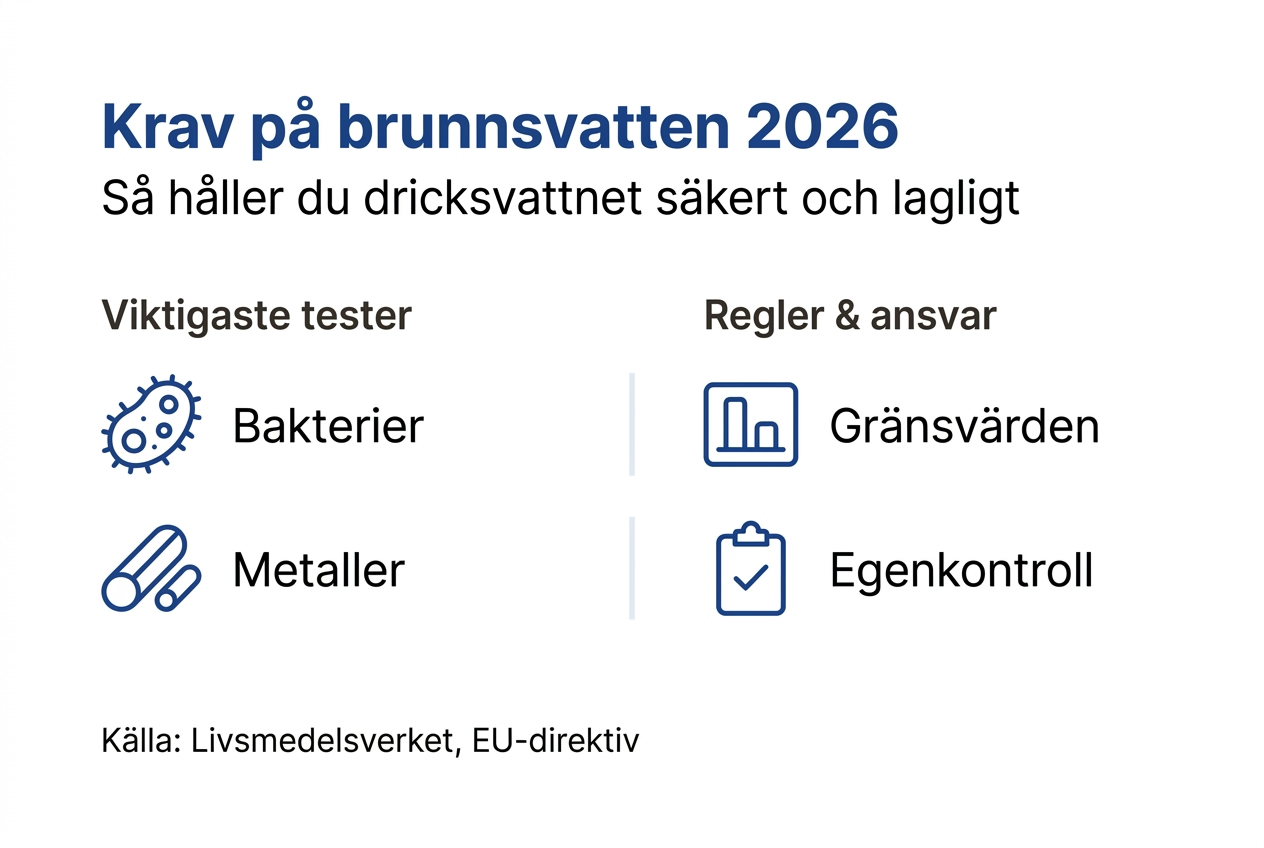
Pro tip: Always document your water quality even if you are not subject to binding rules. In case of property sale or changed circumstances, you will then have current documentation to present.
Water Quality and Health Protection Standards for Well Water
Swedish drinking water is regulated by the EU Drinking Water Directive 2020/2184, implemented through LIVSFS 2022:12. Swedish regulations are often stricter than the EU's minimum requirements, providing a higher safety margin. The regulations define clear limit values for microbiological, chemical, and physical parameters.
The term “drinking water” refers to water intended for drinking, cooking, or other household purposes. “Drinking water quality water” covers a broader range of uses, including water in food production where the water is not necessarily drunk but must meet the same quality requirements to avoid contamination of products.
Key quality parameters analyzed:
- Microbiological indicators: coliform bacteria, E. coli, intestinal enterococci
- Chemical substances: nitrates, fluorides, arsenic, lead, copper
- Metals and minerals: iron, manganese, calcium, pH value
- Radioactive substances: radon, especially in granite areas
- Organic pollutants: PFAS, pesticides, trihalomethanes
Each parameter has established limit values to protect against both short-term and long-term health risks. Exceedances can indicate everything from acute infection risk to long-term exposure to harmful substances. It is therefore critical to regularly check Swedish water quality in your well, even if you are not formally covered by the legislation.
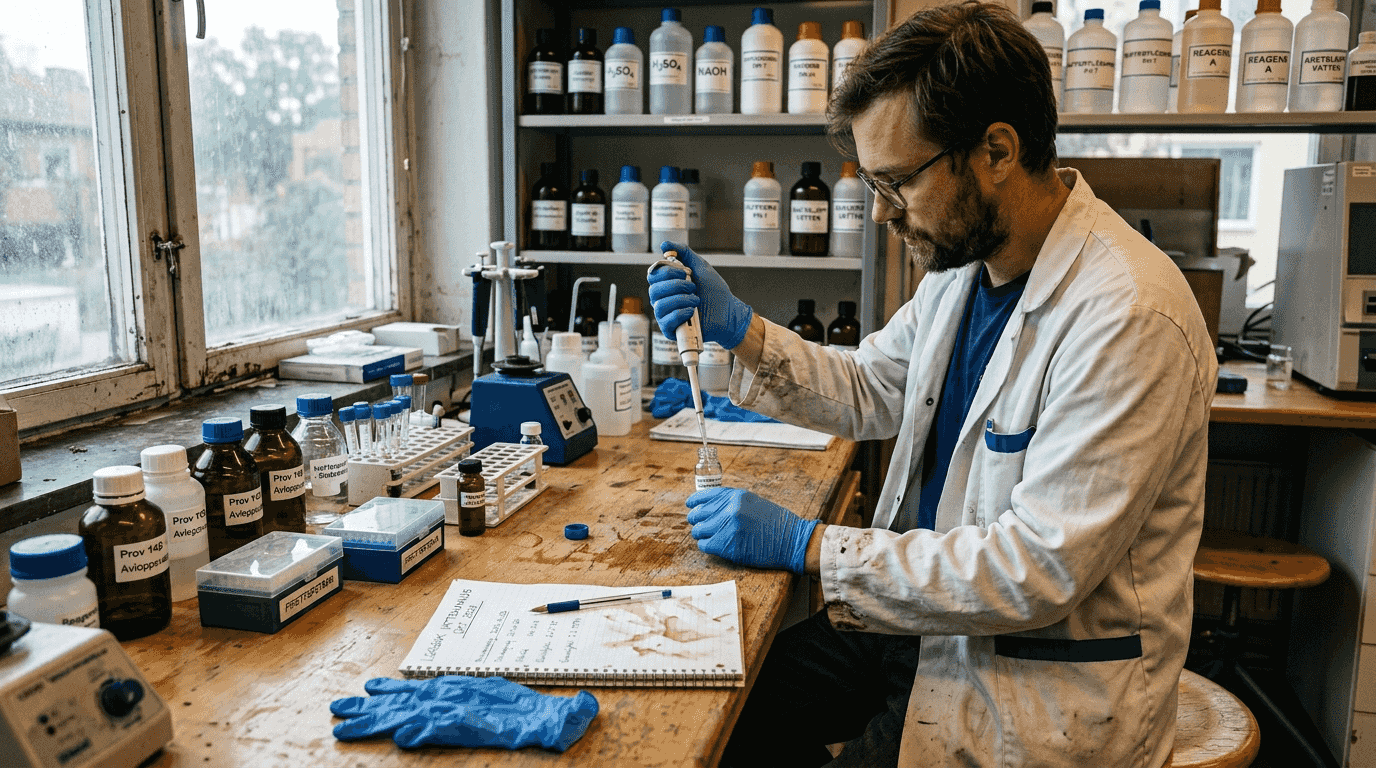
Pro tip: Bacterial analyses should always be prioritized as microbiological risks are the most common acute health hazard in well water. A simple bacterial analysis can reveal contamination from sewage, animals, or surface water.
Food companies must particularly note that even process water, rinse water, and ice must be of drinking water quality. This applies regardless of whether the water comes from the municipal network or a private well. Poor water quality can lead to product contamination and serious consequences for both consumers and businesses.
Practical Steps to Meet Official Well Water Requirements
Ensuring your well water meets official water requirements demands systematic testing and continuous maintenance. Follow these concrete steps to achieve and document compliance.
Step-by-step towards safe well water:
- Identify which requirements apply to your specific situation (private, commercial, food production)
- Choose the right analysis package based on well type, geology, and area of use
- Take water samples according to correct methodology to avoid contamination during sampling
- Have an accredited laboratory analyze the sample according to LIVSFS 2022:12
- Interpret the results against applicable limit values and identify any deviations
- Take necessary actions if values exceed recommendations or requirements
- Document all analyses and actions for future needs
Registering your well with the municipality is not always mandatory for private use but is strongly recommended. Well water registration creates a documented history that facilitates property transactions, grant applications, and contact with authorities.
Recommended test parameters and frequency:
| Parameter | Test Frequency | Reason |
|---|---|---|
| Bacteria (coliforms, E. coli) | Every 3 years, upon change | Acute health risk, most common problem |
| Metals (iron, manganese, lead) | Every 3 years | Long-term health risk, bad taste |
| Nitrates | Every 3 years | Indicates agricultural impact or sewage |
| Radon | Once, if suspected | Carcinogenic with long-term exposure |
| PFAS | If contamination suspected | Persistent substances near industry/airports |
| pH value | Every 3 years | Affects corrosion and metal leaching |
For commercial operators and food companies, more frequent controls are often required according to a risk-based plan. Consult water test instructions for detailed guidance on sampling methodology.
Well maintenance for long-term quality:
- Inspect the well cover annually and ensure it is tight and high above ground level
- Keep the area around the well free from sources of pollution (manure heaps, sewage, chemicals)
- Avoid planting deep-rooted trees near the well
- Ensure drainage diverts surface water away from the well area
- Perform professional well cleaning when necessary, especially for iron or manganese deposits
Pro tip: Always use a Swedac-accredited laboratory for your analyses. Only these results are legally secure and accepted by authorities when official documentation is required.
What Happens in Case of Non-Compliance and Allocation of Responsibility
Responsibility for water quality is allocated differently depending on whether the well is used privately or in commercial operations. For facilities covered by LIVSFS 2022:12, the producer or supplier is always responsible for ensuring that legal requirements are met and health is protected.
A private individual with their own well does not bear formal legal responsibility under drinking water regulations, but has a moral and practical responsibility for their family's health. In case of property sale, poor water quality can become a legal issue if the buyer has not been correctly informed. Therefore, up-to-date water analysis is always recommended before a sale.
Consequences of non-compliance:
- Health risks: Bacterial contamination can cause acute gastrointestinal illness, long-term metal exposure can damage organs
- Legal penalties: Companies and public entities can face injunctions, fines, or, in severe cases, business bans
- Economic consequences: Costs for emergency purification measures, reduced property value, claims for damages
- Loss of trust: Food companies risk reputation and customer loss due to water quality problems
The term "management" of drinking water includes all stages from extraction to distribution. This includes well construction, pumps, pipelines, tanks, and all equipment through which the water passes. All these components must be designed and maintained so that water quality is not impaired.
“Every water producer and supplier bears full responsibility for ensuring that distributed drinking water meets legislative requirements. This responsibility cannot be delegated, even if practical work is carried out by subcontractors. Documentation and regular control are key to both regulatory compliance and a secure water supply.” – The Swedish Food Agency
Support and resources for well owners:
- The municipal environmental and health protection committee provides local advice and can assist with problems
- The Swedish Food Agency offers web-based information and guidance for various water users
- Well drillers and water consultants can conduct risk analyses and recommend actions
- Accredited laboratories provide not only analysis results but also interpretation and recommendations
If you are unsure of your responsibilities or how to act in case of deviating analytical values, contact the municipality or visit our page with questions about well water for more guidance.
Discover Our Water Analyses for Safe Well Water Quality
Meeting official requirements and recommendations becomes much easier with the right tools and expert help. Svenskt Vattenprov offers complete solutions for well owners who want to ensure their water quality with professional analysis methods.
Our complete water analysis covers all key parameters recommended by the Swedish Food Agency and gives you a comprehensive picture of your water. For faster control of microbiological safety, we offer bacterial water analysis focusing on the most common health risks. All our analyses are performed by SGS Analytics, a Swedac-accredited laboratory that follows the same standards as apply to municipal waterworks.
We also assist you with well water registration to create the documentation that may be needed for contacts with authorities or property transactions. With regular testing and professional analysis, you can be confident that your well water maintains high quality and meets applicable standards.
Frequently Asked Questions about Official Well Water Requirements
What is the difference between drinking water and drinking water quality water?
Drinking water is water intended for drinking or household use. Drinking water quality water also includes water in food production that must meet the same quality requirements even if it is not directly consumed. Both must comply with LIVSFS 2022:12 when the legislation is applicable.
How often should well water be tested according to official requirements?
The Public Health Agency of Sweden and the Swedish Food Agency recommend testing every three years for private wells. For commercial use or if legislation applies, more frequent controls are required according to a risk-based plan. Always test immediately if there are changes in odor, taste, color, or the surrounding environment.
What responsibility do I have as a well owner for water quality?
For private use, you have no formal legal responsibility under LIVSFS 2022:12, but you bear responsibility for your family's health. For commercial use or if the well serves 50+ people, you become legally responsible as a water producer. In case of property sale, poor water quality can become a legal issue.
How do I know if my well is covered by LIVSFS 2022:12?
Your well is covered if it produces at least 10 cubic meters of water per day or serves at least 50 people. All commercial or public water supply is always covered, regardless of quantity. Private wells for only the family's needs are normally not subject to binding legal requirements.
Which analyses should I prioritize for safe water use?
Always start with a bacterial analysis as microbiological risks are the most common and acute. Then add metals, nitrates, and pH value for a basic assessment. In granite areas, radon should be analyzed. If specific contamination is suspected, for example near an airport or industry, analyze PFAS. Visit our page on frequently asked questions about well water for more detailed guidance.