

Bacteriological analysis: safe water for Swedish well owners
TL;DR:
- Visual clarity does not guarantee microbial safety; bacteriological analysis is essential.
- Swedish standards demand zero detectable E. coli, coliforms, and enterococci in drinking water.
- Regular testing every three years (or annually for high-risk households) ensures well safety.
Your well water looks crystal clear. It has no strange smell, no odd taste. So it must be safe, right? Not necessarily. Bacteriological analysis is the only reliable way to detect invisible microbial risks hiding in private well water. Harmful bacteria like E. coli can be present in perfectly clear water without any sensory warning. For Swedish well owners, this is not a minor concern. It is a genuine health responsibility, and one that also carries legal weight when selling a property. This article walks you through what bacteriological analysis is, how it works, what the results mean, and what you should do next.
Table of Contents
- What is bacteriological analysis?
- Which bacteria and standards are tested in Sweden?
- How does the analysis process work?
- What do the results mean for your well and health?
- Expert nuance: test frequency, edge cases, and advanced methods
- What most Swedish well owners miss about bacteriological analysis
- Protect your well with accredited bacteriological analysis
- Frequently asked questions
Key Takeaways
| Point | Details |
|---|---|
| Invisible risks | Bacteria may threaten well water safety even if your water looks, smells, and tastes fine. |
| Regulatory standards | Swedish law requires zero E. coli, coliforms, or enterococci in drinking water. |
| Accredited testing essential | Only accredited labs offer results you can trust for health, legal, or property sale needs. |
| Proactive monitoring | Regular, scheduled testing and fast response to contamination help keep your household safe. |
What is bacteriological analysis?
Now that you know clear water is not always safe, let’s understand what bacteriological analysis actually means.
Bacteriological analysis is a laboratory test designed to detect and count specific bacteria in a water sample. It does not test for every possible microorganism. Instead, it focuses on indicator bacteria, which are organisms whose presence signals that contamination has likely occurred. Think of them as warning flags rather than the threat itself.
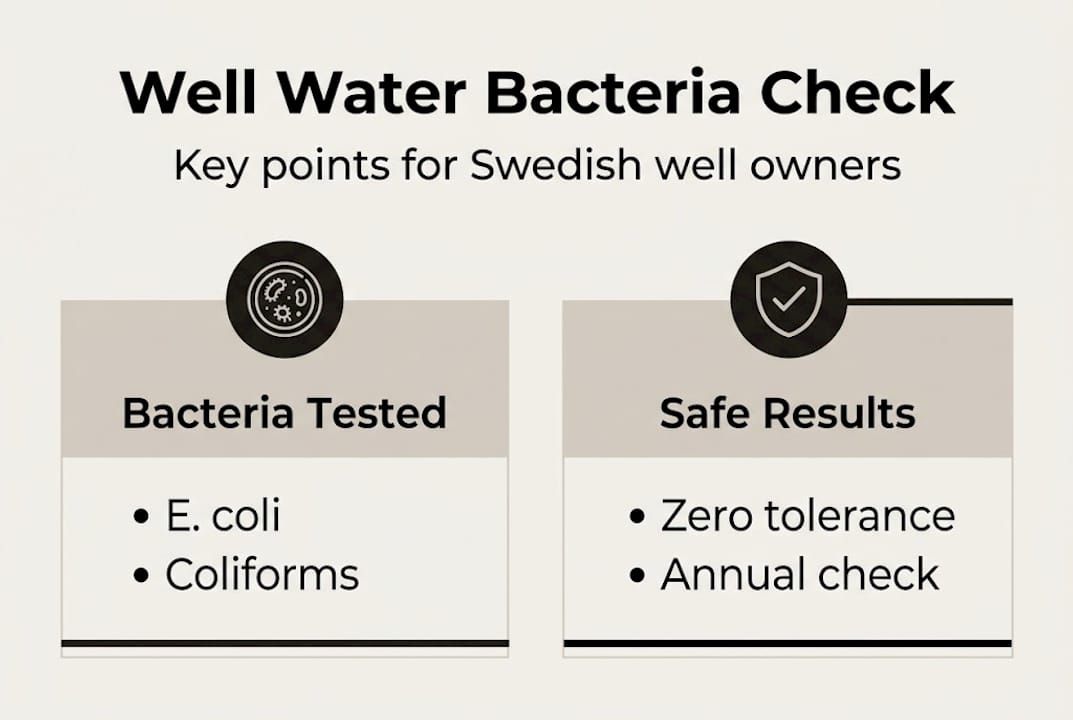
Bacteriological analysis identifies bacteria such as E. coli, total coliforms, and enterococci. These organisms are used as indicators because they are associated with fecal contamination, meaning they suggest that human or animal waste has entered the water supply. Where these bacteria exist, more dangerous pathogens like Salmonella, Campylobacter, or Cryptosporidium may also be present.
Here is what makes this test so important for private well owners:
- Water can look, smell, and taste completely normal while harboring dangerous bacteria
- No home filter or visual check can confirm microbiological safety
- Contamination can enter a well gradually, making it impossible to detect without testing
- Bacteriological analysis is the only method that gives you a confirmed, evidence-based answer
For those connected to municipal water systems, drinking water quality standards are monitored continuously by public authorities. Private well owners carry that responsibility themselves. A bacteriological analysis is how you fulfill it.
Key fact: Approximately 1.2 million Swedish households rely on private wells as their primary drinking water source. Without regular testing, contamination can go undetected for years.
Which bacteria and standards are tested in Sweden?
With the basics in place, the next step is knowing exactly what Swedish labs look for.
Swedish regulations focus on three core indicator bacteria. Each one tells a different story about your water’s safety:
| Bacteria | What it indicates | Swedish limit (CFU/100ml) |
|---|---|---|
| E. coli | Direct fecal contamination | 0 |
| Total coliforms | General contamination risk | 0 |
| Enterococci | Fecal contamination, gut bacteria | 0 |
Swedish standards set limits of 0 CFU/100ml for all three bacteria. CFU stands for Colony Forming Units, which is the standard measurement used to count live bacteria in a sample. Zero means zero. Any detection at all moves your water out of the “safe” category.
The classification system works like this:
- Tjänligt (safe): No bacteria detected, water meets all standards
- Tjänligt med anmärkning (caution): Minor deviations, monitoring recommended
- Otjänligt (unsafe): Bacteria detected, water is not approved for drinking
This zero-tolerance approach reflects how seriously Swedish authorities take fecal contamination. Even a single colony of E. coli is enough to trigger an “unsafe” classification. You can explore more context around these classifications in our guide to essential water analysis facts.
The scale of the problem is worth noting. Studies on microbiological risk in Swedish wells consistently show that between 10 and 20 percent of private wells in Sweden fail bacteriological testing at any given time. That is a significant proportion of households drinking water that does not meet legal safety standards.
How does the analysis process work?
Knowing what’s being tested, it’s useful to see exactly how the process happens in practice.
The process from sample collection to final result follows a clear sequence:
- Order your test kit. You receive a sterile sample bottle and clear water sampling instructions to follow at home.
- Collect your sample correctly. Run the tap for two minutes before collecting, avoid touching the inside of the bottle, and fill it to the marked line. Timing matters because bacteria counts can shift quickly.
- Send the sample promptly. The sample must reach the lab within 24 hours of collection. Temperature control during transport is critical to preserving accuracy.
- Lab processing begins. The accredited laboratory runs the sample through approved methods, most commonly membrane filtration or the Colilert system, which uses enzyme-based detection to identify E. coli and coliforms rapidly.
- Results are issued. You typically receive your results within one to three days of the sample arriving at the lab.
Labs must be Swedac-accredited and use national standards such as SS-EN ISO 9308-1 and SS-EN ISO 9308-2. This is not a bureaucratic detail. Accreditation means the lab’s methods are independently verified, which is what makes the results legally valid for property sales, authority reporting, and subsidy applications.
Pro Tip: Always check that your kit provider uses a Swedac-accredited lab before ordering. Non-accredited results may look identical but will not hold up in official or legal contexts. Our complete Swedish well testing guide walks you through exactly what to look for.
For more detail on how labs evaluate and report results, the assessment and reporting requirements from Livsmedelsverket provide the official framework.
What do the results mean for your well and health?
Once you have the results, the next challenge is interpreting what they mean for your water and health.
Results fall into three categories, and each one calls for a different response:
| Result | Classification | What to do |
|---|---|---|
| No bacteria detected | Tjänligt (safe) | Continue regular monitoring |
| Minor deviation, no E. coli | Tjänligt med anmärkning | Investigate source, retest sooner |
| E. coli or enterococci detected | Otjänligt (unsafe) | Disinfect immediately, retest |
Any E. coli detection requires immediate disinfection and retesting before the water is used again for drinking, cooking, or brushing teeth. Disinfection typically involves chlorination of the well, followed by flushing and a confirmatory test.
Here is what many well owners do not realize:
- A “safe” result today does not guarantee safety next year. Conditions change.
- False negatives are possible if the sample volume is too low or the sample was collected incorrectly
- Even a “caution” result should not be ignored. It often signals a developing problem
- Health risks escalate quickly for children, elderly people, and anyone with a weakened immune system
Pro Tip: If your result comes back as “caution,” do not wait for the next scheduled test. Investigate the likely contamination source, whether that is a nearby septic system, surface water intrusion, or a cracked well casing, and retest within a few weeks.
For a broader view of what drives these risks, our guide on the importance of regular testing covers the most common contamination pathways in Swedish wells. You can also review key water analysis facts to build a fuller picture.
Expert nuance: test frequency, edge cases, and advanced methods
Finally, let’s consider the expert recommendations and evolving landscape of bacteriological analysis.
Private wells should be tested every three years, or annually for households with high-risk users such as infants, elderly residents, or immunocompromised individuals. These are the official Swedish guidelines, and they represent a minimum, not an ideal.
Certain situations call for testing outside the regular schedule:
- After flooding, heavy rainfall, or snowmelt that could carry surface water into the well
- After construction or excavation near the well
- After any change in water appearance, smell, or taste
- Before selling or purchasing a property with a private well
- After a period of disuse, such as a summer cabin reopened in spring
“Testing frequency should reflect actual risk, not just regulatory minimums. A well near agricultural land or a septic system warrants closer attention than one in a remote forested area.”
When results are unclear or disputed, confirmatory testing using a second accredited lab or a repeat sample is the appropriate next step. Do not assume a borderline result is a lab error without verifying.
On the technology side, rapid molecular methods such as qPCR and ATP offer faster screening alternatives. These techniques can detect bacterial DNA within hours rather than days. However, culture-based methods remain the legal standard for compliance purposes in Sweden. Molecular methods are best used as a supplementary screening tool, not a replacement for accredited culture testing.
For a deeper look at detection science, case studies on bacteria detection from the National Institutes of Health provide useful context on how different methods perform in real-world conditions. Our water analysis guidelines summarize the practical implications for Swedish well owners.
What most Swedish well owners miss about bacteriological analysis
With the technical details covered, here is what we have learned from years of working with well owners across Sweden.
The legal minimum testing frequency is a floor, not a ceiling. Testing every three years keeps you compliant, but it leaves long windows where contamination can develop undetected. A family drinking contaminated water for two years before the next scheduled test is not a hypothetical scenario. It happens.
We also see a recurring mistake around lab choice. Some owners use non-accredited testing services because they are cheaper or faster. The results may look official, but they carry no legal weight. If you are selling a property, a non-accredited result will not satisfy a buyer’s due diligence or satisfy the local environmental authority. That can delay or derail a sale entirely.
Finally, “tjänligt med anmärkning” is not a green light. Too many owners read “caution” and do nothing. In our experience, a caution result almost always points to a real and growing problem. Treat it, retest, and document the outcome. You can find more practical guidance in our more water analysis tips resource. Proactive action now is always less costly than reactive damage control later.
Protect your well with accredited bacteriological analysis
Ready to make your water safe and compliant? Here is where you can get started with accredited testing.
At Svenskt Vattenprov, every analysis is processed by SGS Analytics and Eurofins, a Swedac-accredited laboratory that follows Livsmedelsverket’s standards. Our bacterial water analysis kit gives you a legally valid result that holds up for authority reporting, subsidy applications, and property sales. If you want broader peace of mind beyond bacteriology, our comprehensive water testing package covers up to 71 parameters. First-time testers get clear sampling instructions, step-by-step guidance, and personal support throughout the process. Your water deserves more than a guess.
Frequently asked questions
How often should I get a bacteriological analysis for my Swedish well?
Test every three years, or annually if your household includes children, elderly residents, or anyone with a compromised immune system. Testing more frequently after flooding or construction is also strongly recommended.
Which bacteria make my water unsafe under Swedish law?
Any detection of E. coli, total coliforms, or enterococci classifies your water as officially unsafe, or otjänligt, under Swedish standards of 0 CFU/100ml. There is no acceptable threshold for these organisms.
Do I need an accredited lab for well analysis?
Yes. Analyses must use accredited labs following national standards to produce results that are valid for legal compliance, authority reporting, and property transactions.
What should I do if bacteria are found in my well?
Disinfect immediately and retest before resuming normal water use. Do not drink, cook with, or use the water for brushing teeth until a follow-up test confirms it is safe.