

Microbiological water analysis for Swedish wells: 20% at risk
Around 20% of Swedish private wells have water that fails to meet safe drinking standards, yet most well owners have no idea until someone gets sick. Your well looks clean. The water tastes fine. But bacteria don’t announce themselves. Microbiological water analysis is the only reliable way to know what’s actually in your water, and whether it’s safe for your family. This guide explains what the analysis involves, when you need it, how labs run the tests, and exactly what to do if results come back with problems.
Table of Contents
- What is microbiological water analysis?
- Why and when Swedish well owners should test
- Key methods for microbiological water analysis
- Swedish standards and benchmarks for safe well water
- Interpreting your results and next steps for well owners
- Reliable water analysis solutions for Swedish well owners
- Frequently asked questions
Key Takeaways
| Point | Details |
|---|---|
| Indicator bacteria matter | E. coli and coliforms signal dangerous contamination in Swedish well water. |
| Frequent testing prevents illness | Regular three-year testing (annual for vulnerable groups) catches problems early. |
| Accredited labs provide confidence | Testing through accredited labs ensures results meet Swedish standards. |
| Action is crucial at first sign | Detection of E. coli requires immediate disinfection and retesting. |
| Choose the right method | Culture and molecular tests offer different strengths; a combination ensures accuracy. |
What is microbiological water analysis?
Microbiological water analysis detects and quantifies microorganisms in water samples. For well owners, this means checking whether harmful bacteria are present at levels that make the water unsafe to drink. It’s not about chemistry or minerals. It’s specifically about living organisms that can cause illness.
The three key indicator organisms you’ll see on every Swedish water report are:
- E. coli (Escherichia coli): The clearest sign of fecal contamination. Its presence means human or animal waste has entered your water supply.
- Coliforms: A broader group of bacteria that includes E. coli. Elevated coliform counts are a warning signal that something is wrong, even if E. coli isn’t detected yet.
- Enterococci: Another fecal indicator. These bacteria survive longer in water than E. coli, making them useful for detecting older or intermittent contamination.
Swedish standards are strict. E. coli and enterococci must be 0 CFU/100ml (colony-forming units per 100 milliliters) in drinking water. Zero. Not low. Not trace amounts. Zero.
“If any E. coli is detected in your well water, the water is not safe to drink. No exceptions.”
For a broader look at what these results mean in practice, the water analysis facts resource and our water analysis guide are good starting points.
Why and when Swedish well owners should test
Understanding the indicators matters most when you know how often and why to test your well water.
Sweden has roughly 700,000 private wells. Studies suggest 10 to 20% fail Swedish standards for microbiological quality. That’s a significant number of households drinking water that could cause gastrointestinal illness, infections, or worse, especially for children, elderly people, and anyone with a weakened immune system.
Here’s a practical overview of when testing is recommended:
| Situation | Recommended frequency |
|---|---|
| Standard household, healthy adults | Every 3 years |
| Household with children, elderly, or immunocompromised | Annually |
| After flooding or heavy rainfall | Immediately |
| After well repair or construction nearby | Immediately |
| Before selling a property with a private well | Before listing |
The key risks that make testing urgent include:
- Nearby agriculture: Fertilizers and animal waste can leach into groundwater.
- Old or shallow wells: Dug wells are especially vulnerable to surface water intrusion.
- Flooding: Floodwater carries bacteria directly into wells.
- Septic systems: A failing septic tank near your well is a serious contamination risk.
Pro Tip: Don’t wait for your water to look or smell different. Bacterial contamination is almost always invisible and odorless. Regular water testing is the only way to catch problems before they affect your health. Always use an accredited lab so your results meet quality standards for Swedish wells.
Key methods for microbiological water analysis
But what goes on inside the lab, and how confident can you be in the results?
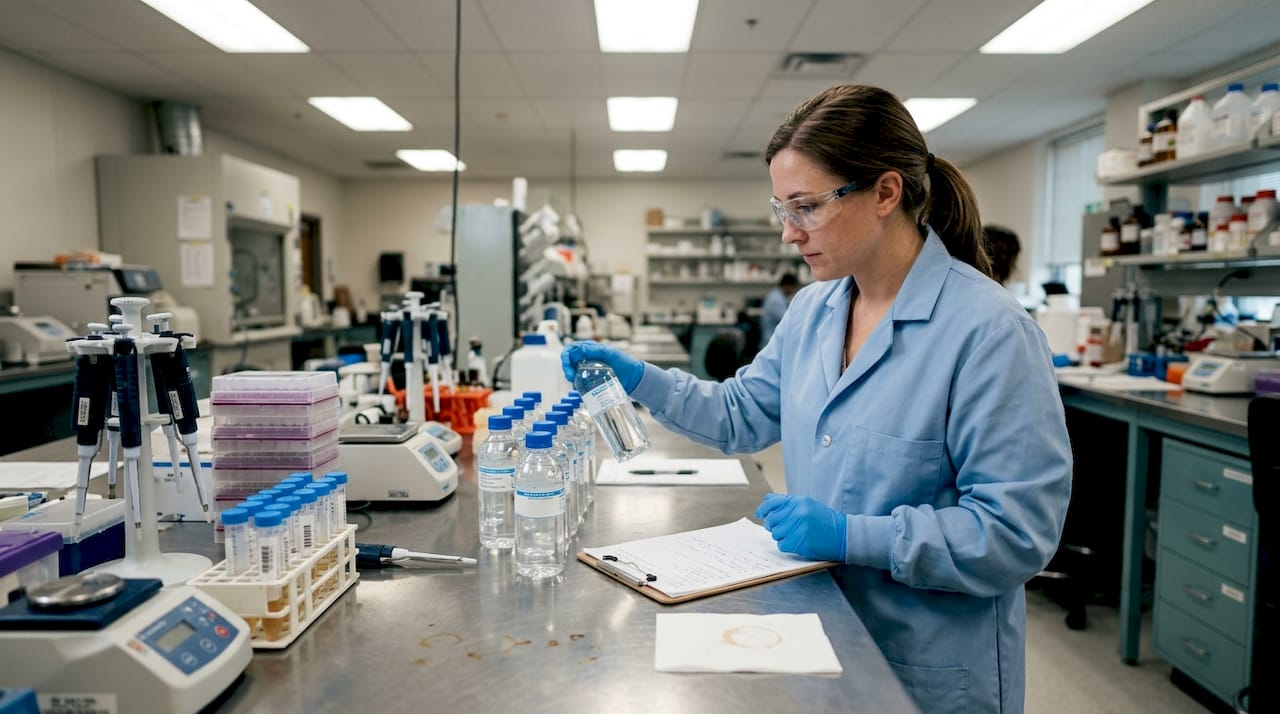
Labs use several established techniques to analyze your water sample. The key methodologies include membrane filtration, multiple tube fermentation, plate count methods, and molecular techniques like PCR (polymerase chain reaction). Each has strengths and trade-offs.
Here’s how the main approaches compare:
| Method | What it detects | Speed | Reliability |
|---|---|---|---|
| Membrane filtration | Living, culturable bacteria | 24 to 48 hours | High for standard indicators |
| Plate count | Total culturable microorganisms | 48 to 72 hours | High, widely standardized |
| PCR (molecular) | DNA from viable and dead cells | 4 to 6 hours | High specificity, less standardized |
| ATP bioluminescence | Active microbial biomass | Minutes | Good for screening, not definitive |
The numbered steps a lab typically follows:
- Sample collection: Your water is collected in a sterile container under controlled conditions.
- Filtration or dilution: The sample is prepared for the chosen method.
- Incubation: Culture-based methods grow bacteria over 24 to 72 hours at controlled temperatures.
- Counting and identification: Colonies are counted and identified against known indicator profiles.
- Reporting: Results are compared against Swedish benchmarks and reported with clear pass or fail indicators.
One important limitation: culture-based methods can miss bacteria that are alive but not actively growing. These are called VBNC organisms (viable but non-culturable). VBNC organisms are missed by standard culture tests, which is why rapid ATP or PCR methods are sometimes used alongside traditional approaches for a more complete picture.
Pro Tip: Ask your lab whether they use accredited methods aligned with SS-EN ISO standards. This matters for the legal validity of your results, especially if you’re selling a property. Our guidelines for Swedish owners explain what to look for in a lab report, and you can also review Swedish water quality benchmarks directly.
Swedish standards and benchmarks for safe well water
Testing methods aside, understanding Sweden’s strict standards helps you interpret results and take action, especially if things go wrong.
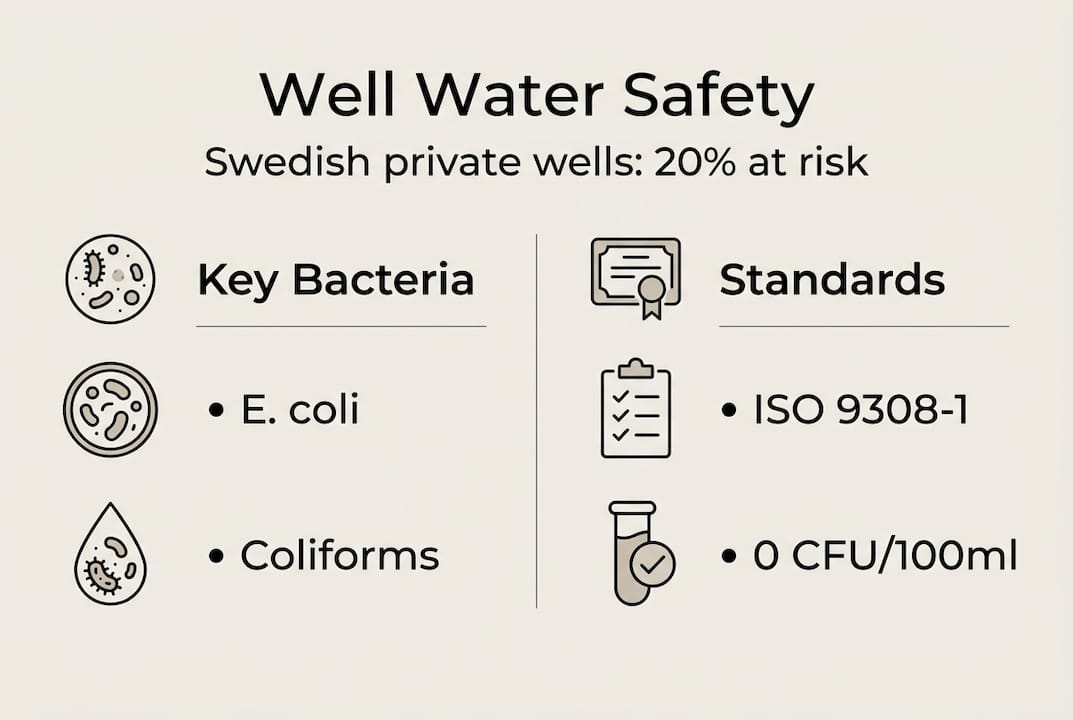
Swedish drinking water regulations align with SS-EN ISO standards. The most relevant is ISO 9308-1, which covers the detection and enumeration of E. coli and coliform bacteria. Livsmedelsverket recommends testing for E. coli, coliforms, enterococci, Pseudomonas aeruginosa, and total culturable microorganisms as part of a complete microbiological assessment.
Here’s a quick reference for the key benchmarks:
| Parameter | Acceptable limit | Action if exceeded |
|---|---|---|
| E. coli | 0 CFU/100ml | Immediate disinfection and retest |
| Enterococci | 0 CFU/100ml | Immediate disinfection and retest |
| Coliforms | 0 CFU/100ml | Investigate source, retest |
| Pseudomonas aeruginosa | 0 CFU/100ml | Investigate plumbing and source |
| Total culturable microorganisms | Varies by context | Evaluate trend over time |
Private well owners in Sweden face no legal mandate to test. But any detection of E. coli requires immediate action, regardless of whether you’re legally required to test. The health risk is real whether or not a regulator is watching.
For a full breakdown of what Livsmedelsverket requires and recommends, see our guide to Swedish regulatory benchmarks and the complete water testing guide for private well owners.
Interpreting your results and next steps for well owners
With standards and testing methods clear, knowing what to do about your results completes the analysis-to-action loop.
When your report arrives, here’s how to work through it:
- Check E. coli first: Any detection above 0 CFU/100ml means the water is unsafe. Stop drinking it immediately.
- Review coliforms: Elevated coliforms without E. coli still signal a problem. Investigate the source before the next test.
- Look at enterococci: A positive result here suggests fecal contamination that may be intermittent or older.
- Compare to benchmarks: Every parameter on your report should be compared against the Swedish limits in the table above.
- Act on any exceedance: Don’t wait for a second opinion. Disinfect the well, identify the contamination source, and retest.
Phased monitoring is the most reliable approach: start with indicator organisms, and if any are exceeded, escalate to testing for specific pathogens. A single clean test result doesn’t guarantee permanent safety. Conditions change with seasons, rainfall, and nearby land use.
Any detection of E. coli requires immediate action such as shock chlorination of the well, followed by retesting after at least 48 hours. If contamination persists, a water treatment system may be necessary.
Pro Tip: If you have children, elderly family members, or anyone immunocompromised at home, don’t rely on a single annual test. Test twice a year, especially after spring snowmelt and heavy autumn rains, when groundwater contamination risk peaks. Our guide to understanding brunnsvatten issues covers the most common contamination patterns by season and region.
Reliable water analysis solutions for Swedish well owners
When it’s time to move from analysis to action, you need a testing service that gives you accurate results, clear explanations, and practical next steps. At Svenskt Vattenprov, we work with SGS Analytics, a Swedac-accredited laboratory, to deliver results that meet Swedish and EU standards. Every report includes plain-language explanations of what each parameter means and what to do if something is off.
Whether you have a dug well or a drilled well, we have a package designed for your situation. Our analysis for dug wells covers 31 parameters with extra focus on surface water intrusion, while our analysis for drilled wells covers 41 parameters tailored to bedrock conditions. If you want maximum coverage, browse all our well water analysis packages to find the right fit. We handle everything from the sampling kit to the final report, so you don’t have to figure it out alone.
Frequently asked questions
How often should I test my private well for microbiological contamination?
Swedish experts recommend testing every three years for standard households, or annually if children, elderly people, or immunocompromised individuals live in the home. Testing immediately after flooding or nearby construction is also strongly advised.
What organisms are most important in Swedish microbiological water analysis?
Livsmedelsverket recommends testing for E. coli, coliforms, and enterococci as the primary indicators. Their presence signals fecal contamination and means the water is not safe to drink without treatment.
What should I do if E. coli is detected in my well water?
Any E. coli detection requires immediate disinfection of the well, typically through shock chlorination, followed by retesting after at least 48 hours to confirm the water is safe again.
Are culture-based methods reliable for Swedish well owners?
Culture-based methods are the standard and are highly reliable for detecting common indicator bacteria. However, they can miss non-culturable organisms, which is why accredited labs sometimes combine them with molecular methods for a more complete result.
Do Swedish private well owners face legal mandates for testing?
There is no legal requirement for private well owners to test their water. However, Livsmedelsverket recommends regular testing to protect health, and a current analysis is expected when selling a property with a private well.
Recommended
- What is water analysis: a guide for Swedish well owners – Svenskt Vattenprov
- How guidelines shape water analysis for Swedish well owners – Svenskt Vattenprov
- 10 essential water analysis facts for Swedish well owners – Svenskt Vattenprov
- Drinking water quality standards for Swedish private wells – Svenskt Vattenprov