

How water testing safeguards your health with a private well
TL;DR:
- Private well owners are responsible for regularly testing their water for bacteria, chemicals, and radiological contaminants.
- Testing frequency depends on household vulnerability and recent events like flooding or repairs.
- Clear classifications guide actions: safe water requires continued monitoring, while unsafe water demands immediate intervention.
Your well water looks perfectly clear. It has no smell, no odd taste. So it must be safe, right? Not necessarily. Some of the most serious contaminants found in private well water, including bacteria, nitrates, arsenic, and PFAS, are completely invisible to the eye and undetectable by smell or taste. If you own a private well in Sweden, you carry full responsibility for your water quality since no municipality monitors it for you. This guide walks you through why regular testing matters, what to look for, how often to test, and exactly what to do when results come back.
Table of Contents
- Why water testing is vital for private well owners
- What should be tested: key contaminants and standards
- How often should you test and when?
- What the test results mean and steps to take
- Our perspective: The real value of testing is peace of mind
- Get reliable water testing for your well
- Frequently asked questions
Key Takeaways
| Point | Details |
|---|---|
| Regular testing is essential | Routine water testing is the best way to ensure your family’s well water is safe. |
| Understand test categories | Microbiological, chemical, physical, and radiological parameters all matter for Swedish private wells. |
| Know when to test more frequently | Test annually if you have infants, elderly, or at-risk family members, and immediately after changes or floods. |
| Act promptly on unsafe results | Stop using unsafe water and seek professional help to resolve issues right away. |
Why water testing is vital for private well owners
When you live on municipal water, a team of technicians tests and treats your supply around the clock. When you have a private well, that responsibility lands entirely with you. Most Swedish well owners understand this in theory, but many underestimate how silently a well can become contaminated.
Groundwater conditions shift constantly. A neighbor’s new septic system, spring flooding, nearby agricultural activity, or even the natural geology beneath your property can introduce harmful substances without any visible warning signs. You will not smell arsenic. You will not taste bacteria. And PFAS, those persistent chemical compounds now found in many Swedish groundwater sources, leave absolutely no sensory trace.
Regular Swedish well water advice from Livsmedelsverket makes this clear: private well owners are fully responsible for the safety of their water. The most reliable safeguard is routine laboratory testing.
Here is what a proper well water test checks for:
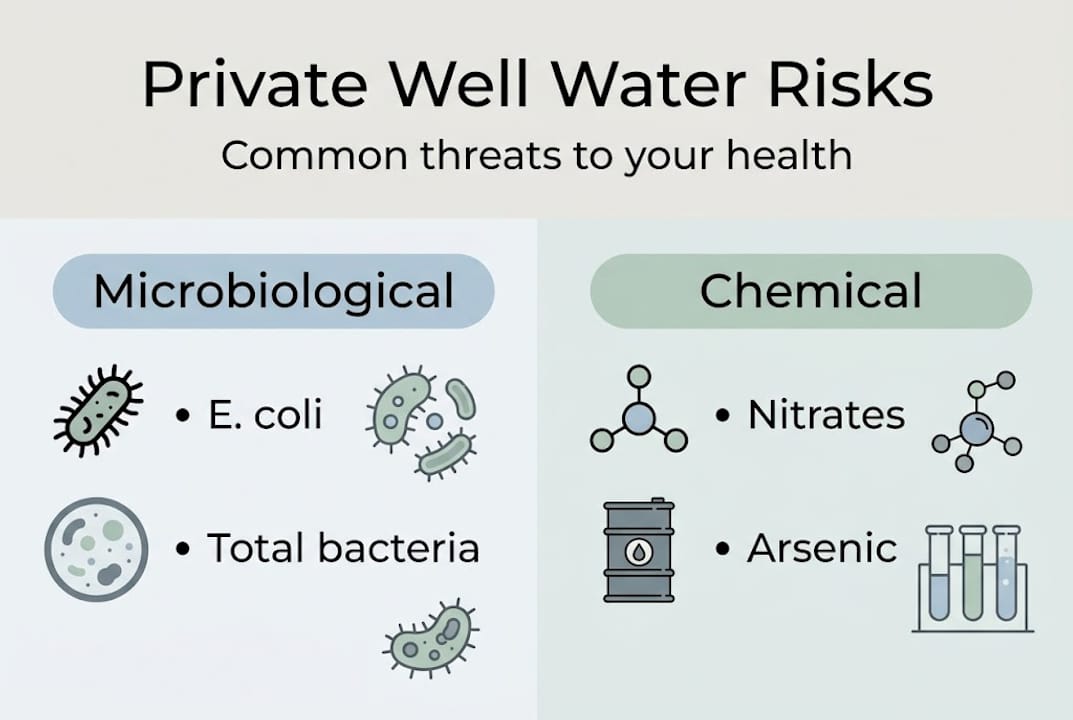
- Microbiological contaminants: Bacteria such as E. coli and enterococci, which signal fecal contamination and pose immediate health risks
- Chemical contaminants: Nitrates, arsenic, heavy metals, and PFAS compounds that accumulate silently and can cause long-term harm
- Physical parameters: Color, turbidity, and odor, which may indicate equipment problems or surface water intrusion
- Radiological parameters: Radon, particularly relevant for wells drilled into granite bedrock common in many parts of Sweden
“Comprehensive testing covers microbiological, chemical, physical, and radiological parameters, classified as tjänligt (safe), med anmärkning (remarks), or otjänligt (unsafe) per Livsmedelsverket standards (LIVSFS 2022:12).”
This classification system gives you a clear, actionable picture of your water quality. It is not just a set of numbers. It tells you where you stand and, if needed, what to do next. For deeper context on understanding your results, explore these well testing explanations that break down what each parameter means in everyday language.
Children, pregnant women, elderly individuals, and people with weakened immune systems are especially vulnerable to waterborne contaminants. For these households, the stakes around water quality are higher, and so is the urgency to test.
What should be tested: key contaminants and standards
Knowing that testing matters is one thing. Knowing exactly what to test for is another. Livsmedelsverket organizes well water parameters into four main categories, each targeting a different type of risk.
| Category | Examples | Primary health concern |
|---|---|---|
| Microbiological | E. coli, enterococci, total bacteria count | Acute gastrointestinal illness |
| Chemical | Nitrates, arsenic, PFAS, lead, manganese | Long-term organ damage, cancer risk |
| Physical | Color, turbidity, odor, pH | Equipment damage, treatment interference |
| Radiological | Radon, uranium | Long-term cancer risk |
Each category poses a distinct risk profile, which is why a thorough test covers all four. A microbiological test alone will not catch arsenic. A chemical panel will not detect a sudden bacterial surge after flooding.
Following guidelines for analysis ensures you choose a package that actually matches your well type and local risk factors. A drilled bedrock well in a granite region carries different risks than a shallow dug well in a coastal farming area.
The most critical contaminants to prioritize include:
- E. coli: The clearest indicator of fecal contamination. Even low concentrations can cause serious illness.
- Nitrates: Common near agricultural land. Dangerous for infants under six months, potentially causing a life-threatening condition known as blue baby syndrome.
- Arsenic: Naturally occurring in Swedish bedrock, especially in certain regions. Long-term exposure is linked to cancer.
- PFAS: Persistent industrial chemicals found increasingly in Swedish groundwater. There are drinking water limits established by Livsmedelsverket, and exceeding them requires action.
- Radon: Particularly relevant for granite-heavy regions like Värmland, Dalarna, and parts of Norrland.
Per Livsmedelsverket standards, results are graded as tjänligt (safe), med anmärkning (with remarks), or otjänligt (unsafe). Understanding which category your water falls into determines your next steps.
Pro Tip: If your well is drilled into bedrock, always include a radon test. Radon is naturally released from granite and has no taste or smell, but long-term exposure through drinking water and indoor air significantly raises health risks.
How often should you test and when?
Now that you know what to test for, the next logical question is how often. The answer depends on your household situation and your well’s history.
Livsmedelsverket testing frequency recommendations provide a clear baseline:
- Every 3 years for stable wells serving typical households with no specific risk factors
- Annually for households that include infants, elderly residents, pregnant women, or anyone who is immunocompromised
- Immediately after any flooding event, plumbing repairs, structural changes to the well, or sudden shifts in your water’s appearance, smell, or taste
These are minimums, not maximums. If something changes near your property, such as new construction, a neighboring farm expanding its operations, or a chemical spill in the area, do not wait for your scheduled test.
“Test every 3 years for stable wells, annually for households with infants, elderly, pregnant, or immunocompromised; immediately after floods, repairs, or changes.”
Many well owners test once and consider the matter settled. But water quality is not static. Seasonal changes, heavy rainfall, new land use nearby, or a gradual shift in the water table can all alter what is in your well, sometimes within months.
The practical value of regular testing is early detection. A test that reveals slightly elevated nitrate levels lets you act before the problem worsens. Waiting until someone in your family becomes ill is a far more costly outcome, financially and emotionally.

For a broader look at how testing schedules fit into water guidelines for private wells in Sweden, there are detailed resources available that help you plan according to your specific situation. You can also review how water is assessed to understand what happens once your sample reaches the lab.
One more scenario worth noting: if you are buying or selling a property with a private well, a current and accredited water analysis is effectively mandatory. Both parties deserve certainty, and an up-to-date test provides exactly that.
What the test results mean and steps to take
Receiving your results can feel overwhelming if you do not know what the classifications mean. Here is a straightforward breakdown.
| Result | Swedish term | What it means | What to do |
|---|---|---|---|
| Safe | Tjänligt | All parameters within approved limits | Continue regular testing on schedule |
| With remarks | Med anmärkning | Minor exceedances detected | Seek expert advice, monitor closely |
| Unsafe | Otjänligt | Major parameter breach | Stop drinking immediately, take action |
Per Livsmedelsverket classification standards, each outcome carries a clear recommended response.
Tjänligt (safe) means your water meets all Swedish and EU drinking water standards. You can drink it with confidence. Keep your test records and plan your next test.
Med anmärkning (with remarks) is the result that most often causes confusion. It does not mean your water is dangerous right now. It means one or more parameters have slightly exceeded recommended levels. For healthy adults, short-term use may be acceptable, but for infants, elderly residents, or pregnant women, you should seek expert guidance immediately. The exceedance may be minor or borderline, and a water treatment specialist can tell you exactly what the finding means for your situation.
Otjänligt (unsafe) demands immediate action. Stop using the water for drinking, cooking, or infant bathing right away. Use bottled water in the interim. Then:
- Contact an accredited water testing provider for a full follow-up analysis
- Investigate possible contamination sources with your local municipality
- Review your options for water treatment, filtration, or well rehabilitation
- Check well water requirements 2026 to understand your legal obligations as a well owner
Pro Tip: Save every test report you receive. These documents are valuable if you later apply for municipal grants for water improvement measures or if you sell your property. Buyers and authorities both appreciate documented testing history.
Our perspective: The real value of testing is peace of mind
After working with thousands of Swedish well owners since 2018, we have noticed something consistent: the families who test regularly are not the ones who worry the most about their water. They are actually the ones who worry the least.
That might sound counterintuitive. But when you have a current, accredited analysis in hand, you know. You are not guessing. You are not wondering if that slight metallic taste last spring was a sign of something. You have data, and data replaces anxiety with clarity.
Regulations are a floor, not a ceiling. Livsmedelsverket’s recommendations set a minimum standard. But choosing to test more frequently, or to use a broader analysis package, is a decision driven by care for your family rather than compliance with rules.
We have also seen how reliable well testing catches small problems before they escalate. A slightly elevated iron level addressed early is a simple filter installation. Left unaddressed for years, it can damage pipes, appliances, and, in some cases, signal deeper geological changes worth investigating. Proactive testing is genuinely the simpler, cheaper, and calmer path forward.
Get reliable water testing for your well
If this guide has made one thing clear, it is that clean-looking water is not the same as safe water. You deserve certainty, and your family deserves the same.
Svenskt Vattenprov offers a full range of accredited analysis packages designed specifically for Swedish private well owners. Every sample is analyzed by SGS Analytics and Eurofins, a Swedac-accredited laboratory working to the same standards applied to public waterworks. Whether you need a standard check or a detailed bacteria testing package, we make the process simple and straightforward. Visit our water analysis for private wells page to find the right package for your home and take the first step toward confident, stress-free water ownership.
Frequently asked questions
How often should I test my private well water in Sweden?
Livsmedelsverket recommends testing every 3 years for stable wells and annually for homes with infants, elderly residents, pregnant women, or immunocompromised individuals. Test immediately after any flooding, plumbing repairs, or sudden changes in water quality.
What does ‘med anmärkning’ mean on water test results?
‘Med anmärkning’ means your water has minor parameter exceedances and may need expert evaluation, but it is not immediately classified as unsafe per Livsmedelsverket drinking water standards. Households with vulnerable members should seek guidance promptly.
Which contaminants are most important to test for in Swedish well water?
Bacteria such as E. coli, nitrates, arsenic, PFAS, and radon are the key contaminants to prioritize, as comprehensive testing covers microbiological, chemical, physical, and radiological parameters that each pose distinct health risks.
What actions should I take if my water is classified as unsafe (‘otjänligt’)?
Immediately stop using the water for drinking or cooking and switch to bottled water. Contact an accredited testing provider for a follow-up analysis and remediation guidance per Livsmedelsverket unsafe water protocols.
Recommended
- Why Water Sampling is Important for Private Wells – Svenskt Vattenprov
- Så identifierar du vattenkvalitetsproblem i svenska privata brunnar – Svenskt Vattenprov
- How to check environmental water quality: Swedish wells – Svenskt Vattenprov
- Important Water Parameters for Private Wells 2026 – Svenskt Vattenprov