

The Swedish Food Agency drinking water: limit values and guideline values
If you have your own well, you – not the municipality – are responsible for ensuring that the water is safe to drink. But how do you actually know what is "safe"? The answer lies in the drinking water limit values established by the Swedish Food Agency. They specify exactly what levels of bacteria, chemicals, and other substances are acceptable in your tap water, and when the water should be treated or completely avoided.
The problem is that the regulations can be difficult to navigate. The Swedish Food Agency distinguishes between limit values and guideline values, between potable, potable with remarks, and non-potable – and which parameters apply depends on whether you have a drilled well, a dug well, or draw water from a lake. Without the right knowledge, you risk either worrying unnecessarily or missing a real health risk.
In this article, we review all relevant limit values and guideline values, explain what they mean in practice, and show you how to interpret your analysis report. We at Svenskt Vattenprov work daily with accredited water analyses for well owners across Sweden, and our analysis reports compare your results directly against the Swedish Food Agency's guidelines. Here we share the knowledge we have accumulated – so that you can make informed decisions about your drinking water.
Why limit values and guideline values exist
Drinking water is not always what it seems. Clear, odorless water can still contain high levels of arsenic, fluoride, or bacteria that you neither see, taste, nor smell. That is precisely the problem that the Swedish Food Agency drinking water limit values are set to solve. Without clear limits for what is acceptable, every laboratory, every municipality, and every private individual would have to make their own assessment. The result would be chaos and increased health risks.
The limit values are not arbitrary figures. They are based on scientific risk assessments that calculate how much of a substance a person can be exposed to throughout their lifetime without measurable harm to health occurring.
How the limit values were developed
Behind each limit value are decades of toxicological research and epidemiological studies. The World Health Organization, WHO, publishes guidelines for drinking water that European countries then use as a basis. The EU develops a common directive, and Sweden implements it in the Swedish Food Agency's regulations on drinking water (SLVFS 2001:30 and LIVSFS 2022:3). This means that the Swedish limit values are rooted in international consensus, not in national political decisions.

The process works roughly like this: researchers identify a substance that may be harmful in drinking water, calculate at what concentration harmful effects occur in animal studies or in exposed populations, and then add a safety margin. For microbiological parameters like E. coli, the logic is even simpler: these organisms should not be present in drinking water at all, which explains why the limit value is zero.
Protecting health in the long and short term
The limit values protect against two different types of risk. One is acute toxicity, i.e., substances that cause rapid harm at high exposure. High levels of nitrate, for example, can cause methemoglobinemia in infants, a condition where the blood cannot bind oxygen normally. The limit value for nitrate is set to eliminate this risk.
The other type of risk is chronic exposure, i.e., substances that are not immediately noticeable but accumulate harm over time. Arsenic is a good example. You can drink water with elevated arsenic levels for months without noticing anything, but the risk of bladder and lung cancer gradually increases with increasing lifetime exposure. The limit value for arsenic in drinking water is set to keep this lifetime risk at an acceptable level.
Why private well owners need to understand the system
Municipal water is continuously monitored by the municipality's water and sewage department, and deviations are automatically reported to the authorities. As a private individual with your own well, you do not have that safety net. You are solely responsible for taking samples, interpreting the results, and taking action if something is wrong. The law does not require you to test the water at a specific interval, but the Swedish Food Agency recommends that you test the water every three years and always in events that may have affected water quality, such as heavy rain, a neighbor's property renovation, or if you notice a change in the water's smell, taste, or color.
Without knowledge of what limit values and guideline values actually mean, you can easily misinterpret an analysis report. A high iron content results in a potable with remarks in the report, but is rarely a health risk. A small presence of E. coli, however, renders the water non-potable and requires immediate action. These are crucial differences to understand, and we will cover them in detail later in the article.
Limit values in drinking water regulations
The Swedish Food Agency's regulations on drinking water, LIVSFS 2022:3, are the central regulatory framework that governs what is permissible in drinking water for facilities that produce more than 10 cubic meters per day or supply more than 50 people. The regulations contain binding limit values for a large number of chemical and microbiological parameters, and these values are non-negotiable. If a limit value is exceeded, the operator must act.
Parameters with binding limit values
The binding limit values in the regulations cover three main categories: microbiological, chemical, and indicator parameters. Microbiological parameters, such as E. coli and intestinal enterococci, have a limit value of 0 per 100 ml. This means that a single positive sample is enough for the water to be classified as non-potable. Chemical parameters include arsenic, lead, nitrate, fluoride, and PFAS. These substances have specific concentration limits based on the scientific risk assessment we described in the previous section.
The Swedish Food Agency's drinking water limit values for PFAS were significantly lowered in 2022, partly due to new EU legislation. The sum of 20 specified PFAS substances may now not exceed 0.10 micrograms per liter.
Below is a selection of the most common parameters and their limit values according to the regulations:
| Parameter | Limit value |
|---|---|
| E. coli | 0 per 100 ml |
| Arsenic | 10 µg/l |
| Nitrate | 50 mg/l |
| Lead | 10 µg/l |
| Fluoride | 1.5 mg/l |
| Sum of PFAS (20 substances) | 0.10 µg/l |
| Turbidity (drinking water out) | 1 FNU |
Classification potable, potable with remarks, and non-potable
When a laboratory analyzes your water and compares the results against the limit values, the assessment falls into one of three classes. Potable means that all parameters are below their respective limit values and that the water is suitable for drinking without restrictions. Potable with remarks means that one or more values deviate from a guideline value but not from a health-related limit value, and that the water can be drunk but that action should be considered in the long term.
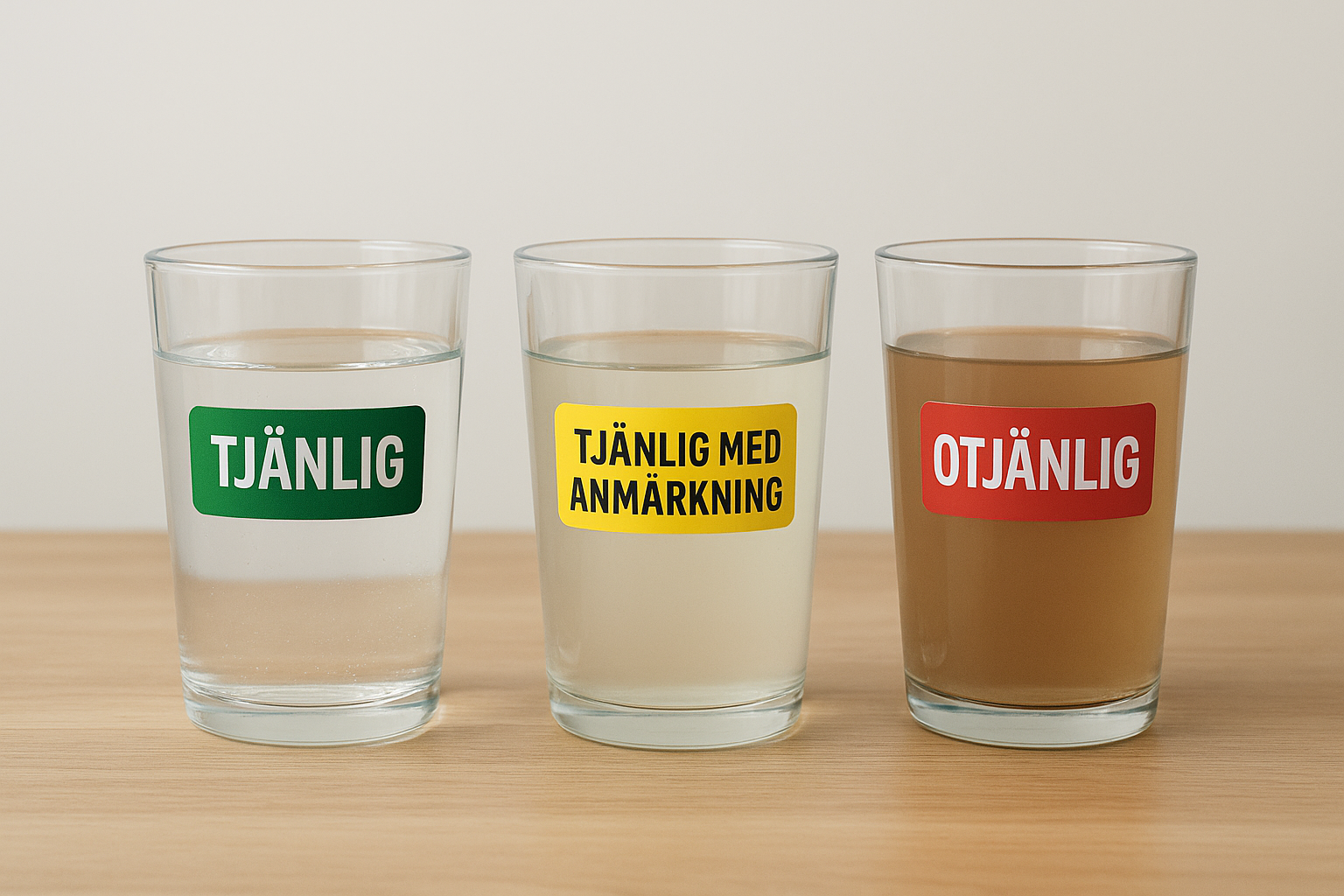
The class non-potable is used when a limit value is exceeded or when a microbiological sample is positive. The water should then not be used as drinking water without first taking action and then performing a new test with an approved result. The difference between the classes is important to understand, as a non-potable result places completely different demands on rapid action than a potable with remarks.
Guideline values for private wells and small facilities
The binding limit values in the Swedish Food Agency's regulations are formally directed at larger facilities that produce more than 10 cubic meters of water per day or supply more than 50 people. If you have a private well on your property, you are therefore not covered by the same legislation. Instead, the Swedish Food Agency has developed separate guideline values specifically adapted for individual wells and small facilities, compiled in the publication "Advice on individual drinking water supply".
Guideline values are not binding in the same way as limit values, but they are directly linked to health risks and should be taken just as seriously when you interpret your analysis report.
What guideline values mean for you as a well owner
Since you as a private individual are not formally obliged to follow the Swedish Food Agency's drinking water limit values in the same way as a municipal water and sewage operator, the guideline values are the closest thing you will get to an official benchmark for your well. Laboratories that analyze well water use these guideline values as reference points and classify your water as potable, potable with remarks, or non-potable based on them.
The guideline values are divided into health-related parameters and parameters related to technical quality and aesthetics. A high iron content is a technical problem that discolors laundry and gives an off-taste, but it normally poses no health risk. Elevated levels of arsenic or nitrate, however, are health-related deviations that require action.
Parameters that commonly deviate in individual wells
Individual wells, especially drilled ones in bedrock, often show elevated levels of naturally occurring substances such as arsenic, radon, fluoride, and manganese. Dug wells, on the other hand, are more exposed to surface water and more often show microbiological deviations, for example, the presence of coliform bacteria or E. coli after heavy rains.
Below are the parameters that most often deviate in well water in Sweden, along with the Swedish Food Agency's guideline values:
| Parameter | Guideline value (potable) | Remark at |
|---|---|---|
| E. coli | 0 per 100 ml | Any detection |
| Coliform bacteria | 0 per 100 ml | Any detection |
| Arsenic | below 10 µg/l | At 5–10 µg/l |
| Radon | below 1,000 Bq/l | At 100–1,000 Bq/l |
| Nitrate | below 50 mg/l | At 25–50 mg/l |
| Iron | below 0.1 mg/l | At 0.1–0.3 mg/l |
| Manganese | below 0.05 mg/l | Upon deviation |
Knowing which parameters are common problems in your region helps you choose the right analysis package and avoid paying for tests you don't need.
The difference between limit value, guideline value, and action limit
Many well owners confuse the three concepts that govern the assessment of drinking water, and it's easy to do so. A limit value, a guideline value, and an action limit are not synonyms but three separate levels in a system designed to catch problems early, before they become serious. Understanding the difference helps you read your analysis report without either worrying unnecessarily or missing a real risk.
Limit value: the legally binding limit
A limit value is the absolute maximum permissible value for a parameter in drinking water. It is legally binding, and the Swedish Food Agency's drinking water limit values formally apply to facilities that produce more than 10 cubic meters per day. However, laboratories apply the same values as a reference even for private wells. If a limit value is exceeded, the water is classified as non-potable, and you should stop using it as drinking water immediately until the problem is rectified and a new approved sample is taken.
A limit value is not a safety margin you can play with, but the point where science says the health risk becomes unacceptable.
Guideline value: health-supported recommendation
A guideline value is not legally binding in the same way as a limit value, but it is based on the same type of health-related risk assessment. The Swedish Food Agency sets guideline values for parameters where a deviation either poses a lower health risk or is related to aesthetic and technical properties rather than direct danger. An elevated iron value discolors your water and gives it a metallic taste, but it is normally not dangerous to drink. A deviation from a health-related guideline value for, for example, arsenic at 5 to 10 micrograms per liter, however, requires you to evaluate the situation and plan an intervention.
The water is classified as potable with remarks when a guideline value is exceeded without any limit value being passed. This means that you can continue to use the water in the short term but that you should rectify the problem and take a new sample.
Action limit: the signal to act now
An action limit is often midway between a guideline value and a limit value and marks the point where you should take concrete action without delay, even if the limit value has not yet been exceeded. Radon is a good example. The guideline value for potable without remarks is below 100 Bq/l, but the need for action arises already at 100 to 1,000 Bq/l, and the limit value for non-potable is 1,000 Bq/l. The system thus gives you a warning and time to act before the situation becomes critical.
Who is responsible for ensuring the water is of the correct quality
Responsibility for drinking water quality differs completely depending on whether you are connected to the municipal network or have your own well. It is a distinction that many well owners do not know until they buy their first property with private water, and it affects everything from how often you need to take samples to who you contact if something is wrong.
Municipal water: municipal responsibility
Households connected to municipal water are not affected by the Swedish Food Agency's drinking water limit values at the individual level, as the municipality's water and sewage department is responsible for the entire chain from the waterworks to your tap. The municipality takes regular samples, reports the results to the county administrative board, and is obliged to inform you as a subscriber if anything deviates. If a limit value is exceeded on the municipal network, it is the municipality's responsibility to rectify the problem, not yours.
The municipality is the responsible operator and bears the legal responsibility for ensuring that the water you drink meets all requirements in the Swedish Food Agency's regulations.
Private well: your own responsibility
If you own a property with a private well, you are solely responsible for your water quality. No authority automatically tests your well, and no one sends a warning if the arsenic level rises. The Swedish Food Agency recommends that you test your well every three years under normal conditions, and more often if you notice changes in smell, taste, or color, live near agricultural land, or if heavy rainfall occurs.
As a well owner, you also have a responsibility to act if a test shows a deviating result. It is not enough to take a test and put the report in a drawer. If the water is classified as non-potable, you must take action and take a new approved test before you continue to use it as drinking water.
Property purchases and shared wells
When buying a property, responsibility for water quality is a central part of the transfer process. The seller has a duty to disclose information, and as a buyer, you should always request a current analysis report. If one is missing, it is wise to take your own test before the purchase is completed, as any problems after possession fall to you as the new owner.
If you share a well with a neighbor or belong to a joint ownership association with a common water supply, responsibility is distributed according to the association's agreement. If the facility is large enough, i.e., if it produces more than 10 cubic meters per day or supplies more than 50 people, the binding regulations come into effect and require a designated operator to take formal responsibility for regular sampling and reporting.
How to interpret your water analysis result
When you get your analysis report back from the laboratory, you will see a long list of parameters and figures side by side. It can feel overwhelming if you don't know what you're looking for. The important thing is to understand the structure of the report and what the different columns actually communicate about your water quality.
How to read the analysis table
Each row in the analysis table shows an measured value for a specific parameter in your water, such as arsenic content or the number of coliform bacteria. Next to the measured value is a reference column with the limit value or guideline value that the laboratory compares against. If your measured value is below the reference value, the parameter is approved and is usually marked with a green highlight or the comment OK. If the value exceeds the reference level, it is flagged with a deviation code or a red highlight.
Always read the reference column in parallel with your measured value, not just the final assessment, as a single deviation can seem small but have great practical significance depending on which parameter it concerns.
It is also important to note the unit in which each parameter is measured. Arsenic is measured in micrograms per liter (µg/l), iron in milligrams per liter (mg/l), and bacteria in number per 100 milliliters. Mixing up the units is a common mistake that leads to incorrect conclusions about how serious a deviation actually is.
What the assessment at the end of the report means
Most accredited laboratories summarize the analysis with a collective classification at the end of the report, based on the Swedish Food Agency's drinking water limit values and guideline values. The classification is either potable, potable with remarks, or non-potable. Potable means that all measured values are within acceptable limits and that you can continue to use the water without restrictions.
The classification potable with remarks means that a guideline value has been exceeded, but that no health-related limit value has been passed. You can use the water for the time being, but you should investigate the cause and plan an action. The classification non-potable is the most serious and means that a limit value has been exceeded or that a microbiological sample is positive. In that situation, you should stop using the water as drinking water immediately, rectify the problem, and then take a new sample to confirm that the water is safe again.
Important parameters and typical problems
Not all parameters in an analysis report are equally common or equally serious. Depending on whether you have a drilled well in bedrock or a dug well in clay soil, the risk of different types of deviations varies greatly. Knowing which parameters typically cause problems in Sweden helps you choose the right analysis package and understand what you are looking for in the report.
Microbiological parameters
Microbiological deviations are the most common problem in dug wells and occur primarily after intense rain, snowmelt, or when the well cover is damaged. E. coli and coliform bacteria enter via surface water that infiltrates the ground and reaches the well. According to the Swedish Food Agency's drinking water limit values, the limit for both parameters is zero per 100 milliliters, meaning that a single positive sample classifies the water as non-potable and requires immediate action.
Microbiological problems are often temporary and can be solved, but they require you to act quickly as exposure to E. coli can cause gastrointestinal illness even at low levels.
Chemical parameters linked to bedrock and soil type
Drilled wells in Sweden's bedrock environment are particularly susceptible to elevated levels of arsenic, radon, fluoride, and manganese. These substances are naturally released from the bedrock and dissolve in groundwater. Arsenic is primarily found in granite-rich areas and is a health risk with long-term exposure as the substance is linked to an increased risk of cancer. Radon is an invisible gas that dissolves in water and is released when you open the tap, which means you can inhale it in the kitchen or bathroom. Both parameters require specific filters if the levels are too high.
Dug wells, on the other hand, are more affected by what happens on the ground surface around the property. Nitrate from fertilizer and agriculture leaches down through the topsoil and reaches the groundwater, and elevated nitrate levels are a widespread problem in agricultural-intensive parts of southern Sweden. Nitrate is particularly dangerous for infants under six months, as their bodies cannot handle the substance in the same way as adults.
Organic contaminants and PFAS
PFAS are a group of persistent chemicals used in firefighting foam, waterproofing agents, and a range of industrial products. These substances do not break down in the environment and accumulate in groundwater, especially near airports, military facilities, and fire training areas. If your property is within a few kilometers of such facilities, you should include a PFAS-specific test in your analysis package, as standard well analyses often do not cover these substances by default.
What to do in case of exceedance
If your analysis report shows that a limit value or health-related guideline value has been exceeded, you need to act in a structured manner. It is easy to either become passive due to confusion or to take the wrong action in the wrong order. The first step is always to determine what type of exceedance it is, as microbiological and chemical problems require completely different interventions.
Do not start by installing a filter or chlorinating the well before you know what the problem actually is – the wrong action solves nothing and can in some cases worsen the situation.
Immediate action for microbiological contamination
When a test shows the presence of E. coli or coliform bacteria, the first thing you do is stop using the water as drinking water. Boil all water that is to be drunk, used for food, or toothbrushing until the problem is resolved and a new approved test confirms that the water is safe. In parallel, you should investigate the likely source of entry. Check the well cover, the condition of the well wall, and the ground surface around the well for cracks or subsidence that could allow surface water to enter. A one-time chlorination of the well can remove bacteria, but if the well's construction is damaged, the problem will return without addressing the source. Always take a new test at least two weeks after chlorination to confirm that the levels have actually dropped to zero.
Chemical exceedances require a different strategy
Chemical deviations from the Swedish Food Agency's drinking water limit values, such as elevated levels of arsenic, fluoride, nitrate, or PFAS, cannot be solved by chlorination. These substances require either a filter adapted for the specific parameter or, in severe cases, an entirely new water source. For arsenic, an activated alumina filter or a reverse osmosis system is usually used, depending on the levels. Nitrate requires an ion exchange filter or a reverse osmosis system, and PFAS is effectively purified with activated carbon or reverse osmosis.
Contact a certified well driller or plumbing company with experience in water purification to get an assessment of which filter system suits your situation. If you choose the wrong type of filter, you can lower one parameter but miss another at the same time. Regardless of which system you install, you owe it to yourself to take a new test after installation to verify that the filter is actually working. A filter that is not maintained can stop purifying the water without you noticing, making regular sampling a permanent part of owning a well.
How to choose the right sampling and analysis
Choosing the right analysis package is not always obvious when you look at the range of well analyses. Well type, geographical location, and property history determine which parameters are most relevant to test, and taking an overly limited package means you might miss deviations that actually affect your health. Start by mapping out your situation before ordering a kit.
Identify your well type and location
Drilled wells in bedrock and dug wells in soil layers behave completely differently and are at risk of different types of contamination. A drilled well in a granite area almost always needs to be tested for arsenic, radon, and fluoride, as these substances are naturally released from the rock and are common causes of the Swedish Food Agency's drinking water limit values being exceeded specifically in drilled wells. A dug well, on the other hand, is more exposed to surface water and always requires an extended microbiological package to detect bacteria that can leak in from the ground surface.
The location of your property plays just as important a role as the well type. If you live near agricultural land, nitrate should be included in the analysis. If the property is within a few kilometers of an airport, military training area, or industrial facility, a PFAS test is warranted, as these substances are not included in standard packages but can be present in groundwater in such areas.
Always choose a package that covers the risks specific to your well type and location, not the cheapest option that only checks a few parameters.
Choose analysis package according to your situation
Many laboratories offer packages adapted for different situations: a basic package for microbiology and the most common chemical parameters, an extended package for drilled wells, and special analyses for PFAS, arsenic, or radon that you add separately. If you are buying a new property with an existing well, you should order a comprehensive package that gives you a complete picture of the water quality from day one, as you don't know how long it has been since the last test was taken or what previous owners may have missed.
If you test your well regularly and have a stable history without deviations, a standard package every three years is often sufficient, supplemented with a quick test for microbiology after events such as heavy rain or work near the well. If you plan to use the water for infants, the elderly, or people with weakened immune systems, you should always choose a broader package and test more often than the general recommendation.
Frequently asked questions about the Swedish Food Agency's values
The same questions arise repeatedly among private individuals who have just received their first analysis report or who are considering taking a sample for the first time. Below, we answer the most common questions about the Swedish Food Agency's drinking water limit values and how they affect you as a well owner in practice.
How often do I need to test my well?
The Swedish Food Agency recommends that you test your well every three years under normal conditions. This is not a statutory obligation for private individuals, but the recommendation is based on the fact that water quality can change over time without you noticing it in taste or smell. Take an extra test immediately if you notice a change in the water's color, smell, or taste, if heavy rain occurs, if you have recently dug or built near the well, or if you plan to give the water to infants.
Do I have to follow the limit values if I have a private well?
You are not legally obliged to follow the Swedish Food Agency's regulations in the same way as a municipal operator, as the regulations are formally aimed at facilities that produce more than 10 cubic meters per day. However, the Swedish Food Agency's guideline values for individual wells apply, and they are based on the same health-related research. This means that an exceedance still poses a real health risk to you and your family, regardless of whether it is legally binding or not.
The fact that a limit value does not formally apply to you does not change the fact that arsenic, bacteria, and other substances cause harm if you drink them regularly.
What happens if my water is classified as non-potable?
No authority will automatically knock on your door or order you to fix the problem if you have a private well with non-potable water. The responsibility is entirely yours. You should stop using the water as drinking water immediately, take appropriate measures depending on what caused the deviation, and then take a new test to confirm that the water is approved before you start using it again.
Do the limit values also apply to summer water and holiday homes?
Yes, the same guideline values apply to all wells you use for drinking water, regardless of whether the property is a permanent residence or a holiday home that you visit a couple of months a year. In fact, wells at holiday homes are often extra exposed because they are not used regularly, which can increase the risk of stagnant water and microbiological growth. Test the well well in advance of the season, not in the middle of it.
Summary and next steps
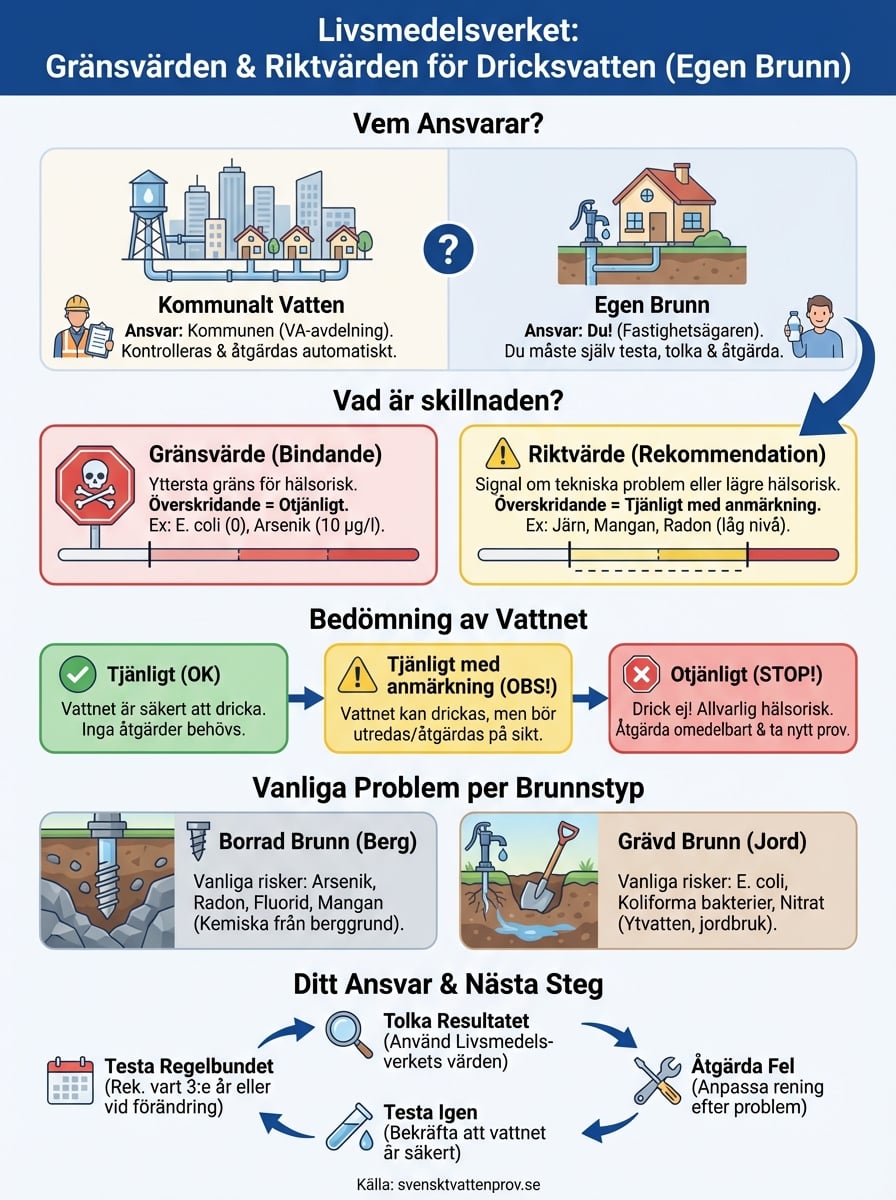
The Swedish Food Agency's drinking water limit values and guideline values are the system that determines whether your well water is safe to drink or not. Limit values are legally binding and lead to the classification non-potable upon exceedance, while guideline values signal that you should act but that the water can be used in the short term. As a private individual with your own well, you are solely responsible for sampling, interpreting the results, and taking action.
The most important thing to take away from this article is that regular sampling is not optional if you care about your family's health. Choose an analysis package that matches your well type and geographical location, and act immediately if a test shows deviations. Do not wait until next year.
Ready to take the next step? Order an accredited well analysis kit directly from Svenskt Vattenprov and get clear results compared against the Swedish Food Agency's guidelines.