

Water composition monitoring: essential for Swedish well owners
TL;DR:
- Most Swedish private wells show water quality issues despite appearing safe. Regular testing is essential as contaminants are invisible and tasteless. Routine monitoring protects health, property value, and provides documented safety records.
Over 82% of Swedish private wells show at least one water quality issue, yet most well owners assume their water is safe because it looks clear and tastes fine. That assumption is genuinely dangerous. Harmful bacteria, heavy metals, PFAS compounds, and radon leave no visible trace and no detectable taste. If you own a private well in Sweden, you are solely responsible for what comes out of your tap, and the only way to know it is safe is to test it. This article explains why that responsibility falls on you, what monitoring actually detects, how to build a testing schedule, and what to do when results come back with problems.
Table of Contents
- Why well owners are responsible for water quality
- Invisible risks: What water composition monitoring actually detects
- How and when to monitor your well water
- What to do if your well water fails: Interpreting results and solutions
- Why routine monitoring is the cornerstone of safe well ownership
- Take the next step: Easy water analysis for Swedish wells
- Frequently asked questions
Key Takeaways
| Point | Details |
|---|---|
| Owner responsibility | Private well owners in Sweden must regularly monitor their own water quality for safety. |
| Invisible risks | Contaminants like bacteria and chemicals often have no taste or color, making routine tests essential. |
| Testing guidance | Follow Livsmedelsverket’s recommendations for frequency and accredited lab analysis. |
| Action on results | If your well water is unsafe, act promptly with treatment and retesting to protect health. |
Why well owners are responsible for water quality
More than 1.2 million people in Sweden rely on private wells for their drinking water. Unlike city residents who receive water that is continuously monitored and treated by municipal authorities, private well owners operate entirely outside that system. Your well, your responsibility.
This is not just a practical reality. It is the legal framework in Sweden. Private well owners must monitor their own water quality, and no government agency is obligated to do it for them. There is no routine inspection, no mandatory annual test, and no authority knocking on your door to check your results.
Sweden’s food safety authority, Livsmedelsverket, provides recommendations but no legal requirements for households serving fewer than 50 people. In plain terms: the guidance is there, but following it is voluntary for private well owners. The legal obligations that apply to public waterworks simply do not extend to your backyard well.
This structure places enormous trust in individual owners. Most people carry that responsibility without realizing the full weight of it. Here is what is actually at stake:
- Property value: A current, clean water analysis is expected in any property sale involving a private well. Missing or outdated results can delay a sale or reduce the purchase price.
- Family health: Children, pregnant women, and anyone with a weakened immune system face greater risk from contaminated water.
- Legal protection: Documented test records protect you if a dispute arises with a neighbor, municipality, or property buyer.
- Early detection: Many contamination problems are gradual. Regular monitoring catches a slow rise in nitrate or iron levels before it becomes a crisis.
“Treating contamination after illness or damage is always more costly, more stressful, and far more disruptive than a routine water test.”
Pro Tip: Store all your water test reports in one folder, either physical or digital. When you sell your property or apply for a grant to improve your water system, having years of documented results is a major advantage.
If you want to understand what standards your water is measured against, a closer look at Swedish well water standards gives you a clear picture of the benchmarks that apply to private wells in 2026.
Invisible risks: What water composition monitoring actually detects
The most unsettling truth about well water contamination is how invisible it is. You cannot smell E.coli. You cannot taste PFAS. Radon has no color. Yet these are exactly the contaminants that monitoring detects in Swedish private wells every single day.
National data from well water statistics paint a sobering picture: only 18% of sampled Swedish private wells are fully problem-free. The remaining 82% show at least one parameter outside recommended limits. Dug wells carry roughly 3.5 times the bacterial contamination risk compared to drilled wells, largely because they sit closer to the surface and are more vulnerable to runoff.
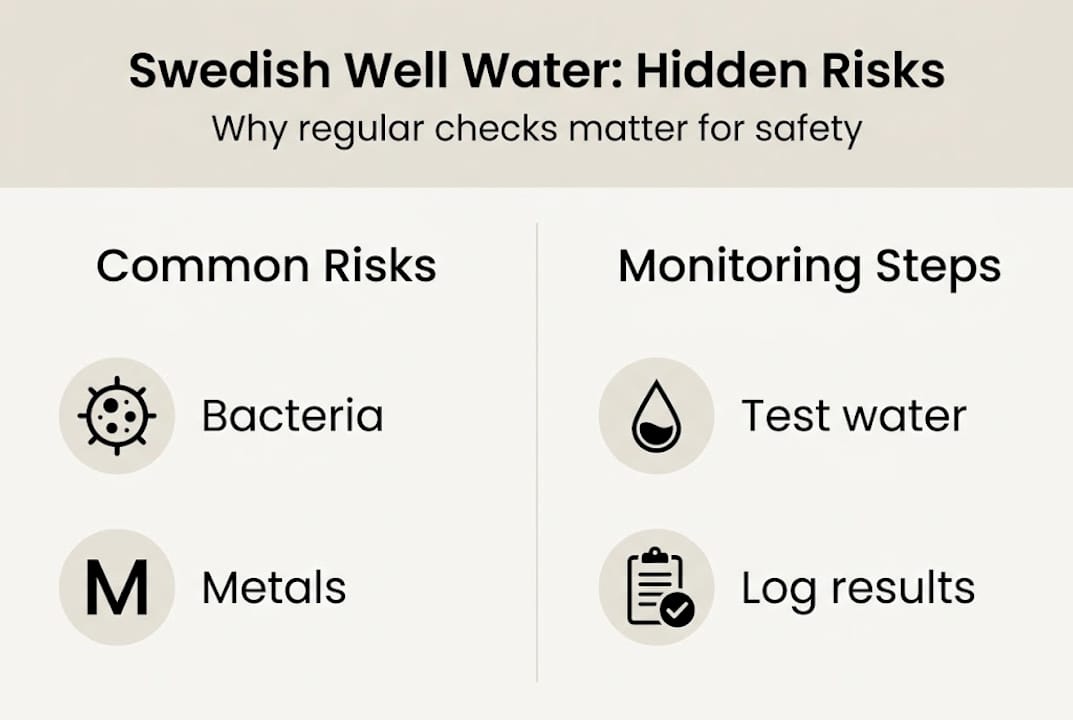
Here is a breakdown of the main contaminant categories and what they mean for your family:
| Contaminant type | Common sources | Health effects |
|---|---|---|
| Bacteria (E.coli, coliforms) | Animal waste, surface runoff, aging well casing | Gastroenteritis, serious illness in children and elderly |
| Nitrate | Agricultural fertilizers, septic systems | Methemoglobinemia (“blue baby” syndrome) in infants |
| Heavy metals (arsenic, lead) | Bedrock geology, old pipes | Cancer risk, neurological damage with long-term exposure |
| PFAS compounds | Firefighting foam, industrial sites, airports | Hormone disruption, immune suppression, cancer risk |
| Radon | Granite bedrock, particularly in central and western Sweden | Lung cancer risk with long-term inhalation from water use |
| Low pH (acidic water) | Naturally soft Swedish groundwater | Corrodes pipes, leaches copper and lead into drinking water |
Livsmedelsverket and EU regulations set firm limits for several of these. E.coli must be zero colony-forming units per 100 ml. Arsenic cannot exceed 10 micrograms per liter. Total PFAS must stay below 0.1 micrograms per liter. These are not suggestions. They are the thresholds at which water becomes genuinely unsafe for consumption.
Bacteria are the most frequently detected problem, appearing in roughly 35% of flagged Swedish wells. Iron and manganese follow at around 30%, causing staining and metallic taste before they reach dangerous levels. pH problems account for about 20% of issues, and radon around 15%. Understanding these numbers is the first step, and exploring essential water analysis facts helps you connect them to your specific situation.
“Clear, odorless water from a dug well in an agricultural area is still among the highest-risk water sources in Sweden for nitrate and bacterial contamination.”
How and when to monitor your well water
Knowing that risks exist is one thing. Having a clear plan to catch them early is another. Fortunately, the testing schedule is straightforward once you understand which category your household falls into.
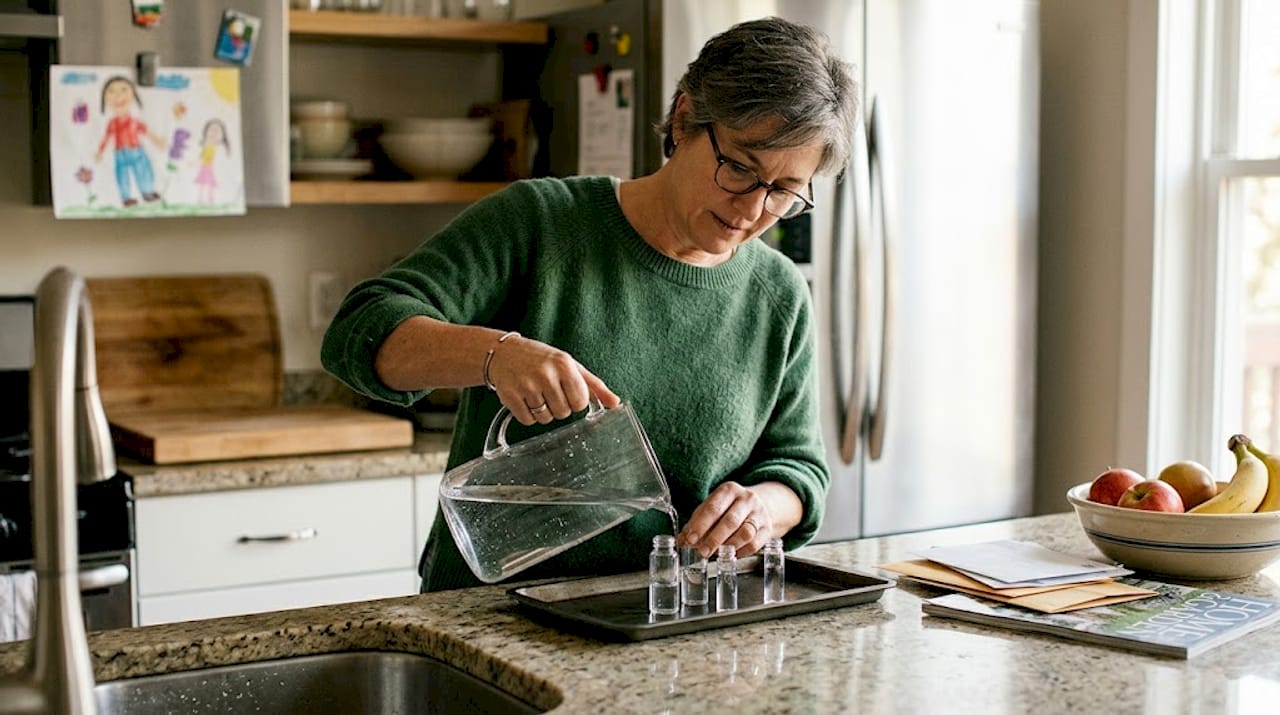
Livsmedelsverket recommends testing well water every three years for most private users, and annually for households with young children, pregnant women, elderly residents, or immunocompromised individuals. Shared wells used by multiple households should also be tested more frequently.
| Household type | Recommended frequency |
|---|---|
| Standard adult household | Every 3 years |
| Household with young children or pregnant women | Annually |
| Shared well (multiple households) | Annually |
| After flooding, construction, or taste/odor change | Immediately |
| Before selling or buying a property with a well | Before listing or closing |
Beyond the schedule, how you collect the sample matters just as much as when you do it. A poorly collected sample can produce inaccurate results and give you false reassurance. Follow these steps:
- Order a kit from an accredited laboratory. Accreditation through Swedac ensures the lab meets the same standards used by public waterworks.
- Flush the tap for two to three minutes before collecting. This clears standing water from the pipes and gives you a true sample of your well water.
- Use sterile sampling bottles provided by the lab. Never rinse or refill them.
- Follow the temperature and transport instructions carefully. Bacterial samples especially are time-sensitive.
- Send the sample the same day, or as directed, to avoid bacterial growth affecting results.
For households near agricultural land, old industrial sites, or in granite-heavy regions, consider a broader test group that includes pesticides, PFAS, or radon alongside the standard bacterial and chemical panel. The guidelines for well water analysis can help you decide which parameters to prioritize based on your location.
Pro Tip: After every test, register your well water results with Sweden’s national well database. This creates a long-term record that is useful for identifying trends and is increasingly expected by buyers and environmental authorities.
What to do if your well water fails: Interpreting results and solutions
Receiving your lab report can feel overwhelming if you are not sure what the categories mean. Swedish water analysis reports classify water into three clear outcomes, and understanding them takes the confusion away.
- Tjänligt (safe): All tested parameters are within recommended limits. Your water is suitable for drinking and household use. No action required beyond your next scheduled test.
- Med anmärkning (requires attention): One or more parameters are elevated but not yet at an unsafe level. This category is a warning signal. Action is advised, and a follow-up test is recommended after addressing the issue.
- Otjänligt (unsafe): One or more parameters exceed health limits. Do not drink the water without treatment. Take immediate steps to identify the source and address it.
For specific failures, the complete guide for Swedish well owners walks through each common problem with practical next steps. Here is a quick reference for the most frequent issues:
- Bacterial contamination: Shock chlorination of the well is the standard first response, followed by a retest four to six weeks later.
- Elevated iron or manganese: An iron filter or oxidation system can be installed. These are relatively common and well-supported in Sweden.
- Low pH (acidic water): A limestone filter or dosing pump raises pH and protects your pipes from corrosion.
- Nitrate above limits: A reverse osmosis filter removes nitrate effectively. Boiling does not help and actually concentrates nitrate further.
- PFAS detected: Activated carbon filtration is the most reliable method for reducing PFAS in drinking water.
Always retest after installing treatment equipment. Equipment can fail or lose effectiveness over time, and a post-treatment test is the only way to confirm it is working. For ongoing concerns or unclear results, consulting an expert in understanding well water issues is a sound next step.
Pro Tip: Keep a log of every test result, every treatment installed, and every maintenance action on your well. Over time, this log shows whether water quality is improving, stable, or deteriorating, which is far more useful than any single snapshot test.
Why routine monitoring is the cornerstone of safe well ownership
Over the years we have worked with well owners across Sweden, one pattern stands out clearly: the households that encounter the most serious problems are almost never the ones who tested recently. They are the ones who assumed everything was fine because nothing had gone wrong yet.
Complacency is understandable. If your water has tasted clean for ten years, why would you expect a problem now? But 1 in 5 Swedish wells is unfit for drinking at any given point. That statistic is not about neglected or visibly damaged wells. Many of those owners had no idea.
The case for routine monitoring goes beyond health. A documented test history protects your property value during a sale, supports applications for improvement grants, and gives you genuine peace of mind rather than the false comfort of ignorance. A comprehensive look at water analysis insights reinforces just how much a regular testing habit can reveal over time.
Children and immunocompromised family members carry the real cost when contaminated water goes undetected. A test every three years is a small investment. The alternative, discovering a problem after illness, is not.
Take the next step: Easy water analysis for Swedish wells
You now understand what is at stake, what to test for, and what to do with your results. The next step is simply to act.
Swensktvattenprov makes it easy to order accredited lab-grade testing for both dug and drilled wells. Our kits are shipped directly to you, used at home, and analyzed by a Swedac-accredited laboratory. Results come with clear explanations and practical recommendations. If you have a dug well, our water analysis for dug wells covers the 31 parameters most relevant to your specific risk profile. You can also register your well to build a long-term record that supports both health monitoring and future property transactions. Your family’s water safety is worth the effort.
Frequently asked questions
How often should I test my private well water in Sweden?
Livsmedelsverket recommends testing every three years for most households, and annually if you have young children, are pregnant, or share the well with others.
What are the main contaminants found in Swedish well water?
Bacteria, iron and manganese, low pH, radon, nitrate, PFAS, and heavy metals are the most common. 82% of sampled wells showed at least one issue, with bacteria appearing in roughly 35% of flagged cases.
What should I do if my water test shows unsafe results?
Take immediate action such as shock chlorination, filtration, or other targeted treatment, then retest to confirm improvement. Otjänligt and med anmärkning results both require a documented response and follow-up test.
Are there legal requirements for private well water testing in Sweden?
No mandatory testing law applies to private households. However, Livsmedelsverket and EU standards provide clear health-based recommendations that owners are strongly advised to follow.
Why test if my well water looks and tastes fine?
Appearance and taste tell you almost nothing about safety. Bacteria, PFAS, and heavy metals are colorless, odorless, and tasteless, making laboratory testing the only reliable way to confirm your water is safe.