

Key water analysis parameters for Swedish private wells
TL;DR:
- About 20% of Swedish private wells deliver unsafe drinking water due to contamination. Regular testing of microbiological, chemical, radiological, and physical parameters is essential for ensuring water safety. Homeowners should follow proper sampling procedures and consult accredited labs to interpret results and take appropriate actions.
Roughly 1 in 5 private wells in Sweden delivers water that is unsafe to drink, with bacterial contamination or hazardous substances showing up in 15 to 20% of tested sources. That is a striking number for something most families use without a second thought. The challenge is not just knowing that a problem might exist. It is knowing which specific parameters to test, what the results actually mean, and how to act when something is off. This article walks you through every key analysis parameter, explains the safety thresholds that matter under Swedish and EU standards, and shows you how to build a testing plan that fits your well and your family.
Table of Contents
- Understanding the main water analysis parameters
- How often you should test your well and why frequency matters
- Recognizing regional and well-specific risks
- How to ensure accurate results: Sampling and lab essentials
- The homeowner’s challenge: Taking charge of water safety beyond the guidelines
- Get reliable, accredited water testing for every Swedish region
- Frequently asked questions
Key Takeaways
| Point | Details |
|---|---|
| Know key parameters | Safe private well water in Sweden depends on monitoring crucial analysis parameters. |
| Test with the right timing | National recommendations offer the safest minimums, but test more often if risks change. |
| Location matters | Well type and regional risks mean some parameters are far more important in certain areas. |
| Proper sampling is critical | Accurate results come only from careful sample collection and accredited labs. |
Understanding the main water analysis parameters
Now that you know how common risky water is, let’s explore exactly which parameters matter most and why. Water quality is not a single measurement. It is a picture built from several categories, each revealing a different kind of risk.
Based on Livsmedelsverket guidelines, the core parameters for private wells fall into four groups: microbiological, chemical, radiological, and physical. Understanding what each group covers helps you ask the right questions before you even collect a sample.
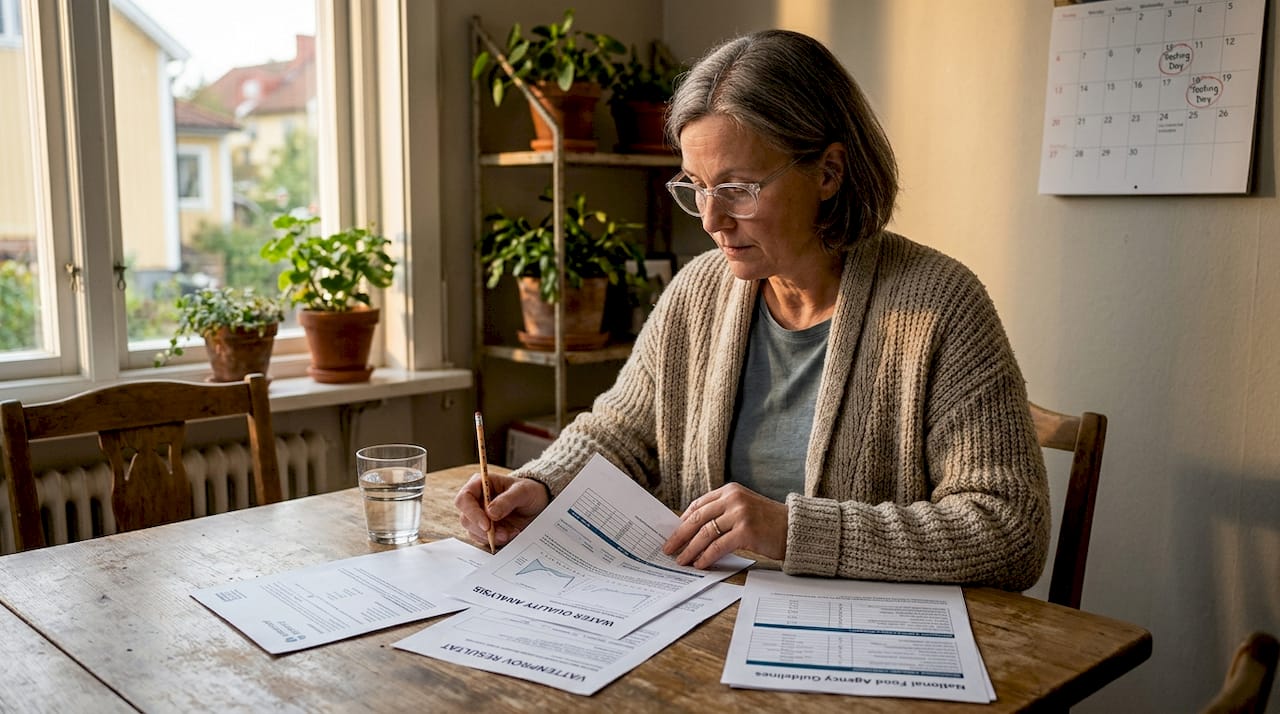
The four parameter categories and their safe limits:
| Parameter | Safe limit | Typical risk source |
|---|---|---|
| E. coli / coliforms | 0 per 100 ml | Sewage, animal waste, surface water |
| Nitrate | ≤50 mg/l | Fertilizers, agriculture, septic systems |
| Lead | ≤5 µg/l | Old pipes, solder joints |
| PFAS (sum) | ≤0.1 µg/l | Firefighting foam, industrial sites, airports |
| Arsenic | ≤10 µg/l | Natural rock geology, mining areas |
| Radon | Action level 1,000 Bq/l | Granite bedrock |
| pH | 6.5 to 9.5 | Acidic soil, mineral-poor rock |
Common health effects linked to each parameter:
- E. coli and coliforms: Gastroenteritis, vomiting, diarrhea, serious illness in vulnerable groups
- Nitrate: Oxygen deprivation in infants (blue baby syndrome), thyroid disruption
- Lead: Neurological damage, especially in children and fetuses
- PFAS: Immune suppression, hormone disruption, increased cancer risk
- Arsenic: Long-term cancer risk, skin and cardiovascular effects
- Radon: Lung cancer risk through inhalation of dissolved gas
- Low pH: Corrosion of pipes, leaching of metals into water
For a broader look at essential water analysis facts and how these parameters interact, it helps to read up before choosing a test package. You can also get a clearer picture of understanding well water issues specific to Swedish conditions before deciding what to prioritize.
Pro Tip: If you have a bedrock well in a granite area, start with radon and arsenic. If you have a dug well near farmland, prioritize bacteria and nitrate. Your geography is your first clue.
How often you should test your well and why frequency matters
With an understanding of which parameters put your well at risk, it is important to consider how often testing should actually happen for real protection.
The recommended testing interval from Livsmedelsverket is every 3 years for stable wells, but annually for households with children under 5, pregnant women, or shared wells. More frequent testing is also recommended after any environmental changes or identified risks.
“Water quality can change gradually without any visible sign. A well that tested clean three years ago may look and taste exactly the same today while harboring elevated nitrate or new bacterial contamination.”
Here is a practical schedule to follow:
- Baseline test first. If you have never tested your well, or if it has been more than 3 years, start with a full analysis covering all major parameter categories.
- Set a 3-year reminder for standard retesting if results are within safe limits and no major changes have occurred.
- Test annually if anyone in your household is pregnant, under 5 years old, elderly, or immunocompromised.
- Test immediately after events such as flooding, drought, nearby construction, or any change in water taste, smell, or color.
- Retest after treatment. If you installed a filter, UV system, or other treatment, verify it is working with a new analysis within 3 months.
Keeping up with drinking water quality standards for private wells helps you understand when your results are borderline versus clearly safe. It is also worth reviewing environmental water quality checks if your surroundings have changed recently.
Pro Tip: After a flood or a very dry summer, test for bacteria and nitrate within 4 to 6 weeks. Both can spike significantly when groundwater levels shift or surface water infiltrates your well casing.
Recognizing regional and well-specific risks
Even with a standard approach to testing, your well’s location and type can change the game when it comes to water safety.
Sweden’s geology and land use vary enormously from north to south. Regional risks include radon in granite areas like Värmland and Dalarna, nitrates near agriculture in southern Sweden, PFAS near airports and industrial sites, and iron or manganese in forested areas. Knowing your region helps you focus your testing budget where it counts.
Risk factors by well type and location:
| Risk factor | Well type most affected | Key parameters to test |
|---|---|---|
| Granite bedrock geology | Bedrock (borrad) well | Radon, arsenic, uranium |
| Nearby agricultural land | Dug (grävd) well | Nitrate, bacteria, pesticides |
| Airport or industrial site within 5 km | Any well type | PFAS |
| Forested or peat-rich soil | Any well type | Iron, manganese, color |
| Coastal location | Shallow or dug well | Chloride, saltwater intrusion |
| Old property with pre-1970s plumbing | Any well type | Lead, copper |
Signs that you may need to expand your standard test panel:
- Water has a yellow, orange, or brown tint (possible iron or manganese)
- Water smells of rotten eggs (hydrogen sulfide, often linked to bacteria)
- Nearby land use has changed, such as new farms, roads, or industrial activity
- You live within a few kilometers of a military base or airport
- Your well is shallow and you experienced heavy rain or flooding recently
You can check groundwater statistics for your area to see what parameters are most commonly elevated in your region. Reviewing water analysis guidelines and well analysis facts can also help you decide whether a standard package or an expanded one fits your situation.
How to ensure accurate results: Sampling and lab essentials
Once you know which risks to focus on, accuracy in testing is essential. Here is how to get it right.
Only results from a Swedac-accredited lab are legally valid for property sales, municipal reporting, or grant applications. Accreditation means the lab follows strict national and EU standards, and its results can be trusted in official contexts. A non-accredited test might give you numbers, but those numbers carry no legal weight and may lack the precision needed to detect borderline contamination.
Step-by-step guide to collecting a water sample correctly:
- Remove any aerator or filter from the tap you are sampling. These can harbor bacteria that skew microbiological results.
- Run the cold tap at full flow for 5 minutes to flush standing water from the pipes. This ensures you are sampling actual groundwater, not stagnant pipe water.
- Flame or disinfect the tap opening with alcohol if you are collecting a bacteria sample. Do not touch the inside of the bottle or cap.
- Fill the sample bottle to the marked line without overflowing. Some bottles contain a preservative tablet. Do not rinse it out.
- Label the bottle clearly with your name, address, date, and time of collection.
- Pack the sample in a cool bag with an ice pack and send it the same day.
Statistic callout: Bacteria samples must reach the lab within 24 hours of collection. Beyond that window, bacterial counts can shift significantly, making results unreliable.
Common mistakes that can invalidate your results include sampling from a hot tap, using a tap with a filter attached, leaving the sample in a warm car, or collecting after a period of very low water use. Each of these introduces error that no lab can correct after the fact.
The homeowner’s challenge: Taking charge of water safety beyond the guidelines
Armed with the process and critical parameters, it is worth reflecting on what separates the most secure Swedish well owners from those who risk surprises.
Here is something the guidelines do not say loudly enough: private wells are not regulated the way public water supplies are. No authority checks your well for you. No inspector shows up after a flood. The responsibility sits entirely with you as the property owner. That is not a criticism of the system. It is simply the reality, and the most prepared homeowners treat it that way.
What we have seen over years of working with Swedish well owners is that the ones who stay safe are not necessarily the ones who test most often. They are the ones who interpret results in context. A nitrate reading of 45 mg/l is technically within the 50 mg/l limit, but if you have a newborn at home and the reading was 30 mg/l three years ago, that upward trend matters. Numbers alone do not tell the full story.
Proactive owners also adjust their testing plan when life changes. A new baby, a neighboring farm that starts using more fertilizer, a dry summer, or a property extension that disturbs the soil near the well casing. Each of these shifts the risk profile. Reviewing guidelines for well owners regularly keeps you aligned with current standards as they evolve.
The most important mindset shift is this: passing a test is not the same as having safe water. It means your water met the standard on that day, under those conditions. Staying safe means staying curious.
Get reliable, accredited water testing for every Swedish region
If you are ready to take the next step in water safety, here is the simplest, most reliable way to test all the right parameters.
At Svenskt Vattenprov, every analysis is processed by SGS Analytics and Eurofins, a Swedac-accredited laboratory that follows Livsmedelsverket and Naturvårdsverket standards. That means your results are legally valid and directly comparable to public water supply benchmarks. For most bedrock well owners, the bedrock well test covering 41 parameters is the right starting point. If bacteria is your primary concern, our bacteria testing package gives you a fast, focused answer. For maximum coverage across all risk categories, the comprehensive water analysis with 71 parameters leaves nothing to chance. Not sure which fits your situation? Contact us and we will help you choose.
Frequently asked questions
What are the most important water analysis parameters for Swedish private wells?
Key parameters include bacteria (E. coli, coliforms), nitrate, lead, PFAS, arsenic, radon, and pH, as defined by Livsmedelsverket guidelines. Your well type and location determine which of these deserve the most attention.
How often should I test my private well water in Sweden?
Test every 3 years for stable wells, but annually if you have young children, pregnant women, or shared wells, and immediately after any environmental changes near your property.
How do I collect a proper water sample for analysis?
Flush the tap for 5 minutes, avoid touching inside the bottle, and send samples cold to an accredited lab within 24 hours for bacteria tests to ensure valid results.
What should I do if my water analysis shows unsafe levels of a parameter?
Install the appropriate treatment such as UV for bacteria, reverse osmosis for nitrates, or aeration for radon, use bottled water in the meantime, and retest after treatment to confirm the solution is working.