

How to identify water quality issues in Swedish private wells
Imagine turning on your kitchen tap one morning and noticing the water has a faint metallic taste, or a slight yellow tint you have never seen before. You are not sure if it has always been this way, or if something changed overnight. For the roughly 1.2 million Swedish households relying on private wells, this uncertainty is unsettling because private well owners bear full responsibility for their own water safety, with no mandatory government testing or oversight. No inspector will knock on your door. No authority will send you a warning. The responsibility is entirely yours, and knowing how to act on it makes all the difference.
Table of Contents
- Understanding your responsibility for private well water
- Common signs of water quality problems
- Preparing for water testing: What you need and when
- Step-by-step process: How to collect a proper water sample
- Interpreting your test results: Key parameters and what they mean
- Troubleshooting: Addressing and preventing water quality issues
- Professional help: Simplify your water quality testing
- Frequently asked questions
Key Takeaways
| Point | Details |
|---|---|
| Full homeowner responsibility | Private Swedish well owners must monitor and maintain their own water quality without government intervention. |
| Recognize warning signs | Changes in taste, odor, or appearance are signals to test your well water promptly. |
| Accredited testing is key | Use only Swedac-accredited labs and proper sampling steps to ensure reliable results. |
| Know your parameters | Learn the critical limits for bacteria, metals, and other contaminants to interpret results effectively. |
| Act on issues quickly | Address and recheck water problems promptly, seeking professional analysis when needed. |
Understanding your responsibility for private well water
Knowing the challenges of private well ownership in Sweden sets the stage for effective self-monitoring. Unlike municipal water users, you operate outside the public water system. There is no regulatory body checking your well annually, no automatic alerts when something goes wrong.
Livsmedelsverket strongly recommends that private well owners test their water regularly, but these are guidelines, not laws. That distinction matters. It means the initiative must come from you. Reviewing water analysis facts for Swedish well owners is a smart starting point before you begin any testing process.
Here is what every private well owner in Sweden should keep in mind:
- No mandatory inspections apply to private wells, regardless of how old or shallow they are.
- You are fully liable if contaminated water causes illness in your household or guests.
- Livsmedelsverket guidelines are non-binding but represent the best available science on safe drinking water.
- Testing intervals vary: every 3 years for stable wells, annually for higher-risk situations.
“The homeowner is solely responsible for ensuring that the water from a private well is safe to drink. There is no public authority that monitors or controls private wells on a routine basis.” — Livsmedelsverket
Familiarizing yourself with well analysis guidelines helps you understand exactly what to test for and when.
Common signs of water quality problems
Spotting issues early enables you to act proactively before serious risks develop. Your senses are your first line of defense. Many water quality problems announce themselves before a lab ever confirms them.
Watch for these warning signs:
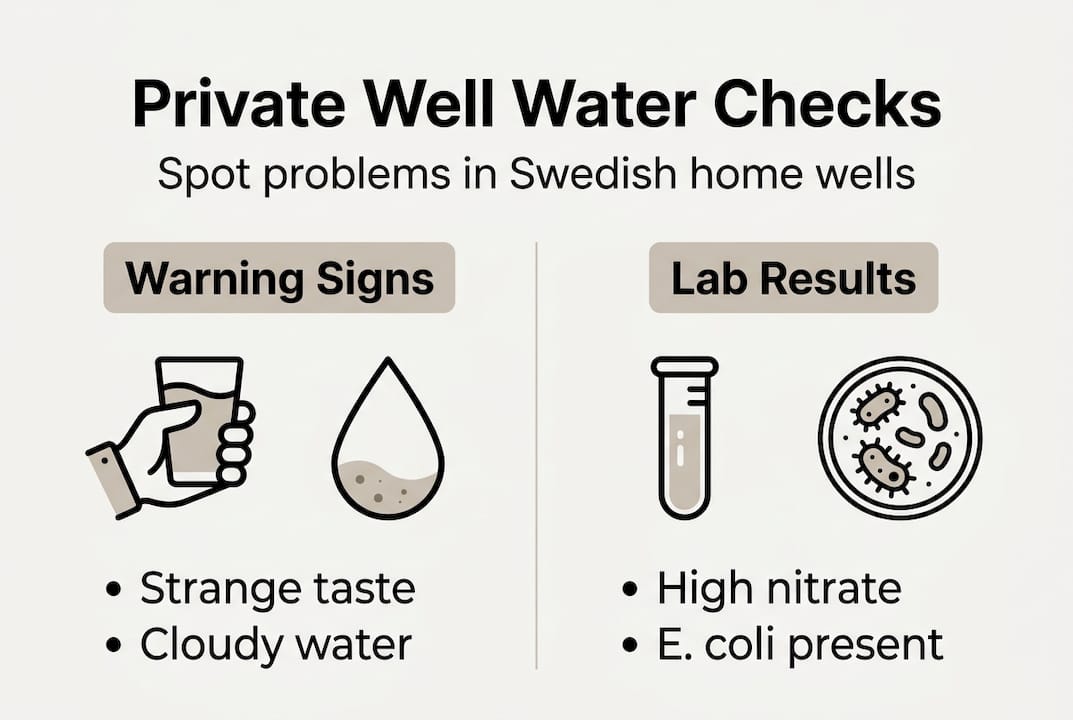
- Unusual taste: A metallic, salty, or bitter flavor often points to elevated iron, manganese, or chloride levels.
- Strange odor: A rotten egg smell typically signals hydrogen sulfide or bacterial activity. A chemical smell may indicate contamination from nearby agriculture or industry.
- Discoloration: Yellow or brown water often means high iron. Blue-green staining on fixtures can indicate copper leaching from pipes.
- Cloudiness or turbidity: Murky water after rain or snowmelt may signal surface water intrusion into your well.
- Recurring stomach issues: If household members frequently experience nausea or digestive upset, microbiological contamination is a real possibility.
- Environmental changes nearby: New construction, flooding, road salting, or agricultural activity close to your property can all affect groundwater quality.
Testing frequency should increase to at least once a year if you have children under 5, if your water taste, odor, or color changes, or after events like flooding or nearby construction. Consulting a well water issue guide can help you match symptoms to likely causes before you even send a sample to the lab.
Pro Tip: Keep a simple log of any changes you notice in your water, including dates and descriptions. This record becomes invaluable when discussing results with a lab or water specialist.
Preparing for water testing: What you need and when
Armed with symptoms and timing, the next step is understanding sampling standards and preparation details. Timing your test correctly and using the right materials are just as important as the analysis itself.
When to test:
- Routinely, at least every 3 years for a stable well with no known issues.
- Annually if your household includes infants, elderly residents, or immunocompromised individuals.
- Immediately after flooding, heavy rainfall, nearby construction, or any sudden change in water appearance or taste.
- Before selling your property, since buyers and lenders increasingly expect a current water quality report.
What you need:
- Sterile sampling bottles provided by your chosen laboratory.
- Clear written instructions from the lab on how to collect the sample.
- A cooler or insulated bag to keep the sample cold during transport.
- Fast delivery, ideally within 24 hours of collection.
Only Swedac-accredited labs following LIVSFS 2022:12 standards produce results that are legally valid and comparable to public water benchmarks. Non-accredited testing kits sold online cannot substitute for this.
| Situation | Recommended action |
|---|---|
| Stable well, no changes | Test every 3 years |
| Children under 5 in household | Test annually |
| After flooding or construction | Test immediately |
| Selling property with private well | Test before listing |
| Taste, odor, or color change | Test immediately |
Understanding the importance of regular testing helps you stay ahead of problems rather than reacting to them. For a full walkthrough of the process, the water testing guide for Swedish well owners covers every step in detail.
Pro Tip: Order your sampling kit before you need it. Having sterile bottles and instructions on hand means you can act immediately when something changes, rather than waiting days for supplies to arrive.
Step-by-step process: How to collect a proper water sample
With materials ready, here is how to ensure reliable water samples for trustworthy lab results. A poorly collected sample can produce misleading results, so precision here protects the integrity of your entire analysis.
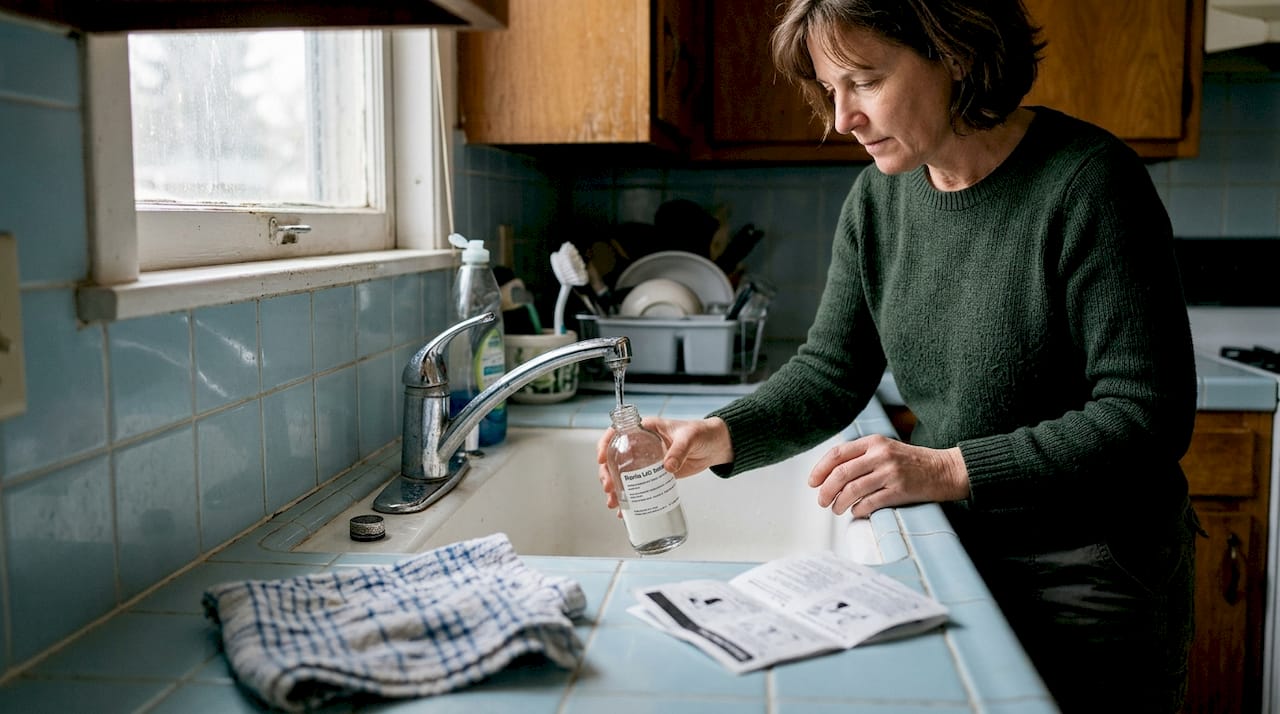
- Use only the sterile bottle from your accredited lab. Never substitute a household container, even if it looks clean. Residue from soap or previous contents will contaminate the sample.
- Remove any aerator from the faucet. Aerators trap bacteria and debris that do not reflect your actual well water. Unscrew and set it aside before sampling.
- Choose the cold tap closest to where water enters your home, ideally before any filters, softeners, or treatment systems. You want to test the raw well water, not the treated output.
- Run the tap for 2 to 3 minutes before collecting. This flushes stagnant water from the pipes and gives you a representative sample from the well itself.
- Fill the bottle carefully without touching the inside of the cap or bottle neck. Contamination from your hands can skew microbiological results.
- Seal, label, and refrigerate immediately. Place the sample in a cooler and deliver it to the lab within 24 hours.
Proper sampling technique is the foundation of a valid water analysis. Even the best laboratory cannot compensate for a sample that was collected incorrectly.
| Correct approach | Common mistake |
|---|---|
| Sterile lab bottle | Household jar or bottle |
| Cold tap before filters | Tap after water softener |
| Aerator removed | Aerator left in place |
| Delivered within 24 hours | Left at room temperature overnight |
| Hands away from bottle interior | Fingers touching bottle neck |
Following these brunn water check steps consistently ensures your results reflect reality, not sampling error.
Interpreting your test results: Key parameters and what they mean
Once your sample is analyzed, interpreting the numbers is crucial to taking action. A lab report lists dozens of values, but a handful of parameters carry the most weight for health and safety.
| Parameter | Safe threshold | Health concern if exceeded |
|---|---|---|
| E. coli | 0 CFU/100 ml | Fecal contamination, acute illness |
| Coliform bacteria | 0 CFU/100 ml | General contamination indicator |
| Enterococci | 0 CFU/100 ml | Fecal contamination |
| pH | 6.5 to 9.5 | Corrosion of pipes, taste issues |
| Iron (Fe) | Less than 0.2 mg/l | Staining, taste, pipe damage |
| Manganese (Mn) | Less than 0.05 mg/l | Neurological risk at high levels |
| Nitrate (NO3) | Less than 50 mg/l | Risk for infants, blue baby syndrome |
| Arsenic (As) | Less than 0.01 mg/l | Long-term cancer risk |
| Lead (Pb) | Less than 0.01 mg/l | Neurological damage, especially in children |
| Radon | Varies by region | Lung cancer risk in granite areas |
| Color | Less than 15 mg Pt/l | Aesthetic, possible organic matter |
Key microbiological and chemical benchmarks are set by Livsmedelsverket and align with EU drinking water directives. Any detection of E. coli or coliforms requires immediate action, since zero tolerance applies. Understanding water quality standards for private wells helps you prioritize which values to address first.
For a deeper look at individual values, the parameter breakdown resource explains each indicator in plain language. If bacteria are your concern, reviewing microbiological analysis methods gives you a clearer picture of what the numbers actually mean.
Troubleshooting: Addressing and preventing water quality issues
When test results signal a problem, use these troubleshooting steps to find and fix the issue. Acting quickly protects your household and prevents a temporary problem from becoming a permanent one.
- Identify the likely source. Check your well cap for cracks or gaps. Look at the proximity of your well to septic systems, agricultural fields, or roads treated with salt or chemicals.
- Match the treatment to the contaminant. UV disinfection is effective against bacteria. Iron and manganese filters address metal overload. Aeration systems reduce radon in water from granite bedrock areas.
- Do not skip the retest. After any treatment or repair, retest and verify that levels have returned to safe thresholds. A single fix does not guarantee lasting results.
- Consult a local expert. Your lab report provides context, but a certified water technician or hydrogeologist can assess structural issues with your well that no test alone can reveal.
- Monitor groundwater trends. Climate change and seasonal drought can lower groundwater levels, concentrating contaminants. You can monitor groundwater levels through SGU’s national database to stay informed about regional trends.
Common sources of well contamination include:
- Cracked or poorly sealed well casings
- Septic systems located too close to the well
- Surface runoff carrying fertilizers or pesticides
- Old pipes leaching lead or copper
- Natural geology releasing arsenic, radon, or manganese
“If your results show elevated bacteria, do not wait. Stop using the water for drinking and cooking until the source is identified and treated.” — Livsmedelsverket guidance
Understanding what water analysis covers helps you choose the right follow-up test after remediation, so you are not paying for parameters that are not relevant to your situation.
Professional help: Simplify your water quality testing
If home troubleshooting feels overwhelming, or you simply want full confidence in your results, professional accredited testing removes the guesswork entirely. Knowing your water is safe should not require a chemistry degree.
At Svenskt Vattenprov, every analysis is processed by SGS Analytics and Eurofins, a Swedac-accredited laboratory operating under the same standards as public waterworks. Results are legally valid, clearly explained, and come with concrete recommendations tailored to your specific situation. For households wanting thorough coverage across all major risk categories, the complete water analysis package tests 71 parameters and leaves nothing to chance. If your primary concern is microbial safety, the bacteria water testing package delivers fast, focused results. We handle everything from sampling kit to final report, so you can focus on what matters.
Frequently asked questions
How often should I test my private well in Sweden?
Test at least every 3 years for a stable well, or annually if you have small children, notice changes in water quality, or experience nearby environmental disturbances like flooding or construction.
What are the main signs of contaminated well water?
Changes in taste, odor, color, or clarity are the most common early indicators. Recurring stomach illness among household members may also point to microbiological contamination that is not visible to the eye.
How do I collect a valid water sample for lab testing?
Use only the sterile bottle supplied by your accredited lab, collect from the cold tap before any filters, remove the aerator first, and deliver to a Swedac-accredited lab within 24 hours of collection.
What are normal values for E. coli and nitrate in Swedish well water?
E. coli and coliforms must be zero CFU per 100 ml. Nitrate should stay below 50 mg/l. Any detection of E. coli requires immediate action regardless of the level.
Can changes in weather or climate affect my water quality?
Yes. Drought and extreme rainfall can both concentrate or introduce contaminants into groundwater. Low groundwater levels increase risk, and regular monitoring through SGU’s national database helps you stay aware of regional trends.
Recommended
- 10 essential water analysis facts for Swedish well owners – Svenskt Vattenprov
- Drinking water quality standards for Swedish private wells – Svenskt Vattenprov
- What is water analysis: a guide for Swedish well owners – Svenskt Vattenprov
- How guidelines shape water analysis for Swedish well owners – Svenskt Vattenprov