

Important substances to analyze in drinking water from a well
Many well owners never notice that their water is contaminated. It tastes normal, has no smell, and looks clear. Yet, it can contain bacteria, metals, or chemicals that affect health over a long period. The Swedish Food Agency recommends that you regularly analyze your well water, precisely because problems are rarely visible to the naked eye. In this article, we go through which substances should always be included in your water analysis, how often you should take samples, and what to do if the results show deviations.
Table of Contents
- How often should you analyze your drinking water?
- Which substances should always be analyzed in drinking water?
- Most common water problems and risks in Swedish wells
- How to take and interpret water samples correctly
- Secure your water analysis with expert help
- Common questions about water analysis for private wells
Key Insights
| Point | Details |
|---|---|
| Analyze at intervals | Test your water at least every three years, or annually if you have children, a new well, or changes. |
| Normal analysis required | Always include microbiology, metals, nitrate/nitrite, and basic chemical parameters. |
| Common problems in wells | Bacteria and metals are most common, especially in drilled wells and agricultural areas. |
| Correct interpretation provides security | Read the results against the Swedish Food Agency's limit values, and in case of deviations – investigate and rectify. |
| Professional sampling | Always use an accredited lab, send the sample chilled, and follow sampling instructions carefully. |
How often should you analyze your drinking water?
After understanding why water analyses are important, the next question is: when should you actually take a sample? The answer depends on your living situation and the type of well you have.
Analysis should be done every three years, but certain situations require you to act faster. Here are the most common occasions when you should take a sample without waiting:
- You have children under 5 years old in the household. Infants and young children are particularly sensitive to nitrates and bacteria. Do not wait for the next regular analysis.
- You have bought or are selling a property. A current water analysis is a requirement when buying a house and provides security for both parties. Read more about drinking water requirements for well owners.
- There has been a flood or heavy rainfall. Surface water can penetrate the well and carry bacteria.
- You notice a change in taste, smell, or color. This is a clear sign that something has changed in the water.
- The surroundings have changed. New construction, agriculture, or industry nearby can affect groundwater.
Always choose a Swedac-accredited laboratory for your analysis. This guarantees that the results are reliable and comparable to Swedish limit values. If you have more questions about sampling, you can find answers to common questions about well water.
Pro tip: Set a reminder in your calendar every three years. It's easy to forget, and three years go by quickly.
Which substances should always be analyzed in drinking water?
Now that you know when sampling is needed, it's time to look at exactly which substances should be tested. The Swedish Food Agency's normal analysis covers both microbiological and chemical parameters, and there are good reasons for each individual test.
Microbiological tests aim to find bacteria that should not be present in drinking water:
- E. coli is a sign of fecal contamination, meaning that feces from humans or animals have reached the well.
- Coliform bacteria are a broader measure of hygienic quality.
- Cultivable microorganisms show the total amount of bacteria in the water.
The chemical and physical parameters are just as important. Here is an overview:
| Parameter | Why it is tested |
|---|---|
| Arsenic | Naturally occurring in bedrock, carcinogenic at high levels |
| Lead | Can leach from old pipes, dangerous for children |
| Uranium | Found in granite, stresses the kidneys |
| Nitrate and nitrite | High in agricultural areas, dangerous for infants |
| Fluoride | Naturally occurring in groundwater, damages teeth at high levels |
| Radon | Radioactive gas in drilled wells |
| Iron and manganese | Gives taste and discoloration, technical problems |
| pH value | Acidic water leaches metals from pipes |
| Turbidity | Cloudy water can hide bacteria |
A figure that puts everything into perspective: only 20 percent of private wells in Sweden had potable water without remarks according to national data from 2007 to 2019. This means that four out of five wells had something to report. This is a high proportion, and it shows why regular analysis is not optional.
If you want to understand what the various limit values for water substances mean in practice, there is good guidance available.
Most common water problems and risks in Swedish wells
After reviewing the entire analysis list, it is valuable to understand which problems are actually most common in Swedish wells. This depends largely on where you live and what type of well you have.
Common problems in Swedish wells include bacteria such as E. coli and coliforms, elevated levels of nitrate and nitrite, metals from the bedrock, and radon and PFAS. Here is a comparison between the two most common well types:
| Problem | Drilled well | Dug well |
|---|---|---|
| Bacteria | Lower risk | Higher risk |
| Metals (arsenic, uranium) | More common | Less common |
| Radon | Occurs in granite | Rare |
| Surface water intrusion | Uncommon | Common |
| Nitrate | Depends on surroundings | Depends on surroundings |
Dug wells are shallower and more exposed to surface water. This makes them more susceptible to bacteria, especially after heavy rain or snowmelt. Drilled wells reach deeper groundwater but can contain natural metals such as arsenic and uranium depending on the bedrock.
Important to know: PFAS, a group of persistent chemicals, can occur in groundwater near fire stations, airports, and certain industries. If you live near such activities, you should specifically test for PFAS.
Iron and manganese are the most common deviations in Swedish wells. They give the water a metallic taste and can discolor laundry and sanitary porcelain. They are rarely a direct health risk, but they signal that the water needs to be treated. Nitrate, on the other hand, is a serious risk for infants under six months and should always be checked if you live in an agricultural area.
See more about statistics on well problems and how your region compares to Swedish water quality in general.
How to take and interpret water samples correctly
Knowing what to analyze is the first step. Here's how to take the sample itself and what happens after the analysis.
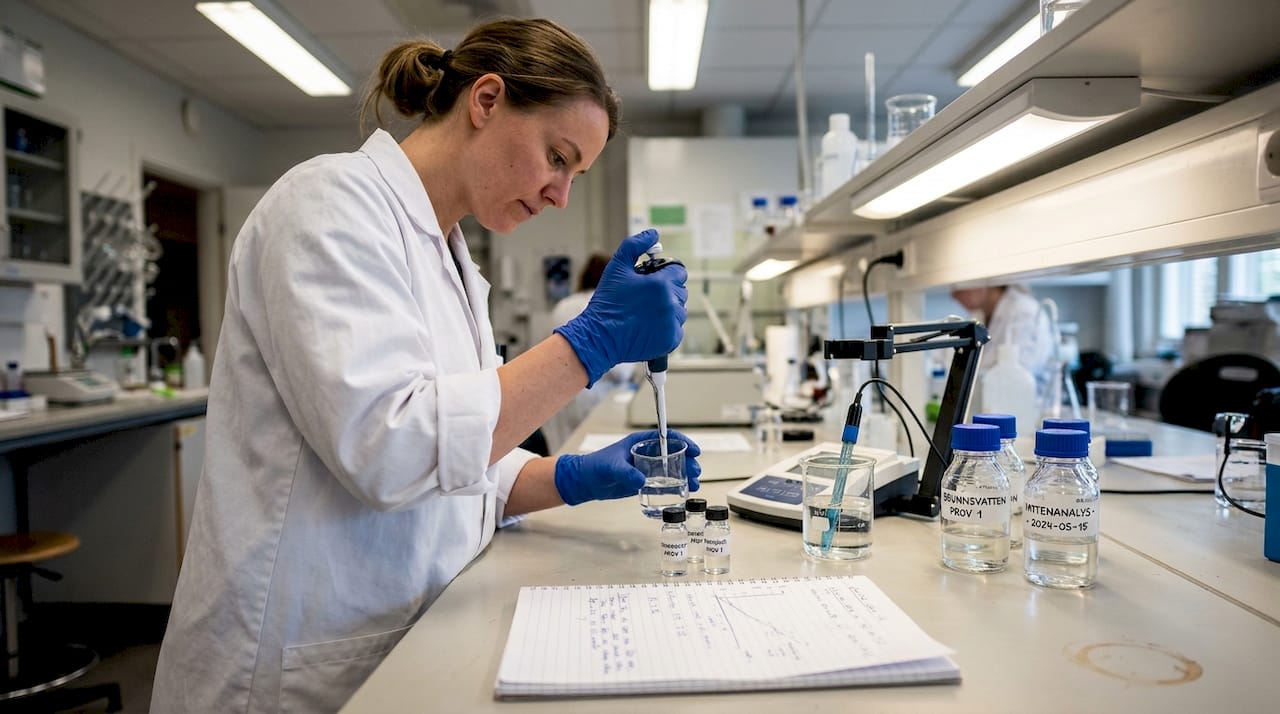
Incorrect sampling can lead to misleading results, even if the laboratory is excellent. Follow these steps to ensure a reliable sample:
- Always use the sterile bottle from the laboratory. Do not transfer to another container.
- Take the sample from the kitchen tap, not from a filter or a mixer with extra functions.
- Flush the tap for two to three minutes before taking the sample, so that stagnant water in the pipes is flushed out.
- Fill the bottle without touching the inside of the lid or the bottle neck.
- Chill the sample immediately and send it the same day or the next morning. Microbiological samples change rapidly at room temperature.
The sample should be taken from the kitchen tap in a sterile laboratory bottle, chilled and sent quickly, and the results interpreted against the Swedish Food Agency's limit values.
When you receive your analysis result, each parameter is compared against established limit values. Values marked as unfit require immediate action. Values with remarks mean that something should be rectified but is not acutely dangerous.
In case of deviations, you should first investigate the cause. Is the well sealed? Is there a possible source of contamination nearby? Then, choose a remedy based on the problem: UV light for bacteria, reverse osmosis for metals and chemicals, or carbon filter for taste and odor. Read more about improvement measures for well water and follow our guide to clean drinking water for concrete advice.
Pro tip: Always save your analysis results. They are valuable for a future house sale and help you see trends in water quality over time.
Secure your water analysis with expert help
Once you know which substances should be included in an analysis and how to interpret the results, it's easy to take the next step. At Svenskt Vattenprov, you will find analysis packages adapted for your specific type of well, whether you have a drilled well, a dug well, or a surface water intake.
We offer everything from targeted bacteria analysis to a complete analysis package with up to 71 parameters for maximum security. All samples are analyzed by SGS Analytics, a Swedac-accredited laboratory, and the results are delivered with clear explanations and concrete recommendations. You don't need to interpret numbers on your own. See all analysis options for wells and choose the package that best suits your situation.
Common questions about water analysis for private wells
Which substances are most critical to analyze in a private well?
E. coli, coliform bacteria, lead, arsenic, nitrate, and uranium are the most important substances to always test in a private well. These are covered by the Swedish Food Agency's normal analysis.
What do I do if my water contains too high levels of metal or bacteria?
Install adapted purification such as UV light for bacteria or reverse osmosis for metals, and investigate the cause of the deviation, for example, the well's tightness or a source of contamination nearby.
Is a quick test sufficient for water analysis?
No. Quick tests are unreliable and do not provide the complete picture that an accredited laboratory does. Always use a Swedac-accredited laboratory for reliable and comparable results.
What is PFAS and should it be analyzed?
PFAS is a group of persistent chemicals that can occur in groundwater near fire stations and industries. PFAS should be tested if you live in a risk area.
How do I save money on water analysis?
Gather several households nearby and order a group analysis, or choose an analysis package that is specially adapted for your well type so that you don't pay for parameters that are not relevant to you.