

Water analysis when selling a house: security for buyers and sellers
Many believe that water analysis is a mandatory step when selling a house. It is not. There is no legal requirement for water analysis when selling a property with a private well. Yet, it is one of the most crucial steps you can take, both as a seller and a buyer. An analysis protects you from health risks, legal disputes, and financial surprises that could otherwise arise long after the deal is done. This article guides you through why analysis is essential, which tests apply, what the process looks like, and what to do if results show problems.
Table of Contents
- Why Water Analysis is Important When Selling a House
- Which Water Analyses Are Needed When Selling a House with a Private Well
- How Often Should Water Analysis Be Performed and When?
- How Water Analysis is Done: Step-by-Step
- What Happens if the Water Quality Doesn't Meet Standards?
- How to Get Help with Water Analysis Before Selling a House
- Frequently Asked Questions About Water Analysis When Selling a House
Key Insights
| Point | Details |
|---|---|
| No legal obligation | There is no requirement for water analysis when selling a house, but it is highly recommended. |
| Security for both parties | A current water analysis provides security for both buyer and seller. |
| Faults can become legal problems | Hidden defects in water quality can lead to seller liability if not disclosed. |
| Difference depending on well type | Drilled and dug wells require different analyses, e.g., radon and bacteria. |
| Sampling is easy | Water analysis is carried out by accredited laboratories with samples from the kitchen tap. |
Why Water Analysis is Important When Selling a House
A house with a private well is attractive. Private water, no municipal fees, freedom. But well water is not controlled by the municipality. It's your responsibility to know what's in it.
Health risks are concrete. Well water can contain E. coli and other bacteria that cause stomach illness. It can contain heavy metals like arsenic and lead, which accumulate in the body over time. In some areas, PFAS, persistent chemicals linked to serious health problems, are present. Radon is common in drilled wells in granite-rich areas. None of these contaminants can be seen, smelled, or tasted.
The legal aspect is equally important. As a seller, you have a duty to disclose. As a buyer, you have a duty to inspect according to the Swedish National Food Agency. This means the buyer is expected to thoroughly inspect the property, including water quality. But if the seller knew about a problem and did not disclose it, it could be classified as a hidden defect, potentially leading to claims for price reduction or damages.
A water analysis is not just a piece of paper. It is proof that you, as the seller, have taken your responsibility, and that the buyer knows what they are purchasing.
The financial consequences can be significant. A well that needs sanitizing or a water system that requires filters can cost tens of thousands of kronor. Understanding the importance of water analysis early in the process can save both money and conflicts.
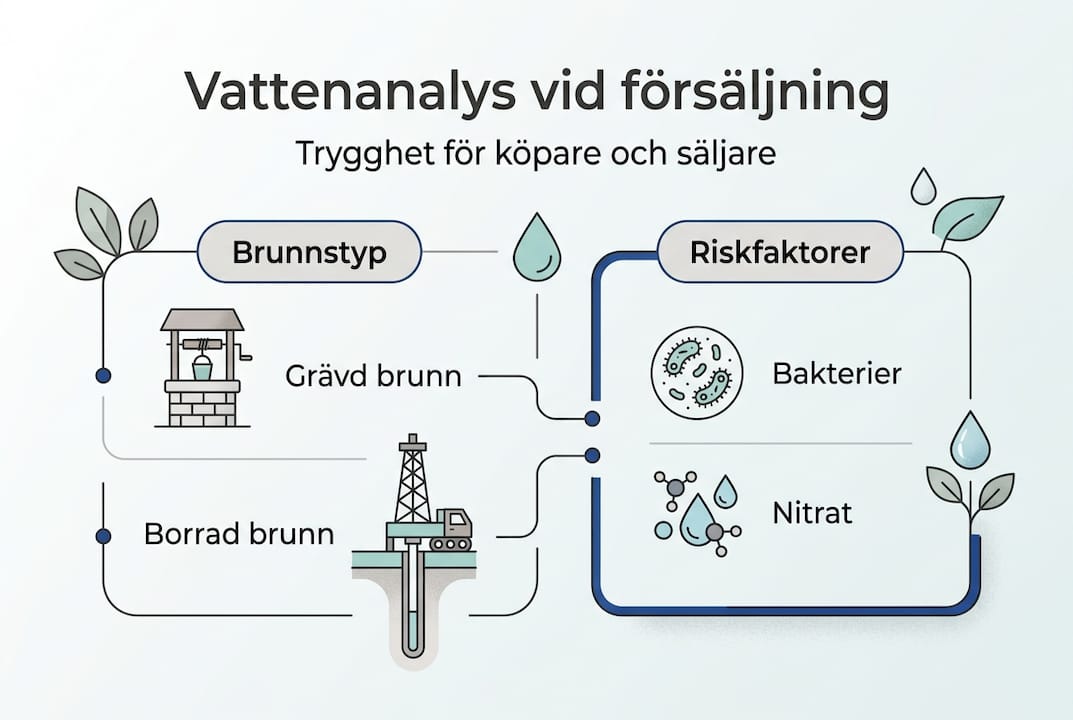
In short: an analysis costs little. A dispute over a hidden defect costs much more.
Common contaminants to be aware of:
- Bacteria: E. coli, coliform bacteria, enterococci
- Chemicals: nitrate, nitrite, PFAS, pesticides
- Metals: arsenic, lead, manganese, iron
- Radioactive substances: radon (especially in drilled wells)
- Physical parameters: pH, hardness, turbidity
Pro tip: Always ask for a current water analysis when viewing a house with a private well. If the analysis is older than three years, or completely missing, you should factor in the cost of a new analysis and consider it in your bid.
Which Water Analyses Are Needed When Selling a House with a Private Well
There isn't a single standard test that fits all wells. The choice depends on the well type, surroundings, and what you want to know.
The basic distinction is microbiological versus chemical analysis. Microbiological analysis measures bacteria and microorganisms. Chemical analysis measures substances such as metals, nitrate, pH, and organic compounds. For a house sale, you want both. Analyses include microbiological, chemical, and health-related parameters and are sent to accredited laboratories for reliable results.
Dug wells and drilled wells have different risks. Dug wells are shallower and more susceptible to surface water intrusion, increasing the risk of bacteria and nitrates from agriculture or sewage. Drilled wells reach deeper groundwater but can have higher levels of radon, arsenic, and manganese.
| Well type | Primary risks | Recommended package |
|---|---|---|
| Dug well | Bacteria, nitrate, surface water intrusion | Analysis dug well (31 parameters) |
| Drilled well | Radon, arsenic, manganese, iron | Analysis drilled well (41 parameters) |
| Both types | PFAS (near airports, industry) | Add PFAS analysis |
| Maximum security | All parameters | Complete+ (71 parameters) |
When selling a house, we recommend at least one package that covers both microbiological and chemical parameters. If the property is located near an airport, military facility, or industrial area, you should add a PFAS analysis. If the well is in a granite area, for example in Värmland, Dalarna, or parts of Norrland, a radon test is important.
If you want to understand common water quality deficiencies in Sweden, or read about drinking water limit values according to the Swedish National Food Agency, there are good resources to consult before choosing a package.
Common analysis packages for house sales:
- Microbiological basic analysis: bacteria, E. coli, enterococci
- Chemical analysis: metals, nitrate, pH, hardness
- Radon analysis: for drilled wells in granite areas
- PFAS analysis: 30 PFAS substances for risk areas
- Complete package: covers all the above and more
How Often Should Water Analysis Be Performed and When?
The Swedish National Food Agency recommends analysis every three years, but more often if the well serves several households or if there are small children in the household. This is a rule of thumb, not a ceiling.
There are situations where you should test immediately, regardless of when the last analysis was done:
- Before selling a house – always. A fresh analysis strengthens trust and protects you legally.
- After heavy rain or flooding – surface water may have entered the well.
- With new construction or agricultural activity nearby – groundwater may have been affected.
- If the water changes in taste, smell, or color – test immediately.
- When a new well is drilled or dug – verify quality from the start.
- If you recently bought the property – don't assume previous owners tested.
| Situation | Recommended action |
|---|---|
| Normal operation, no change | Every three years |
| Several households on the same well | Every year |
| Small children in the household | Every year |
| Before selling a house | New analysis regardless of last date |
| Change in surroundings | Immediately |
| Abnormal taste, smell, or color | Immediately |
A guide to ensuring clean water can help you plan sampling correctly and understand what the results mean in your specific situation.
How Water Analysis is Done: Step-by-Step
The process is simpler than many think. You don't need to hire a consultant or book a technician to come to your home. You take the sample yourself, at home in the kitchen.
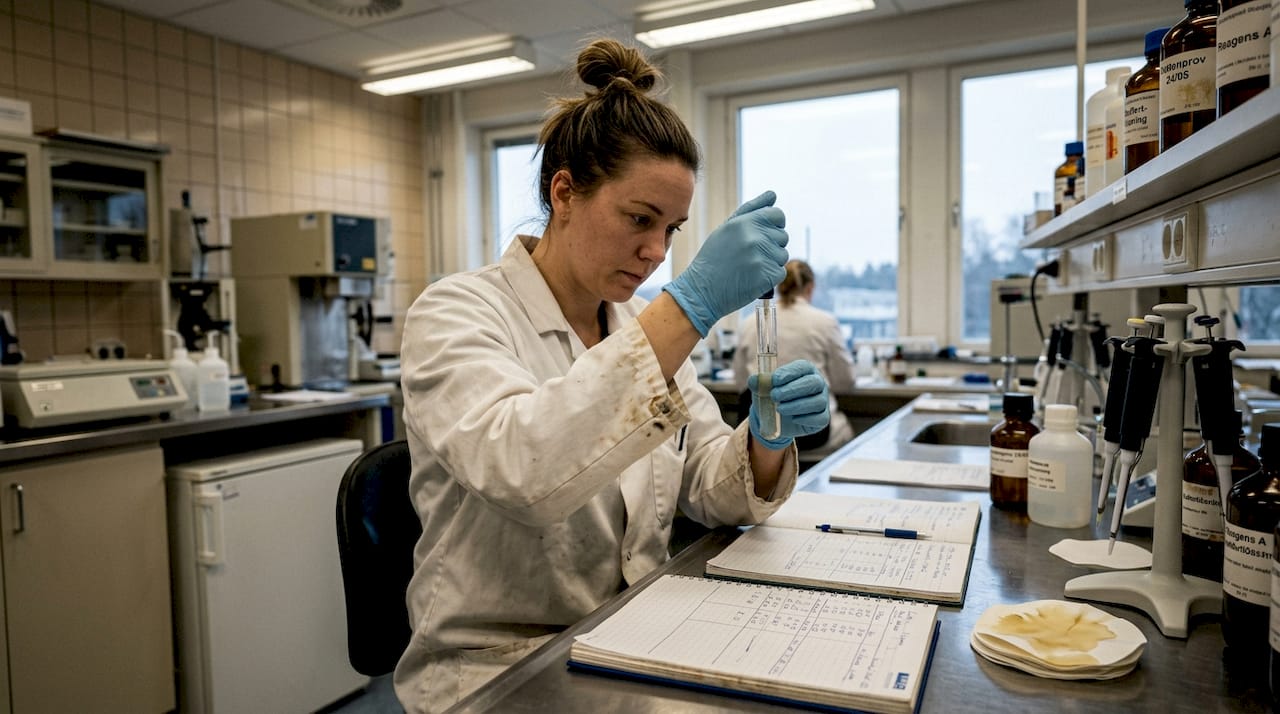
Samples are taken from the kitchen tap and then sent to a Swedac-accredited laboratory for analysis. Here's how the process works:
- Order an analysis kit – choose a kit based on well type and needs. You will receive sample bottles and clear sampling instructions sent to your home.
- Prepare for sampling – read the instructions carefully. Clean the kitchen tap with rubbing alcohol. Let the water run for 2 minutes before filling the bottles.
- Take the sample – fill the bottles according to the instructions. Different bottles are used for microbiological and chemical analysis, respectively. Do not mix them up.
- Send the sample quickly – microbiological samples are time-sensitive. Send on the same day or the day after sampling, preferably not before a weekend.
- Receive and interpret results – you will receive a report with all measured values compared against the Swedish National Food Agency's limit values. Deviating values are clearly marked.
Pro tip: Never take the sample on a Friday if you cannot send it immediately. Microbiological samples that sit over the weekend yield unreliable results. Choose a Monday to Wednesday for the best outcome.
Unsure why sampling is important or do you have common questions about water analysis? Answers to most concerns are gathered in one place.
What Happens if the Water Quality Doesn't Meet Standards?
An analysis result showing deviating values is not a disaster. It is information. And information gives you the opportunity to act.
The Swedish National Food Agency recommends measures depending on the type of problem identified. Bacteria can often be remedied by chlorination and cleaning of the well. High levels of iron or manganese are handled with filters. PFAS and radon require more specific solutions, but there are proven methods for both.
Common actions for inadequate water quality:
- Bacteria: chlorination, well cleaning, UV filter
- Iron and manganese: iron filter, aeration
- Radon: radon separator, ventilation of the water system
- PFAS: activated carbon filter, reverse osmosis
- Nitrate: reverse osmosis, new water source
- Low pH (acidic water): neutralization filter
The legal aspect is important to understand. If the seller knew about deficient quality but did not inform the buyer, it could be classified as a hidden defect under the Land Code. This could lead to claims for a price reduction, compensation for measures, or in the worst case, cancellation of the purchase.
As a seller, it is always better to know about a problem and deal with it openly, rather than hoping it won't be discovered. Transparency protects you.
If the analysis shows problems before a sale, you have three options: remedy the problem and take a new sample, price the property considering the need for remediation, or clearly inform the buyer in the contract. All three are better than hiding the information. Read more about well water statistics and information on Swedish water quality to put your results into a broader context.
How to Get Help with Water Analysis Before Selling a House
Now you know why water analysis matters, which tests are relevant, and how the process works. The next step is to actually carry out the analysis, and it's easier than you think.
Svenskt Vattenprov offers analysis packages tailored to your specific situation. If you have a dug well, there's a package with 31 parameters, with an extra focus on bacteria and surface water intrusion. If you have a drilled well, our most popular package covers 41 parameters including radon and metals. If you want maximum security before a sale, we recommend our complete water analysis with 71 parameters. All samples are analyzed by SGS Analytics, a Swedac-accredited laboratory, and the results are legally sound and directly usable for property transactions. You receive sampling equipment sent to your home, clear instructions, and an easy-to-understand report.
Frequently Asked Questions About Water Analysis When Selling a House
Do I have to perform a water analysis before selling a house with a private well?
No, there is no legal requirement for water analysis when selling a house, but it is strongly recommended to avoid health risks and legal liabilities.
Which substances are tested in a water analysis of a private well?
Commonly tested substances include bacteria, nitrate, heavy metals, radon (drilled well), PFAS, and pH value. Analyses include microbiological, chemical, and health-related parameters and are performed by accredited laboratories.
How often should well water be analyzed?
The Swedish National Food Agency recommends analysis every three years, more often if the well serves several households or if there are small children in the household.
What happens if the analysis shows poor water quality?
You should remedy the deficiencies, for example, through filters or sanitation. If the seller knew about and did not inform, poor water quality can become a legal issue during a sale.
Who performs the analysis and where should samples be taken?
The sample is taken from the kitchen tap and sent to an accredited laboratory, often listed with Swedac or through commercial entities like Svenskt Vattenprov.