

Identify signs of altered water quality in wells in 2026
Many well owners believe that bad water always smells foul or tastes strange. However, the reality is more nuanced. Subtle changes in color, deposits on faucets, or sudden variations in water clarity can signal serious problems long before they become apparent to your senses. Recognizing these early signs is crucial to protect your family's health and ensure a safe water supply. This article provides practical knowledge to identify common signs of altered water quality and know when to act.
Table of Contents
- Summary of Key Signs of Altered Water Quality
- Common Sensory Signs of Altered Water Quality
- Difference Between Aesthetic and Health-Related Water Problems
- Practical Steps to Detect and Manage Altered Water Quality
- How Svenskt Vattenprov Can Help You Secure Your Well Water Quality
- Frequently Asked Questions About Signs of Altered Water Quality
Summary of Key Signs of Altered Water Quality
| Sign | Explanation |
|---|---|
| Taste, Odor, and Color Changes | These sensory indicators are often the first signs of mineral or bacterial issues in well water. |
| Discoloration and Deposits | Brown water or rust stains on porcelain usually indicate elevated levels of iron or manganese. |
| Sudden Changes | Rapid variations in water quality can indicate microbiological risks that require immediate analysis. |
| Chronic Problems | Slow changes over time are often linked to chemical substances that need professional assessment. |
| Laboratory Tests | Only certified analyses can confirm actual health risks and distinguish them from aesthetic problems. |
Common Sensory Signs of Altered Water Quality
Your senses are the first tools for detecting problems in well water. When you turn on the tap and notice something different, you should pay attention to these signals. Taste changes can be due to iron, manganese, and sulfur bacteria affecting the water in different ways. A metallic aftertaste often indicates high iron levels, while an earthy or musty taste can come from organic matter or algae in the well. Bitter taste is usually associated with high pH or the presence of certain minerals.
The smell tells its own story about what is happening in your well. A stale, rotten egg smell almost always signals water odor and taste problems related to sulfur bacteria or hydrogen sulfide in the water. These bacteria thrive in oxygen-poor environments and produce gases that give off the characteristic smell. A chlorine-like smell, on the other hand, may indicate that a neighbor has treated their well, or that there are residues of disinfectant in the system. Moldy or earthy odors point to organic decomposition or surface water intrusion.
Color changes are perhaps the most obvious visual sign. Clear water that suddenly turns brown, yellow, or reddish almost always indicates elevated levels of iron or manganese. When these minerals come into contact with oxygen, they oxidize and give the water its characteristic color. Cloudy or milky water can be due to air in the pipes, but also to fine particles of clay or sediment. A greenish tint may indicate algal influence, especially in dug wells with surface water intrusion.

These sensory changes are rarely dangerous in themselves, but they serve as early warning signs. Observing and documenting them regularly helps you detect trends before they develop into more serious problems. A guide for safe drinking water can provide structure to your monitoring.
Pro Tip: Fill a white container with water and let it sit for 30 minutes. Iron and manganese oxidize during this time, making any color changes more apparent than when the water flows directly from the tap.
Common sensory signs to observe:
- Metallic, earthy, or bitter taste that has changed from before
- Smell of rotten eggs, stale, or mold when you turn on the tap
- Browning, yellowing, or cloudiness in the water
- Red or brown stains on porcelain, sinks, or textiles after washing
- Increased foaming or altered water hardness
Difference Between Aesthetic and Health-Related Water Problems
Understanding the difference between cosmetic and dangerous water problems is crucial for prioritizing the right actions. Aesthetic problems rarely cause health risks, while microbiological changes can be dangerous. Iron and manganese cause discoloration and stains but are not toxic at normal levels. They primarily affect how the water looks, tastes, and smells. The same applies to hard water with high calcium levels that cause limescale deposits but do not pose a health risk.
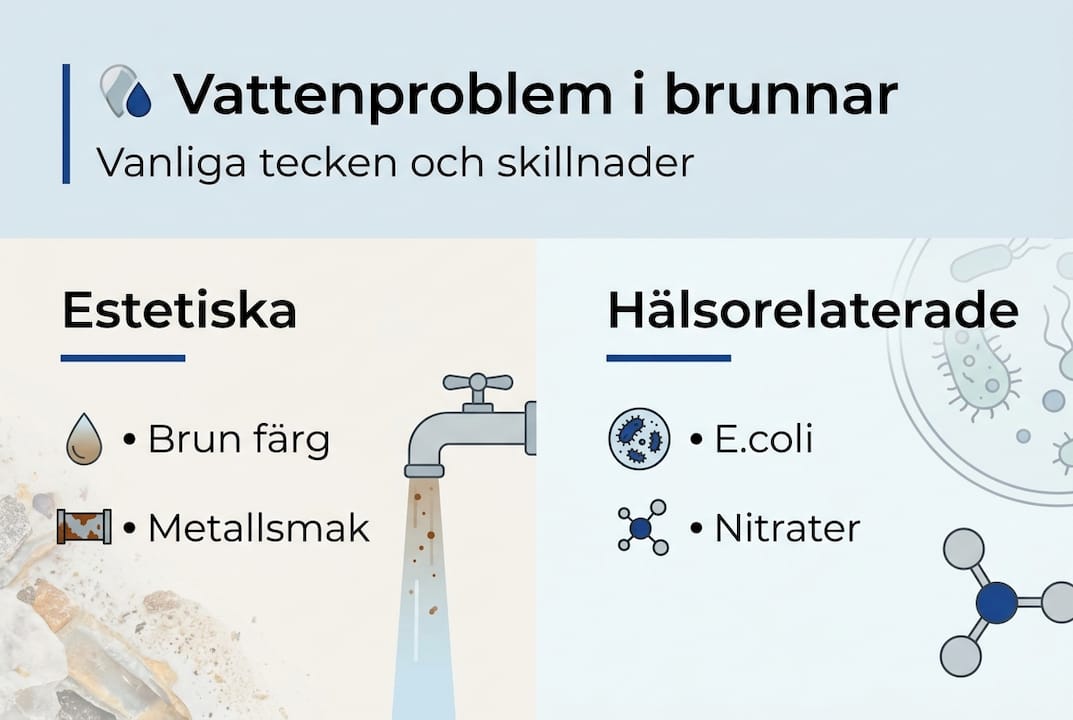
Microbiological threats are a completely different category. Bacteria such as E. coli, enterococci, and coliform bacteria can cause acute gastrointestinal illnesses, diarrhea, and other infections. These microorganisms rarely show clear sensory signs until the problem is extensive. You can have dangerous bacterial levels in the water without noticing any change in taste, smell, or color. This makes regular sampling critical, especially after floods, spring thaws, or if animals have been near the well.
Chemical problems often develop slowly and can be difficult to detect without analysis. Nitrates from fertilizer or sewage, PFAS from industrial activity, pesticides from agriculture, or arsenic from the bedrock do not show obvious signs. However, long-term exposure can lead to serious health effects. Prioritize microbiological analysis for sudden changes, chemicals for chronic problems, or if you live in risk areas.
Statistics from well water statistics show that many Swedish wells have aesthetic problems that do not directly affect health. But the same data also shows that microbiological deviations occur more often than well owners believe. Knowing what type of problem you have helps you make the right decisions about measures and investments.
| Problem Type | Common Signs | Health Risk | Action Priority |
|---|---|---|---|
| Aesthetic (iron, manganese) | Browning, stains, metallic taste | Low to none | Medium |
| Microbiological (bacteria) | Sudden odor, cloudiness, stomach upset | High | Urgent |
| Chemical (nitrates, PFAS) | No clear signs | Medium to high with long-term exposure | High in risk areas |
| Hardness (calcium) | Limescale deposits, poorer soap lather | None | Low |
A thorough understanding of important water parameters helps you interpret your observations correctly. When you know what different signs mean, you can act quickly in the face of real threats and avoid unnecessary worry about harmless aesthetic problems.
Pro Tip: Create a simple logbook where you note the date, weather conditions, and any changes in the water. Patterns over time can reveal if problems are seasonal or linked to specific events such as heavy rain or snowmelt.
Practical Steps to Detect and Manage Altered Water Quality
Systematically monitoring and acting on signs requires a structured approach. Here are the five steps that give you control over your well water quality.
-
Observe regularly. Make it a habit to check the water every week. Fill a glass and observe the color and clarity against a white background. Smell the water directly from the tap. Note the taste when you drink. Check faucets, sinks, and toilets for new stains or deposits. Small changes are easier to detect when you have a regular reference point.
-
Document thoroughly. Write down all deviations with the exact date and description. Include weather conditions, such as heavy rain or significant temperature variations. Note if there have been changes in the surroundings, such as new construction, drainage, or agricultural activity. Photograph any discoloration or deposits. This documentation will be invaluable when communicating with laboratories or authorities.
-
Take water samples correctly. Once you have identified signs of a problem, the next step is professional analysis. Follow thorough sampling instructions to ensure reliable results. Use sterile sampling containers and avoid contamination. Take samples at the right time, usually early in the morning when the water has been still overnight. For bacterial analyses, timing is critical; the sample must be analyzed within 24 hours.
-
Analyze with reliable laboratories. Always choose Swedac-accredited laboratories that comply with Swedish and European standards. The results should be comparable to the guidelines of the National Food Agency and the Swedish Environmental Protection Agency. A good analysis report explains each parameter and provides concrete recommendations based on your values. Understand what the numbers mean for your specific situation.
-
Implement the correct measures. Based on the analysis results, you may need different solutions. Iron and manganese often require oxidation and filtration. Bacteria require disinfection, perhaps shock chlorination or UV treatment. High nitrate levels may require reverse osmosis or switching water sources. Chemical contaminants may need special filters or, in the worst case, a new well. Read more about well water improvement measures to choose the right solution.
25% of Swedes get drinking water from private wells, and climate change affects quality. More extreme weather conditions, longer dry periods followed by intense rain, increase the risk of both microbiological and chemical contamination. Your proactive monitoring therefore becomes increasingly important.
| Step | Action | Frequency | Tool |
|---|---|---|---|
| 1 | Sensory check | Weekly | Glass, white background, smell and taste test |
| 2 | Documentation | Upon each deviation | Logbook, camera, weather data |
| 3 | Sampling | Every 3 years or upon signs | Sterile sampling containers, instructions |
| 4 | Laboratory analysis | After sampling | Swedac-accredited laboratory |
| 5 | Measures | Based on results | Filter, disinfection, purification system |
Pro Tip: Save all analysis results in a binder or digital folder. Historical data helps you see trends and may be necessary for government contacts, grant applications, or property sales.
How Svenskt Vattenprov Can Help You Secure Your Well Water Quality
When you detect signs of altered water quality, you need a reliable partner for analysis and advice. Svenskt Vattenprov offers complete solutions for well owners who want security and clarity. Our analysis packages are compiled by experts and analyzed by SGS Analytics, a Swedac-accredited laboratory that complies with the regulations of the Swedish Food Agency and the Swedish Environmental Protection Agency.
Choose between bacteria water analysis for quick microbiological control in case of acute signs, or complete water analysis for a comprehensive picture of bacteria, minerals, and chemicals. You receive clear sampling instructions, fast online analysis results, and personal advice to understand what your results mean. We help you from observation to action, so you can feel confident about your water supply.
Frequently Asked Questions About Signs of Altered Water Quality
How often should I check my well water?
The Public Health Agency and the National Food Agency recommend professional analysis every three years for normal conditions. But you should perform sensory checks every week and take samples immediately if there are changes in taste, smell, color, or if events such as flooding, new construction nearby, or animal intrusion have occurred. More information can be found in our frequently asked questions about water.
Which signs of altered water quality are most critical?
Sudden changes in odor or taste, especially if accompanied by cloudiness, are most critical as they can indicate bacterial contamination. Gastrointestinal discomfort in family members after water use is an urgent warning sign. Slow changes such as increasing discoloration or new deposits should also be taken seriously but are rarely acute health risks.
Can discoloration always mean the water is dangerous?
No, discoloration is usually an aesthetic problem linked to iron or manganese that does not pose a direct health risk at normal levels. Brown or yellowish water from these minerals is unpleasant but not toxic. However, discoloration can sometimes mask more serious problems, so a professional analysis is needed to confirm that they are only aesthetic substances.
What type of water analysis is best suited for suspected problems?
For sudden changes or suspected bacteria, start with a bacterial analysis to quickly determine microbiological safety. For chronic problems such as discoloration, deposits, or constantly abnormal taste, choose a complete analysis that covers bacteria, minerals, and basic chemicals. If you live near industry, an airport, or intensive agriculture, special analyses for PFAS or pesticides may be warranted.
How do I act on sudden changes in taste or odor?
Immediately stop drinking the water until it has been analyzed. Use bottled water for drinking and cooking. Contact an accredited laboratory for urgent sampling, especially bacterial analysis. Document exactly when the change began and if anything specific has happened, such as heavy rain, snowmelt, or work in the area. If several people experience gastrointestinal discomfort, also contact the healthcare center and the municipality's environmental office.