

What is PFAS in drinking water – risks, sources, and limit values
PFAS are sometimes called "forever chemicals" – and for good reason. These synthetic substances barely break down in nature and have been found in drinking water in more and more places across Sweden in recent years. But what exactly are PFAS in drinking water, and why should you, as a well owner, care?
PFAS is a collective name for thousands of chemical compounds that have been used in, among other things, firefighting foam, impregnating agents, and non-stick coatings. These substances spread through soil and groundwater, which means they can end up in your well – without you noticing it. PFAS are neither visible, nor do they have a smell or taste. The only way to know if your water contains them is to test it with an accredited analysis, which is precisely what we at Svenskt Vattenprov offer.
In this article, we explain what PFAS are, how they end up in drinking water, what health risks research points to, and what limit values apply in Sweden. You will also receive concrete advice on how to find out if your water is affected – and what you can do about it.
Why PFAS End Up in Drinking Water
PFAS are used in hundreds of industrial processes and consumer products, and it is precisely the spread from these applications that allows the substances to eventually find their way down to the groundwater. Unlike many other pollutants, PFAS remain in the soil and water for an extremely long time, meaning that pollution from decades ago can still affect your well water today.
Common Sources of PFAS Contamination
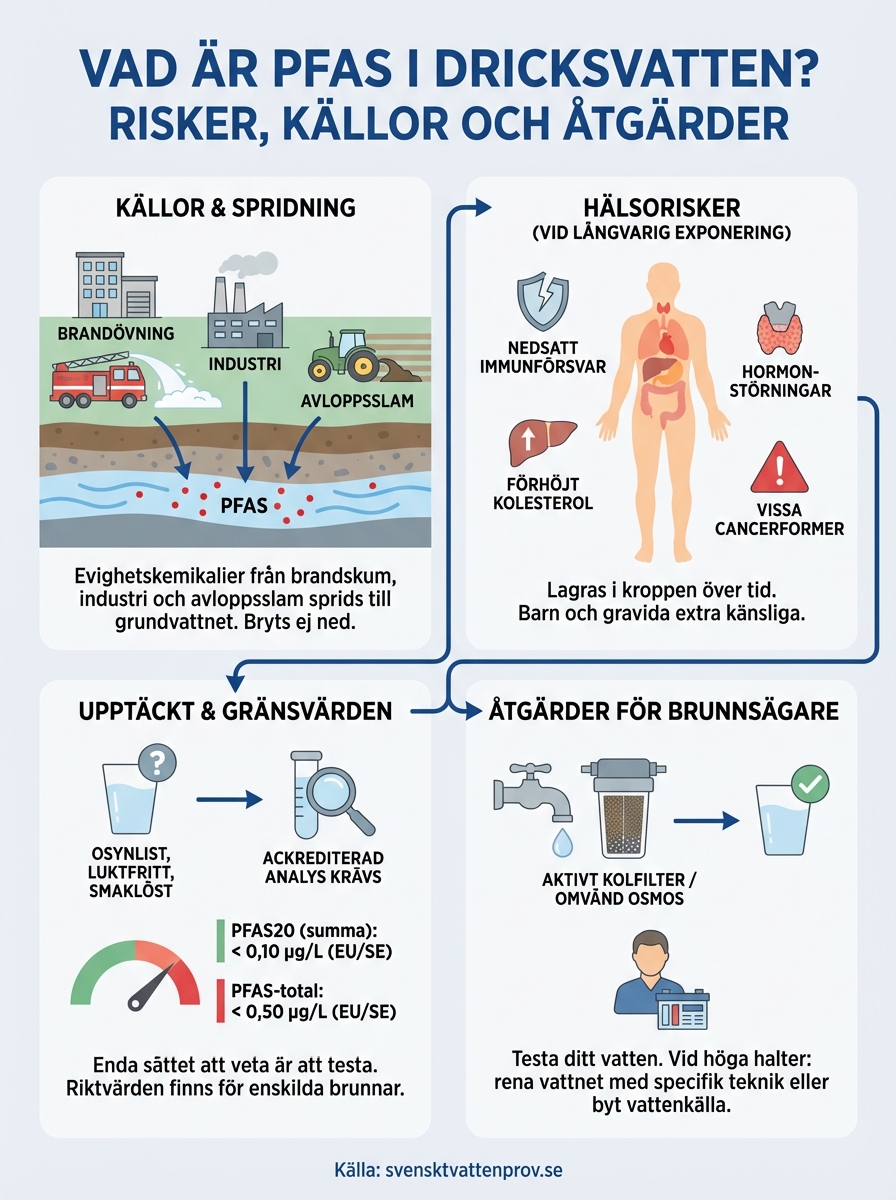
One of the most significant sources of PFAS contamination in Sweden is firefighting foam, known as AFFF. It has been used extensively at military airbases, civilian airports, and fire training sites across the country. The County Administrative Board and the Swedish Environmental Protection Agency have identified hundreds of sites where the soil is heavily contaminated with PFAS after these exercises.
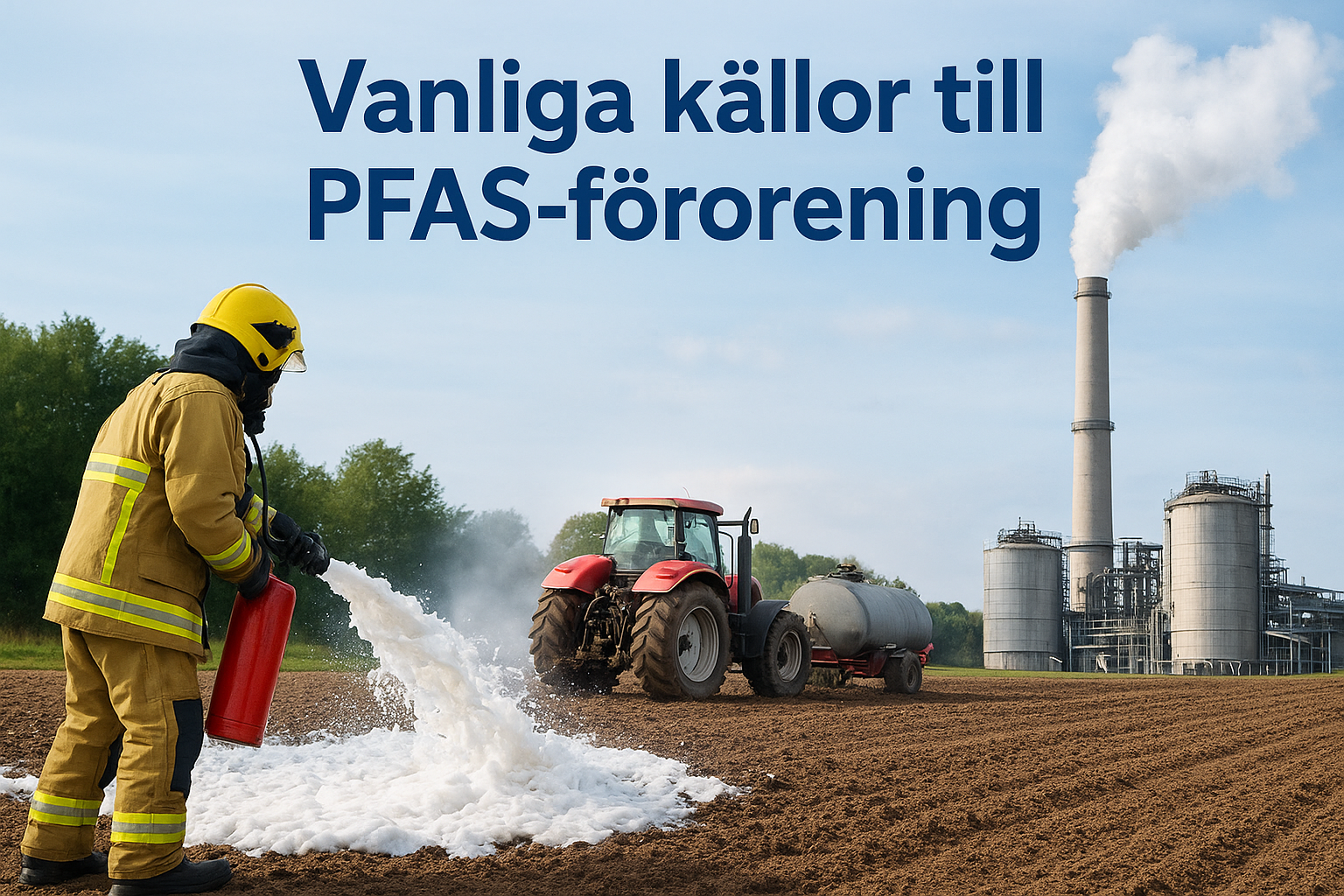
Sewage sludge spread on agricultural land is another important pathway for dispersal. For many years, sewage sludge contained high levels of PFAS, and when it was used as fertilizer, the soil absorbed the substances. Industries that manufactured or used PFAS-based products – such as textiles, food packaging, and electronic components – have also contributed to contaminating soil and groundwater in their immediate vicinity.
The Swedish Environmental Protection Agency estimates that there are at least 5,000 potentially PFAS-contaminated sites in Sweden.
How PFAS Reaches Groundwater
PFAS are water-soluble and do not bind strongly to soil particles, which means they move relatively quickly downwards in the soil. Rain and meltwater transport them deeper and deeper until they reach the groundwater. Once there, the substances can spread horizontally with the groundwater flow and affect wells several kilometers away from the original contamination.
This very mobility makes PFAS so problematic for well owners. Your well could be located far from the nearest industry or fire training site and still contain measurable levels of PFAS. The question of what PFAS in drinking water is about, therefore, is not just about the nature of the chemistry but also about how difficult it is to determine in advance who will be affected.
How PFAS Affects Health
PFAS are stored in the body for a long time. Unlike many other chemicals, these substances are not broken down by the body's normal processes, which means they accumulate in the blood and organs year after year. It is precisely this characteristic that makes the question of what PFAS in drinking water is a concrete health issue and not just an environmental issue.
What Research Shows About Health Risks
Research from, among others, the EU's food safety authority EFSA points to a link between high PFAS levels in the body and several serious health problems. These include an increased risk of elevated cholesterol, impaired immune function, hormonal disturbances, and certain forms of cancer. Studies also show that PFAS can disrupt thyroid function and the body's ability to regulate blood lipids.
In 2020, EFSA established a new tolerable weekly intake for four PFAS substances and concluded that exposure levels in large parts of the European population already exceed what is considered safe.
Children and Pregnant Women Are Especially Vulnerable
Children and fetuses are more sensitive to PFAS exposure than adults, as the substances can affect growth and neurological development. Pregnant women can transfer PFAS to the fetus via the blood, and breastfeeding mothers can transfer the substances via breast milk. This means that families with children or planned pregnancies have an extra reason to check their well water.
Regular exposure via drinking water is considered one of the most important exposure pathways for PFAS. The longer you drink contaminated water, the more the substances accumulate in your body.
What Limit Values Apply in Sweden
Sweden follows the EU Drinking Water Directive from 2020, which for the first time established specific limit values for PFAS in drinking water. These limit values primarily apply to municipal drinking water but constitute an important reference point even when assessing the quality of your private well.
EU Limit Values for PFAS
The EU directive divides the limit values into two categories. The sum of 20 specified PFAS substances (the so-called PFAS20 sum) must not exceed 0.10 micrograms per liter. The sum of all measured PFAS substances in total must not exceed 0.50 micrograms per liter. The Swedish Food Agency has implemented these limit values in Swedish regulations, and they apply as binding values for public water supplies throughout the country.
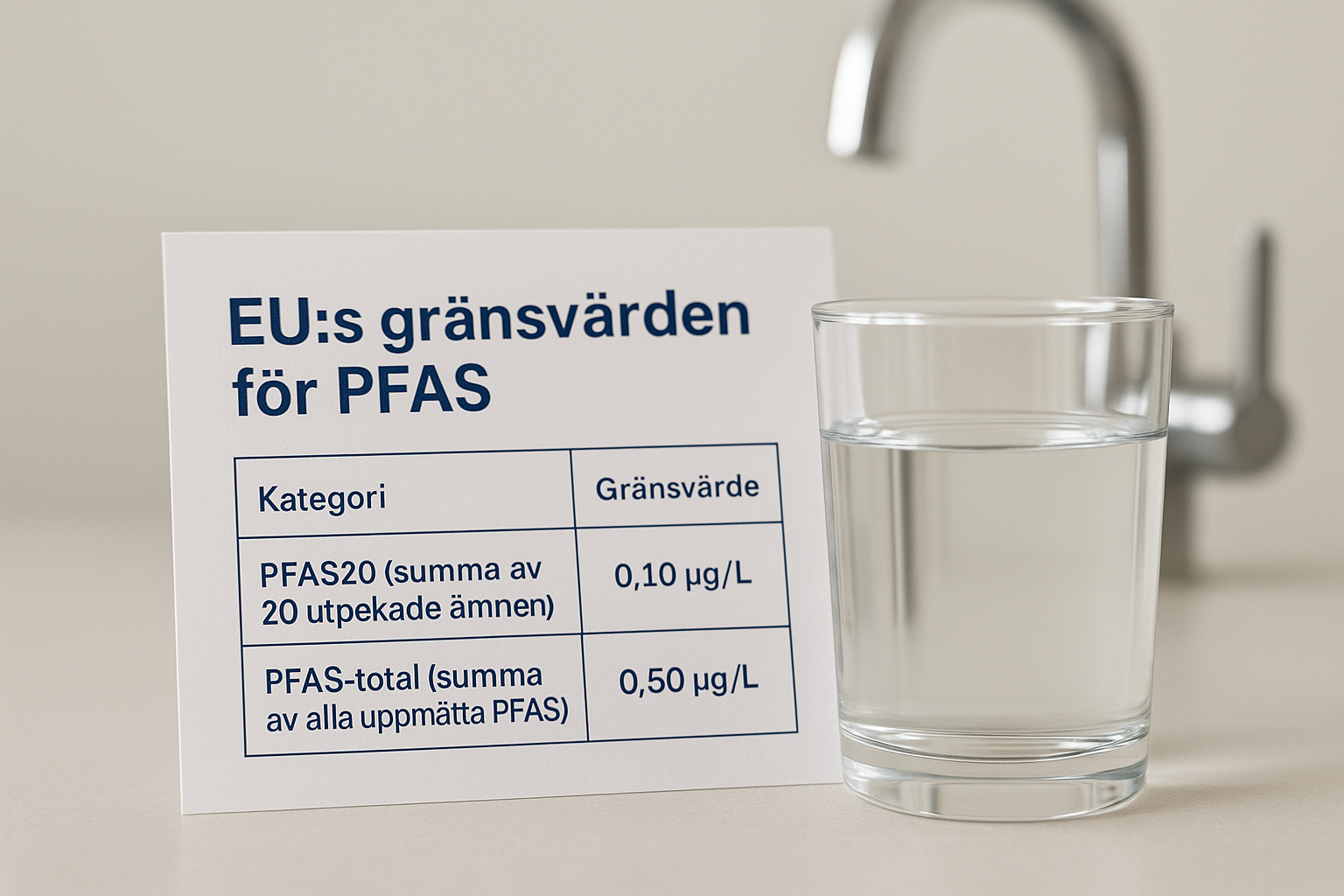
| Category | Limit Value |
|---|---|
| PFAS20 (sum of 20 specified substances) | 0.10 µg/L |
| PFAS-total (sum of all measured PFAS) | 0.50 µg/L |
The limit values are based on a precautionary principle because research cannot yet pinpoint an absolutely safe exposure level for PFAS.
What Applies to Private Wells
For private wells and private water sources, the exact same legislation as for municipal water does not apply. Instead, the Swedish Food Agency's guideline values are used as guidance when interpreting your analysis results. These guideline values are based on the same levels as the EU directive and help you to determine if measures are needed based on what you actually find in your water.
Understanding what PFAS in drinking water is, is a good first step, but you also need to know which levels are actually problematic in order to act correctly. An accredited water analysis reports the levels per substance and as sum values, which makes it easy to compare directly against applicable limit values and guideline values without having to interpret raw data on your own.
How to Determine PFAS in Your Water
The only way to know for sure if your water contains PFAS is to have it analyzed in an accredited laboratory. Since PFAS are neither visible, nor do they have a smell or taste, a routine visual inspection provides no useful information. The question of what PFAS in drinking water is, is therefore not just theoretical; it is directly linked to whether you actually test your water or not.
Choose the Right Analysis
You need a PFAS-specific analysis package to get relevant answers. A standard well water package measures bacteria, metals, and chemical parameters, but does not always include PFAS unless you actively add it. Check that the analysis covers at least the 20 PFAS substances on which the EU limit values are based, the so-called PFAS20 sum.
If you live near a fire training site, a military area, or an industrial plot, the risk of PFAS contamination in the groundwater is particularly high, and an analysis is especially justified.
How Sampling Works
Taking a water sample is easier than most people think. You order a sampling kit at home, follow the enclosed instructions, and return the sample with the pre-paid return shipping included. The laboratory analyzes the sample, and you receive a clear result showing exact levels per substance and sum values, directly comparable with the Swedish Food Agency's guideline values.
The result is normally reported within a few working days and includes a clear review of what the measured levels mean for you and your household situation.
What You Can Do If Levels Are High
If the analysis shows that your water contains PFAS levels above the limit values, you need to act quickly. The most important first step is to stop drinking the water immediately and switch to bottled water or an alternative water source until the problem is resolved. The question of what PFAS in drinking water is, therefore, does not end with the analysis; it leads directly to concrete actions.
Short-Term Measures
Buy bottled water or get water from a known safe source while you investigate the problem. Keep in mind that PFAS do not disappear when boiled, which means that boiling the water does not help and only gives a false sense of security. Contact your municipality's environmental department if you suspect that the contamination comes from a specific industry or fire training site nearby, as they can help identify the source.
Boiling does not remove PFAS from drinking water; it is important to know this before making decisions about temporary measures.
Long-Term Solutions
To solve the problem permanently, there are several technical options. Activated carbon filters of the granular activated carbon (GAC) type are one of the most proven methods for reducing PFAS in drinking water and are used in both municipal facilities and private systems. Reverse osmosis is another option that effectively removes PFAS but requires regular maintenance and replacement of filter membranes.
Consult a certified water purification technician before installing any system, as the choice of technology depends on which specific PFAS substances are present in your water and at what levels.
Next Steps
Now you know what PFAS in drinking water are, where they come from, what health risks they are associated with, and what you can do if the levels in your water are too high. Knowledge itself changes nothing for you as a well owner; it is action that makes a difference.
The practical next step is simple: order a PFAS-specific water analysis package and send in a sample from your well. You need no prior knowledge and no technician on site. You handle the sampling yourself at home with the kit and instructions provided, and return shipping is already paid.
The result will give you a concrete answer within a few working days, with levels per substance and clear comparisons against the Swedish Food Agency's guideline values. Take control of your water quality today and order your analysis from Svenskt Vattenprov.