

How to evaluate groundwater safety for Swedish well owners
Discovering that your well water might not be safe is unsettling. You rely on that water every single day, for drinking, cooking, and bathing, and unlike households connected to a municipal supply, you carry the full responsibility for monitoring and maintaining its quality. No authority is automatically checking your well. No alarm goes off when contamination creeps in. That reality makes a structured, repeatable evaluation process not just useful but essential, both for protecting your family’s health and for preserving the value of your property.
Table of Contents
- What you need before starting: Preparation and context
- Step-by-step: The process for evaluating groundwater safety
- Critical tests, benchmark limits, and interpreting your results
- Event-triggered retesting and what to do when problems are found
- What most guides miss about groundwater safety evaluation
- Get peace of mind with accredited water analysis
- Frequently asked questions
Key Takeaways
| Point | Details |
|---|---|
| Context is crucial | Always start by understanding your well type and local risk factors before testing. |
| Follow a stepwise process | Use a structured method from risk identification to retesting for reliable groundwater safety evaluations. |
| Parameters and limits change | Benchmark results against current guidelines and update your decisions when official standards change. |
| Act quickly after events | Retest water and take prompt action after floods, repairs, or drought to maintain safety. |
What you need before starting: Preparation and context
Once you know why testing matters, you need to ensure you’re starting with the right information and supplies in hand. Jumping straight to sample collection without context is one of the most common mistakes well owners make. The type of well you have, what’s happened nearby recently, and what your previous results showed all shape which tests you actually need.
Start by identifying your well type. A drilled well (bergborrad brunn) taps deep bedrock and typically faces different risks than a dug well (grävd brunn), which sits closer to the surface and is more vulnerable to surface water runoff and agricultural contamination. Knowing this distinction helps you and your lab choose the right analysis package from the start. You can read more about essential water analysis facts to understand how well type influences what you should test for.
Next, document any recent events or land use changes near your property. Has a neighbor started farming or applied pesticides? Has there been flooding, heavy rainfall, or drought? Were any repairs done to your well or plumbing? These factors directly influence contamination risk, and Swedish well quality standards under LIVSFS 2022:12 make clear that defining your risk context is the essential first step in any safety evaluation.
Pull out any previous test results you have. Trends over time are far more informative than a single snapshot. If your nitrate levels have been creeping upward over three test cycles, that pattern tells a story a single result cannot.
Finally, contact an accredited laboratory and order a sampling kit before you do anything else. This ensures you collect the sample correctly and that the right preservatives and containers are used for each parameter.
Preparation checklist
| Item | Details to gather |
|---|---|
| Well type | Drilled, dug, or surface water |
| Well age and depth | Year installed, depth in meters |
| Recent nearby events | Flooding, agricultural activity, repairs |
| Previous test results | Dates and key parameter values |
| Lab contact and kit | Accredited lab confirmed, kit ordered |
| Household water use | Drinking, irrigation, livestock |
Pro Tip: Take photos of your well and its surroundings before sampling. If contamination is found later, visual documentation of the site helps investigators identify potential sources much faster.
Step-by-step: The process for evaluating groundwater safety
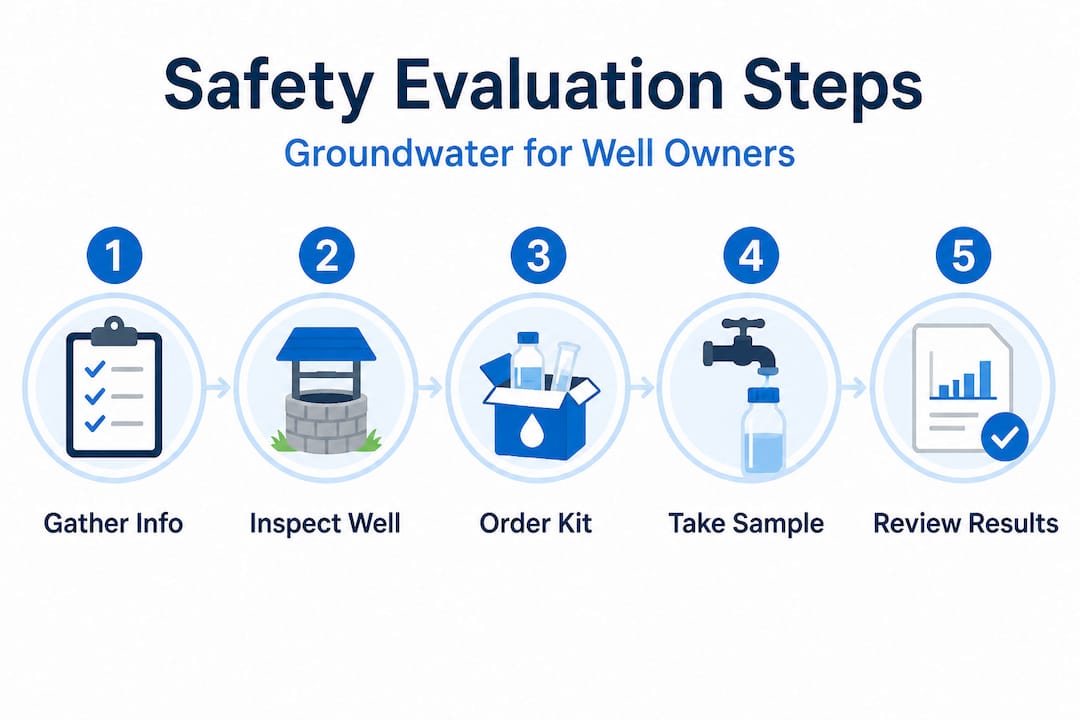
With everything organized, you’re ready to follow a clear, logical process used by Swedish authorities and adapted for private wells. The framework below aligns with the Kontrollwiki guidance for drinking water quality problems under LIVSFS 2022:12, which outlines how to test the right parameters with an accredited lab, compare results to health-based guideline limits, and act and retest after treatment or unusual events.
- Define your risk context. Identify your well type, note any recent land use changes, flooding, repairs, or drought conditions, and review previous results.
- Choose the right analyses. Based on your risk context, select parameters to test. A drilled well near a former military airfield needs PFAS testing. A dug well near farmland needs nitrate and bacteria testing. A well in a granite region needs radon analysis.
- Collect samples correctly. Follow the lab’s instructions precisely. Flush the tap before sampling, use the provided containers, and keep samples cool during transport. Incorrect collection is the single biggest cause of unreliable results.
- Send samples to an accredited laboratory. Only a Swedac-accredited lab can produce results that are legally valid for property sales, grant applications, or regulatory contact.
- Compare results to guideline limits. Check each parameter against current Swedish thresholds. Do not rely on limits from old reports, as guidelines are actively being revised, particularly for PFAS and arsenic.
- Act on results. If values exceed limits, investigate the source, consult a water treatment specialist, and implement appropriate treatment. Inform all household members.
- Retest after action. Treatment only counts as effective when a follow-up test confirms it. Always retest after installing filtration, disinfection systems, or after any repair work.
Routine vs. event-triggered evaluation
| Factor | Routine evaluation | Event-triggered evaluation |
|---|---|---|
| Trigger | Scheduled every 3 years | Flood, drought, repair, observed change |
| Urgency | Planned, no immediate risk | Potentially urgent, act quickly |
| Parameters | Standard package for well type | Targeted to suspected contamination |
| Follow-up | Next scheduled cycle | Retest after action, then return to routine |
| Documentation | Add to logbook | Document event, findings, and actions taken |
“Systematic evaluation is not a one-time task. It is an ongoing cycle of assessment, action, and verification that protects your household over the long term.”
Pro Tip: Keep a dedicated logbook, either a physical notebook or a digital folder, where you record every test date, result, action taken, and retest outcome. This record is invaluable when selling your property or applying for improvement grants.
You can find a detailed water testing guide that walks through sampling procedures and lab submission in practical terms.
Critical tests, benchmark limits, and interpreting your results
Now that the process is clear, you need to know exactly what to test, how the results matter, and what’s changing in Swedish guidance. Not all parameters carry equal weight. Some signal immediate health risk; others are long-term concerns that require monitoring over time.
Priority parameters for Swedish private wells
- E. coli and coliform bacteria: The most urgent indicators of fecal contamination. Even low counts require immediate action, including boiling water until the source is identified and resolved.
- Nitrate: Particularly dangerous for infants. High nitrate levels often signal agricultural runoff or a poorly sealed well. The Swedish limit is 50 mg per liter, matching EU standards.
- Arsenic: Naturally occurring in Swedish bedrock, especially in certain granite formations. Long-term exposure increases cancer risk. Limits are under review and may tighten.
- Lead: Can leach from older plumbing. Even low concentrations affect neurological development in children.
- PFAS (per- and polyfluoroalkyl substances): A growing concern near airports, fire training sites, and industrial areas. The Swedish EPA PFAS guidance emphasizes that risk management for PFAS relies on risk assessments and context-specific guidance, not a single generic threshold. This means you need to update decisions when guideline thresholds change, and check the latest limits each time you receive a new report.
- Radon: Dissolved radon gas is a concern in granite-heavy regions like Värmland, Dalarna, and parts of Norrland. It is odorless and invisible, making testing the only way to detect it.
- pH and hardness: These affect the corrosivity of your water and how effectively treatment systems work. Acidic water can dissolve metals from pipes.
One important point that many homeowners overlook: guideline limits are not permanent. Swedish authorities are actively revising thresholds for PFAS and arsenic as new health research emerges. A result that was considered acceptable three years ago may no longer meet current standards. Always check your report against the most current limits, not the ones printed on an old test certificate.
For a thorough breakdown of PFAS in well water and practical guidance on checking PFAS safely, these resources explain what different concentration levels mean for your household and when to seek further investigation.
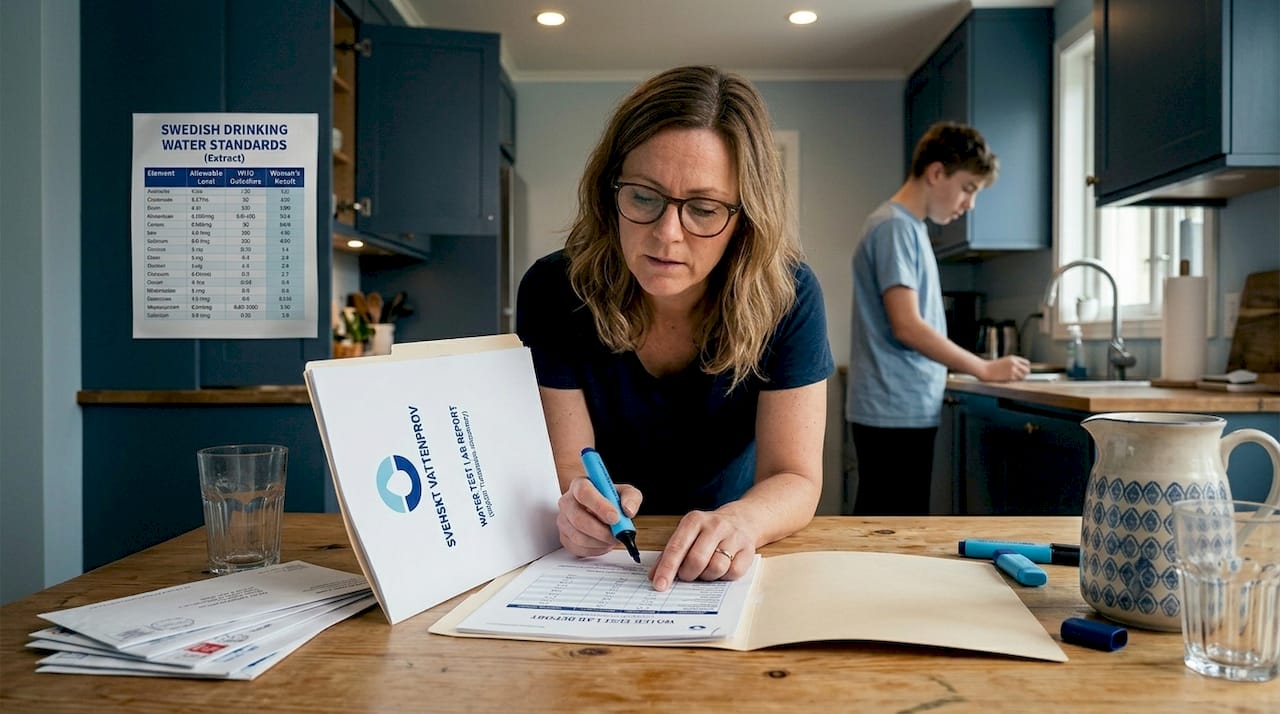
When you receive your results, read the lab report alongside the current guideline limits. If any parameter exceeds its limit, do not wait. Move immediately to the event-triggered response process described in the next section.
Event-triggered retesting and what to do when problems are found
Routine testing is only the baseline. Specific events or problem findings require decisive, additional steps to maintain safety. Swedish groundwater conditions are not static. SGU has warned that drought, low groundwater levels, and flooding can significantly change contamination risk, meaning your well’s safety profile can shift between scheduled tests.
Events that require unscheduled retesting:
- Extended drought or unusually low groundwater levels
- Flooding or heavy rainfall that may have reached the well
- Any repair or modification to the well, pump, or pressure system
- A sudden change in water appearance, smell, or taste
- New industrial, agricultural, or construction activity nearby
- A neighbor’s well testing positive for contamination
When any of these events occur, follow this response sequence:
- Event occurs. Note the date, nature of the event, and any observed changes to your water.
- Retest immediately. Order a targeted analysis based on the likely contamination type. Flooding suggests bacteria and nitrate. Industrial activity suggests PFAS or heavy metals.
- Investigate the cause. Work with your lab or a water specialist to understand where the contamination is coming from. Is it a one-time event or an ongoing source?
- Assess the health risk. Consider who in your household is most vulnerable. Infants, pregnant women, and immunocompromised individuals face higher risk from many contaminants.
- Take corrective actions. This may include shock chlorination for bacterial contamination, installing filtration, repairing the well seal, or temporarily using an alternative water source.
- Retest to confirm safety. Treatment must be verified. A second test after action confirms whether the intervention worked.
Important: If results indicate a serious health risk, such as high E. coli counts or arsenic above the action level, stop using the water for drinking and cooking immediately. Use bottled water until retesting confirms the problem is resolved.
The Kontrollwiki framework for drinking water quality problems lays out this same logic: investigate cause, assess health risk, take actions, and manage information transparently. You can also review groundwater statistics to understand how common various contamination types are across Sweden, which helps put your own results in perspective.
Pro Tip: Always inform every person in your household about retesting and results, not just the person who ordered the test. If a problem is found, everyone needs to know what water they can and cannot use, and why.
What most guides miss about groundwater safety evaluation
With the core process covered, here is what experience and careful review of real-world cases reveal as the most critical yet overlooked aspects of groundwater safety evaluation.
The biggest mistake we see is treating test parameters as fixed targets. Homeowners test once, file the results, and assume that if they passed three years ago, they will pass again. But guideline values change. PFAS limits in Sweden have been revised multiple times in recent years as research has revealed new health risks at lower concentrations. A well that tested “safe” for PFAS in 2022 may not meet the thresholds being applied in 2026. This is not a technical failure. It is a knowledge gap that catches people off guard.
A second overlooked issue is the quality of result interpretation. Not all lab reports are equally clear. Some present raw numbers without clear indication of whether a value is within acceptable limits or not. If your report does not explicitly tell you whether each parameter passes or fails current Swedish guidelines, ask for clarification. You should never have to guess whether your water is safe. Reading essential water analysis tips can help you understand what a well-structured report should look like and what questions to ask if yours falls short.
The third gap is communication within the household. We have seen situations where one family member orders testing, receives results, takes action, and never tells anyone else. That is a real problem when the person who ordered the test is traveling and someone else is drinking water that should not be used. Groundwater safety is a household responsibility, not an individual one.
Finally, systematic follow-up is what separates effective management from false reassurance. Testing without acting on results, or acting without retesting to confirm success, leaves you with an incomplete picture. The process only works when every step is completed.
Get peace of mind with accredited water analysis
Having a reliable partner for testing simplifies the process and gives you confidence in your next steps.
At Svenskt Vattenprov, we have supported thousands of Swedish well owners since 2018, from Skåne to Norrland, through exactly the kind of structured evaluation process described in this guide. Every analysis we offer is processed by a Swedac-accredited laboratory, and every report includes clear benchmarking against current Swedish and EU guideline limits. You never have to guess what your results mean.
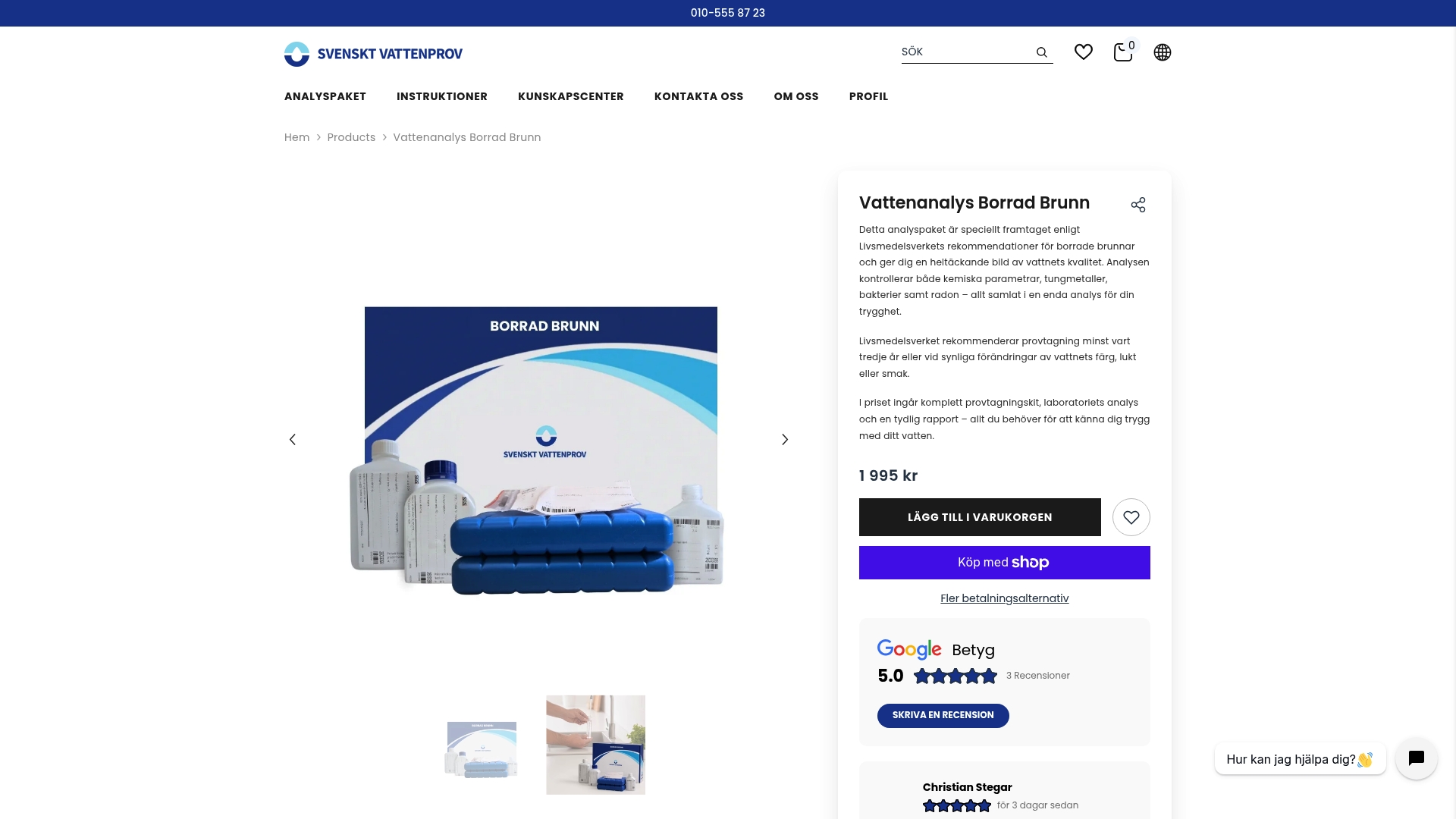
Whether you need a standard analysis for a drilled well, a targeted PFAS check, or a full 71-parameter assessment for maximum certainty, our private well test packages are designed to match your specific situation. We include sampling equipment, clear instructions, and personal guidance so the process is straightforward from start to finish. Ready to take the next step? Order accredited water analysis and know exactly what is in your water.
Frequently asked questions
How often should I test my private well water in Sweden?
Test at least every three years under routine conditions, and always retest after major events such as flooding, drought, or repairs, since groundwater contamination risk can shift significantly after these events.
Which parameters are most important for groundwater safety?
Bacteria (E. coli), nitrate, PFAS, and heavy metals such as arsenic and lead are the top priorities for Swedish private wells, as confirmed by Swedish EPA guidance on water safety parameters.
What should I do if a test shows contamination above limits?
Investigate the source, assess the health risk for all household members, take corrective action such as treatment or repair, and retest to confirm safety, following the Kontrollwiki framework for quality problem response.
How do I interpret new PFAS or arsenic limits in well reports?
Check the latest thresholds from the Swedish EPA each time you receive results, since PFAS guidelines are actively being updated and a value that was acceptable previously may no longer meet current standards.