

How to check for PFAS in your private well water safely
TL;DR:
- PFAS chemicals are invisible contaminants in well water that pose serious health risks.
- Proper sampling and professional laboratory testing are essential for accurate PFAS detection.
- Reverse osmosis is currently the most reliable household method to reduce PFAS levels below safe limits.
Your well water may look crystal clear and taste perfectly fresh, yet still carry invisible chemical contaminants that no amount of boiling will remove. 1 in 5 Swedish private wells fail drinking water standards, and PFAS (per- and polyfluoroalkyl substances) are among the most serious threats well owners face today. Unlike bacteria or sediment, PFAS give no warning signs. This guide walks you through understanding the risks, gathering the right materials, collecting a proper sample, and knowing exactly what to do once your results arrive.
Table of Contents
- Understanding PFAS risks and Swedish guidelines
- What you need: Preparing to test your well water
- Step-by-step: Collecting a water sample for PFAS testing
- Interpreting your results and what to do if PFAS is detected
- Perspective: Private well owners are Sweden’s first line of defense
- Test your water with accredited experts
- Frequently asked questions
Key Takeaways
| Point | Details |
|---|---|
| Lab testing is essential | Only accredited laboratory analysis can accurately detect PFAS in private well water. |
| Follow Swedish guidelines | Test every three years, or annually if you are at higher risk or have young children. |
| Proper sampling matters | Use sterile bottles, flush your tap first, and deliver samples to the lab quickly. |
| Act if limits are exceeded | Stop drinking the water and seek treatment if PFAS are above Swedish thresholds. |
Understanding PFAS risks and Swedish guidelines
PFAS is a group of over 10,000 synthetic chemicals that have been used in industrial processes, firefighting foam (especially at airports and military sites), non-stick cookware coatings, and water-repellent textiles for decades. They are sometimes called “forever chemicals” because they do not break down naturally in soil, water, or the human body. Once they enter groundwater, they stay there.
The health concerns are serious. PFAS accumulate in the body over time, a process called bioaccumulation, and have been linked to thyroid disruption, immune system effects, elevated cholesterol, and certain cancers. Vulnerable groups, including children under five, pregnant women, and people with compromised immune systems, face the greatest risk from long-term exposure.
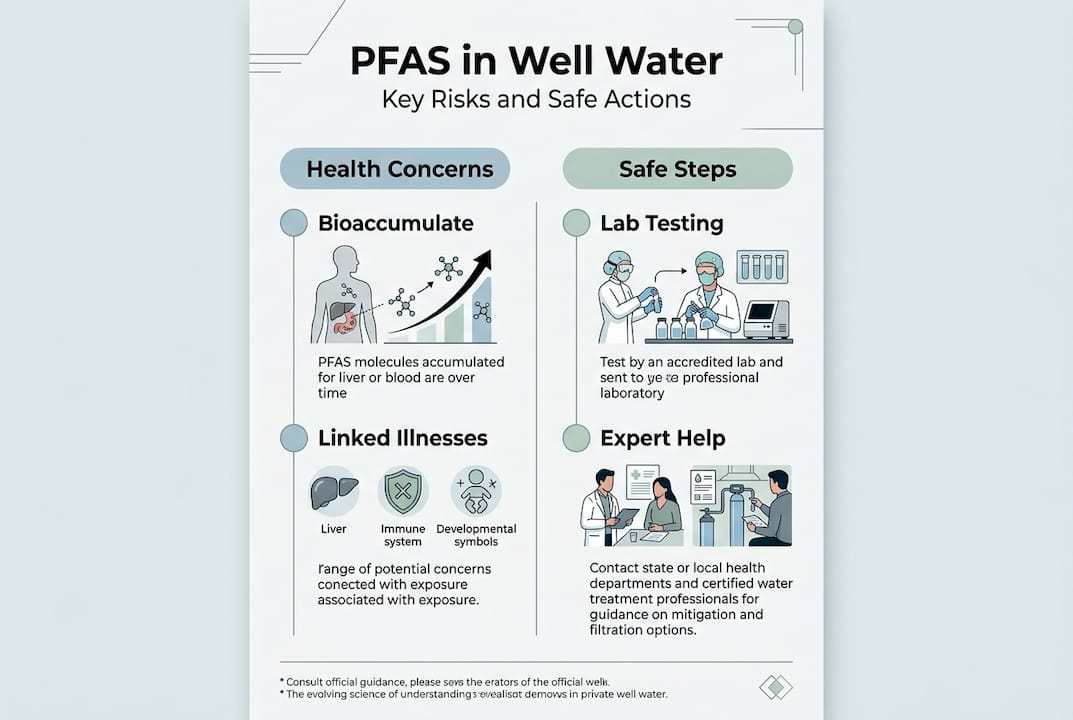
Sweden updated its regulatory limits effective January 2026. According to official chemical parameters, two key thresholds now apply to drinking water:
| Regulatory group | What it measures | Limit |
|---|---|---|
| PFAS4 | Four most regulated PFAS compounds | 4 ng/L |
| PFAS21 | Sum of 21 PFAS compounds | 100 ng/L |
These are extremely low limits, measured in nanograms per liter. To put that in perspective, 4 ng/L is four billionths of a gram in a single liter of water. Standard senses cannot detect this.
Key risk factors that raise your testing priority:
- Proximity to airports, military bases, or fire training sites where firefighting foam was historically used
- Nearby industrial activity involving textiles, paper, or chemical manufacturing
- Agricultural land where PFAS-containing sludge may have been applied as fertilizer
- Children or pregnant women in your household
Swedish water guidelines for private wells recommend testing every three years at minimum, and more frequently if any of the above risk factors apply to your property. Critically, private wells are entirely the owner’s responsibility. No government agency monitors your water for you. For detailed PFAS well water guidance specific to Swedish conditions, including regional contamination maps, reviewing current Swedish water quality standards is a strong starting point. You can also check KEMI’s official PFAS facts for the latest regulatory background.
Important: PFAS contamination has no smell, no color, and no taste. If you are waiting for a warning sign, you will wait too long.
What you need: Preparing to test your well water
Before you collect a single drop of water, preparation matters. Using the wrong container or skipping a step can invalidate your entire sample, meaning you pay for a test that tells you nothing reliable.
Choosing the right test: PFAS4 vs. PFAS21
| Test type | Compounds analyzed | Best for | Typical cost |
|---|---|---|---|
| PFAS4 | 4 key PFAS compounds | Basic screening, lower-risk areas | Lower cost |
| PFAS21 | 21 PFAS compounds | Near risk sites, families with children | Moderate cost |
If you live near an airport, a former military base, or any industrial site, choose the PFAS21 test. It covers a broader spectrum and gives you a much clearer picture of actual exposure. If you are doing a routine check in a low-risk rural area, PFAS4 is a reasonable starting point.
Your preparation checklist:
- Sterile sampling bottles provided by the laboratory (never substitute with old jam jars or household containers)
- The lab’s printed instruction sheet (read it fully before you start)
- Access to a cold water tap directly connected to your well
- A permanent marker to label your bottle clearly
- A cooler or insulated bag for transport
You must use Swedac-accredited labs such as Eurofins or SGS Analytics for results that are legally valid and comparable against Swedish drinking water standards. Results from non-accredited sources cannot be used in contact with your municipality’s environmental health board or in a property sale.
When you order a PFAS test kit, the sampling bottles and instructions are included. For a broader view of what else your well water may contain, comprehensive well water testing covers multiple contaminant categories in one analysis.
Pro Tip: Many accredited labs have local drop-off points across Sweden. Using a drop-off location instead of mailing your sample cuts transit time significantly and reduces the risk of your sample arriving outside the required delivery window.
Step-by-step: Collecting a water sample for PFAS testing
Proper collection is where most homeowners make mistakes. A contaminated or improperly handled sample produces unreliable results, and you will not know the results are wrong until you have already acted on them.
Follow these steps exactly as described in your lab’s instructions:
- Select the right tap. Use a cold water tap that connects directly to your well, before any filters, water softeners, or treatment systems. Testing filtered water tells you about your filter’s performance, not your actual well water.
- Flush the line. Run the cold tap for 2 to 5 minutes to clear standing water from the pipes. This ensures your sample reflects the groundwater, not water that has been sitting in household plumbing.
- Do not touch the inside of the bottle or lid. Hold the bottle from the outside only. Even trace amounts of skin oils or residue can affect PFAS analysis at nanogram-level detection.
- Fill the bottle to the marked line. Do not overfill or underfill. Follow the exact volume specified in your lab instructions.
- Seal immediately and firmly. Cap the bottle right after filling. Do not set the open bottle down on any surface.
- Store in a cool, dark place. Place the sealed bottle in your cooler immediately. Keep it between 2 and 8 degrees Celsius until delivery.
- Deliver within 24 to 48 hours. Correct sampling protocol requires delivery within this window to preserve sample integrity. Delays can degrade certain PFAS compounds and affect accuracy.
“A sample that arrives at the lab in poor condition is not just a wasted cost. It is a missed opportunity to protect your family.”
For additional handling guidance, essential sampling tips cover common errors Swedish well owners make during collection.
Pro Tip: Write your sample ID, collection date, and collection time directly on the bottle with a permanent marker before you even open the tap. Do this in advance so you are not scrambling with wet hands afterward.
Interpreting your results and what to do if PFAS is detected
Your lab report will list individual PFAS compounds and their concentrations in nanograms per liter. Look for two summed values: PFAS4 and PFAS21. These are the numbers that matter most for comparing against Swedish regulatory limits.
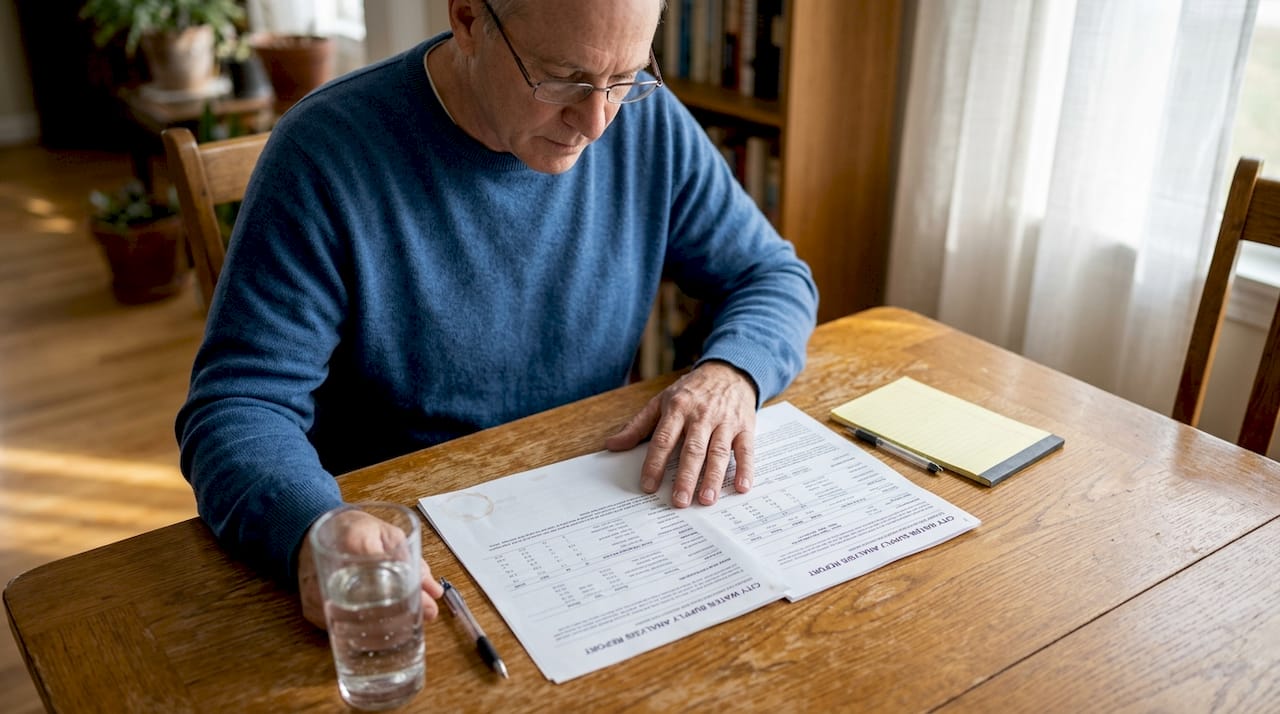
| Result | Meaning | Recommended action |
|---|---|---|
| PFAS4 below 4 ng/L | Within safe limits | Continue regular testing every 3 years |
| PFAS4 above 4 ng/L | Exceeds limit | Stop drinking, consult lab, investigate source |
| PFAS21 below 100 ng/L | Within safe limits | Monitor and retest on schedule |
| PFAS21 above 100 ng/L | Exceeds limit | Immediate action required |
If your results exceed official PFAS limits, take these steps without delay:
- Stop using the water for drinking and cooking immediately. Do not boil it as a solution. Boiling concentrates PFAS rather than removing them.
- Contact your lab or a water quality specialist to discuss the specific compounds detected and their likely sources.
- Notify your municipality’s environmental health board (miljö- och hälsoskyddsnämnd), especially if you suspect a nearby industrial or agricultural source.
- Investigate treatment options. Reverse osmosis systems remove virtually all PFAS compounds and are the most reliable household treatment solution. Activated carbon filters can reduce some PFAS types but are less effective against the full PFAS21 spectrum.
- Retest after any treatment system is installed to confirm it is working as expected. Also retest after significant environmental events nearby, such as a fire, flooding, or new construction.
For detailed guidance on handling PFAS exceedances, including how to evaluate treatment systems for Swedish conditions, additional resources are available. You can also review PFAS risk management from KEMI for regulatory context.
Key fact: Reverse osmosis is currently the only household treatment method confirmed to reliably reduce PFAS4 and PFAS21 levels below Swedish regulatory limits.
Perspective: Private well owners are Sweden’s first line of defense
Here is something most well owners do not fully internalize: when you own a private well, you are the water authority for your household. There is no municipal monitoring, no automatic alert system, and no government inspector checking your tap. That responsibility sits entirely with you.
The most common mistake we see is homeowners relying on taste, smell, or the fact that “we have always drunk this water with no problems.” PFAS are undetectable by any human sense. Long-term exposure effects accumulate silently over years, not days.
Another widespread misconception is that consumer test strips or basic home kits are sufficient. They are not. PFAS detection requires laboratory equipment capable of measuring at nanogram-per-liter sensitivity, which no home kit currently provides.
Reviewing your well owner responsibilities under Swedish regulations is worth doing. Beyond your own household, consider talking to neighbors with private wells. A culture of regular, professional testing in your community creates shared awareness and can help identify contamination sources faster when problems do arise.
Test your water with accredited experts
If reading this has made you realize it has been more than three years since your last water test, or if you have never tested for PFAS at all, now is the right time to act.
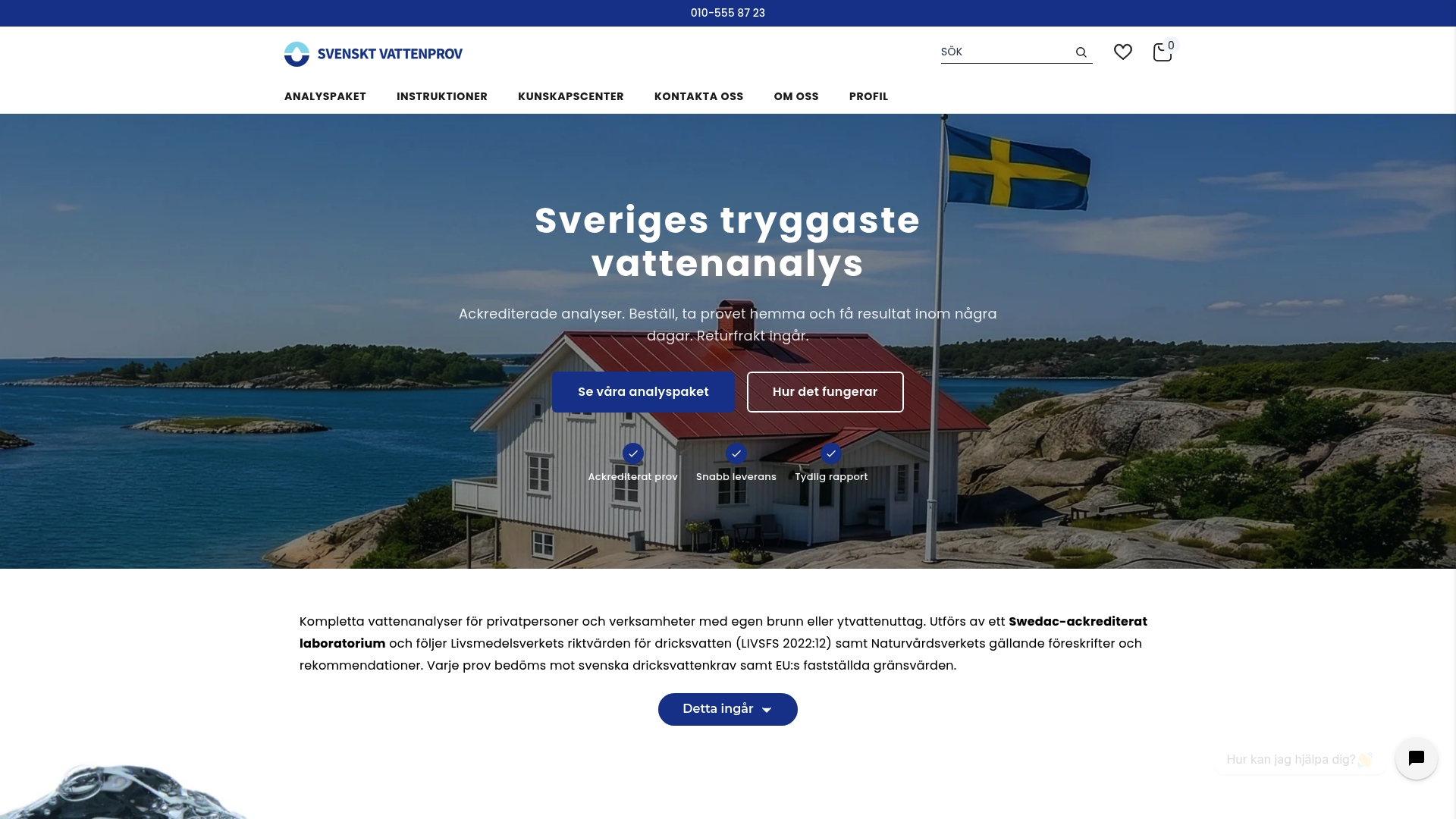
At Svenskt Vattenprov, we make the process straightforward. You order PFAS analysis directly from our website, receive a complete sampling kit with sterile bottles and clear instructions, and send your sample to SGS Analytics and Eurofins, two Swedac-accredited laboratories. Your results come with plain-language explanations and specific recommendations, not just a column of numbers. To learn about Swedish water quality and what is typical in your region, our resource pages cover the full picture. We are here to support you through every step.
Frequently asked questions
How often should I test my private well for PFAS in Sweden?
Swedish guidelines recommend testing every three years for most households, or annually if there are children under five, a pregnancy, or known contamination risk sources within your area.
Can I use a home test kit to check for PFAS?
No. Lab analysis is required for PFAS detection because the regulatory limits are measured in nanograms per liter, a sensitivity level that no consumer home kit can reliably achieve.
What should I do if my PFAS levels are too high?
Stop using the water for drinking and cooking immediately, and consult a water specialist about treatment. When PFAS exceeds limits, reverse osmosis is the most effective household treatment option available.
How quickly will I get my PFAS test results?
Turnaround time from Swedac-accredited labs is typically 10 to 14 days after the lab receives your sample, depending on the specific analysis package selected.