

Water test packages: ensuring safe well water in Sweden
Many homeowners with private wells assume their water is safe because it looks clear and tastes fine. That assumption is genuinely dangerous. Sweden has around 700,000 private wells, and a significant share of them carry contaminants that are completely invisible to the senses. Livsmedelsverket (the Swedish Food Agency) is clear on this: regular, accredited testing is the only reliable way to know what is actually in your water. A water test package simplifies that entire process, bundling the right analyses into one ordered kit so nothing gets missed and every result counts legally.
Table of Contents
- What is a water test package?
- Why accreditation matters for water testing
- Regulatory requirements for well water testing in Sweden
- How to choose the right water test package for your well
- Our take: what most articles miss about private well water testing
- Need reliable well water testing? Explore trusted solutions
- Frequently asked questions
Key Takeaways
| Point | Details |
|---|---|
| Definition clarified | A water test package is a standardized set of analyses for private well water, guided by Swedish regulations. |
| Accreditation essential | Only Swedac-accredited tests are accepted for legal and health compliance in Sweden. |
| Regular testing required | Private well owners are responsible for ongoing water quality checks according to Livsmedelsverket guidelines. |
| Package selection tips | Tailor your water test package to your well’s profile and regulation requirements for best results. |
| Avoid common pitfalls | Don’t rely solely on sight or taste—comprehensive testing is key to safety and compliance. |
What is a water test package?
After laying out the stakes, it is worth stepping back to define exactly what a water test package is and why it is built the way it is.
A water test package is a predefined set of analyses offered by accredited laboratories for testing private well water quality in Sweden, covering microbiological, chemical, physical, and radiological parameters based on Livsmedelsverket recommendations. In practice, that means you receive one sampling kit, collect your water sample according to clear instructions, send it off, and get back a structured report covering every parameter the package includes.
Each category of parameter exists for a specific reason. Understanding what each one catches helps you appreciate why skipping any category is a real risk.
Microbiological parameters include bacteria such as E. coli, coliform bacteria, and enterococci. These indicate fecal contamination and are among the most urgent health threats in well water. They are most common in dug wells or after flooding, but drilled wells are not immune. To understand more about the kinds of problems that affect Swedish wells specifically, our well water issues guide walks through each risk type in practical terms.
Chemical parameters cover a wide range: nitrates and nitrites from agricultural runoff, arsenic from natural bedrock, manganese, iron, hardness (calcium and magnesium), pH (a measure of how acidic or alkaline the water is), and in some packages PFAS (per and polyfluoroalkyl substances, a group of industrial chemicals that do not break down naturally). High iron causes staining and poor taste. Arsenic and PFAS are far more serious because they accumulate in the body over time without any obvious warning signs.
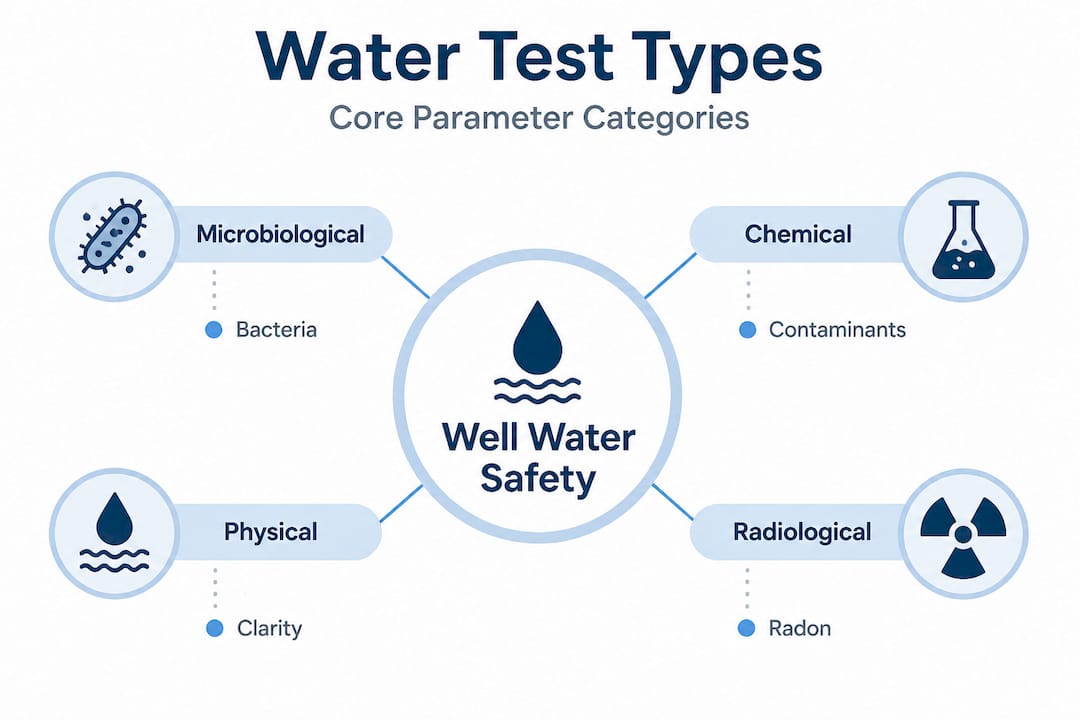
Physical parameters address turbidity (cloudiness), color, and conductivity. These don’t always signal health risks directly, but they indicate whether something in the water has changed, which warrants further investigation.
Radiological parameters, especially radon, matter enormously for wells drilled in granite bedrock areas like Värmland, Dalarna, and parts of Norrland. Radon is a naturally occurring radioactive gas that dissolves into groundwater and is released when water is used indoors. Prolonged exposure is linked to lung cancer risk. You can find a thorough breakdown of how Sweden sets limits for each contaminant in our overview of drinking water quality standards.
| Parameter category | Examples | Main health concern |
|---|---|---|
| Microbiological | E. coli, coliforms, enterococci | Gastrointestinal illness, serious infection |
| Chemical | Arsenic, nitrates, PFAS, iron, pH | Long-term toxicity, cancer risk, infrastructure damage |
| Physical | Turbidity, color, conductivity | Indicator of contamination or system change |
| Radiological | Radon | Lung cancer risk from indoor air exposure |
No single category can be skipped without creating blind spots in your safety picture.
Why accreditation matters for water testing
Now that you know what a water test package entails, it is crucial to understand why choosing an accredited provider is not just recommended. It is legally necessary.
Labs must be Swedac-accredited (ISO 17025) for their results to be valid for use in property sales or regulatory filings. Swedac is Sweden’s national accreditation body, and ISO 17025 is the international standard that certifies a laboratory’s technical competence and the reliability of its measurement methods. In plain terms, it means the lab has been independently verified to produce results you can trust and use officially.
Why does this matter to you as a homeowner? Consider two scenarios. First, you are selling your property. The buyer’s bank or their realtor requests a water quality certificate. If your test was done by a non-accredited lab, that result is worthless in the transaction. You will have to test again, causing delays and extra costs. Second, you apply for a municipal grant for water improvement measures. The environmental health board (miljö och hälsoskyddsnämnden) requires certified results. A non-accredited report will be rejected outright.
Our detailed Swedac accreditation guide explains exactly what to look for when verifying a lab’s credentials before you order.
| Feature | Accredited lab (Swedac/ISO 17025) | Non-accredited lab |
|---|---|---|
| Results valid for property sales | Yes | No |
| Results accepted by regulatory bodies | Yes | No |
| Methods independently verified | Yes | No |
| Can be used for grant applications | Yes | No |
| Results usable in health authority contact | Yes | No |
The difference is stark. Paying a few extra kronor for an accredited test package is not an upgrade. It is the baseline.
Pro Tip: Before placing any order, ask the provider directly which accredited lab processes your samples. Reputable providers list this information clearly. If they don’t, treat that as a warning sign.
Regulatory requirements for well water testing in Sweden
With accreditation covered, it is time to see how regulations shape the process for every Swedish well owner.
Livsmedelsverket guidelines set the framework for what private well owners are expected to do when it comes to water safety. While the law doesn’t impose criminal penalties on homeowners who skip testing, the practical and financial consequences of neglect are serious. An outdated or absent water analysis can block a property sale, invalidate insurance claims, or leave your household exposed to health risks you never knew existed.
The core obligations for Swedish well owners come down to a clear set of actions.
- Test regularly. Livsmedelsverket recommends testing at least every three years under normal conditions.
- Test immediately if you notice any change in taste, smell, color, or cloudiness.
- Test after disturbances near your well, such as new construction, flooding, or nearby agricultural activity.
- Test before selling your property. A current, accredited result is expected in any well-water property transaction.
- Keep documentation. Records of past test results are valuable for spotting trends and for dealings with authorities.
A striking statistic: Studies of Swedish private well water have found that roughly one in three wells show at least one parameter exceeding Livsmedelsverket’s recommended limit values. Many of those owners had no idea anything was wrong. That is not a fringe problem. It is a widespread one.
“Every private well owner is personally responsible for the quality of their drinking water. Unlike municipal water, private wells are not subject to continuous monitoring. The responsibility lies entirely with the property owner.” Livsmedelsverket
That responsibility feels heavy, but it doesn’t have to be complicated. Our guide on guidelines for analysis breaks the regulatory picture into clear, manageable steps. And if you want to understand exactly which limit values apply to each contaminant, our resource on drinking water guideline values translates the official thresholds into practical language.
One critical point many homeowners miss: the three-year recommendation is a minimum for wells with no known issues. If your well is older, if it’s a dug well prone to surface water intrusion, or if you live near farmland, industrial sites, or former military airfields, you should test more frequently. Radon-prone granite regions warrant separate radon tests on top of a standard package.
How to choose the right water test package for your well
Finally, let’s put all this understanding into action with clear steps for choosing a package tailored to your situation.
Choosing the right package starts with understanding that no single package is right for every well in every region of Sweden. A coastal property in Halland faces saltwater intrusion risks that a granite-bedrock well in Dalarna simply doesn’t. A farm well near fertilized fields needs nitrate monitoring that an urban fringe well might not prioritize equally.
Here is a practical, step-by-step process for making the right choice.
- Identify your well type. Drilled (bergborrad) wells and dug (grävd) wells have different vulnerability profiles. Dug wells are more exposed to surface contamination and typically need broader microbiological testing.
- Map your geography. Are you in a granite region? Add radon testing. Near farmland? Prioritize nitrates. Close to an industrial site or former airport? Consider PFAS testing separately.
- Review past results if available. If you’ve tested before, check which parameters came close to or exceeded limit values. Those deserve closer attention in your next package.
- Match to Livsmedelsverket minimums. Make sure your chosen package covers at least the parameters recommended for your well type. A reputable provider will clearly state which guidelines their package meets.
- Check for add-on flexibility. Some risks are local and specific. A good provider lets you add individual tests, such as PFAS analysis or a dedicated radon test, to a base package without forcing you to buy an entirely separate kit.
- Verify the lab. Confirm your provider uses a Swedac-accredited lab. Ask which lab specifically, and check that their accreditation is current.
- Read the sampling instructions carefully. Even the best package produces unreliable results if the sample is collected incorrectly. Follow the water sampling instructions exactly as provided.
Pro Tip: If you live near a former military base, an industrial estate, or an airport, add a dedicated PFAS test even if your standard package doesn’t include it. PFAS contamination can be highly localized, and a general package may not test for all 30 relevant PFAS compounds that matter in your specific area.
The goal is a package that gives you a complete, accurate picture of your water quality. Not a bare-minimum checkbox exercise.
Our take: what most articles miss about private well water testing
Most guides on water testing present it as a straightforward compliance task. Test every three years, keep a record, done. That framing understates the real picture in ways that leave homeowners unprepared.
The single biggest mistake we see is reactive testing. Homeowners wait until something tastes off or a neighbor reports a problem before they order a test. By then, the contamination has often been present for months or years. Bacteria and certain heavy metals don’t build up to tasteable concentrations before they cause harm. Arsenic is a perfect example: you can drink water with elevated arsenic levels for years with no obvious symptoms while the body accumulates exposure.
Our groundwater statistics Sweden page shows clearly how uneven contamination risks are across Swedish regions. The variety is striking, and it reinforces why geography should always be the starting point for choosing a package, not an afterthought.
The second overlooked issue is documentation. We regularly speak with homeowners who have tested their water, received good results, and then lost or discarded the report. When they come to sell their property five years later, they have nothing to show. A current result from within three years is the standard expectation in a well-water property transaction. Older results may still offer context, but they won’t satisfy buyers or their advisors.
“A single clean test result tells you the water was safe on one day. Ongoing documentation over multiple testing cycles tells you whether your water is consistently safe and whether conditions are changing. That long-term picture is what responsible well ownership actually looks like.”
Finally, there is the misunderstanding that “comprehensive” means overcomplicated. Some homeowners see a package with 41 or 71 parameters and assume it must be excessive. In reality, a broader package doesn’t make the process harder for you. It simply means the lab checks more things. You still collect one sample. You still get one report. The difference is that you see a fuller picture of your water quality, and you have stronger legal documentation to stand on.
Testing is not a bureaucratic obligation. It is the most direct way you can protect your household’s health and your property’s value.
Need reliable well water testing? Explore trusted solutions
If you want to test your well water with confidence, starting with the right provider makes all the difference.
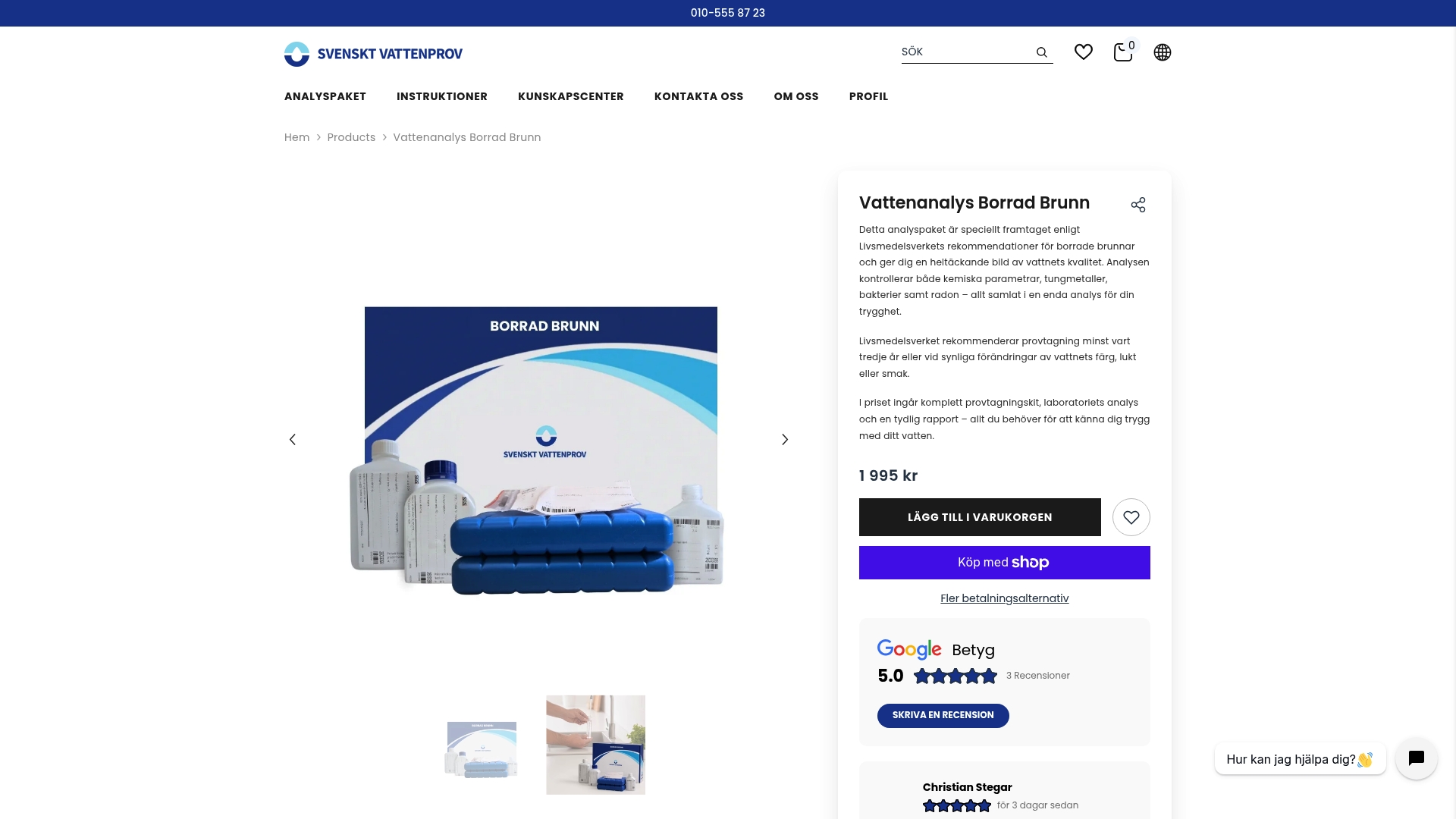
At Svenskt Vattenprov, all our accredited water test packages are analyzed by SGS Analytics and Eurofins, one of Sweden’s leading Swedac-accredited laboratories. That means every result you receive is legally valid, whether you need it for a property sale, a grant application, or simply your own peace of mind. You can browse our full range of water analysis options to find the package that fits your well type and location. If you have a drilled well and want to start with our most popular package covering 41 parameters, the water analysis for drilled wells is an excellent place to begin. We include clear sampling instructions, a full report with plain-language explanations, and personal guidance if any result raises questions. You don’t have to figure this out alone.
Frequently asked questions
How often should I test my private well water in Sweden?
Livsmedelsverket recommends testing your well water at least once every three years, or immediately if you notice any changes in color, taste, or smell.
Do I need an accredited lab for water test packages?
Yes. Only Swedac-accredited labs (ISO 17025) offer results that are valid for property sales and regulatory compliance in Sweden.
What parameters are included in a standard water test package?
Standard packages typically test for microbiological, chemical, physical, and sometimes radiological parameters, covering the key contaminants identified in Livsmedelsverket guidelines.
Can I customize a water test package for specific risks?
Yes. Many providers allow you to add targeted tests for contaminants like PFAS or radon based on your well’s location, type, or testing history.
Are test packages needed if my water looks and tastes fine?
Yes. Many harmful contaminants, including arsenic, radon, and PFAS, are tasteless and colorless, so visible cues are never a reliable measure of safety.