

Swedac Accreditation: Requirements, Steps, and Why it Matters
When you order a water analysis, you want to be able to trust the results. This is where Swedac accreditation comes in – an independent quality assurance that shows a laboratory actually lives up to international standards for competence and reliability. Without that guarantee, you can never be sure that the figures in your analysis report are correct.
Swedac, which is the Swedish Board for Accreditation and Conformity Assessment, is Sweden's national accreditation body. They review and approve laboratories, certification bodies, and other operations that need to demonstrate that they meet the required standards. For us at Svenskt Vattenprov, it is a cornerstone: all water analyses we offer are performed by Swedac-accredited laboratories, giving you as a well owner or property buyer peace of mind that the results are accurate and legally sound.
In this article, we explain what Swedac accreditation actually means, how it differs from certification, what requirements are placed on a business seeking accreditation, and how the process unfolds step by step. You will also learn why accreditation matters – not only for laboratories, but for you who rely on their work.
Why accreditation matters
Accreditation is not a marketing trick. It is a formal proof of technical competence, issued by an independent body, which shows that a business meets specified requirements. For you, who will make decisions based on an analysis result, for example when buying a house or when you suspect your well water is contaminated, it matters greatly where the results come from.
What accreditation actually guarantees
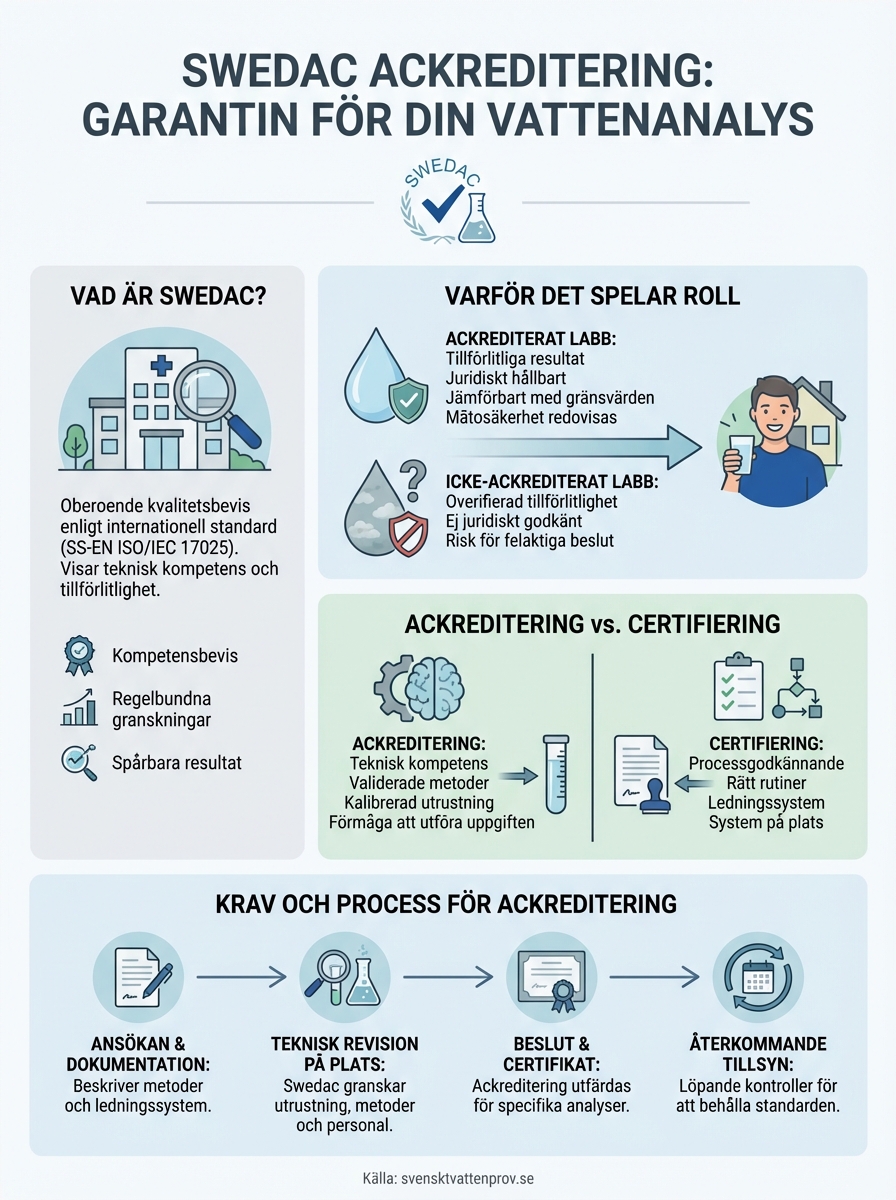
When a laboratory has Swedac accreditation, it means that Swedac regularly reviews the lab on-site and checks that its methods, equipment, and personnel meet the standard. The laboratory follows the international standard SS-EN ISO/IEC 17025, which sets requirements for everything from how samples are received and handled to how measurement uncertainty is reported.
Accreditation is not a one-time approval – Swedac conducts recurring surveillance to ensure that the laboratory continues to meet the requirements.
This means that the results you receive are traceable, reproducible, and comparable with international reference values. You can trust that a value of, for example, 5 µg/l arsenic is indeed 5 µg/l, and not an error due to insufficient calibration or incorrect method.
Consequences of choosing a non-accredited lab
If you choose a laboratory without accreditation, you practically lack the ability to verify the reliability of the analysis. The results may be correct, but they can also be incorrect, and you have no external body that has controlled the process. In a property transaction, you risk that such an analysis result will not be accepted by the counterparty or by authorities.
It is therefore about more than a paper requirement. Accreditation protects you from paying for a result you cannot use or trust.
Accreditation or certification
Many confuse accreditation and certification, but they are not the same thing. Both involve independent review, but they assess different things and fulfill different functions in quality work.

What certification means
Certification means that an organization demonstrates that it follows a specific standard, such as ISO 9001 for quality management. It is a process approval that confirms that the business has the right procedures in place, but it does not evaluate whether the organization is actually capable of performing technically advanced tasks such as chemical analyses or microbiological measurements.
Take a laboratory as an example: it can be certified and still lack sufficient method competence or calibrated measuring equipment to deliver reliable results. This is precisely the gap that accreditation fills.
What distinguishes accreditation from certification
Swedac accreditation goes significantly further. It assesses whether a laboratory actually has the technical capability to conduct its analyses correctly, including handling equipment, validating methods, and reporting measurement uncertainty. It is a competence validation, not just a process check.
Simply put: certification shows that you have the right system in place, accreditation shows that you can do the job.
For you, who order a water analysis, the difference is crucial. If you choose an accredited lab, you know that the results will stand up to external scrutiny, regardless of whether it is a regulatory requirement or a property transaction.
Requirements for Swedac accreditation
For an organization to be granted Swedac accreditation, it must meet a clear set of requirements based on the international standard SS-EN ISO/IEC 17025. The requirements cover both how the organization is structured and how technical analyses are performed in practice.
Organizational requirements
The laboratory must have a documented management system that governs how processes are planned, executed, and followed up. This means that procedures for handling deviations, complaints, and allocation of responsibilities are written down and known by the staff. Some key organizational requirements are:
- Clear roles and responsibilities within the laboratory
- Documented procedures for handling samples and reports
- System for identifying and correcting deviations
Technical requirements
On the technical side, it is required that the laboratory can demonstrate that all analysis methods are validated and that the measuring equipment is regularly calibrated against traceable reference values.
Swedac not only reviews the documentation but also conducts physical on-site audits to confirm that the requirements are actually being met.
In addition, personnel must have documented competence in the analysis areas covered by the accreditation, and the laboratory must report measurement uncertainty for each method. It is the combination of these requirements that ensures the results hold up to external scrutiny.
How Swedac accreditation works
The process for obtaining Swedac accreditation follows a structured procedure in several steps. The laboratory applies, undergoes a technical audit, and must then continuously maintain the standard to retain its accreditation.

Application and initial assessment
The laboratory begins by submitting a formal application to Swedac along with documentation describing the organization's methods, equipment, and management system. Swedac then performs an initial check to see if the application is complete and if the organization appears to meet the basic requirements for accreditation.
Before the audit begins, the laboratory must be able to demonstrate that the management system is actually in operation, not just documented on paper.
Audit and decision
Following the initial assessment, Swedac conducts an on-site technical audit where assessors examine equipment, methods, and staff competence directly in the laboratory. They verify that reality matches the submitted documentation.
If the audit shows that all requirements are met, Swedac makes a decision on accreditation and issues an accreditation certificate that specifies exactly which analysis areas are included. The laboratory then undergoes recurring surveillance to confirm that the standard is maintained over time.
How to use accreditation for water testing
As a well owner, you don't need to understand all the technical details behind Swedac accreditation, but you should actively use it to choose the right lab and interpret your results correctly.
Check the lab before ordering
The first step is to verify that the laboratory is accredited before you submit the sample. On Swedac's website, you can search for approved laboratories and see exactly which analysis areas their accreditation covers. Accreditation applies to specific methods and parameters, not the laboratory as a whole, so check that the specific analysis you need is actually included.
A laboratory may be accredited for microbiological analyses but not for chemical ones, so always check that your specific analysis is covered.
Read the report with accreditation in mind
When you receive your analysis result, you can trust that the methods are validated and the equipment calibrated. You can directly compare your values against the Swedish Food Agency's limit values without questioning whether the measurement was done correctly.
Furthermore, the results are legally usable in a property transaction or contact with authorities. You can present the analysis and know that the documentation will stand up to external scrutiny.
Brief summary and next steps
Swedac accreditation is a formal proof of competence that shows a laboratory meets international requirements for accuracy and reliability. It differs from certification by assessing technical capability, not just processes. The requirements are based on the standard SS-EN ISO/IEC 17025 and cover everything from validated methods and calibrated equipment to documented personnel competence and reporting of measurement uncertainty. The process begins with an application, is followed by an on-site technical audit, and concludes with an accreditation certificate that specifies exactly which analyses the lab is approved for. Surveillance is also ongoing, meaning that the standard must be actively maintained over time.
For you as a well owner, this means that you should always choose an accredited lab when testing your drinking water. The results you receive are traceable, legally sound, and directly comparable to the Swedish Food Agency's limit values. Are you ready to take the next step? Order a water analysis from a Swedac-accredited laboratory and get answers you can actually use.