

Understanding your Swedish well water report clearly
Nearly half of Swedish private well owners misinterpret the classification “tjänligt med anmärkning” on their water reports, assuming it signals immediate danger when it often does not. That single misunderstanding leads some people to panic unnecessarily, while others dismiss genuinely urgent findings because the label sounds reassuring enough. Your well water report contains real, actionable information that directly affects your family’s health, your property’s compliance status, and your confidence as a homeowner. This guide walks you through every layer of that report, from the broad classification labels to the individual parameters, so you can read your results with full clarity and know exactly what to do next.
Table of Contents
- Decoding Swedish well water report classifications
- Key water parameters and what they reveal
- How often should you test? Guidelines for Swedish well owners
- What guidelines really mean: Riktvärden vs Gränsvärden
- The expert lens: Avoiding common mistakes with Swedish well water reports
- Get peace of mind: Take the next step in well water safety
- Frequently asked questions
Key Takeaways
| Point | Details |
|---|---|
| Know your classification | Understanding if your well water is ‘safe’, ‘safe with remarks’, or ‘unsafe’ is key to informed decisions. |
| Focus on critical parameters | Microbiological and chemical readings directly affect your health and should always be prioritized. |
| Test regularly for safety | Follow Sweden’s recommended schedule—more often if your household includes high-risk members or shared wells. |
| Act on expert nuances | Always use accredited labs, confirm with double tests after treatment, and be mindful of guidance vs. legal limits. |
| Consult when in doubt | For unclear or borderline results, consult a qualified expert rather than self-diagnosing based on aesthetics alone. |
Decoding Swedish well water report classifications
To understand your latest water report, start by knowing what the three main classifications actually mean. Swedish authorities use a standardized system to summarize water quality results, and each label carries a specific meaning for how you should respond.
According to Livsmedelsverket, Swedish water reports classify results as “tjänligt” (safe), “tjänligt med anmärkning” (safe with remarks, often for aesthetic or technical issues), or “otjänligt” (unsafe, stop use immediately). Understanding the difference between these three outcomes changes everything about how you respond.
| Classification | English meaning | What it signals | Recommended action |
|---|---|---|---|
| Tjänligt | Safe | All parameters within guidelines | No action required; retest every 3 years |
| Tjänligt med anmärkning | Safe with remarks | Minor technical or aesthetic deviations | Investigate cause; monitor or address issue |
| Otjänligt | Unsafe | One or more health-critical failures | Stop drinking immediately; contact authorities |
The most commonly misread classification is “tjänligt med anmärkning.” Many homeowners either assume their water is dangerous when it is not, or they incorrectly file the report away and forget about it. In reality, this classification typically refers to elevated iron levels, slightly off pH, or cosmetic color issues that affect taste or plumbing but do not represent an immediate health risk. That said, some remarks do point to real problems that need follow-up.
“Otjänligt” is different. That word means stop. If your report carries that classification, you should treat the water as undrinkable until the issue is resolved and a new clean analysis confirms it is safe.
A well water report is not just a document for your files. It is a direct window into what your household is consuming every single day.
Understanding Swedish water quality standards helps you put each classification in context, especially when you are deciding whether a remark requires immediate investment or simply ongoing observation.
Key water parameters and what they reveal
Once you know your report’s classification, the next step is to dig into the individual parameters that determine those ratings. A classification is just the summary. The parameters are the evidence.
Swedish well water analysis covers four main categories of parameters:
- Microbiological: Presence of bacteria that indicate fecal contamination or pathogenic risk
- Chemical: Dissolved substances including metals, nitrates, and synthetic compounds like PFAS
- Radiological: Naturally occurring radioactive elements, particularly radon in granite areas
- Physical: Properties like pH, color, turbidity, and conductivity that affect usability and taste
Guideline values for Swedish wells include microbiological limits (E. coli: 0 per 100 ml, coliforms: 0 per 100 ml), chemical limits (nitrate: no more than 50 mg/l, arsenic: no more than 10 µg/l, lead: no more than 5 µg/l, PFAS sum: no more than 0.1 µg/l), a radiological action level for radon at 1000 Bq/l, and a physical pH range of 6.5 to 9.5.
| Parameter | Guideline value | Health risk if exceeded |
|---|---|---|
| E. coli | 0 per 100 ml | Gastrointestinal illness, serious infection |
| Coliforms | 0 per 100 ml | Indicator of fecal or surface water contamination |
| Nitrate | ≤50 mg/l | Risk for infants under 6 months (blue baby syndrome) |
| Arsenic | ≤10 µg/l | Long-term cancer risk with chronic exposure |
| Lead | ≤5 µg/l | Neurological damage, especially in children |
| PFAS (sum) | ≤0.1 µg/l | Hormone disruption, immune system effects |
| Radon | Action level 1000 Bq/l | Increased lung cancer risk with long-term exposure |
| pH | 6.5 to 9.5 | Corrosion risk outside range, taste issues |
The parameters most commonly flagged in Swedish private wells vary by region. High iron and manganese concentrations are frequent in forest areas and certain clay soils. Radon is a serious concern in granite-heavy regions like Värmland, Dalarna, and parts of Bohuslän. PFAS contamination is most often found near airports, industrial sites, and areas with a history of firefighting foam use. Nitrates tend to be elevated near agricultural land.
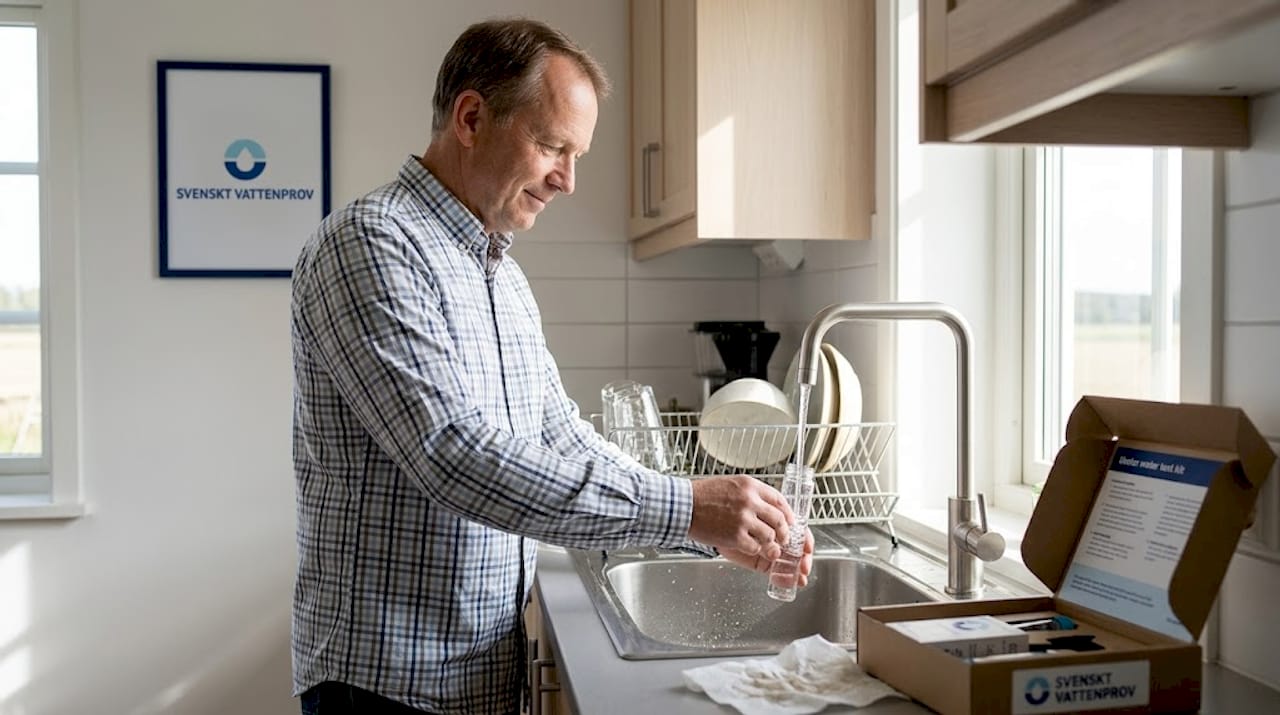
Health-related parameters are always the priority. If E. coli, arsenic, nitrate, lead, or PFAS exceed guidelines, you need to act. Aesthetic parameters like iron, color, and turbidity are important for your plumbing and comfort, but they rarely pose an immediate health threat.
To explore more detail on each of these measurements, these essential water analysis facts for Swedish well owners provide a solid foundation.
How often should you test? Guidelines for Swedish well owners
Understanding the values is just half the equation. Maintaining safe water means knowing when to re-test and update your analysis.
The standard recommendation from Livsmedelsverket is to test your well water every three years minimum. However, annual testing or more frequent testing is recommended for households that include children under five years old, pregnant women, elderly individuals, or people with weakened immune systems. Wells shared between more than two properties also fall into the higher-frequency category.
The following situations call for immediate testing, regardless of when your last analysis was conducted:
- After a flood or heavy rain event that could have affected the well structure
- Following any repair, cleaning, or maintenance work on the well
- When you notice changes in taste, smell, or the color of your water
- If new construction, agricultural activity, or industrial operations have started nearby
- After a long period of non-use, such as a summer cottage reopening in spring
- Before selling or purchasing a property with a private well
Each of these scenarios creates conditions where contamination can enter the water supply, even if previous tests were clean. A well that tested perfectly three years ago may have changed significantly due to groundwater shifts, casing deterioration, or surface water intrusion.
Pro Tip: Always use a Swedac-accredited laboratory for your well water analysis. Results from non-accredited labs cannot be used for compliance purposes, property sales, or subsidy applications. After installing any filtration or treatment system, retest to confirm the system is working correctly before resuming normal water use.
Read more about why regular water testing is so important for Swedish private well owners, especially as climate patterns and land use continue to shift.
What guidelines really mean: Riktvärden vs Gränsvärden
Seeing parameters above or below guideline values can be unsettling. Here’s what those numbers are designed to mean for you as a private well owner.
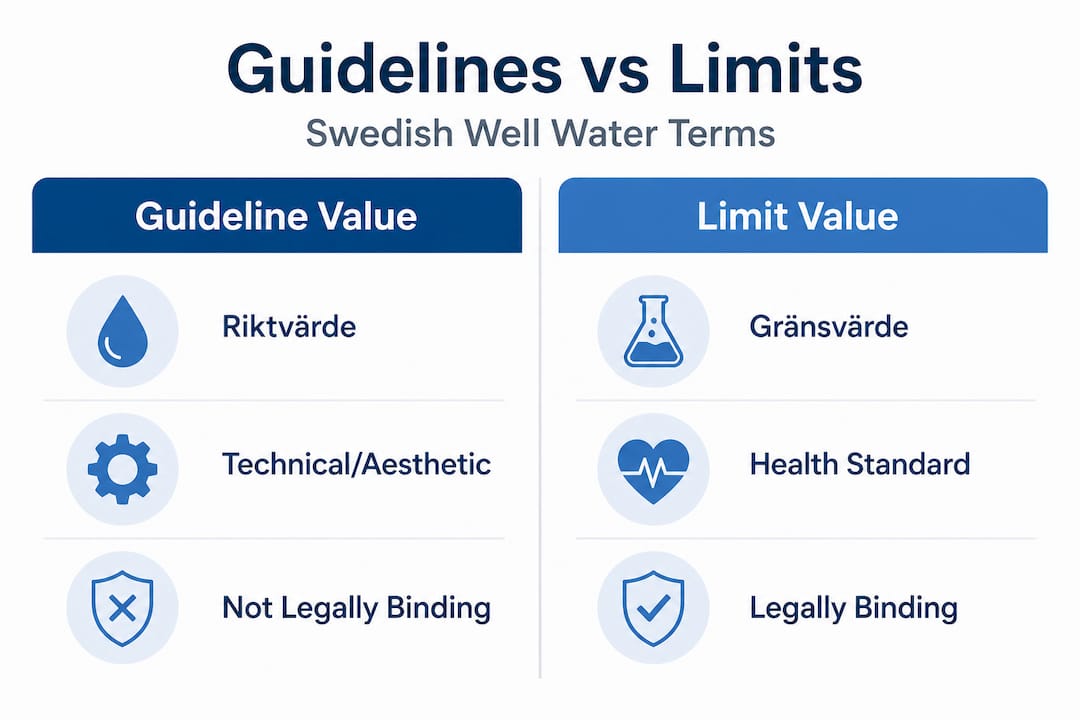
There are two distinct types of threshold values you will encounter in Swedish water quality documentation. Riktvärden guide private wells while gränsvärden set mandatory limits for public water suppliers. Private well owners are not legally required to meet the same binding rules as public waterworks, but they are expected to follow the riktvärden as strong advisory guidance based on the same health science.
Here is the practical distinction:
- Riktvärden (advisory values) apply to private wells. They are based on health, aesthetic, and technical grounds. Exceeding them does not trigger automatic legal enforcement, but it does signal a risk that you should address.
- Gränsvärden (mandatory limits) apply to public water suppliers. These are legally binding and enforceable by municipal health authorities.
This does not mean riktvärden are optional in any casual sense. The underlying science is identical for both types of values. If arsenic exceeds 10 µg/l in a private well, the health risk is exactly the same as if it occurred in a public system. The difference is administrative, not biological.
Aesthetic parameters such as high iron, elevated color readings, or unpleasant odors are usually classified under riktvärden for technical or comfort reasons. They typically do not carry the same urgency as parameters related to pathogens, heavy metals, or radiological contamination. That said, they often point to conditions in your well or plumbing that are worth addressing before they become more serious.
Pro Tip: If you are unsure whether a flagged parameter is a health concern or simply a technical one, do not rely on a general internet search. Reach out to a water quality professional who can differentiate between urgent action and reasonable monitoring. Context matters enormously, and the water analysis guidelines for Swedish well owners can help you frame the right questions.
The expert lens: Avoiding common mistakes with Swedish well water reports
There is a pattern we see repeatedly among Swedish well owners, and it is worth addressing directly. The official guidance is clear and well-structured. The problem is that reading numbers on a report is not the same as understanding what they mean for your specific household, your well type, your geology, and your family’s health profile.
One of the most consequential mistakes is using a non-accredited laboratory. This happens more often than you might expect, often because a cheaper or faster service looked reliable enough online. But results from non-accredited labs cannot be used for compliance, property transactions, or subsidy applications. You essentially pay for a result that has no legal standing. Vulnerable groups, including households with young children or immunocompromised members, also need stricter monitoring than the general three-year recommendation suggests.
Another costly mistake is treating a clean result after installing a filter as permanent confirmation. After any treatment system is installed, such as a UV disinfection unit, a carbon filter, or an iron removal system, you need to retest after the system is running. Two consecutive clean samples are the standard for confirming a treatment is working. Many homeowners skip this step and simply assume the problem is solved.
Perhaps the most overlooked mistake is focusing on aesthetic parameters at the expense of health parameters. A well owner who notices rust-colored water will naturally concentrate on iron. That is understandable. But while they are focused on the staining in their sink, they may miss elevated arsenic or an emerging bacterial issue that shows no visible sign whatsoever.
The truth is that the most dangerous contaminants in well water are often invisible and odorless. Bacteria, arsenic, radon, PFAS, and nitrates give you no sensory warning at all. This is precisely why what is water analysis matters beyond just reading numbers. It is the act of checking what you cannot see or smell.
Real expertise means not just reading numbers, but understanding which numbers demand immediate attention, which require monitoring, and which simply need a conversation with someone who knows Swedish groundwater.
Get peace of mind: Take the next step in well water safety
Understanding your water report is the first step. Ensuring ongoing safety and compliance is what protects your household over the long term.
If reading this guide has prompted questions about your own well, or if it has been more than three years since your last analysis, it is time to act. At Svenskt Vattenprov, we provide SGS Analytics and Eurofins-certified testing that meets Swedac accreditation standards, the same standards used by public waterworks across Sweden. Our reports are clear, detailed, and include personal guidance on what your results mean and what to do next. Whether you need a full water analysis package covering 71 parameters or a targeted drilled well water analysis built specifically for bergborrade brunnar, we have the right option for your situation. Contact us and we will help you choose the right package for your well type, location, and household needs.
Frequently asked questions
What does “tjänligt med anmärkning” mean on my water report?
It means your water is considered safe to drink, but there are minor technical or aesthetic issues that you may want to investigate and address over time.
Which well water parameter should I worry about the most?
Microbiological parameters like E. coli and coliform bacteria are the most urgent, as zero tolerance applies and any detection indicates an immediate health risk that requires action.
How can I make my water report valid for compliance?
Use an accredited laboratory, and after installing any treatment system, confirm with two consecutive clean samples before considering the issue resolved.
Are guideline values (“riktvärden”) legally binding for my private well?
Riktvärden are advisory recommendations, not enforceable legal requirements for private wells, but they are grounded in the same health science as the mandatory gränsvärden applied to public water systems.