

Must-know water testing facts for Swedish well owners
TL;DR:
- Swedish private well owners are solely responsible for testing and ensuring water safety. Routine testing is essential to detect invisible contaminants like bacteria, PFAS, nitrate, and heavy metals. Regular testing and proper interpretation help prevent health risks, property issues, and legal liabilities.
If you own a private well in Sweden, the safety of your drinking water rests entirely on your shoulders. Unlike municipal water systems, private wells have no mandatory government monitoring or routine testing. That means contaminants like bacteria, PFAS, nitrate, and heavy metals can build up silently, with no authority stepping in to warn you. The risks are real, and the consequences, ranging from serious illness to property devaluation, are entirely preventable. This article covers the essential facts every Swedish well owner needs to know, from your legal obligations to what professional testing actually involves.
Table of Contents
- Your legal responsibility: No one else is testing your well
- Top contaminants and warning signs to watch for
- How professional water testing in Sweden works
- Comparing water testing packages: What you get
- Expert perspective: The costly pitfalls most well owners overlook
- Take the next step: Reliable water testing for Swedish well owners
- Frequently asked questions
Key Takeaways
| Point | Details |
|---|---|
| You are responsible | Swedish well owners must test and monitor their own water, not the government. |
| Watch for warning signs | Changes in taste, smell, or appearance mean it’s time to test your water. |
| Choose accredited labs | Accredited laboratory testing and proper sample collection are essential for reliable results. |
| Select the right package | Match your testing package to your well’s age, type, and contamination risk. |
| Test regularly | Annual or post-event tests help keep your water safe and your family healthy. |
Your legal responsibility: No one else is testing your well
This is the fact that surprises most people: the Swedish government does not test, monitor, or take any responsibility for the quality of water in private wells. You are entirely on your own. According to Swedish food and environmental regulations, well owners bear full responsibility for testing and ensuring their drinking water meets safe standards. There is no inspector coming to check, no annual report filed on your behalf, and no automatic alert if something goes wrong underground.
This legal reality has practical consequences that go well beyond health. Consider what is at stake:
- Health and safety: Contaminated water can cause acute illness, long-term organ damage, or chronic exposure to carcinogens without any visible warning signs.
- Property value: A well with undocumented or poor water quality can seriously complicate or derail a property sale. Buyers increasingly request recent test results, and lenders may require them.
- Legal liability: If you sell a property with a private well and water quality issues are later discovered, you may face legal exposure for failing to disclose known risks.
- Neighbor relations: Contamination from your land, for example from a leaky septic system, can affect nearby wells and create disputes.
“As a private well owner, you are the water authority for your household. No one else holds that role.”
Understanding Swedish water quality standards is the starting point for knowing what your water should look like and what deviations mean. From there, using an assessment guide for well owners helps you interpret results and prioritize action. The bottom line: proactive testing is not optional. It is the only protection you have.
Top contaminants and warning signs to watch for
Not all water problems are obvious. Some of the most dangerous contaminants are completely invisible, odorless, and tasteless. That is what makes routine testing so important. Here are the most common threats found in Swedish private wells:
- Coliform bacteria and E. coli: Often the result of surface water infiltration, old well casing cracks, or nearby septic systems. Even low levels are a serious health risk.
- PFAS (per- and polyfluoroalkyl substances): Persistent chemicals that accumulate in the body and have been linked to cancer and immune disruption. Common near airfields, industrial sites, and areas that used firefighting foam.
- Nitrate: High levels often indicate agricultural runoff or nearby animal waste. Particularly dangerous for infants and can cause “blue baby syndrome.”
- Arsenic and other heavy metals: Occur naturally in Swedish bedrock, especially in granite-rich regions. Long-term exposure is linked to cardiovascular disease and cancer.
- Radon: A radioactive gas that dissolves into groundwater from surrounding rock. Drinking radon-contaminated water adds to overall radiation exposure.
Warning signs you should never ignore include a sudden change in taste, a sulfur or metallic smell, cloudy or discolored water, and staining on fixtures or laundry. These are signals to test immediately, not later.
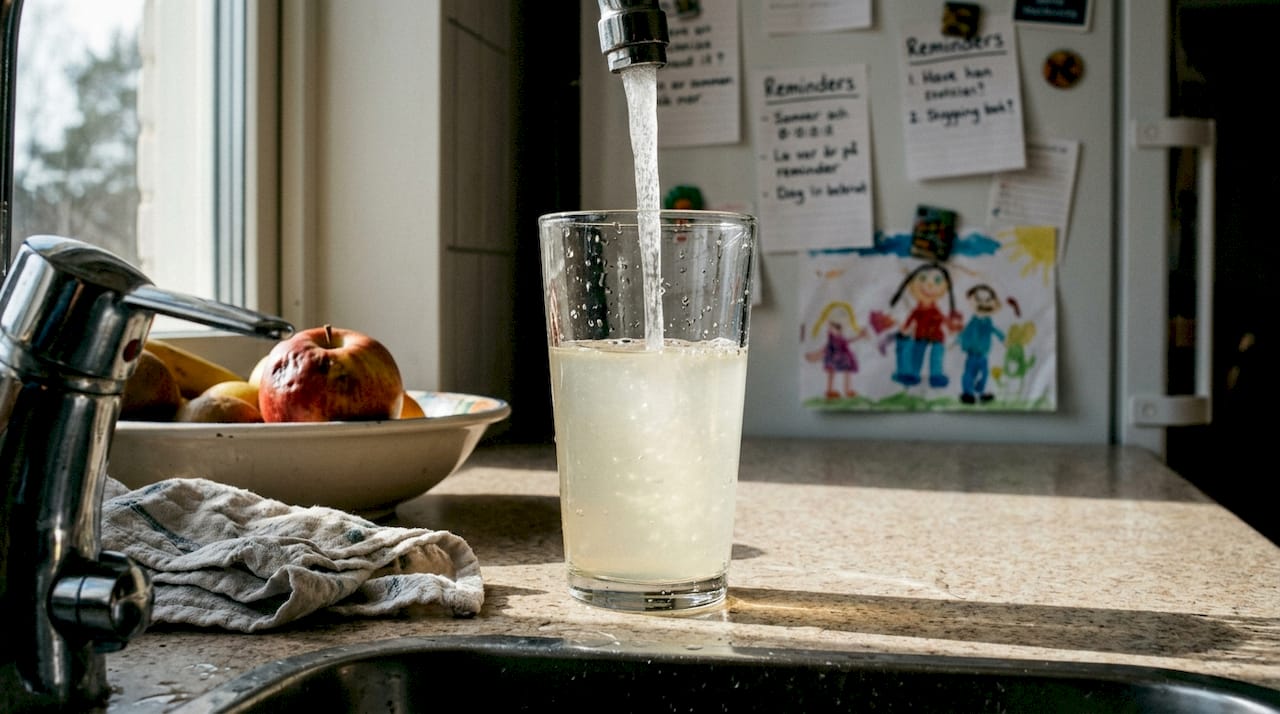
Drought conditions add another layer of risk. Low groundwater levels increase the chance of surface water infiltration, which carries bacteria, nitrate, and other pollutants directly into your well. SGU, the Geological Survey of Sweden, regularly issues warnings when groundwater levels drop to critical thresholds. If your region is under one of those warnings, treat it as a prompt to test.
Pro Tip: Check the essential well water facts page and cross-reference with current groundwater statistics to see whether your area is currently at elevated risk. Seasonal dry spells are one of the most underestimated triggers for contamination events.
How professional water testing in Sweden works
Many well owners assume testing is complicated or time-consuming. In practice, the process is straightforward when you work with the right provider. Here is how it typically works:
- Order your test kit. You receive a sampling kit with everything you need: sterile bottles, clear instructions, and a pre-paid return label.
- Collect your sample correctly. Run your tap for a set amount of time before collecting, and follow the instructions carefully. Improper sampling is one of the leading causes of inaccurate results.
- Send the sample to the lab. The kit goes directly to an accredited laboratory where it is registered and prioritized.
- Receive your results. You get a detailed report within a few business days, with each parameter explained in plain language alongside any recommended actions.
The quality of your results depends heavily on where the analysis happens. Accredited labs use standardized ISO methods, which means every parameter is measured against validated, reproducible procedures. This is not just a quality assurance checkbox. It is what makes the results legally usable, for example when contacting your municipality’s environmental health board or applying for grants to improve your water system.
Here is a quick overview of what professional testing typically covers:
| Category | Parameters tested | Why it matters |
|---|---|---|
| Microbiology | E. coli, coliform bacteria, enterococci | Detects sewage and surface contamination |
| Chemistry | pH, hardness, iron, manganese, nitrate | Affects taste, pipes, and health |
| Metals | Arsenic, lead, cadmium, chromium | Naturally occurring or from old infrastructure |
| Organic compounds | PFAS, solvents | Industrial and agricultural contamination |
| Radioactivity | Radon | Relevant in granite bedrock areas |
Follow the lab testing steps carefully and review the testing guidelines before you collect your sample. A small mistake at the collection stage can invalidate the entire analysis.
Comparing water testing packages: What you get
Choosing the right test package matters. A basic bacteria check tells you very little if your well is in a granite area with potential radon exposure, or near an old airfield with PFAS risk. Here is a practical comparison of the most relevant options for Swedish well owners:
| Package | Best for | Key parameters | Parameters covered |
|---|---|---|---|
| Bacteria analysis | Dug wells, post-flooding | E. coli, coliforms, enterococci | ~5 |
| Drilled well analysis | Bedrock/bergborrad wells | Bacteria, metals, chemistry, radon | ~41 |
| Dug well analysis | Grävd brunn, surface water risk | Bacteria, nitrate, chemistry | ~31 |
| Complete analysis | Older properties, pre-sale | All major categories plus PFAS | ~71 |
| PFAS analysis | Near industry/airfields | 30 PFAS compounds | 30 |
For most drilled wells, the 41-parameter package covers the essentials well. Dug wells, which sit shallower and are more exposed to surface water, warrant the focused dug-well package with extra attention to microbiology and nitrate. If you are selling a property, or if your well is older than 20 years, a complete analysis gives you the clearest picture and the strongest documentation.
Pro Tip: Use the fact checklist to match your well type, location, and risk factors to the right package before you order. Spending slightly more on a broader test once is far better than missing a critical contaminant and retesting later.
Situations that always call for a comprehensive test include moving into a new property with a private well, returning to a seasonal property after a long absence, and any time major repair or construction work has taken place near the well. As Swedish regulations confirm, that responsibility belongs entirely to you.
Expert perspective: The costly pitfalls most well owners overlook
After working with thousands of well owners across Sweden, we have noticed a pattern that concerns us. The most common mistake is not a technical one. It is the belief that good-tasting water is safe water. It is not. PFAS, arsenic, and radon leave no taste, no smell, and no color. Families can drink contaminated water for years without realizing it.
The second overlooked risk is timing. Many well owners test once and then forget about it. But your well’s water quality changes. A dry summer, a neighbor’s new septic system, or a crack in the well casing can transform clean water into a health hazard within a single season. Crucial regular testing is not overcaution. It is the only way to catch problems before they affect your family.
Finally, most people never retest after repairs, flooding, or construction near their well. That is when contamination is most likely to occur, and it is exactly when testing is most urgent. Do not assume the water returned to normal on its own.
Take the next step: Reliable water testing for Swedish well owners
Knowing the risks is only useful if you act on them. At Svenskt Vattenprov, we have built our entire service around making professional water testing straightforward, reliable, and easy to understand for private well owners.
Whether you need a focused bacteria water analysis after a flooding event, a thorough complete water analysis before selling your property, or the purpose-built testing for dug wells that addresses the specific risks of shallower groundwater sources, we have the right solution. Every analysis is carried out by SGS Analytics and Eurofins, a Swedac-accredited laboratory, and every result comes with clear explanations and practical guidance. You will never be left wondering what a number means or what to do next.
Frequently asked questions
How often should I test my private well in Sweden?
You should test at least once a year and after any maintenance, flooding event, or construction near your well. Since private well owners hold full responsibility for water safety, routine testing is the only way to stay ahead of emerging risks.
What are the most common contaminants found in Swedish wells?
Bacteria, PFAS, nitrate, and metals like arsenic and lead are the most frequently detected issues. Low groundwater levels significantly raise the chance of surface contamination, particularly with bacteria and nitrate during dry seasons.
Do I need a professional lab for reliable results?
Yes. Only accredited labs using standardized ISO methods guarantee results that are accurate, reproducible, and legally valid for use with authorities or in property transactions.
What should I do if my test results show high levels of contamination?
Stop using the water for drinking and cooking immediately, and contact a water specialist for guidance on remediation options. Do not wait to act, as some contaminants pose serious health risks even with short-term exposure.