

Integrated water analysis: safe well water for Swedish homes
TL;DR:
- Invisible contaminants like bacteria, radon, PFAS, and heavy metals are undetectable by taste or sight.
- Integrated water analysis tests multiple parameters for comprehensive well water safety assessment.
- Regular testing and professional lab analysis are essential for ensuring safe drinking water from private wells.
Many well owners believe that if their water looks clear and tastes fine, it must be safe. That assumption is understandable, but it can be dangerous. Invisible contaminants like bacteria, radon, PFAS, and heavy metals leave no color, smell, or taste behind. In Sweden, private well owners bear full responsibility for their own water safety, with no municipal oversight to catch problems for you. Integrated water analysis, meaning a complete multi-parameter well water test covering microbiological, chemical, physical, and radiological risks, is the only reliable way to know what is actually in your water. This article breaks down what it covers, why it matters, and how to act on your results.
Table of Contents
- What is integrated water analysis?
- Why comprehensive well water testing is crucial
- What does an integrated water analysis include?
- How to interpret integrated water test results
- A Swedish expert’s perspective: What most well owners miss
- Get peace of mind with accredited water analysis
- Frequently asked questions
Key Takeaways
| Point | Details |
|---|---|
| Comprehensive testing is crucial | Integrated water analysis means checking for all major risks, not just taste or appearance. |
| Invisible contaminants matter | Bacteria, radon, and PFAS can be present in safe-looking water. |
| Legal and health standards apply | Only accredited analyses are valid for legal uses and clearly interpret results. |
| Tailor to your well type | Dug and drilled wells have different risks and should use customized test packages. |
| Act on results, not assumptions | Always follow up with treatment or retesting if your water is classified as unfit or has remarks. |
What is integrated water analysis?
The term “integrated water analysis” does not have a single universal legal definition. No international standard body has formally registered it as a specific methodology. In the Swedish context, it refers to holistic well water testing that covers all major health-related risk categories in one coordinated process, rather than testing for just one or two isolated parameters.
Think of it this way. A single-parameter test might check only for coliform bacteria. That tells you something, but it tells you nothing about arsenic levels, radon, nitrates, or pH. An integrated approach brings all of those categories together into one structured analysis, giving you a complete picture instead of a fragment.
For Swedish private well owners, the relevant categories typically include:
- Microbiological: E. coli, coliform bacteria, and total bacterial count
- Chemical: Nitrates, nitrites, arsenic, lead, manganese, iron, and other metals
- Physical: pH, turbidity (cloudiness), conductivity, and color
- Radiological: Radon, which is particularly relevant in granite-heavy regions like Värmland and Dalarna
“The quality of drinking water from private wells is the responsibility of the property owner. Testing should cover all relevant risk categories to ensure health safety.” — Livsmedelsverket
Livsmedelsverket’s guidance shapes what responsible well testing looks like in Sweden. Their recommendations inform the water quality standards that accredited labs use when evaluating your results. A good well water testing guide will always reference these benchmarks.
The key point is that integrated analysis is not about running every conceivable test. It is about running the right tests across all risk categories so that no major threat goes undetected. For most Swedish households, that means a package covering 30 to 70 parameters, depending on your well type and local geology.
Why comprehensive well water testing is crucial
Knowing what integrated water analysis covers, it is vital to understand why it is essential for your home.
In Sweden, private well owners are legally responsible for their own water quality. There is no government body that automatically monitors your well. No alert system will notify you if bacteria levels spike after a heavy rain. No inspector will show up if radon starts seeping into your groundwater. That responsibility sits entirely with you.
The risks are real and more common than most people expect. Up to 20% of private wells in Sweden contain substances that exceed health-based safety limits. Roughly 15% fail due to bacterial contamination alone. These are not rare edge cases. They are everyday households where families drink, cook, and bathe using water they believe is safe.
Some of the most serious threats are completely invisible:
- Radon: A naturally occurring radioactive gas that dissolves into groundwater in granite zones. No taste, no smell, no color.
- PFAS: Synthetic chemicals from industrial and firefighting sources that accumulate in the body over time. Undetectable without lab testing.
- Arsenic: Found naturally in certain Swedish bedrock formations. Chronic exposure causes serious long-term health effects.
- Nitrates: Common near agricultural land. Particularly dangerous for infants under six months.
- Coliform bacteria: Can enter wells after flooding, heavy rain, or aging well casings.
Households with young children, pregnant women, or immunocompromised individuals face heightened risk from all of these. Livsmedelsverket recommends testing every three years for most households, and annually for households with young children. You can explore Swedish groundwater statistics to understand regional risk patterns across the country.
Pro Tip: If you have recently experienced flooding, a dry summer followed by heavy rain, or nearby construction activity, test your well immediately rather than waiting for your regular cycle.
The importance of regular water testing cannot be overstated. Water quality changes over time. A well that tested clean three years ago may have shifted due to changes in the surrounding land, seasonal groundwater movement, or gradual corrosion of well components.
What does an integrated water analysis include?
To see exactly what you get from integrated water analysis, let’s break down the typical parameters and process.
Most comprehensive packages test between 30 and 70 parameters. The exact number depends on your well type and the package you choose. A standard drilled well package typically covers 41 parameters. A dug well package focuses on 31, with extra attention to surface water intrusion risks. A full-spectrum package can reach 71 or more.
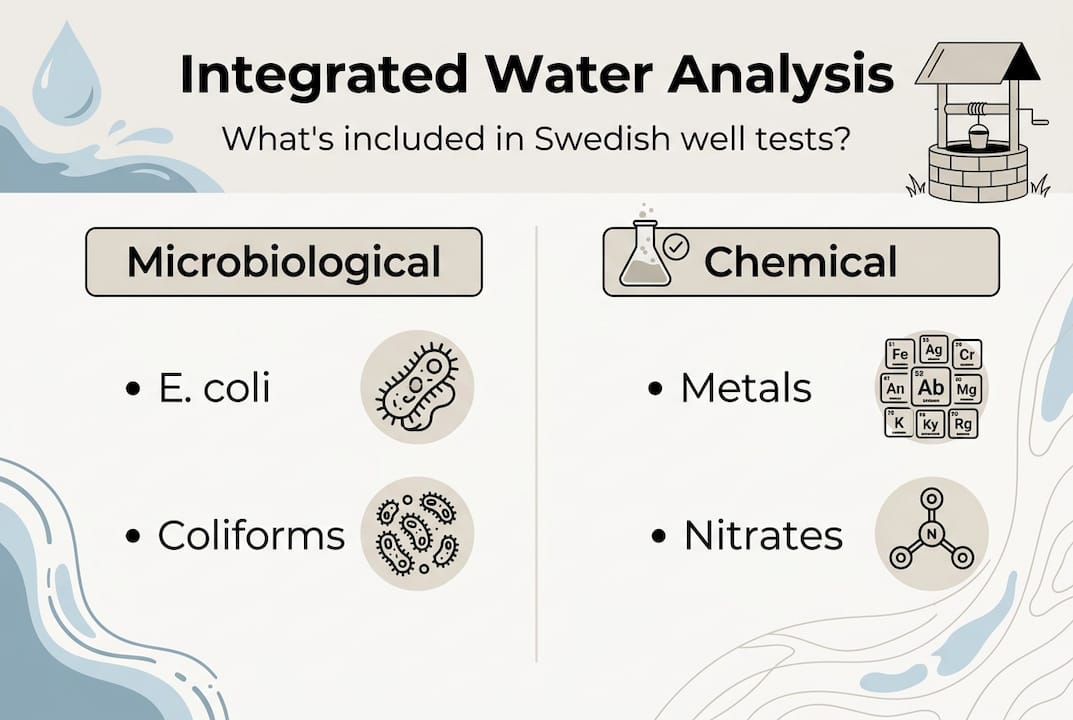
| Category | Common parameters | Detection method |
|---|---|---|
| Microbiological | E. coli, coliforms, total count | Culture methods, ISO 9308-1 |
| Chemical (metals) | Arsenic, lead, iron, manganese | ICP-MS, ICP-OES |
| Chemical (other) | Nitrates, nitrites, fluoride | Ion chromatography |
| Physical | pH, turbidity, conductivity, color | Spectrophotometry |
| Radiological | Radon | Liquid scintillation |
The technology behind modern water analysis is precise. ICP-MS (inductively coupled plasma mass spectrometry) can detect metals at parts-per-trillion concentrations, which is essential for identifying trace levels of arsenic or lead that would still pose health risks. Standard water chemistry analysis methods like ISO 9308-1 are used for bacterial counts to ensure results are internationally comparable.
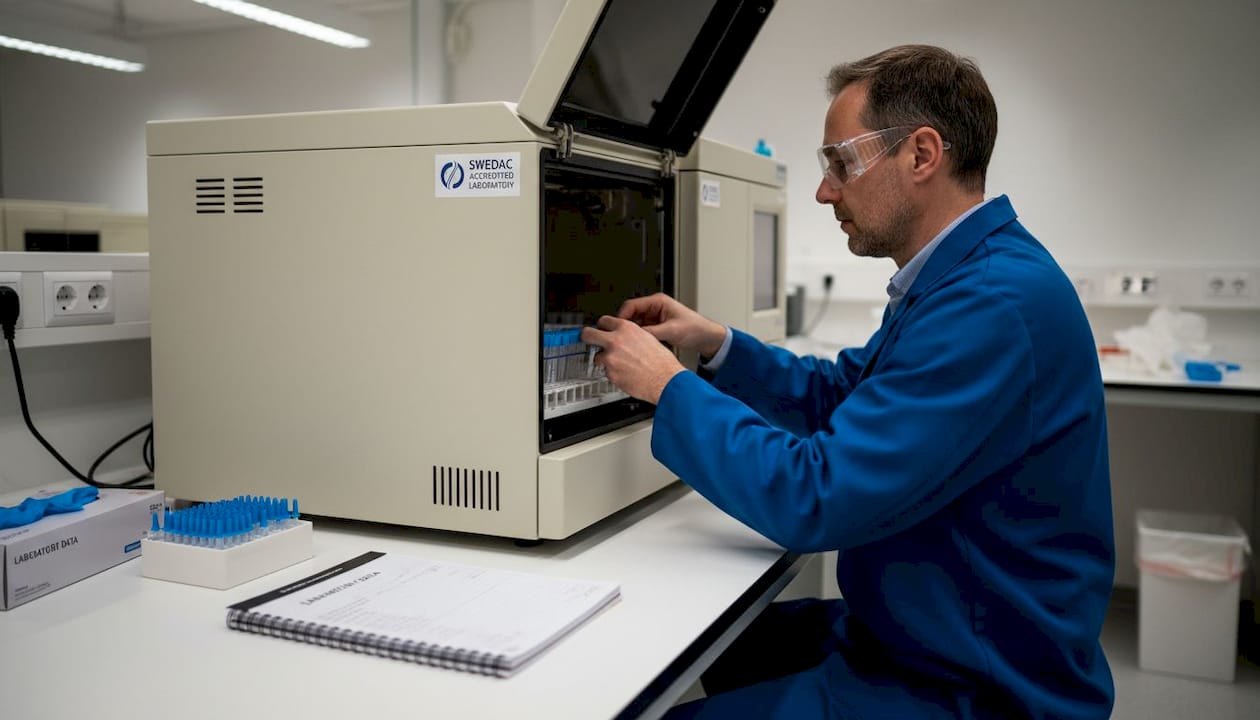
Accredited labs matter here. Only Swedac-accredited laboratories, such as SGS Analytics, Eurofins, and IVL, produce results that are legally recognized for property sales, grant applications, or official health authority submissions. Results from non-accredited providers may not hold up in those contexts.
Sampling technique also affects accuracy. You must use sterile bottles provided by the lab, follow cold-chain transport protocols, and collect samples before any in-home filtration. Contaminating the sample during collection can produce false results.
Pro Tip: Always collect your water sample from the cold tap closest to the well entry point, after flushing the pipe for two minutes. This gives the most representative reading of your actual groundwater.
For deeper context on what each parameter means for your specific situation, the water analysis essentials guide is a useful resource.
How to interpret integrated water test results
Once you have had a comprehensive analysis, understanding your lab report is critical to taking action.
Swedish lab reports for private well water use three core classifications defined by Livsmedelsverket:
| Result category | Swedish term | What it means |
|---|---|---|
| Fit for drinking | Tjänligt | All parameters within safe limits |
| Remark | Med anmärkning | One or more values slightly above normal, monitor or treat |
| Unfit | Otjänligt | One or more values exceed health limits, action required |
The three result categories give you a clear starting point, but the details inside the report matter just as much as the overall classification.
Here is how to respond based on your result:
- Tjänligt (fit): Your water meets current safety standards. Continue regular testing on schedule. Keep records for future property transactions.
- Med anmärkning (remark): A value is elevated but not at an immediately dangerous level. Common examples include slightly high iron or manganese, which affect taste and appliances but are not acute health risks. Investigate the cause and consider a targeted treatment solution.
- Otjänligt (unfit): Stop drinking the water immediately. Contact the lab for specific guidance on which parameter failed and by how much. Install appropriate treatment, then retest before resuming use.
Edge cases deserve attention. If you have recently installed a filtration system, retest after installation to confirm it is working. After flooding, retest even if your last result was clean. If you are selling a property, an accredited result dated within the past year is typically expected by buyers.
For a step-by-step walkthrough of the full process, the guide on how to test your well covers everything from ordering a kit to submitting your sample. You can also refer to the official Livsmedelsverket guidelines for the regulatory context behind each classification.
A Swedish expert’s perspective: What most well owners miss
After working with thousands of Swedish well owners, one pattern stands out clearly. Most people only test their water when something seems wrong. A strange smell. A slight discoloration. A new neighbor mentioning their well had issues. But the most dangerous contaminants give no warning at all.
Radon is a perfect example. Sweden has some of the highest natural radon concentrations in the world, particularly in granite-heavy regions. It dissolves silently into groundwater and has no taste or odor. The health risks from invisible threats like radon and PFAS accumulate over years of exposure, not days. By the time symptoms appear, the damage is already done.
Sensory checks are simply not a substitute for lab analysis. We hear this often: “Our water tastes great, so it must be fine.” That logic does not hold. Visual clarity and pleasant taste confirm nothing about bacterial counts, arsenic levels, or PFAS concentrations.
Another commonly overlooked step is retesting after installing a filtration or treatment system. A filter changes your water chemistry. Without a follow-up test, you cannot confirm it is working correctly or that it has not introduced new imbalances. Understanding the full range of well water risks is what separates reactive well management from genuinely safe water stewardship.
Get peace of mind with accredited water analysis
If this article has made one thing clear, it is that well water safety requires evidence, not assumptions. Integrated water analysis gives you that evidence, covering every major risk category in a single, structured process.
At Svenskt Vattenprov, we offer Swedac-accredited testing packages designed specifically for Swedish private wells. Whether you have a drilled well, a dug well, or need a full-spectrum check, we have a package that fits. Our complete water analysis covers 71 parameters for maximum certainty. The dug well analysis is tailored for surface water risks, while our drilled well analysis covers the 41 parameters most relevant to bedrock sources. Every result comes with clear explanations and concrete next steps.
Frequently asked questions
How often should I test my private well water in Sweden?
Standard guidance is every 3 years, or annually if there are young children in your household. Testing more frequently is also recommended after flooding or changes in the surrounding environment.
Does clear and good-tasting water mean it’s safe?
No. Many dangerous contaminants like bacteria, radon, and PFAS have no taste or odor and require lab testing to detect. Sensory checks alone cannot confirm water safety.
Which parameters are typically included in integrated water analysis?
Comprehensive tests cover bacteria, metals, nitrates, pH, hardness, and often radon or other area-specific risks, with 30 to 70 parameters depending on the package and well type.
Are all water analysis providers in Sweden accredited?
No. Only Swedac-accredited labs like Eurofins, SGS, and IVL guarantee results that are valid for legal, grant, or property sale requirements. Always verify accreditation before ordering.
What should I do if my well analysis is ‘unfit’ (otjänligt)?
Stop drinking the water right away, consult your lab for specific guidance, and consider treatment or remediation before retesting your well. Do not resume use until a follow-up test confirms the water is safe.