

Complete Water Analysis: Protect Your Family's Health
Many well owners believe that clear water automatically means safe water. The truth is that deadly bacteria, carcinogenic arsenic, and radioactive radon can be present in crystal clear well water without being seen, smelled, or tasted. A complete water analysis is the only method to ensure that your water is safe to drink. By testing microbiological, chemical, physical, and radioactive parameters, you get a complete picture of the water quality and can protect your family from hidden health risks that can develop over time.
Table of Contents
- Key Insights
- What Does a Complete Water Analysis Involve?
- Why is a Complete Water Analysis Important for Health and Safety?
- Different Packages and How to Choose the Right Analysis for Your Well
- How to Analyze Your Well and Interpret Results
- Discover Our Water Analyses for Your Needs
- Frequently Asked Questions About Complete Water Analysis
Key Insights
| Point | Details |
|---|---|
| Complete water analysis required | A complete analysis tests microbiological, chemical, physical, and radioactive parameters for a comprehensive picture of water quality. |
| Sampling every three years | Recommended regular testing is at least every three years and more often when infants are in the household. |
| Identifies hidden risks | A complete analysis reveals potentially dangerous substances such as bacteria and nitrates that are not visible in smell or taste. |
| Comprehensive test packages provide protection | Covers microbiological, chemical, physical, and radioactive parameters, providing security and legal assurance. |
Key Insights
| Insight | Significance |
|---|---|
| Complete analysis covers microbiological, chemical, physical, and radioactive substances | Provides comprehensive protection against all types of contamination |
| 15-20% of private wells contain harmful substances | Regular testing is essential, not optional |
| The Swedish Food Agency recommends testing every three years | More often if there are infants or changes in water quality |
| Early detection prevents serious health problems | Bacteria, nitrates, and arsenic can cause acute illness or cancer |
| Comprehensive test packages provide legal security | Necessary for property sales and grant applications |
What Does a Complete Water Analysis Involve?
A complete water analysis involves testing microbiological, chemical, physical, and sometimes radioactive parameters according to the Swedish Food Agency's guidelines. This differs significantly from a simple bacterial analysis or a basic chemical test. A comprehensive investigation gives you the complete picture of what is actually in your water.
Microbiological tests form the basis of water safety. They identify E. coli and coliform bacteria, which indicate fecal contamination and a risk of serious stomach illness. These organisms can come from surface water, animal waste, or poorly constructed wells. A single positive bacterial test requires immediate action as bacteria can multiply rapidly under the right conditions.
Chemical analyses measure a wide range of substances that affect both health and water usability. The pH value indicates whether the water is acidic or basic, which affects corrosion in pipes and the efficiency of purification equipment. Iron and manganese cause brown discoloration and metallic taste but rarely pose direct health risks. Nitrate, however, is dangerous, especially for infants, and often comes from fertilizers or sewage leaks. Arsenic is a naturally occurring carcinogenic substance in certain rocks that requires continuous monitoring.
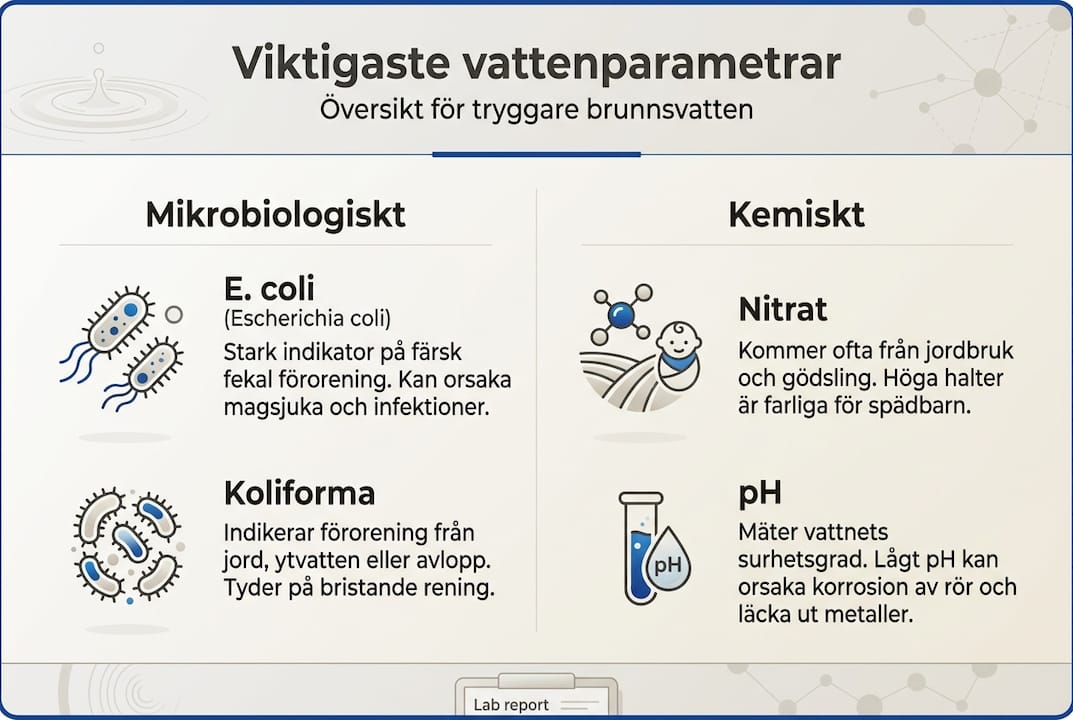
Physical parameters assess the water's comfort and usability in everyday life. Hardness measures calcium and magnesium, which affect washing results and appliance longevity. Color and turbidity can indicate organic matter or iron compounds. Odor can signal hydrogen sulfide or other volatile substances that need attention.
Radioactive substances like radon occur naturally in granite areas and are the second most common cause of lung cancer after smoking. Radon is invisible and odorless but can accumulate in the body over decades. A water analysis for your own well should include radon measurement if you live in risk areas.
Analysis specifications follow the Swedish Food Agency's regulation LIVSFS 2022:12, which sets limit values for drinking water. These standards are based on extensive research on long-term health effects and ensure that your water meets the same requirements as municipal water.
Important parameters in a complete analysis:
- E. coli and coliform bacteria for microbiological safety
- pH, alkalinity, and conductivity for water chemistry
- Iron, manganese, copper, and zinc for metal content
- Nitrate, nitrite, and ammonium for nitrogen impact
- Arsenic, lead, and cadmium for toxic heavy metals
- Hardness, chloride, and sulfate for water quality
- Radon for radioactive radiation in risk areas
Why is a Complete Water Analysis Important for Health and Safety?
Well water may look perfect but hide life-threatening contaminants. The Swedish Food Agency recommends testing at least every three years, as 15-20% of private wells have hazardous substances. This statistic shows that the problem is significantly more common than most well owners believe.

Bacteria cause acute infections that can develop into serious illness within days. E. coli can lead to bloody diarrhea, kidney failure, and, in the worst case, death, especially in children and the elderly. Coliform bacteria signal that the well is vulnerable to surface water intrusion, which opens the door for campylobacter, salmonella, and other pathogens. A single rain shower can introduce millions of bacteria into a poorly constructed well.
Nitrate poses a particular danger to infants under six months. High nitrate levels can cause methemoglobinemia, also known as blue baby syndrome, where the blood loses its ability to transport oxygen. This condition can be fatal if not detected in time. Pregnant women are also at increased risk as nitrates can affect fetal development. The limit value is 50 mg/l, but many experts recommend keeping levels below 25 mg/l for maximum safety.
Arsenic and radon are carcinogenic substances that accumulate in the body over decades. Arsenic in drinking water is linked to skin cancer, bladder cancer, and lung cancer even at low exposures. Radon decays into radioactive particles that get stuck in the lungs, dramatically increasing the risk of lung cancer. Since these substances do not cause immediate symptoms, the problem is often discovered only when serious illness has already developed.
Hard water with high calcium and magnesium levels damages household appliances by forming limescale deposits in water heaters, dishwashers, and washing machines. This shortens the life of appliances by up to 50% and increases energy costs as limescale reduces heat transfer efficiency. Corrosive water with low pH can dissolve copper and lead from pipes, leading to metal poisoning over time.
Health risks ranked by severity:
- Bacteria: Acute illness within days, potentially fatal
- Nitrate: Methemoglobinemia in infants, birth defects
- Arsenic: Cancer after long-term exposure (10-30 years)
- Radon: Lung cancer after decades of exposure
- Lead and copper: Neurological damage, especially in children
- Iron and manganese: Aesthetic problems, no direct health risks
“Many well owners only discover contamination when someone in the family gets sick or when a property inspection requires water analysis. By then, the damage may already be done. Preventive testing is always cheaper than treating diseases or repairing damaged plumbing systems.”
Pro tip: Always test your well water before an infant is born or when moving to a new property. Infants are extremely sensitive to nitrates and bacteria, and previous owners' test results say nothing about current water quality. Well water statistics show that water quality can change dramatically in just a few years.
Different Packages and How to Choose the Right Analysis for Your Well
Choosing the right analysis package depends on your well type, geographical location, and specific risk factors. A complete analysis is recommended as a multipack with 30-40 parameters, especially for property sales or when you want maximum security.
Classic packages focus on the most common and critical parameters such as bacteria, nitrate, pH, and basic metals. These are well-suited for regular monitoring of wells that have previously shown good results. A classic package typically covers 25-35 parameters and provides a solid foundation for water safety without analyzing more unusual substances.
Complete+ packages offer maximum coverage with 70+ parameters, including rare heavy metals, organic substances, and radioactive substances. This package is highly recommended for the first analysis of a new well, for suspected problems, or when you live near potential sources of contamination such as industries, airports, or intensive agriculture. The extended analysis provides you with complete insight and legal documentation that lasts for years.
Customized packages are available for dug and drilled wells, as these have different risk profiles. Dug wells are shallower and more vulnerable to surface water intrusion, requiring extra focus on bacteria and nitrate. Drilled wells reach deeper groundwater but may have higher levels of naturally occurring substances such as arsenic, radon, and fluoride. A complete water analysis+ covers both types with an adapted parameter list.
Comparison of analysis packages:
| Package type | Number of parameters | Best for | Price (approx.) |
|---|---|---|---|
| Basic | 15-20 | Annual follow-up, known wells | 1,500-2,000 SEK |
| Classic | 25-35 | Standard every three years | 2,500-3,500 SEK |
| Complete | 40-50 | First analysis, property purchase | 4,000-5,000 SEK |
| Complete+ | 70+ | Maximum security, risk areas | 6,000-8,000 SEK |
| Specialized | Varies | PFAS, radon, heavy metals | 2,000-4,000 SEK |
Geographical factors influence which parameters are most important. Wells in Skåne and Gotland need to focus on hardness and lime problems. Granite areas in Värmland and Dalarna require radon analysis. Coastal areas need to test for saltwater intrusion with chloride and sodium. Agricultural areas require careful monitoring of nitrates and pesticides.
Factors influencing package choice:
- Well type: dug or drilled affects the risk profile
- Well age and condition determine the likelihood of problems
- Proximity to contamination sources such as industry or agriculture
- Previous analysis results and known problems in the area
- Specific needs such as property sales or grant applications
- Budget and frequency of planned testing
Pro tip: Always start with a comprehensive package for the first analysis. Once you know your well's profile, you can then switch to more targeted follow-up analyses every three years. This saves money in the long run while maintaining full control over water quality. Consult experts on water analysis packages for personalized guidance based on your specific situation.
How to Analyze Your Well and Interpret Results
Conducting an accurate water analysis requires careful sampling and understanding the significance of the results. The Swedish Food Agency and Svenskt Vattenprov provide guidelines for sampling and interpretation assistance to ensure reliable results.
Step-by-step sampling:
- Order analysis package and receive sampling equipment with sterile bottles and detailed instructions
- Choose the correct sampling point, preferably a kitchen tap with cold water directly from the well without filters or softeners
- Clean the tap thoroughly with alcohol or chlorine solution and let the water run for 2-3 minutes to flush out stagnant water
- Fill the sample bottles according to instructions without touching the inside or caps, fill completely for bacterial samples but leave a little air space for chemical samples
- Label the bottles clearly with date, time, and sampling point
- Send samples the same day or store cold overnight; bacterial samples must reach the laboratory within 24 hours
Analysis typically takes 7-14 business days depending on the scope of the package. Bacterial analyses can provide preliminary results within 2-3 days, while chemical analyses require more time for accurate measurement. Special analyses such as PFAS or radon can take up to three weeks.
Result interpretation requires understanding limit values and what deviations practically mean. Each parameter is compared against the Swedish Food Agency's norms and classified as approved, technical deviation, or health risk. Approved values mean the water is safe to drink. Technical deviations affect taste, odor, or usability but do not pose an immediate health risk. Health risks require immediate action and an alternative drinking water source.
Common deviations and their significance:
- E. coli detected: Immediate health risk, boil water or use bottled water until the problem is resolved
- Nitrate over 50 mg/l: Dangerous for infants, investigate source of contamination
- pH below 6.5: Corrosive water that dissolves metals, install pH adjustment
- Iron over 0.2 mg/l: Brown discoloration and metallic taste, install iron filter
- Radon over 100 Bq/l: Long-term cancer risk, install radon separator
- Arsenic over 10 μg/l: Carcinogenic, requires reverse osmosis or alternative water source
Warning signs in analysis results require different actions depending on the severity. Bacteria require disinfection of the well, inspection of the well cap, and possible repair of casing pipes. High nitrate levels require investigation of nearby sources of contamination such as old sewage systems or fertilization. Metal problems can be solved with various filtration methods. Radon requires special equipment for separation.
Pro tip: Save all analysis results in a binder or digital folder. This creates a history that shows trends over time and facilitates property sales or grant applications. Compare new results with previous ones to detect deterioration early. A guide for well owners will help you understand long-term changes.
Contact experts when analysis results show serious deviations or when you are unsure what actions are needed. Professional advice can save thousands of kronor by identifying the right solution immediately instead of trying various methods. Many municipalities offer free advice through their environmental and health protection unit for well owners with water problems.
Discover Our Water Analyses for Your Needs
Now that you understand the importance of complete water analysis, the next step is to protect your family by testing your well water. Svenskt Vattenprov offers analysis packages adapted for different well types and needs, all analyzed by a Swedac-accredited laboratory according to the Swedish Food Agency's regulations.
Our complete water analysis+ package covers 71 parameters and gives you maximum security with comprehensive testing of microbiological, chemical, physical, and radioactive substances. For targeted testing, we offer water analysis for bacteria for quick checks of microbiological safety. Dug wells receive tailored analysis through our dug well water analysis package with a focus on surface water intrusion.
Ordering is simple: choose a package, receive sampling equipment at home, follow the instructions, and send the samples back. Within two weeks, you will receive a clear report with results, explanations, and concrete recommendations. Our customer service will help you interpret the results and plan any necessary actions.
Frequently Asked Questions About Complete Water Analysis
How often should I analyze my well water?
The Swedish Food Agency recommends analysis at least every three years for established wells with a good history. Test more often if there are changes in taste, odor, or color, when infants are in the household, after floods, or when there are changes in the surroundings such as new development or agricultural activity. The first analysis of a new well should be comprehensive to establish a baseline.
What are the most common health risks in well water?
Bacteria such as E. coli constitute the most common acute health risk and can cause severe gastroenteritis within days. Nitrate is particularly dangerous for infants and can cause methemoglobinemia. Long-term risks include arsenic and radon, which are carcinogenic after decades of exposure. Iron and manganese primarily cause aesthetic problems but no direct health risk.
What does a complete water analysis cost?
Prices vary between 2,500 SEK for basic packages up to 8,000 SEK for comprehensive analyses with 70+ parameters. A standard package with 30-40 parameters typically costs 3,500-5,000 SEK. This includes sampling equipment, laboratory analysis, report, and advice. Special analyses such as PFAS or radon cost an additional 2,000-4,000 SEK. The investment is minimal compared to the cost of illness or water purification systems.
How do I know if my water is safe to drink?
You cannot assess water safety by appearance, taste, or odor because many dangerous substances are invisible and tasteless. Only laboratory analysis can confirm safety by measuring bacteria, chemicals, and metals against limit values. Clear water can contain deadly bacteria or carcinogenic arsenic. Regular testing is the only way to guarantee safety over time. Visit questions and answers about water analysis for more information.
What do I do if the analysis shows contamination?
The action depends on the type and level of contamination. For bacteria, boil the water immediately and disinfect the well, check the well cap and casing pipes. High nitrate levels require investigation of the contamination source and possibly a new well or purification system. Metal problems are solved with appropriate filters based on which metals have been detected. Radon requires special equipment for separation. Always contact experts for advice on serious deviations and follow up with a new analysis after taking action.