

How to validate your Swedish well water lab report
You open the envelope, pull out your water lab report, and stare at two pages of numbers, abbreviations, and units you’ve never seen before. Is E. coli at 1 CFU/100ml a problem? Does your iron level at 0.4 mg/L mean you need a filter? And is this report even legally valid if you need to sell your property next year? These are questions thousands of Swedish well owners face every time a new analysis arrives. Research shows that around 20% of Swedish private wells fail at least one official safety limit, with bacteria, radon, arsenic, PFAS, and nitrates being the most common offenders. This guide walks you through exactly how to validate your report so you can act with confidence.
Table of Contents
- What does it mean to validate a water lab report?
- Essential requirements for a valid water report
- Step-by-step: How to validate your water lab report
- Troubleshooting, common mistakes, and when to seek help
- What most well owners miss about water lab report validation
- Get expert-validated water testing for peace of mind
- Frequently asked questions
Key Takeaways
| Point | Details |
|---|---|
| Accreditation is mandatory | Only Swedac-accredited labs deliver legally valid water results. |
| Prioritize key health risks | Bacteria, nitrate, and PFAS need your attention first on every report. |
| Validation steps are clear | Check lab credentials, match parameters, and verify against guidelines every time. |
| Common mistakes can void results | Using non-accredited labs, missing health parameters, or ignoring report dates can cause problems. |
What does it mean to validate a water lab report?
Validation, in this context, means confirming that your water lab report is trustworthy, legally usable, and interpreted correctly. It is not just about reading the numbers. It means checking that the lab producing those numbers meets the standards required by Swedish law and EU directives, and that the results you receive can actually be used when you need them most.
Why does this matter so much? Consider three situations where an invalid report causes real problems. You are selling a property with a private well, and the buyer’s agent rejects your water analysis because it came from a non-accredited lab. You apply for a municipal grant to install water treatment equipment, and the environmental office refuses your application for the same reason. Or you share results with your local health inspector after a neighbor reports a contamination event, and those results carry no official weight.
Swedish regulations, aligned with EU Drinking Water Directive standards, require that water analyses used for official purposes come from Swedac-accredited labs. Swedac is Sweden’s national accreditation body, and ISO 17025 is the international standard that certified labs must follow. As stated by Livsmedelsverket (the Swedish Food Agency), accredited water analysis requirements mandate that only results from these labs are legally valid for property sales, grant applications, and official municipal reporting. Non-accredited results simply lack legal weight, no matter how sophisticated the test.
Validation also means understanding the importance of accredited water analysis for your family’s health decisions. A report that looks professional but comes from an unqualified lab can give you false confidence or unnecessary alarm. Knowing how to check is your first line of defense.
Key reasons validation matters:
- Legal compliance: Only accredited results are accepted by municipalities, courts, and real estate transactions.
- Health decisions: Treatment choices and safety measures depend on results you can trust.
- Reproducibility: Accredited labs follow strict protocols so results can be compared over time.
- Financial protection: Grants and subsidies for water improvement often require accredited documentation.
“A water report is only as valuable as the lab that produced it. If the accreditation is missing, the numbers on the page are just numbers.”
Essential requirements for a valid water report
Now that you understand why validation matters, let’s be specific about what a valid report actually looks like. There are several non-negotiable elements to check every time.
Accreditation status is the first box to tick. The lab must hold Swedac accreditation under ISO 17025. This should be clearly printed on the report, often with a Swedac logo or reference number. If you cannot find it, call the lab and ask directly. Per official well water requirements, Livsmedelsverket confirms that legally valid lab results must originate from Swedac-certified facilities.
Sample handling documentation is the second critical element. The report should include the date and time of sampling, the method used to collect the sample, and how the sample was stored and transported. Bacterial parameters like E. coli can change rapidly if samples are kept too warm or too long before analysis. A gap of more than 24 hours between collection and analysis for microbiological tests is a red flag.
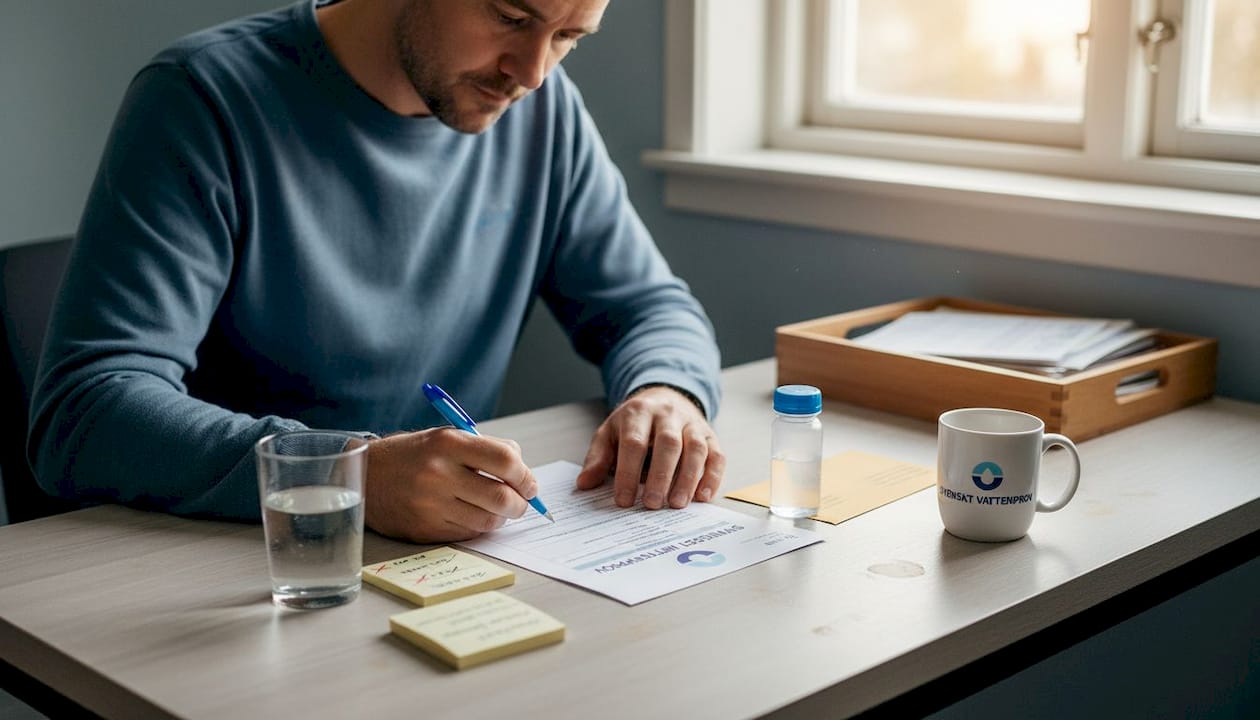
Reporting standards matter too. Results should be reported in units that match Livsmedelsverket’s guidelines, and each parameter should be compared against the applicable limit or guideline value.
Here is a direct comparison of what you will find in accredited versus non-accredited reports:
| Element | Accredited lab report | Non-accredited lab report |
|---|---|---|
| Swedac/ISO 17025 reference | Always present | Missing or vague |
| Legal validity for property sales | Yes | No |
| Accepted by municipalities | Yes | No |
| Comparison against Livsmedelsverket limits | Standardized | May vary or be absent |
| Chain of custody documentation | Included | Often missing |
| Repeatable, auditable methodology | Required | Not guaranteed |
| Usable for grant applications | Yes | No |
The parameters tested also deserve attention. Not all parameters carry the same weight. There is an important distinction between health parameters and aesthetic parameters:
- Health parameters: E. coli, intestinal enterococci, nitrate, nitrite, arsenic, PFAS compounds, radon, and lead. Exceedances here mean a genuine risk of illness or long-term harm.
- Aesthetic parameters: Iron, manganese, turbidity, color, odor, and taste. These affect how water looks, smells, or tastes but rarely pose a direct health threat at levels commonly found in Swedish wells.
Pro Tip: When you receive your report, use a highlighter or pen to mark health parameters separately from aesthetic ones. This instantly tells you where to focus your attention and whether action is urgent or optional.
Step-by-step: How to validate your water lab report
With requirements clearly understood, here is a practical process you can follow every single time a new lab report arrives.
Step 1: Confirm accreditation. Locate the Swedac logo or accreditation reference number on the first page of the report. Cross-reference this on the Swedac website if you are unsure. No accreditation, no trust. This step takes two minutes and saves significant trouble later.
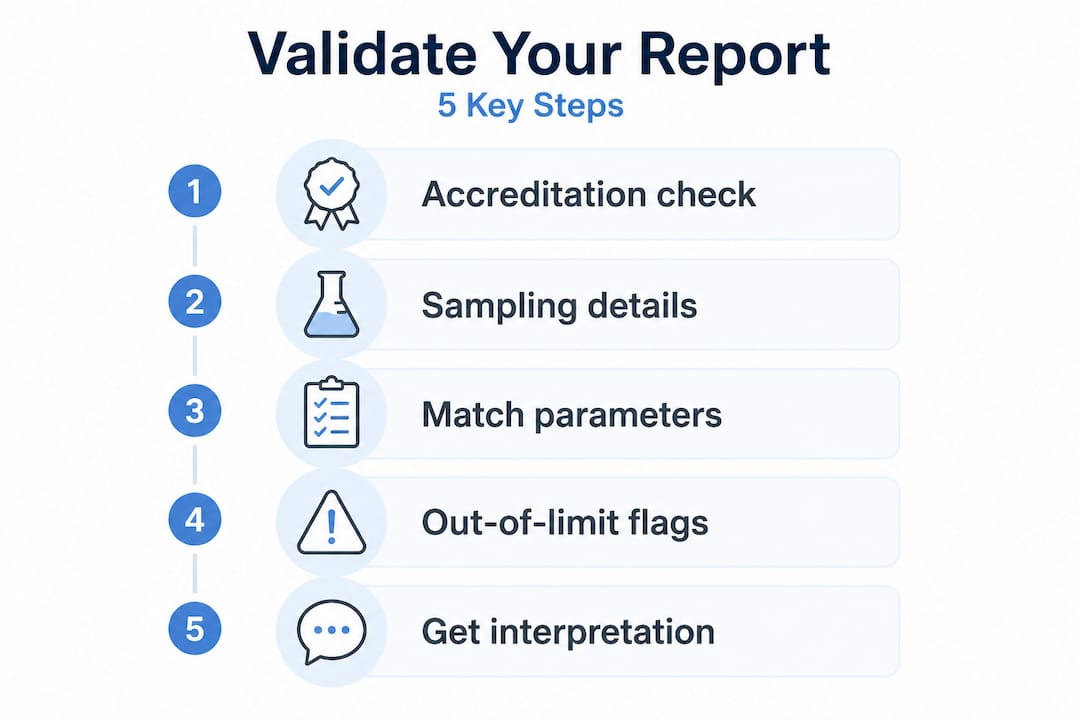
Step 2: Check the sampling details. Verify the date and time of sampling and the analysis date. For microbiological parameters, the gap should be no more than 24 hours. Confirm that samples were collected using a proper sterile kit, not a recycled bottle from your kitchen.
Step 3: Match parameters to your well type. A drilled bedrock well in a granite area needs radon testing. A shallow dug well near agricultural land needs nitrate and coliform bacteria as priorities. This guide to water analysis can help you confirm which parameters are relevant for your situation. Not every package fits every well.
Step 4: Identify out-of-limit values. Most accredited lab reports will flag exceedances clearly, often in red or bold text. Look for any value marked as above the guideline or limit value (gränsvärde in Swedish). Here is a quick reference table for some of the most critical parameters:
| Parameter | Limit/guideline | Health risk if exceeded |
|---|---|---|
| E. coli | 0 CFU/100 ml | Yes, acute gastrointestinal illness |
| Nitrate | 50 mg/L | Yes, especially for infants |
| Nitrite | 0.5 mg/L | Yes, hemoglobin disruption |
| Arsenic | 10 µg/L | Yes, long-term cancer risk |
| PFAS (sum of 4) | 0.1 µg/L | Yes, immune and hormonal effects |
| Radon | 1000 Bq/L | Yes, lung cancer risk |
| Iron | 0.2 mg/L | Aesthetic, rarely a health threat |
| Manganese | 0.05 mg/L | Borderline, neurological concern at high levels |
| Lead | 10 µg/L | Yes, especially neurological harm in children |
Research confirms that around 20% of Swedish private wells fail at least one safety limit, which means there is a real chance your report shows at least one value worth acting on.
Step 5: Seek interpretation if unsure. If any value is flagged and you do not understand what it means or what to do next, do not guess. Contact the lab, consult Livsmedelsverket’s online resources, or reach out to a certified water testing provider for guidance.
Pro Tip: Keep a folder, physical or digital, with every water report you have ever received for your property. Comparing results over multiple years reveals trends that a single report cannot show. A slow rise in nitrate over three years tells a very different story than a one-time high reading.
Troubleshooting, common mistakes, and when to seek help
Even with a clear process in place, real-world situations get complicated. Here are the most common mistakes Swedish well owners make when handling their water lab reports.
Using a non-accredited lab. Some online suppliers and local hardware stores sell test kits or offer lab services that are not Swedac-accredited. The results might look legitimate, but they will be rejected for any official purpose. This is the single most costly mistake, especially if it surfaces during a property sale.
Testing too infrequently or testing the wrong parameters. Folkhälsomyndigheten (the Public Health Agency of Sweden) and Livsmedelsverket recommend testing at minimum every three years, with more frequent checks after heavy rainfall, flooding, nearby construction, or changes in taste or smell. Testing only the basics when you live near a former military airfield, where PFAS contamination is a known risk, means you could miss the one parameter that matters most for your situation.
Misreading aesthetic vs. health exceedances. A report showing iron at 0.5 mg/L looks alarming if you do not know that iron is an aesthetic parameter. Conversely, a nitrate level of 45 mg/L, just under the 50 mg/L limit, might not be flagged but still warrants careful monitoring, especially in a household with infants. The distinction matters enormously. Expert guidance on result interpretation specifically highlights that health parameters like E. coli and nitrate must be prioritized over aesthetic ones when making safety decisions.
Relying on expired results. Water quality changes. A report from four years ago tells you nothing reliable about today’s conditions. For property sales, most municipalities require results no older than one to two years. Always check the age of your report before relying on it.
“One of the most common calls we receive is from sellers who discover, days before a closing, that their water report is outdated or came from a non-accredited lab. The cost is always higher than if they had checked earlier.”
When should you seek professional help rather than handling validation yourself? If your report shows any exceedance of a health parameter, if you are unsure which parameters apply to your specific well type, or if your report is being used for a property transaction, grant application, or regulatory submission, get expert support. Knowing your limits is part of responsible well ownership. These essential water analysis facts can help you figure out when a professional second opinion is the right call.
What most well owners miss about water lab report validation
Here is something we have observed working with well owners across Sweden, from the chalk-rich soils of Gotland to the granite bedrock of Dalarna: most people treat validation as a pass or fail checkbox. Either the report is accredited, or it is not. Either the values are within limits, or they are not. That framing misses something important.
Passing a standard test does not automatically mean your water is safe for every member of your household. Consider this: an E. coli result of 0 CFU/100 ml means no detectable bacteria at the time of testing. It does not mean the well is protected from future contamination. A shallow dug well near a manure storage area might test clean in February but fail badly in May after snowmelt.
The real insight from expert interpretation guidelines is that risk-based, targeted testing consistently outperforms generic minimum testing. What does that mean in practice? It means your testing choices should be driven by your specific situation: your geography, your neighbors’ land use, your well’s age and construction, and any local contamination history. A family living 2 km from a former military airfield should be testing PFAS every single year. A farmer with livestock nearby should prioritize nitrate and coliform bacteria. A homeowner in a granite area needs radon on the list.
Compliance and safety are not the same thing. A report can be fully compliant, accredited, and within all limits, yet still leave critical gaps if the wrong parameters were tested. This is why we believe strongly in a comprehensive approach to Swedish water quality that goes beyond the minimum. Ask not just “did I pass?” but “did I test the right things for my actual risk profile?”
Get expert-validated water testing for peace of mind
Understanding how to validate your water lab report is a genuine skill, and you have now taken a solid step toward protecting your family and your property. But knowing what to look for is only half the equation.
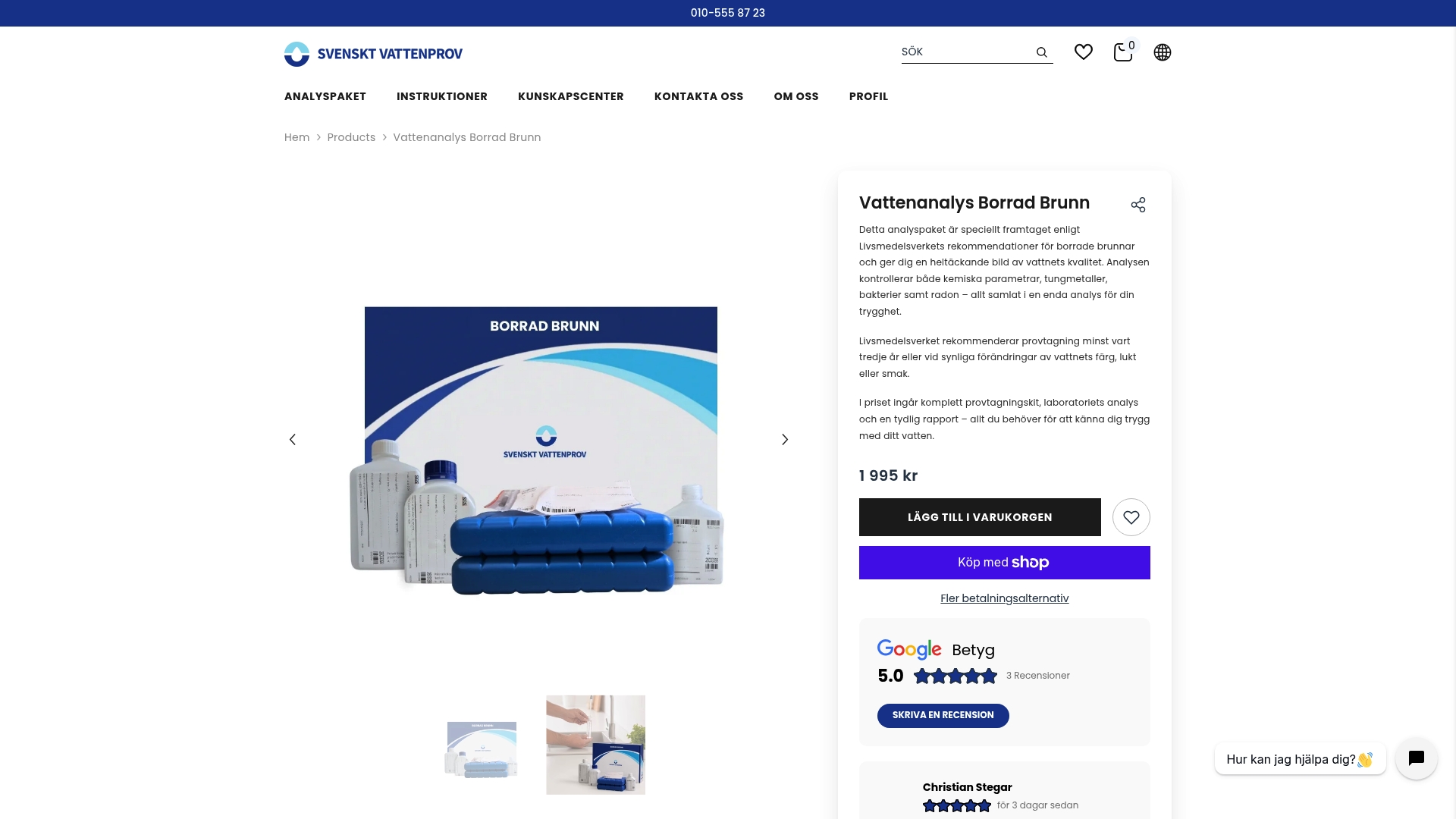
At Svenskt Vattenprov, every analysis is carried out by SGS Analytics and Eurofins, a fully Swedac-accredited laboratory operating under ISO 17025 standards. Our reports are legally valid for property sales, municipal submissions, and grant applications. If you want a thorough baseline for your property, the complete water analysis covers 71 parameters and leaves nothing to chance. For owners of drilled bedrock wells, the analysis for drilled wells covers 41 targeted parameters most relevant to your well type. Each report comes with clear explanations and concrete recommendations so you always know exactly what your results mean and what to do next.
Frequently asked questions
How do I know if my water test lab is Swedac-accredited?
Check the lab’s accreditation certificate or the report for the ISO 17025 logo and Swedac reference number. Only labs with this certification provide legally valid results for official use in Sweden.
Which water parameters are most important for my health?
Focus first on E. coli, nitrate, and PFAS, since these carry the greatest direct health risks. Parameters like iron mainly affect taste or color. This expert guidance on distinguishing health from aesthetic parameters is essential reading.
Are reports from non-accredited labs accepted for property sales?
No. Only Swedac-accredited (ISO 17025) lab results are legally valid for property sales, official permits, and municipal requirements in Sweden.
My report shows iron above the guideline. Is my water dangerous?
High iron is typically an aesthetic issue affecting color and taste rather than a direct health threat. Your priority should be checking health parameters like bacteria and nitrate first. Expert interpretation standards confirm this distinction clearly.
How often should I test and validate my private well water?
Test annually for bacteria and nitrate at minimum, and immediately after any changes in taste, smell, or clarity. With around 20% of Swedish private wells failing at least one safety threshold, regular testing is the most effective way to stay ahead of risk.