

How drinking water is assessed: guide for Swedish well owners
TL;DR:
- Swedish private well owners are responsible for regularly testing and maintaining their water quality. Contaminants like bacteria, nitrates, and heavy metals can be invisible and require proactive monitoring. Proper treatment and documentation are essential for ensuring safe water and property value.
Many Swedish well owners assume their water is clean because it looks clear and tastes fine. That assumption can be dangerous. Over 1 million Swedish households rely on private wells, and studies estimate that 15 to 20 percent have water with health-hazardous levels of contaminants. The problem is that most harmful substances, from bacteria to arsenic to radon, are completely invisible. This guide walks you through what a water quality assessment actually involves, what standards your water is measured against, how to act on the results, and why staying proactive protects both your family and your property value.
Table of Contents
- The unique responsibility of Swedish private well owners
- Standards and recommendations for water quality assessment
- The step-by-step process: How your well water is assessed
- Responding to poor results: Next steps and risk management
- What most well owners overlook about water assessment
- How Svenskt Vattenprov can help safeguard your well water
- Frequently asked questions
Key Takeaways
| Point | Details |
|---|---|
| Personal responsibility | As a Swedish well owner, you must manage your own water quality—there is no mandatory government testing. |
| Regular testing is vital | Follow recommended schedules to protect health, especially for children, elderly, and at-risk groups. |
| Know what to check | Assess for bacteria, chemicals, and metals using accredited labs for safety and regulatory compliance. |
| Act quickly on problems | If results are poor, investigate, treat, and retest while documenting all actions for compliance or sale. |
| Professional support available | Accredited services can simplify ongoing testing and help you interpret results and choose the right treatments. |
The unique responsibility of Swedish private well owners
When you connect to a municipal water system, a team of professionals monitors your water around the clock. They test it constantly, treat it, and are legally required to notify you if something goes wrong. You have zero responsibility for that process.
Owning a private well is a completely different situation. Private well owners are personally responsible for ensuring their water is safe. There is no government agency conducting mandatory testing on your behalf. No one will knock on your door if your water develops a problem. That responsibility sits entirely with you.
This is not a minor distinction. Sweden has approximately 700,000 private wells, and the quality of water in those wells varies enormously by region, geology, land use, and well age. Understanding well water quality standards is the first step toward taking that responsibility seriously.
“Clear water is not the same as safe water. Many of the most serious contaminants have no color, no taste, and no odor.”
Common contamination sources for Swedish private wells include:
- Bacteria and E. coli from nearby septic systems, animal waste, or surface water intrusion
- Nitrates and nitrites from agricultural fertilizers leaching through soil
- Heavy metals such as arsenic, lead, and manganese from natural geology or old pipes
- Radon from granite bedrock, particularly common in areas like Värmland, Dalarna, and parts of Småland
- PFAS (per and polyfluoroalkyl substances) near airports, military sites, or industrial areas
- Iron and manganese causing discoloration and taste issues, common in forested regions
- Saltwater intrusion along coastal areas
The geology under your property largely determines your risk profile. A well drilled into granite carries different risks than a shallow dug well in agricultural land. Reviewing water analysis guidelines for your specific well type helps you understand which parameters deserve the most attention.
The core takeaway here is simple. You are the water authority for your household. Acting like one means testing regularly, understanding results, and responding when something is off.
Standards and recommendations for water quality assessment
Swedish drinking water standards are set by Livsmedelsverket (the Swedish Food Agency) and align with EU Drinking Water Directive requirements. These standards define maximum acceptable levels for dozens of parameters, from microbiological contaminants to chemical substances to physical properties like pH and turbidity.
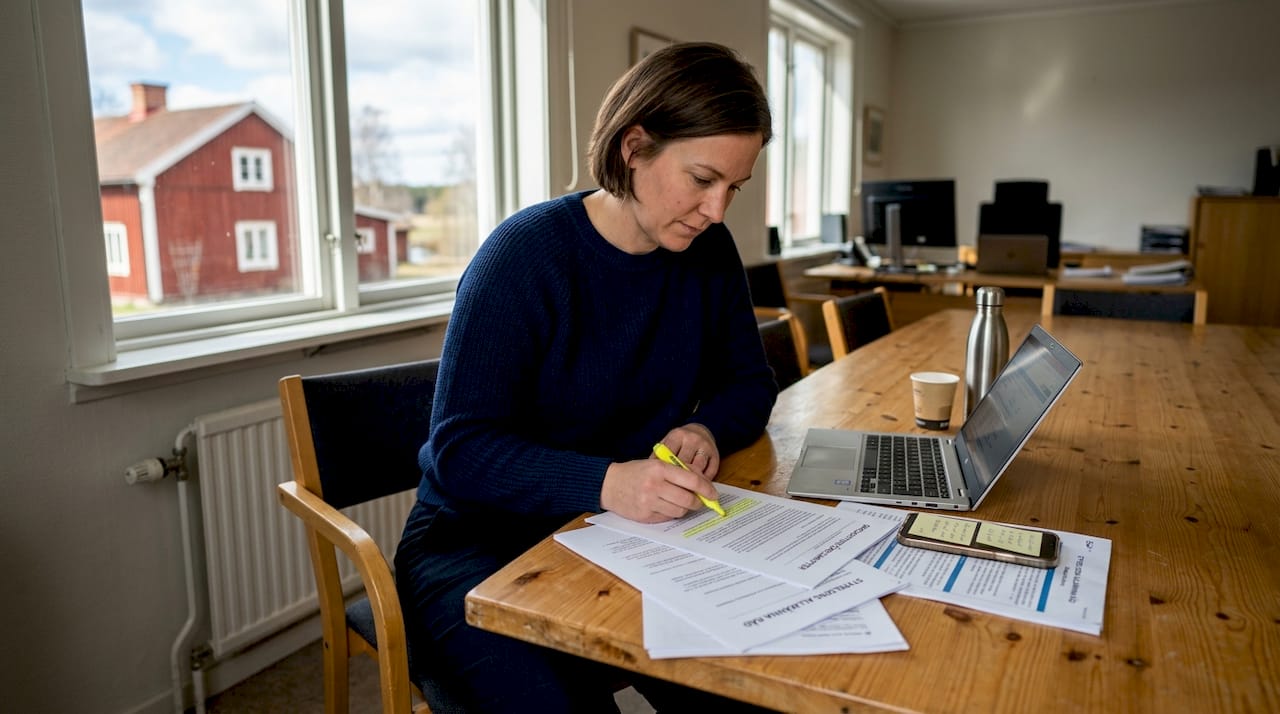
Livsmedelsverket recommends testing well water at least every three years, and annually for households with high-risk members such as infants, elderly individuals, or people with weakened immune systems.
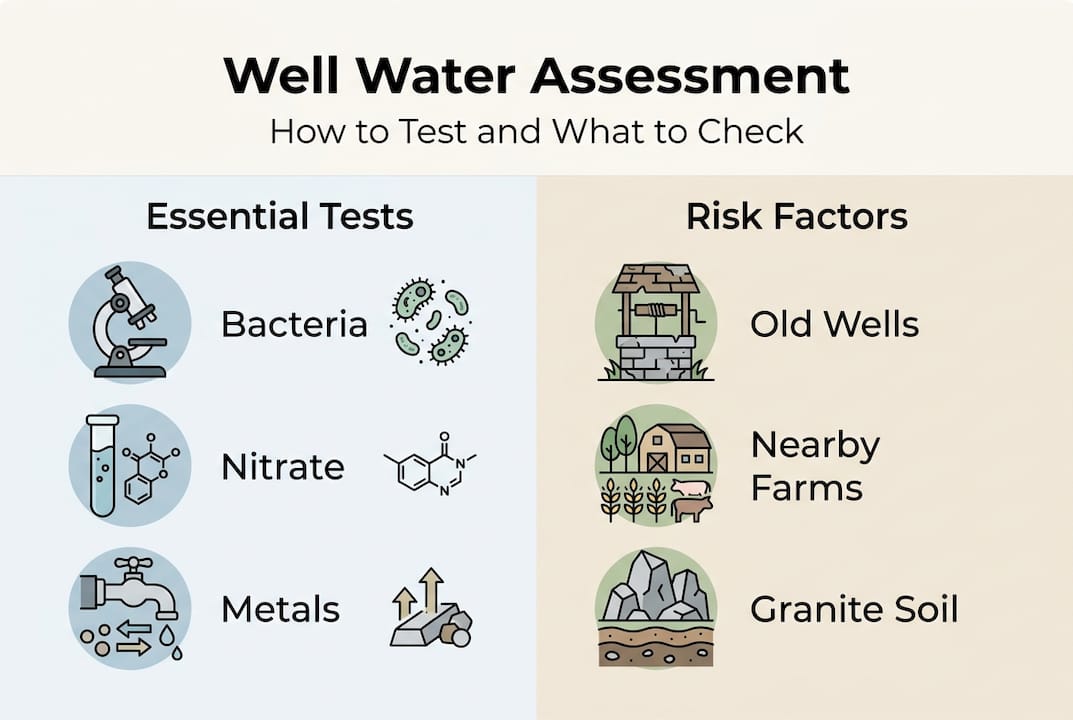
A standard well water assessment typically covers:
| Parameter category | Examples | Why it matters |
|---|---|---|
| Microbiological | E. coli, coliform bacteria, enterococci | Direct indicators of fecal contamination |
| Chemical | Nitrate, nitrite, PFAS, pesticides | Linked to agricultural or industrial pollution |
| Metals | Arsenic, lead, manganese, iron | Natural geology or pipe corrosion |
| Physical/chemical | pH, hardness, turbidity, conductivity | Affects taste, pipe wear, and treatment efficiency |
| Radioactive | Radon, uranium | Elevated in granite-heavy regions |
Beyond the regular three-year cycle, you should test outside the normal schedule in these situations:
- After a flood, storm, or any event that could allow surface water into the well
- When you notice changes in taste, odor, or color
- Before and after major construction or drilling activity nearby
- When purchasing or selling a property with a private well
- After repairing or cleaning the well itself
- If a neighbor’s well has tested positive for contamination
Pro Tip: If you have a newborn at home, test for nitrates specifically. Infants are particularly vulnerable to nitrate poisoning, which can cause a condition called methemoglobinemia, sometimes called “blue baby syndrome.” Standard three-year testing may not be frequent enough in agricultural areas.
For a thorough overview of what each test covers and how to prepare, the complete testing guide for Swedish well owners is a useful starting point. You can also review key water analysis facts to understand what the numbers in your report actually mean.
The step-by-step process: How your well water is assessed
The assessment process is more straightforward than most people expect. Here is how it works from beginning to end.
- Choose your analysis package. Different packages test for different parameters. A borrad brunn (drilled well) in a granite area needs radon testing. A grävd brunn (dug well) near farmland needs nitrate and bacteria focus. Match the package to your well type and local risk factors.
- Order your sampling kit. The kit arrives with sterile bottles, clear sampling instructions, and prepaid return packaging. Everything you need is included.
- Collect the sample correctly. Let the tap run for two to three minutes before collecting. Use cold water from a kitchen tap. Do not touch the inside of the bottle or cap. Fill each bottle to the marked line. Timing matters: the sample must reach the lab within 24 hours.
- Send the sample. Use the prepaid packaging and drop it at the nearest postal point. Samples collected Monday through Thursday have the best chance of arriving within the required window.
- Receive and read your report. Results typically arrive within a few business days. Each parameter is listed with your measured value, the accepted limit, and a clear pass or flag indicator.
Pro Tip: Take your sample early in the morning on a weekday. This gives the lab maximum time to process it and reduces the risk of the sample sitting over a weekend.
If results show water is unfit, investigate the cause, apply appropriate treatment, and retest. Keep all records for compliance purposes or future property transactions.
Reading the report does not require a chemistry degree. A good analysis service explains each flagged value in plain language and tells you what to do next. That clarity is what separates a useful report from a confusing spreadsheet of numbers.
Responding to poor results: Next steps and risk management
Getting a flagged result is unsettling, but it is far better than not knowing. The key is to respond systematically rather than panic.
First, identify the likely source of the problem. Common causes include:
- Bacterial contamination: Often linked to a cracked well casing, nearby septic system, or surface water entering the well after heavy rain
- High nitrates: Typically from agricultural runoff or a septic system too close to the well
- Elevated metals: Usually geological, though old pipes and fittings can contribute lead or copper
- Radon: Almost always geological; the well location and depth are the primary factors
Treatment options vary depending on the contaminant. Here is a practical comparison:
| Contaminant | Treatment option | Notes |
|---|---|---|
| Bacteria | UV disinfection or chlorination | UV is preferred for ongoing use; shock chlorination for one-time events |
| Nitrates | Reverse osmosis (RO) filter | Effective but requires maintenance |
| Iron and manganese | Oxidation filter or aeration | Common and well-tested solutions |
| Radon | Aeration or activated carbon filter | Aeration is more effective for high radon levels |
| PFAS | Activated carbon or RO filter | Both reduce PFAS; carbon filters need regular replacement |
| Lead | Point-of-use filter certified for lead | Also consider replacing old pipes |
After treatment is installed, retest. Do not assume the problem is solved without verification. Document everything: the original test results, the treatment installed, and the follow-up test results. This documentation matters if you ever need to contact the municipality, apply for grants for water improvement, or sell the property.
The importance of regular testing becomes especially clear when you realize that contamination can return even after successful treatment. Filters degrade, well casings age, and land use around your property changes over time.
What most well owners overlook about water assessment
After working with thousands of well owners across Sweden, we have noticed a pattern. Most people test when they are supposed to, get a clean result, and then mentally file the whole topic away for three years. That clean result becomes a kind of permission slip to stop paying attention.
The problem is that water quality is not static. A well that tested clean in 2023 can develop bacterial contamination after a wet spring in 2025. A neighbor’s new septic installation can shift your nitrate levels within months. Seasonal flooding, nearby construction, and changes in agricultural activity are all triggers that fall between scheduled test cycles.
We also see owners who test the basics but skip essential testing facts around radon or PFAS because those parameters feel abstract. But radon exposure through drinking water is a real health risk in granite regions, and PFAS contamination is showing up in areas that never expected it.
Treat water assessment as an ongoing habit, not a box to check. Notice changes in your water. Respond to events in your environment. Test outside the schedule when something feels off. That mindset is what actually keeps your family safe.
How Svenskt Vattenprov can help safeguard your well water
Taking charge of your well water quality is much easier with the right partner. At Svenskt Vattenprov, we have been helping Swedish well owners get clear, actionable answers about their water since 2018.
Our analysis packages are processed by SGS Analytics and Eurofins, a Swedac-accredited laboratory operating to the same standards as public water utilities. Every report comes with plain-language explanations and specific recommendations, not just a table of numbers. Whether you need accredited well water testing for a drilled well, a dug well, or a more targeted check for bacteria through our bacteria analysis packages, we have a package that fits your situation. Contact us and we will help you choose the right one.
Frequently asked questions
How often should I test my private well water in Sweden?
Test your well at least every three years, and annually if your household includes children under five, elderly individuals, or anyone with a compromised immune system.
What should I do if my well water fails the assessment?
Identify the contamination source, apply proper treatment such as filtration or disinfection, and retest before resuming normal water use.
What contaminants are commonly checked during assessment?
Water is typically tested for bacteria, nitrate, metals, pH, and chemicals from agriculture or septic systems, along with radon in high-risk geological areas.
Is there mandatory government testing for private wells in Sweden?
No. Private well owners bear full responsibility for testing and safety decisions, with no mandatory government oversight or scheduled inspections.
Does water assessment documentation matter for property sales?
Yes. Keeping testing and remedy records supports regulatory compliance and gives buyers confidence, making property transactions with private wells significantly smoother.