

Water testing for farms: protect crops and meet Swedish standards
Roughly 1 in 5 private wells in Sweden contain contaminants at levels that exceed safe thresholds, yet the vast majority of farm owners never receive a warning sign. No strange taste, no visible discoloration, no obvious smell. The water looks perfectly fine, and that is exactly what makes it so dangerous. For farms growing ready-to-eat crops, running irrigation systems, or supplying water to livestock, the consequences of contaminated water extend well beyond a regulatory notice. They reach into crop yields, food safety records, and the trust your buyers place in your produce. This guide walks you through what to test, when to test, and how to build a water testing program that holds up under scrutiny.
Table of Contents
- Why water quality matters for Swedish farms
- Key regulations and standards for farm water testing
- What should farms test for? Common risks and scenarios
- Practical steps for effective water testing on your farm
- Beyond the checklist: What most farm guides miss about water testing
- Reliable water testing solutions for Swedish farms
- Frequently asked questions
Key Takeaways
| Point | Details |
|---|---|
| Regular testing is essential | Even modern Swedish farms risk contamination and need ongoing water quality checks to protect their crops. |
| Compliance means safer crops | Following Swedish faroanalys and testing standards ensures food safety and smooth audits. |
| Risks vary by farm type | Private wells, commercial farms, and crop types each require tailored water testing approaches. |
| Proactive testing saves money | Early detection of contaminants prevents expensive crop losses and regulatory fines. |
Why water quality matters for Swedish farms
Water is not just a resource on a farm. It is an active input that touches every product you grow, process, or sell. When that input is contaminated, the contamination travels with it.
“Water testing ensures irrigation water is safe for crop production, preventing contamination of ready-to-eat vegetables and ensuring food safety compliance under Swedish regulations.”
This matters most when you grow crops that go straight to the consumer’s plate without cooking. Lettuces, spinach, strawberries, fresh herbs. These products are the highest-risk category in Swedish food safety rules because there is no heat step to kill pathogens. One overhead irrigation event with contaminated water can spread E. coli or Campylobacter across an entire field. By harvest time, the contamination is invisible. The berries look fine. The salad leaves look crisp. But the risk is real and present.
Poor water quality also creates longer-term soil problems. Irrigation water with elevated iron, manganese, or sodium can alter soil pH and structure over several growing seasons, gradually reducing yields and making the land harder to work. Farms that rely on groundwater in limestone-rich regions like Skåne or Gotland face different chemical profiles than those drawing from granite-bedrock wells in Dalarna or Värmland. Understanding those Swedish water quality parameters is the starting point for any effective testing plan.
Here is a summary of how poor water quality affects farm operations:
- Crop safety: Pathogens in irrigation water contaminate produce before harvest, creating serious food safety risks.
- Soil health: High mineral loads in water degrade soil structure and fertility over time.
- Regulatory exposure: Contamination events trigger inspections, recalls, and potential bans from retail supply chains.
- Market access: Major Swedish and European buyers increasingly require documented water quality testing as part of supplier certification.
- Reputation risk: A single contamination incident linked to your farm can take years to recover from commercially.
The financial cost of a single contamination event, including recall logistics, lab investigation, and lost contracts, typically runs into hundreds of thousands of kronor. Regular water testing costs a small fraction of that. The math is straightforward.
Now that you understand why this issue matters, let’s break down exactly what farms must analyze and when.
Key regulations and standards for farm water testing
Swedish food safety regulation for farms follows a risk-based model rather than a one-size-fits-all mandate. That means the rules you face depend heavily on what you grow, how you irrigate, and what your risk assessment reveals.
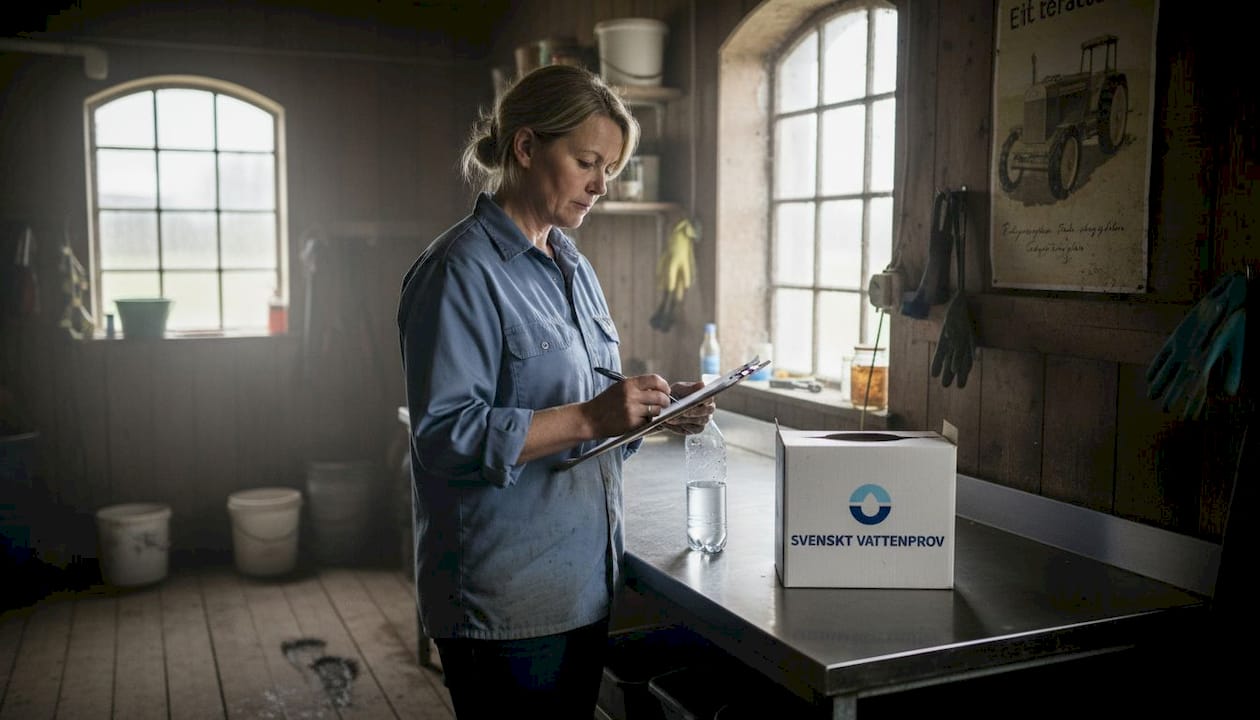
According to guidelines from Livsmedelsverket, farms must use drinking water quality or clean water for irrigation where necessary based on a risk assessment, specifically close to harvest for ready-to-eat products like salad. The standard is stricter for overhead irrigation than for drip systems, because overhead spray directly contacts edible plant surfaces.
There is no universal mandatory testing requirement for small farm irrigation water. However, if your risk analysis, known in Swedish regulations as a faroanalys, identifies a contamination risk to crops or to the food you produce, testing becomes required. For private wells, Folkhälsomyndigheten recommends testing every three years. For commercial food production, the bar is higher, and drinking-water quality standards apply where relevant.
Here is how requirements compare across common farm scenarios:
| Farm type | Water source | Crop type | Testing requirement |
|---|---|---|---|
| Small market garden | Private well | Ready-to-eat salad | Faroanalys required; likely triggers testing |
| Large commercial farm | Surface water | Processed vegetables | Faroanalys required; stricter controls expected |
| Hobby farm | Dug well | Livestock use | Testing recommended; 3-year cycle |
| Strawberry producer | Bored well | Fresh fruit, overhead irrigation | Faroanalys required; microbiological testing essential |
| Grain farm | Private well | Cooked/processed | Lower risk; testing advisable but rarely mandated |
The faroanalys process works similarly to a HACCP plan in food manufacturing. You identify your water sources, map the hazards that could realistically affect each one, and determine what controls or tests you need. The key word is realistic. If your well is 200 meters from the nearest cattle operation and sits uphill from it, the nitrate risk is lower than if you share a watershed with intensive livestock farming downstream.
How to meet the regulatory standard in practice:
- Document your water sources and how each one is used on the farm.
- Identify potential contamination routes for each source.
- Determine whether those risks require testing based on Swedish guidelines.
- Select accredited tests matched to identified risks.
- Archive results, along with your faroanalys documentation, for inspection readiness.
Pro Tip: Keep printed copies of your faroanalys and water test results in a dedicated folder that inspectors can access immediately. Digital records are fine as backup, but auditors in Swedish agricultural inspections often expect physical documentation on site.
With the main rules and triggers in mind, it’s time to get practical about what and how you should be testing.
What should farms test for? Common risks and scenarios
Not every farm needs the same test panel. The contaminants that matter on your operation depend on your local geology, your proximity to other land uses, your water source type, and how you apply that water to crops.
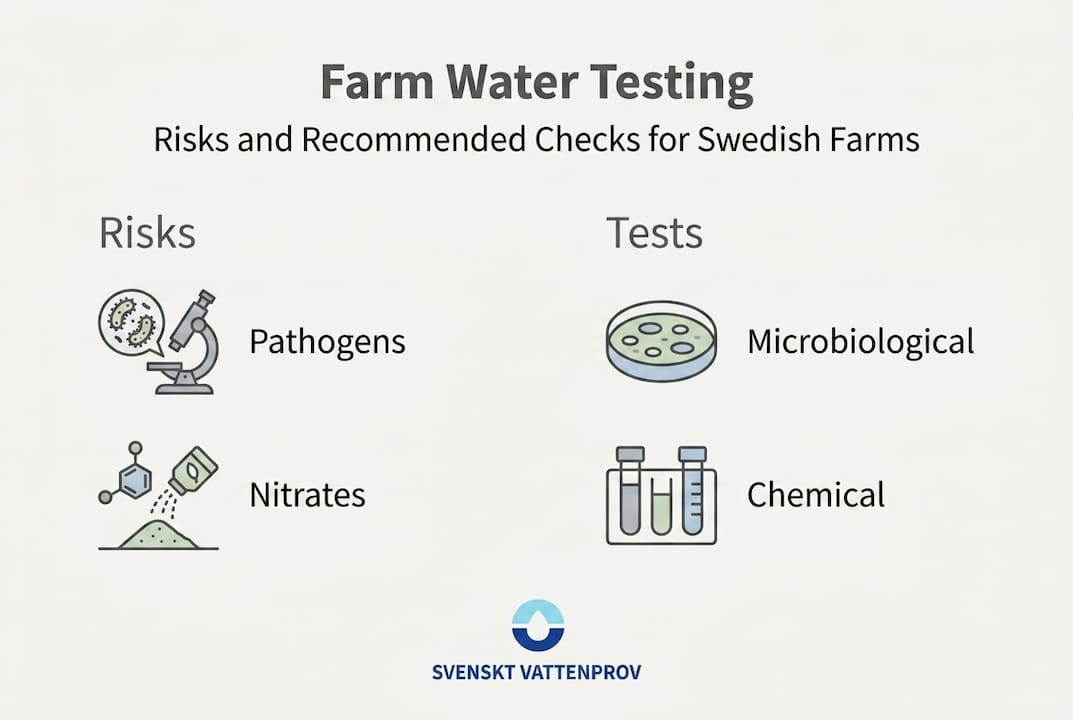
The most common risk categories for Swedish agricultural water include:
- Pathogens (E. coli, Campylobacter, Cryptosporidium): The primary concern for any farm growing ready-to-eat produce or using water for direct crop contact.
- Nitrates: Elevated in areas with intensive livestock farming or heavy fertilizer use nearby. High nitrate levels signal that surface runoff or manure leachate may be reaching your water source.
- Pesticides: Farms near conventional agricultural areas face residue risks from neighboring spray drift or runoff into shared water bodies.
- Radon: Particularly relevant for farms drawing from bored wells in granite bedrock areas, including large parts of central and northern Sweden. Radon in water poses an inhalation risk when the water is aerated during irrigation.
- Arsenic and manganese: Naturally occurring in certain Swedish geological zones, these metals can accumulate in soil and produce over time with repeated irrigation.
Quality needs vary by irrigation type. Drip irrigation is inherently safer because water reaches only the root zone, not the edible plant surfaces. Overhead sprinklers and spray systems require stricter water quality because droplets directly contact leaves, fruit, and stems that will be eaten. Crops harvested close to the ground, like lettuce or spinach, face higher exposure than tall crops harvested above spray height.
Here is a practical overview of testing priorities by scenario:
| Water source and scenario | Primary risk | Recommended tests |
|---|---|---|
| Bored well, granite area | Radon, arsenic | Radon-specific + heavy metals panel |
| Surface water near livestock | E. coli, Cryptosporidium, nitrates | Full microbiological + nitrogen compounds |
| Well near arable fields | Nitrates, pesticides | Chemical panel including pesticide screening |
| Coastal well | Saltwater intrusion, chloride | Chemical panel including conductivity, chloride |
| Dug well, overhead irrigation | Pathogens, surface runoff | Microbiological + basic chemical |
Consider farm water analysis methods that cover both microbiological and chemical parameters, since risks rarely fall into just one category. A well near both granite bedrock and arable land may need testing for radon, arsenic, nitrates, and pathogens simultaneously.
Pro Tip: Annual microbiological testing is genuinely low-cost compared to the risk it addresses. A basic E. coli and coliform test takes a single water sample and can be completed within days. If your farm uses overhead irrigation on ready-to-eat crops, this is the single most impactful test you can run every year.
When reviewing your results, always consult best sampling practices before collecting your sample. Improper sampling, such as letting the tap run too briefly, using unclean containers, or sampling after a pump repair, produces results that do not reflect actual water quality.
Understanding what to test for helps, but running a robust testing program is about process and consistency.
Practical steps for effective water testing on your farm
Having a sound understanding of risks and regulations is necessary, but it only translates into protection when you put a repeatable process in place. Here is how to build one.
A five-step farm water testing process:
-
Map your water sources. List every source of water used on your farm, including wells, surface intakes, collected rainwater, and municipal connections. Note what each source is used for, irrigation, washing, livestock, or worker sanitation.
-
Complete a faroanalys for each source. For each source, consider what contamination hazards are realistic given your local geology, land use history, and neighboring activities. Write this down. Even a simple one-page document counts as a formal risk assessment and protects you during inspections.
-
Select accredited tests that match your identified risks. Use the risk profile you developed to choose test panels. A farm with granite-bedrock wells needs radon testing. A farm downstream from cattle operations needs nitrate and pathogen testing. Do not guess. Match tests to risks.
-
Follow strict sampling procedure. Step-by-step water sampling guidance matters more than most farm owners realize. Samples must be collected in sterile containers, at the right time relative to pump operation, and shipped to the lab quickly. A poorly collected sample can produce a false-safe result that gives you false confidence.
-
Review results and act on deviations. When a result comes back outside the acceptable range, treat it as actionable information, not an anomaly to ignore. Elevated E. coli requires immediate follow-up: identify the source, retest, and if necessary, apply treatment and adjust practices. Archive every result.
Beyond the five steps, annual microbio testing is strongly recommended for farms near agricultural activity, especially those using irrigation on ready-to-eat produce. The cost is minimal. The early warning value is significant.
Additional ongoing practices to maintain water safety on your farm:
- Inspect well casings and pump equipment seasonally for cracks, flooding risk, or animal access.
- Review your faroanalys whenever land use near your farm changes, such as a new livestock operation or construction activity nearby.
- Keep your water system clean, including tanks, filters, and pipework that can harbor biofilm.
- Communicate water quality records proactively to buyers and auditors. It signals professionalism and builds trust.
Browse available water testing packages to find a combination that covers your farm’s risk profile without paying for parameters that are irrelevant to your situation.
Beyond the checklist: What most farm guides miss about water testing
Most guidance on farm water testing focuses on regulatory triggers. Test when required, document what you must, and move on. That framing treats water testing as a compliance task rather than a management tool, and that is where many farms leave real value on the table.
We have worked with farm owners across Sweden who discovered elevated nitrate levels or coliform bacteria not because an inspector asked, but because they tested proactively and caught a problem early. In every one of those cases, the cost of intervention was dramatically lower than it would have been after a crop contamination event or a failed audit.
Water quality also tells you things about your land that no other test does. Rising iron levels in a well can signal changes in the water table. Increasing nitrates can indicate that your soil’s buffering capacity is being overwhelmed. These are farm management signals, not just food safety signals.
The farms that manage water quality well treat it the same way they treat soil health: as a long-term asset that rewards consistent attention. The ones who only test reactively tend to be the ones fielding urgent calls from buyers when something goes wrong.
We believe that building water testing into your regular farm calendar, alongside soil sampling and equipment checks, is one of the lowest-cost, highest-return management decisions you can make. And when you review food production water standards in that light, compliance stops being a burden. It becomes part of how you protect everything you’ve built.
Reliable water testing solutions for Swedish farms
Protecting your crops and staying compliant with Swedish food safety standards starts with knowing exactly what is in your water.
At Svenskt Vattenprov, we offer the Vattenanalys Gård package, designed specifically for farms and equestrian operations. It covers an extended range of microbiological and chemical parameters relevant to agricultural use, all analyzed by SGS Analytics and Eurofins, a Swedac-accredited laboratory. Results are legally valid for regulatory contacts, inspections, and buyer audits. You receive a clear, plain-language report with practical recommendations, not just numbers on a page. Whether you are running a market garden, a berry farm, or a livestock operation, we help you identify the right tests for your specific risk profile and get results you can act on. Explore our farm water testing options and take the next step toward safer, more resilient farm water management.
Frequently asked questions
Is water testing mandatory for all Swedish farms?
No, it’s only required if your farm’s risk analysis identifies a contamination risk to crops or food safety, but conducting a faroanalys itself is required for food-producing farms.
How often should private farm wells be tested?
Private wells are recommended for testing every three years, but farms near agricultural activity should conduct microbiological testing annually as a minimum precaution.
Which contaminants should be prioritized in Swedish farm water testing?
The key risks include pathogens, nitrates, pesticides, radon, and arsenic, with priority depending on your local geology and land use patterns.
What is a “faroanalys” and why is it important?
A faroanalys is a farm-level risk assessment similar to a HACCP plan; Swedish regulations use it to determine whether and what water testing is required for your specific operation.
Does the irrigation method affect the need for water testing?
Yes. Overhead irrigation and crops eaten raw demand stricter water quality and more frequent testing than drip systems or crops that will be cooked before consumption.