

Guide to water sampling for private wells 2026
Owning your own well means taking personal responsibility for the water quality that your family drinks and uses daily. Every year, thousands of well owners in Sweden suffer from poor water quality, often without knowing it until health problems arise. Regular water testing is not just a recommendation; it is a necessary safety measure to protect your family's health. This guide explains exactly what you need to know about when, how, and why you should test your well water, as well as how to interpret the results and act on them.
Table of Contents
- Key Insights
- Preparing for Water Sampling
- How to Take a Water Sample Step-by-Step
- Interpreting Water Analysis Results
- Common Problems and Best Measures for Well Water
- Discover Our Water Analyses and Services
- Frequently Asked Questions about Private Well Water Testing
Key Insights
| Point | Details |
|---|---|
| Regular water sampling | Regular water sampling is an important safety measure that helps detect well water problems early. |
| Sterile sample bottle | Use a sterile sample bottle from an accredited laboratory to reduce the risk of contamination and inaccurate results. |
| Cold tap without strainer | The sample is taken from a cold tap directly connected to the well, without a strainer or filter. |
| Accredited laboratory | Choose an accredited laboratory that complies with the requirements of the National Food Agency and the Swedish Environmental Protection Agency so that the results are legally valid. |
| Unsuitable water action | If the analysis shows unsuitable water, quick action and follow-up are required. |
Key Insights
| Insight | Detail |
|---|---|
| Sampling frequency | At least every three years, more often for households with children or pregnant women |
| Correct method | Sterile bottle from accredited lab, cold tap without strainer, immediate sealing |
| Scope of analysis | Bacteria, chemical substances, metals, and radon |
| Result types | Suitable, with remarks, or unsuitable water |
| Action requirements | Prompt action is required for unsuitable water to protect health |
Preparing for Water Sampling
Proper preparation determines whether your water sample yields reliable results. Many well owners make the mistake of taking samples without understanding the importance of sterile equipment and correct handling. Use a sterile bottle from an accredited lab, fill from a cold tap without a strainer, and seal immediately to avoid contamination that leads to misleading results.
The equipment you need is simple but specific. A sterile sampling bottle from an accredited laboratory is fundamental. Regular bottles from home will not work as they may contain bacteria or chemical residues. The sample should be taken from a cold water tap that lacks a strainer or filter, as these can affect both bacterial and chemical analyses. The water must come directly from the well without passing through purification equipment.
The timing of sampling plays a greater role than many realize. Avoid taking samples immediately after heavy rains or snowmelt, as surface water can then penetrate more easily and provide temporarily deviating values. Wait at least three to four days after such weather events to get a more representative sample. Under stable weather conditions, you will get results that better reflect your well's normal water quality.
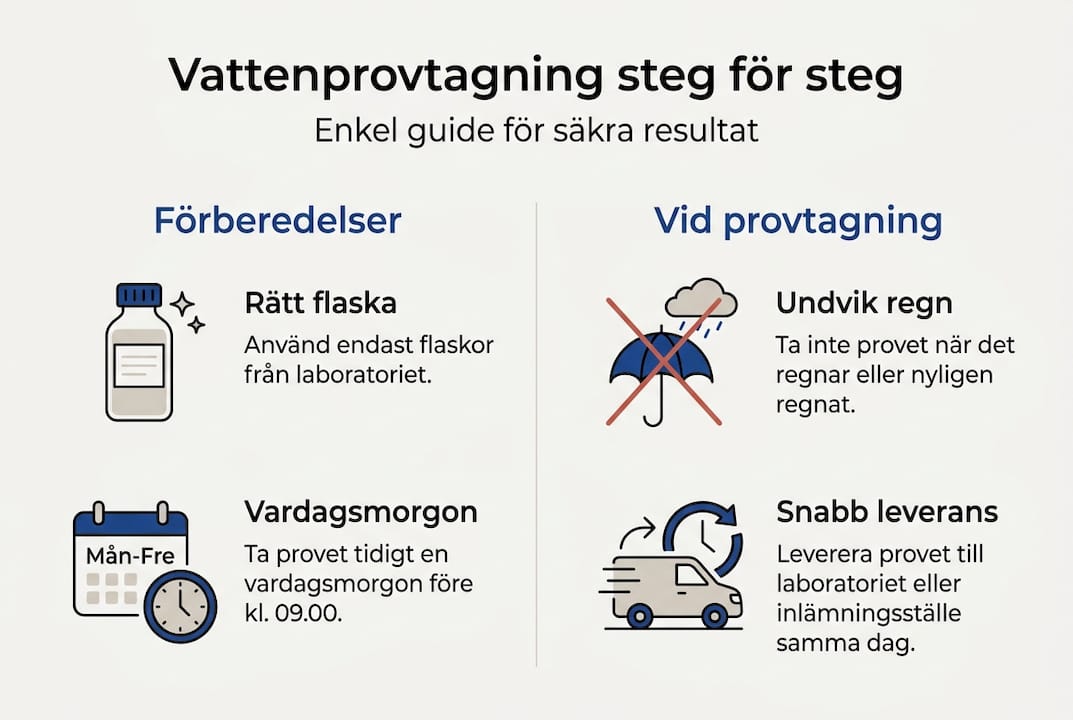
Prompt delivery to the laboratory is critical, especially for bacterial and radon analyses. Bacteria can multiply or die in the bottle if the sample sits too long, affecting the result. Radon is a gas that leaks out of the sample over time. Therefore, send your sample on the same day or no later than the day after sampling. Store the bottle in a cool, dark place until dispatch.
Pro Tip: Always take samples on a weekday morning when you can send the package the same day. Avoid Fridays and weekends when the laboratory is closed, as delays can negatively impact the reliability of the analyses.
Choosing an accredited laboratory ensures that your analysis complies with the requirements of the National Food Agency and the Swedish Environmental Protection Agency. The results will then be legally valid and can be used for communication with authorities, grant applications, or property sales. Always follow the specific instructions that come with your sampling kit for the best results.
How to Take a Water Sample Step-by-Step
The sampling process requires accuracy at every step to avoid contamination. Many well owners fail to get accurate results because they overlook important details. Sampling requires a sterile bottle from an accredited lab, filling from a cold tap without a strainer, immediate sealing, and prompt dispatch, especially for radon and bacterial analyses.
-
Choose the right tap for sampling. Use a cold water tap that is directly connected to the well, preferably an outdoor tap or a tap in the basement. Avoid taps with strainers, aerators, or filters as these can affect the analysis results. If the tap has such parts, unscrew them before sampling.
-
Clean the tap thoroughly. Wipe the tap nozzle with a clean cloth or paper dipped in alcohol or chlorine. Let the tap run for two to three minutes to flush out stagnant water from the pipes. This gives you water directly from the well, not from the pipes.
-
Carefully open the sampling bottle. Never touch the inside of the bottle or the lid with your fingers. Hold the lid with the opening facing downwards to prevent dirt from falling into it. Place the lid on a clean surface where it cannot be contaminated.
-
Fill the bottle under running water. Hold the bottle under the water stream without the tap coming into contact with the bottle's opening. Fill to the indicated level according to the instructions, usually about one centimeter from the rim. For some analyses, specific fill levels may be required.
-
Seal the bottle immediately and thoroughly. Screw the lid on tightly so that no air can enter. Label the bottle clearly with your name, date, and time of sampling if this is not already pre-printed. Check that the label is securely attached.
-
Store and send the sample correctly. Place the bottle in the accompanying packaging and keep it cool, preferably in the refrigerator if you cannot send it immediately. Send the sample on the same day or the day after at the latest. For radon analyses, fast handling is particularly important because radon leaks out of the sample.
Pro Tip: Photograph your sampling with a timestamp. This can be valuable if you later need to document that the sample was taken correctly, especially for property sales or communication with authorities.
Following these steps carefully will give you reliable results that truly reflect your well's water quality. If you are unsure about any step, contact the laboratory before taking the sample. It is better to ask than to get misleading results that cost both time and money. Read more about how to test well water for further guidance.
Interpreting Water Analysis Results
When you receive your analysis results, it can feel overwhelming with all the numbers and parameters. Understanding what the results mean is crucial for taking appropriate action. Results are categorized as suitable, with remarks, or unsuitable, where remarks require investigation and unsuitable means the water should not be consumed.
Suitable water meets all requirements according to the National Food Agency's drinking water standards. You can use the water without restrictions for drinking, cooking, and personal hygiene. This does not mean the water is perfect, but that no parameters exceed the limit values for health risks.
Water with remarks contains parameters that deviate from guideline values but do not necessarily pose an immediate health risk. Common remarks include slightly elevated levels of iron, manganese, or pH outside the ideal range. You should investigate the cause and consider measures, especially if the deviation is significant or if the household has children or pregnant individuals.
Unsuitable water exceeds limit values for one or more parameters that may pose a health risk. This could be bacteria, high levels of nitrate, arsenic, or other hazardous substances. The water must not be used for drinking or cooking until the problem is rectified. Boiling helps against bacteria but not against chemical contaminants.
Common parameters to pay attention to include several critical measurements:
- Coliform bacteria and Escherichia coli indicate fecal contamination and acute health risk.
- pH value affects corrosion in pipes and the efficiency of purification equipment.
- Nitrate can be dangerous for infants and indicates influence from agriculture or sewage.
- Iron and manganese cause discoloration and bad taste but are rarely harmful to health.
- Radon is a radioactive gas that increases the risk of lung cancer with long-term exposure.
| Parameter | Limit Value | Health Risk if Exceeded | Common Action |
|---|---|---|---|
| E. coli | 0 per 100 ml | High, stomach flu | UV light, chlorination, investigate source |
| Nitrate | 50 mg/l | High for infants | Reverse osmosis, investigate source |
| Radon | 100 Bq/l | Medium, long-term | Aeration, carbon filter |
| Iron | 0.2 mg/l | Low, aesthetic | Iron filter, aeration |
| pH | 6.5 to 9.5 | Low, corrosion | pH adjustment |
When you receive results with remarks or unsuitable water, act quickly. Contact your municipality's environmental and public health committee for guidance on measures. They can help you understand what is required and what grant opportunities are available. For a deeper understanding of specific parameters, read about important water parameters that affect your well.
Common Problems and Best Measures for Well Water
Swedish wells face various challenges depending on geological conditions and environmental impact. Knowing the most common problems helps you act proactively. 20% of private wells were unsuitable and 15 to 20% showed bacterial problems according to surveys, which shows that problems are more common than many think.
Bacterial problems often arise in dug wells or due to inadequate well construction. Surface water penetrating can carry coliform bacteria or E. coli from soil, sewage, or animals. Symptoms of bacterial problems may include stomach upset in family members, but often nothing is noticed until an analysis is done. Measures include sealing the well, installing UV light or chlorination, and investigating the source of contamination.
Iron and manganese are naturally occurring in bedrock and cause reddish-brown or black water, stains on porcelain, and a metallic taste. High levels are common in forest areas and older bedrock. Filters for iron and manganese, UV or chlorine for bacteria, and aeration for radon are common measures according to experts. Iron filters with oxidation and filtration effectively solve the problem.
Radon is a radioactive gas that dissolves in groundwater, especially in granite areas like Värmland, Dalarna, and parts of Norrland. Long-term exposure through inhalation of radon from water increases the risk of lung cancer. Radon is removed by aeration where the water is sprayed into a tank and the gas is ventilated out, or by carbon filters that bind the radon.
Nitrate often comes from agricultural fertilizers, sewage, or manure that leaks into the groundwater. High nitrate levels are particularly dangerous for infants under six months as it can cause oxygen deficiency in the blood. Reverse osmosis is the most effective home solution, but investigating and eliminating the source is most important in the long term.
| Problem | Cause | Symptom | Recommended Action |
|---|---|---|---|
| Bacteria | Surface water intrusion, poor sealing | Stomach upset, no visible change | UV light, chlorination, seal well |
| Iron/manganese | Natural bedrock | Reddish-brown water, stains, metallic taste | Iron filter with oxidation |
| Radon | Granite bedrock | No direct, long-term cancer risk | Aeration, carbon filter |
| Nitrate | Agriculture, sewage | No visible, dangerous for infants | Reverse osmosis, investigate source |
| Low pH | Acidic bedrock, granite | Corrosion, blue-green stains | pH-raising filter |
Pro Tip: Invest in a holistic solution rather than addressing problems one at a time. A combined multi-stage purification system can handle bacteria, metals, and chemicals simultaneously, providing better long-term water quality and lower total cost.
Preventive measures reduce the risk of future problems. Keep the area around the well clear of contamination sources such as manure piles, oil drums, or chemicals. Ensure that well caps and seals are intact. Avoid driving heavy vehicles over the well. Regularly check that surface water flows away from the well, not towards it. For more information on long-term solutions, read about well water improvement measures.
Discover Our Water Analyses and Services
Now that you understand the importance of regular water testing and how to interpret the results, the next step is to ensure your family's water quality. Svenskt Vattenprov offers complete solutions adapted to Swedish well conditions, from sampling to analysis and advice.
Our water analyses for private wells cover all critical parameters such as bacteria, metals, chemicals, and radon. Each analysis package is carefully compiled to provide you with the information that truly matters for your water quality. We collaborate with SGS Analytics, a Swedac-accredited laboratory that complies with the regulations of the National Food Agency and the Swedish Environmental Protection Agency.
Choose between our packages depending on your well type and needs. Water Analysis Drilled Well with 41 parameters is our most popular for bedrock wells. Water Analysis Dug Well focuses on surface water intrusion with 31 parameters. For maximum security, we recommend a complete water analysis with 71 parameters that also covers unusual contaminants.
We handle the entire process. You will receive a sampling kit with a sterile bottle and clear instructions. After you send in the sample, it is analyzed in the laboratory, and you receive an easy-to-understand report with concrete recommendations. Our team is available to answer questions and guide you if measures are needed. Explore all our water analysis packages to find the solution that best suits you.
Frequently Asked Questions about Private Well Water Testing
How often should I test my well water?
The Public Health Agency of Sweden and the National Food Agency recommend testing at least every three years under normal conditions. If the household has children under five, pregnant individuals, or immunocompromised persons, you should test annually. Also, test immediately if there are changes in taste, smell, color, or if there have been changes in the surroundings such as new construction or agricultural activity.
How do I ensure the sample is correct?
Always use a sterile bottle from an accredited laboratory and never take samples in your own containers. Choose a cold tap without a strainer that is directly connected to the well. Clean the tap, let the water run for a few minutes, fill the bottle without touching the inside, and seal immediately. Send the sample on the same day or the day after, especially for bacterial and radon analyses.
What do different result categories mean?
Suitable water meets all drinking water requirements and can be used without restrictions. "With remarks" means that some values deviate from guideline values but do not necessarily pose an immediate health risk; however, you should investigate the cause. Unsuitable water exceeds limit values for hazardous substances and must not be used for drinking or cooking until the problem is rectified.
What measures are recommended for unsuitable water?
For unsuitable water, immediately stop using the water for drinking and cooking. Contact your municipality's environmental and public health committee for guidance. Depending on the problem, measures may include UV light or chlorination for bacteria, iron filters for metals, aeration for radon, or reverse osmosis for nitrate. Always investigate the root cause to prevent recurring problems.
Can I trust analysis results from any laboratory?
No, always choose a Swedac-accredited laboratory that complies with the requirements of the National Food Agency and the Swedish Environmental Protection Agency. Only accredited analyses are legally valid and can be used for communication with authorities, grant applications, or property sales. Non-accredited rapid tests may provide indications but are not sufficient for official purposes or reliable assessment of health risks.
What does a water analysis for a private well cost?
The cost varies depending on the scope of the analysis. Basic bacterial analyses cost from a few hundred kronor, while complete analyses with 40 to 70 parameters cost between 2000 and 4000 kronor. Special analyses such as PFAS or extended metal tests may cost more. Invest in a comprehensive analysis at least every three years to get a complete picture of your water quality and avoid future health risks.