

How to improve water quality in Swedish private wells
Imagine filling a glass from your well tap, watching the water run clear and crisp, and feeling completely confident it’s safe for your children to drink. That confidence can shatter the moment you learn that some of the most dangerous contaminants in well water are completely invisible, odorless, and tasteless. For Swedish homeowners with private wells, reliable testing is the only dependable starting point because you simply cannot judge water quality by how it looks or how it tastes. This guide walks you through everything you need to know, from understanding the actual risks to testing your water, acting on the results, and staying protected long term.
Table of Contents
- Understand the risks of untreated private well water
- What you need before you start: tools and reliable testing
- Step-by-step: How to test and act on your well water quality
- Legal requirements and recommendations every well owner should know
- Why well owners can’t afford to wait: Our expert take
- Take the next step: Trusted water testing and solutions
- Frequently asked questions
Key Takeaways
| Point | Details |
|---|---|
| Testing comes first | Visual inspection isn’t enough; accredited water testing is critical for safety. |
| Act on results quickly | If contaminants are found, stop using the water, treat, and always retest to ensure it’s safe. |
| Legal self-responsibility | Private well owners must be proactive, as most legal rules do not cover individual wells. |
| Tailored treatment works | Use a treatment method that matches your specific water quality issue, not a one-size-fits-all solution. |
Understand the risks of untreated private well water
Private wells draw water from groundwater sources that travel through layers of soil, rock, and sediment before reaching your tap. That journey is a long one, and a lot can go wrong along the way. The problem is that most contaminants leave no trace you can detect with your senses.
Consider some of the most common issues Swedish well owners face:
- Coliform bacteria and E. coli: Introduced through surface water intrusion, animal waste, or aging well structures. Can cause acute gastrointestinal illness.
- Arsenic: A naturally occurring element in Swedish bedrock, particularly in certain granite formations. Long-term exposure is linked to serious illness.
- Radon: Dissolved from granite and other rocks into groundwater. Colorless, odorless, and a known health concern when present in high concentrations.
- Nitrates: Often linked to agricultural runoff, fertilizers, or septic systems. Particularly dangerous for infants.
- Iron and manganese: Common in forested areas of Sweden. They affect taste and can stain fixtures, but elevated levels also raise health questions.
- PFAS (per- and polyfluoroalkyl substances): Found near airports, fire training sites, and some industrial areas. These do not break down and accumulate in the body over time.
“The practical way to improve drinking water quality starts with reliable testing, not trusting taste or smell, and then using treatment matched to the contaminant found.”
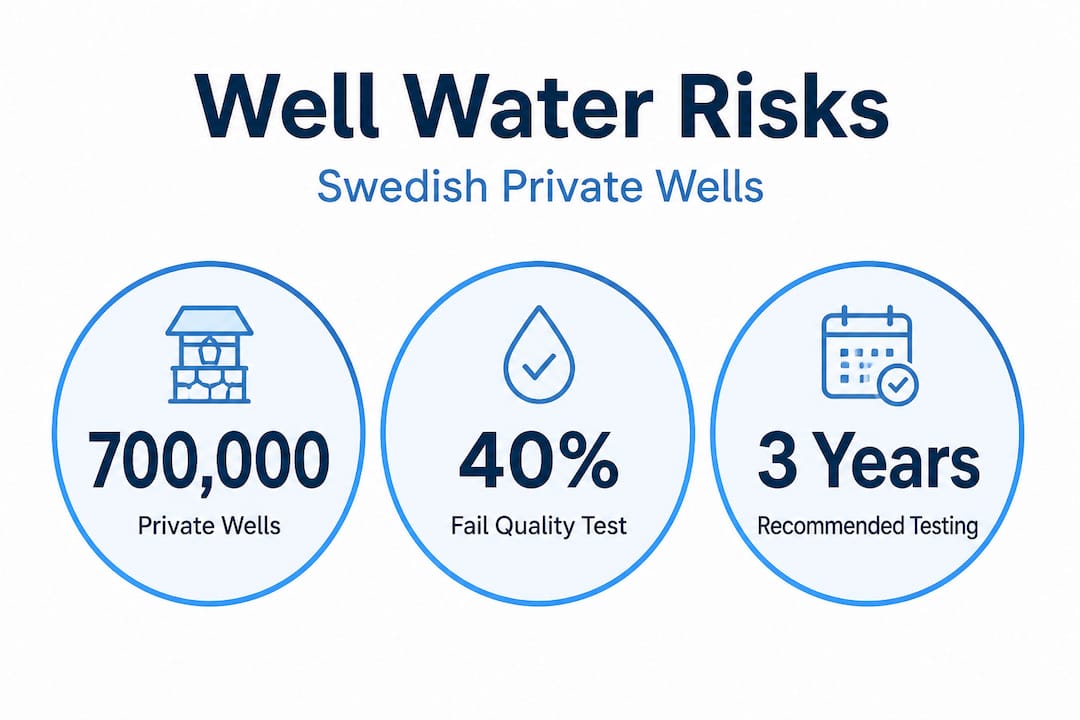
Health effects vary widely depending on what is in your water and how long you have been exposed to it. Some bacteria cause illness within hours. Arsenic, nitrates, and PFAS build up silently over months and years, and by the time symptoms appear, exposure has already been significant. That is why looking at Swedish groundwater quality stats is sobering: a meaningful proportion of tested private wells contain at least one parameter above recommended limits.
The good news is that all of these risks are manageable. But you have to know what you are dealing with first. Understanding what the current drinking water standards require gives you a benchmark to measure your results against.
Now that we have highlighted why you cannot judge water quality by appearance alone, let us tackle what you need to get started.
What you need before you start: tools and reliable testing
With a clear understanding of the risks, it is time to prepare for accurate testing and ongoing monitoring. The foundation of any improvement plan is a proper water analysis. Guessing, or relying on a neighbor’s experience, is not a strategy.
Here is what you will need before collecting your first sample:
- A certified sample collection kit from an accredited laboratory or a trusted supplier who partners with one.
- Clean gloves and sterile sample bottles provided in the kit. Using your own containers will invalidate the results.
- Clear written instructions for how, when, and where to collect the sample from your specific well.
- A way to document and store your results so you can compare them over time. A simple spreadsheet works well.
Choosing the right test package matters. Not all analysis kits cover the same parameters, and the risks in your area depend heavily on your well type, local geology, and surroundings.
| Well type | Recommended test focus | Typical parameters covered |
|---|---|---|
| Drilled well (bergborrad) | Radon, arsenic, metals, bacteria | 41+ parameters |
| Dug well (grävd brunn) | Bacteria, nitrates, turbidity | 31+ parameters |
| Near agricultural land | Nitrates, pesticides, bacteria | Extended package |
| Near airport or industrial site | PFAS compounds | 30 PFAS substances |
| Lake or surface water | Parasites, turbidity, bacteria | Surface water package |
Pro Tip: Always collect your water sample in the morning, after the water has sat in the pipes overnight. This gives the most accurate picture of what your water actually contains at the source.
A proper water analysis guide will walk you through exactly how to handle the sample to avoid contamination before it reaches the lab. Even small errors, like letting the bottle touch your fingers on the inside, can produce false positives for bacteria.
One critical detail many well owners overlook: testing should not be a one-time event. Regular water testing matters because groundwater quality shifts over seasons, after heavy rainfall, when nearby land use changes, and as your well structure ages. A test from five years ago tells you very little about what is in your glass today.
Step-by-step: How to test and act on your well water quality
Once you are equipped to test and monitor, the next step is executing the process and responding effectively when issues arise.
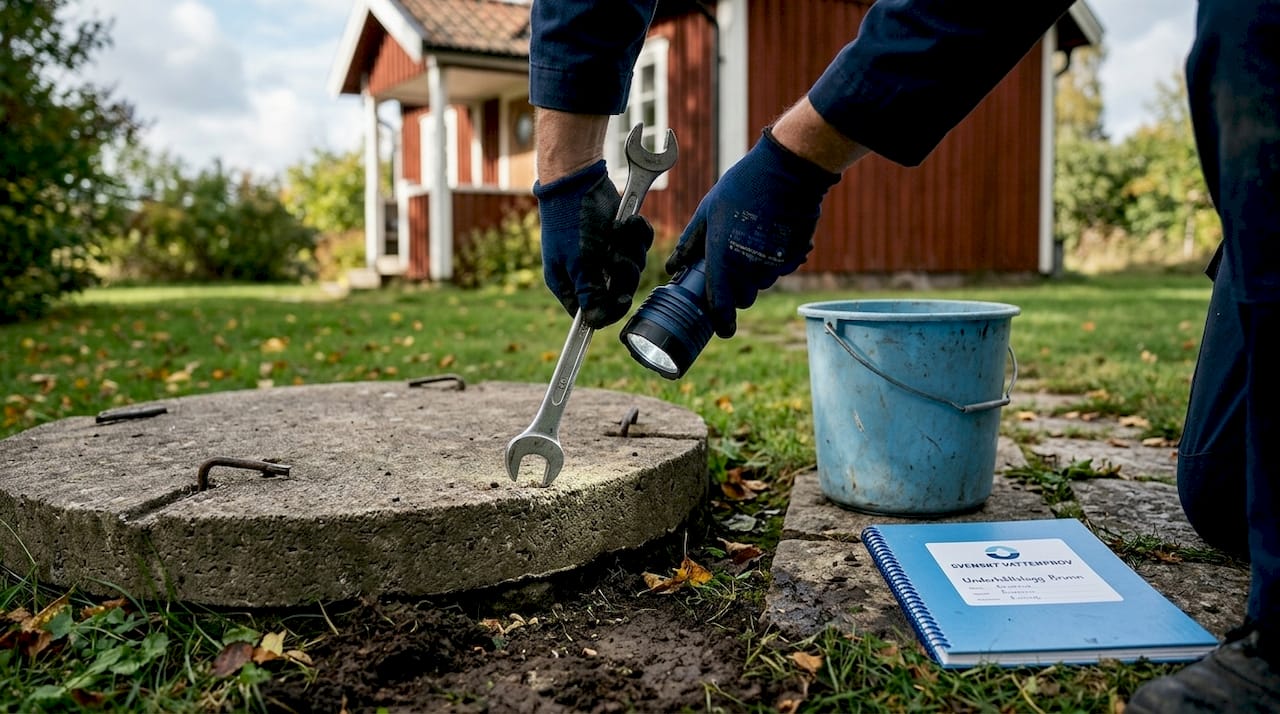
1. Order the right test package for your situation. Base this on your well type, local environment, and any known regional concerns. If you are close to granite geology, radon testing is essential. If you are near farmland, nitrates and pesticides deserve priority.
2. Collect your sample following the exact instructions provided. This is not a step to rush. Run cold water from the tap for 2 to 3 minutes before collecting the sample to flush the pipes. Fill the bottle to the marked line, seal it immediately, and keep it cool until it ships to the lab.
3. Send the sample promptly. Most kits require the sample to arrive at the lab within 24 hours of collection for bacteria testing to remain valid. Follow shipping instructions precisely.
4. Review your results carefully. A good lab report will show your measured value, the Swedish or EU recommended limit, and whether your result is within acceptable range. Focus on any parameter flagged as exceeding the limit.
5. Take immediate action if values are unsafe. Swedish guidance for quality problems is clear: stop using the water for drinking and cooking, treat the specific issue, and retest to confirm improvement before resuming use.
6. Match your treatment to the specific contaminant found. This is a step many people get wrong.
| Contaminant | Appropriate treatment method |
|---|---|
| Bacteria and E. coli | UV disinfection or chlorination |
| Arsenic | Reverse osmosis or adsorption filter |
| Radon | Aeration or granular activated carbon filter |
| Iron and manganese | Oxidation filter (birm or manganese greensand) |
| Nitrates | Reverse osmosis or ion exchange |
| PFAS | Activated carbon filter or reverse osmosis |
7. Retest after treatment is installed. Do not assume the filter is working. Test again to verify that your specific contaminant is now within safe limits.
Pro Tip: Keep a physical binder or digital folder with every test result, the date it was collected, any changes you made to treatment, and the follow-up result. This record becomes invaluable if you ever sell your property or need to demonstrate water safety to a health authority.
Important: Remediation logic for Swedish wells consistently emphasizes three steps: stop, treat, and verify. Skipping the verification step is one of the most common and costly mistakes well owners make.
Understanding the full picture of what can go wrong is worth your time. Reading an in-depth well issues guide gives you context about how different problems develop and what they actually mean for your household. And before committing to any treatment system, reviewing essential water analysis facts will help you avoid overspending on solutions that do not match your specific results.
A note on statistics: Studies of Swedish private wells consistently show that a significant share of tested wells contain at least one parameter outside recommended limits. In some regions, the proportion is higher than many well owners expect. This is not a rare edge case. It is a routine finding that reinforces why testing matters.
Legal requirements and recommendations every well owner should know
After testing and action, it is essential to know how Swedish recommendations and legislation affect your responsibilities as a well owner.
The first thing to understand is the distinction between regulated water systems and private household wells. LIVSFS 2022:12 is the primary drinking water regulation in Sweden, but it applies mainly to water systems that serve 50 or more people, or that produce more than 10 cubic meters per day. If your well serves only your household or a small property, you fall outside those legally mandated controls.
What that means in practice:
- No mandatory testing schedule exists for your private well under current Swedish law.
- No authority will automatically check whether your water meets health standards.
- You are responsible for the quality of the water your family drinks.
“Private households with small private wells are typically outside the legally mandated controls, but Livsmedelsverket issues strong recommendations to private well owners for regular testing and appropriate action when quality problems are found.”
Livsmedelsverket, Sweden’s National Food Agency, recommends testing well water at least once every three years under normal conditions, and immediately if you notice any change in taste, color, odor, or cloudiness. They also recommend testing after nearby land use changes, after flooding, after repairs to the well, or when you purchase a property with an existing well.
These are voluntary recommendations, not enforceable mandates for private households. But voluntary does not mean optional if you care about your family’s health. The absence of legal enforcement simply means the responsibility falls entirely on you.
Understanding the specific quality standards for Swedish wells gives you the benchmarks that Livsmedelsverket uses to assess whether water is safe. Even though you are not legally compelled to meet them, those limits reflect genuine health thresholds based on scientific evidence.
Statistic worth noting: Sweden has approximately 700,000 private wells. The vast majority of them operate with no routine monitoring whatsoever. That is a substantial number of households relying on water that has never been formally tested.
Why well owners can’t afford to wait: Our expert take
Over the years, we have spoken with well owners from Skåne to Norrland, and one pattern shows up again and again. Many people test their well once, get a clean result, and then consider the matter permanently settled. They trust tradition. They trust that their neighbor’s well is fine, so theirs must be too. They trust that clear water is safe water.
That trust is understandable. But it is a risk that quietly grows every year.
Contamination develops over time. A well that was clean in 2018 can have elevated arsenic or bacterial counts today, simply because the surrounding geology shifted, a nearby septic system aged, or agricultural activity intensified. Nothing about the water’s appearance changes. You would never know without testing.
What makes this situation particularly serious is the regulatory gap we described above. With no mandatory monitoring for small private wells, there is no safety net. No inspector will knock on your door. No authority is tracking your groundwater. If something changes in your well, the only person in a position to catch it early is you.
We believe that routine, accredited testing is not a luxury or a bureaucratic exercise. It is the most direct way to protect the people who drink from your well every single day. When you understand your Swedish drinking water standards, you see that the limits are not arbitrary numbers. They are thresholds below which health authorities are confident about long-term safety.
The real cost of ignoring this is not the price of a water analysis kit. It is the cumulative exposure to a contaminant that could have been caught and treated early. That is the uncomfortable truth we have watched too many well owners learn the hard way.
Take the next step: Trusted water testing and solutions
Protecting your family’s drinking water does not have to be complicated, but it does require action.
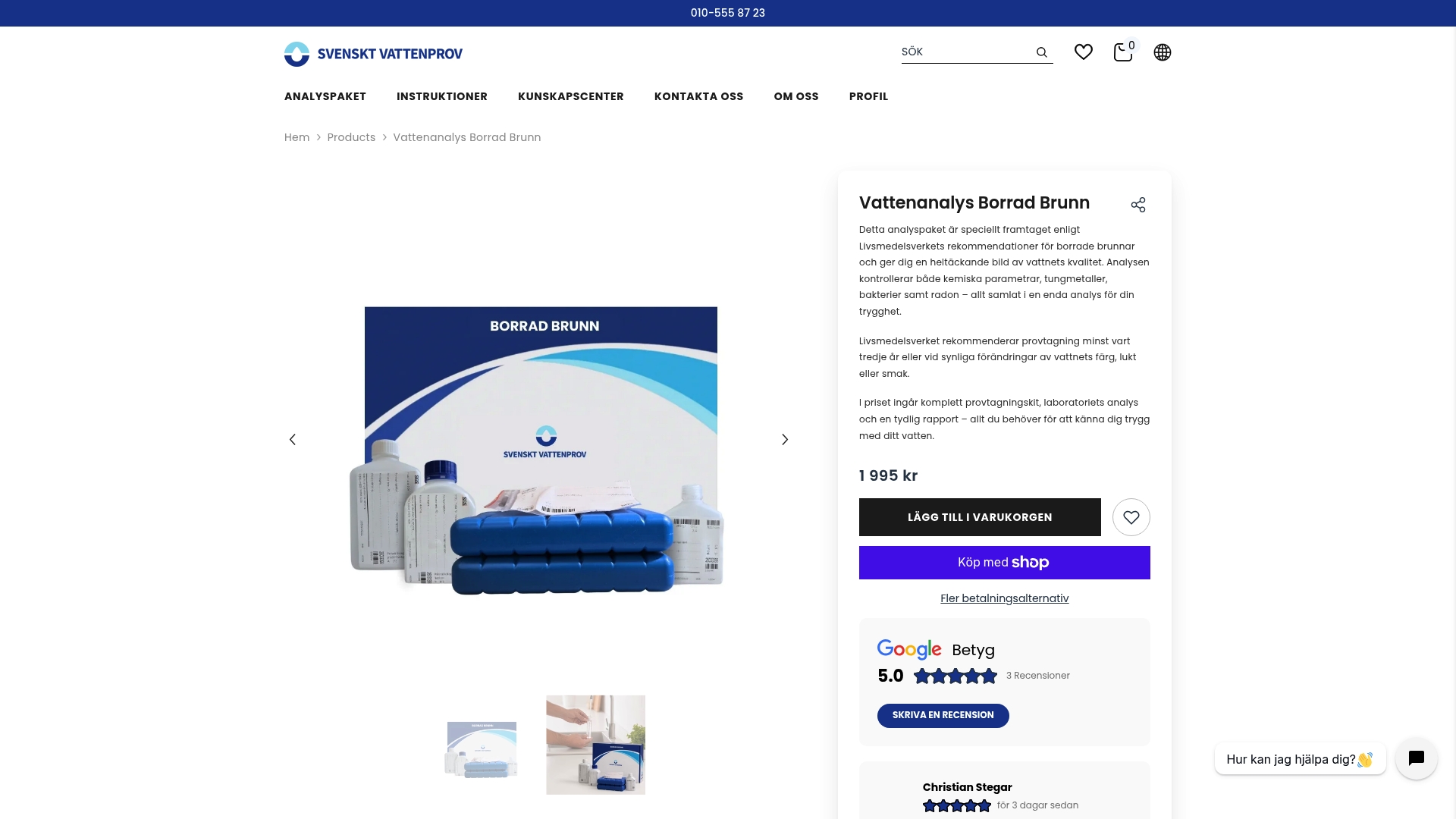
At Svenskt Vattenprov, we offer accredited water analysis packages analyzed by SGS Analytics and Eurofins, a Swedac-certified laboratory that follows the same standards as public water utilities. Whether you have a drilled well, a dug well, or a surface water intake, we have a package designed to cover the parameters that matter most for your situation. Our reports go beyond raw numbers. You get clear explanations of what each result means and concrete guidance on next steps. If your analysis reveals an issue, we can also point you toward proven treatment filters for specific contaminants that match exactly what your water needs. Unsure which package is right for you? Contact us and we will help you choose.
Frequently asked questions
How often should I test my private well in Sweden?
Test your well at least once every three years under normal conditions, or immediately if you notice any change in taste, color, or odor. Reliable, regular testing is the only dependable way to monitor water safety over time.
What should I do if my water test shows contamination?
Stop using the water for drinking or cooking right away, apply a treatment method matched to the specific contaminant, and retest before resuming use. Swedish guidance consistently frames remediation as: stop, treat, and verify.
Are there legal limits I need to follow for my well water?
Private wells serving individual households are not strictly regulated under LIVSFS 2022:12, but Livsmedelsverket issues strong voluntary recommendations for regular testing and prompt action when quality problems are found.
Can I trust taste or smell to tell if my water is safe?
No. Many harmful bacteria, arsenic, PFAS, and radon are completely invisible and odorless, which is exactly why lab testing is essential and cannot be replaced by sensory evaluation alone.